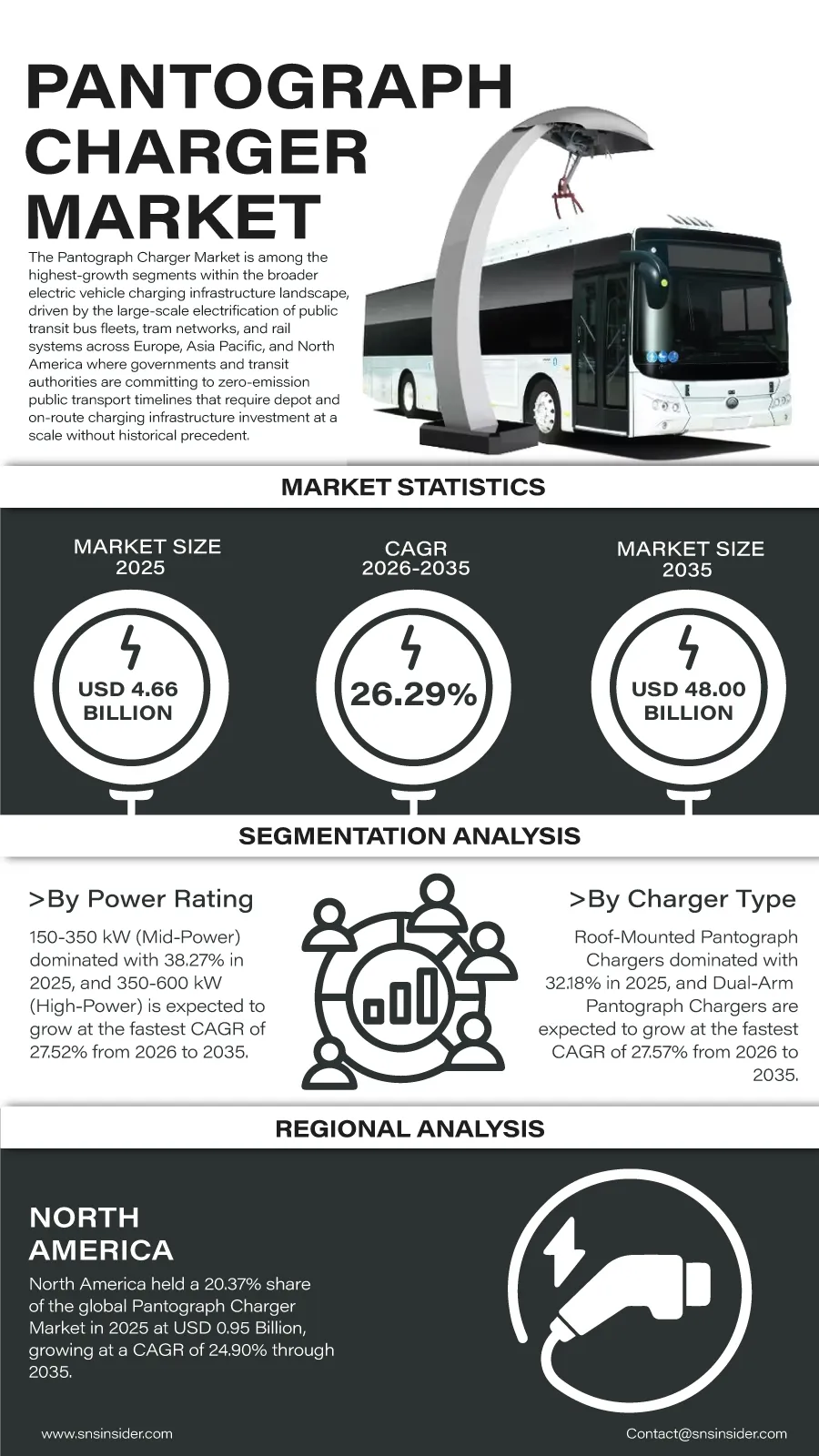
The global Pantograph Charger Market is poised for exceptional expansion as transit authorities, municipalities, and commercial fleet operators accelerate the transition toward zero-emission transportation. “According to a recent study by SNS Insider, the global Pantograph Charger Market size valued at USD 4.66 billion in 2025, is anticipated to grow to USD 48.00 billion by 2035, registering a CAGR of 26.29% over the 2026–2035 forecast period.”
The fast pace of modernization of public transport systems with electrification is leading to the changing requirements for infrastructure related to charging. The development of advanced systems that allow for charging overhead and ensure the possibility to operate without breaks in charging processes is growing.
Electric buses, trams, and other commercial transport is increasing its share in public transit, leading to the need for developing charging infrastructure with increased power generation capacity and efficiency of usage.
To Get Detailed Insights on the Pantograph Charger Market – Request a Free Sample Report
Smart Charging Technologies Accelerate Industry Transformation
The process of innovation will keep on transforming the charging systems for pantographs, as new models of intelligent charging stations come to the market that optimize performance of fleets and make the operation simpler. The modern charging stations are designed in such a way that they include such functions as monitoring, predictive maintenance, diagnostics and energy optimization that help to increase the reliability of charging and manage electricity consumption more effectively.
Ultra-fast charging solutions make it possible to utilize the vehicles more efficiently, as the charging time during planned halts is considerably decreased.
Further cooperation between developers of charging solutions, manufacturers of electric vehicles, utilities, and transportation agencies can be expected within the next decade.
Key Market Findings Highlight Strong Growth Opportunities
With respect to power ratings, chargers that offer 150-350 kW of power generation were estimated to generate 38.27% of the worldwide revenues in 2025 due to the prevalence of these types of chargers in urban transit systems. On the other hand, the 350-600 kW chargers will show the highest growth at a rate of CAGR 27.52% between 2025 and 2035 due to the rising need for fast chargers in the heavy-duty segments.
With regards to the types of chargers, the roof-mounted pantograph chargers accounted for 32.18% of the overall market revenue in 2025. Dual-arm pantograph chargers will be the fastest-growing segment at CAGR 27.57% between 2025 and 2035 due to the increasing demand for flexible chargers.
The share of various applications is continuously changing based on fleet electrification trends. The public transit segment such as the electric buses and trams was generating 52.63% of the market revenues in 2025. The fastest growing application will be commercial EV charging infrastructure, which will grow at a CAGR of 28.32% between 2025 and 2035 due to the rapid investments made by companies in delivering their products via logistics, deliveries, etc.
Finally, end-users have a significant impact on the growth of the market. The transit authorities and municipal operators will account for 57.92% of the revenues in 2025. The fastest growing end-user segment will be commercial EV charging infrastructure providers at CAGR 27.95%.
An Infographic Representation of the Global Pantograph Charger Market
Sustainable Transportation Investments Continue to Expand
Policymakers all around the world are implementing far-reaching programs that are focused on reducing transportation emissions as well as upgrading public transportation infrastructures. It results in an active involvement of investments into projects related to electrified transportation, electric vehicle charging stations, and power grid upgrades required for the successful electrification of fleets.
Improvements in battery technologies, energy efficiency management, and even automated charging are making it even more economically viable. Given the growing urban population and increasing importance of sustainable development, there will be a growing need for efficient charging infrastructures.
Regional Markets Drive Global Expansion
In 2025, Europe had the largest share of the global market revenue, 29.68%, due to the presence of a mature electric public transport charging network, favorable regulations, and investment in clean mobility infrastructure. The region is leading in terms of adoption of advanced charging solutions for buses, trams, and railway transit systems.
On the other hand, the Asia Pacific region is estimated to become the fastest growing market at a CAGR of 27.55% till 2035. The factors driving growth include fast urbanization, adoption of electric buses, initiatives by governments to promote electrification, and increased production capacity.
Leading Industry Participants Expand Innovation Strategies
Increasing competition in the pantograph charger industry can be witnessed as there are investments being made in the development of high-power chargers, energy management systems, automation facilities, and partnership strategies with the transportation authorities around the world.
ABB, Siemens, Schunk Transit Systems, Heliox, Kempower, Wabtec, ChargePoint, Alstom, CRRC, and Ekoenergetyka-Polska are some of the main firms involved in the global pantograph charger market.
An SNS Insider analyst Santosh Bhul commented, "The rapid electrification of public transportation and commercial vehicle fleets is fundamentally reshaping charging infrastructure requirements worldwide. Continued advances in high-power charging technologies, automation, and intelligent energy management will play a critical role in supporting the next generation of sustainable mobility."
About the Author

Get in touch