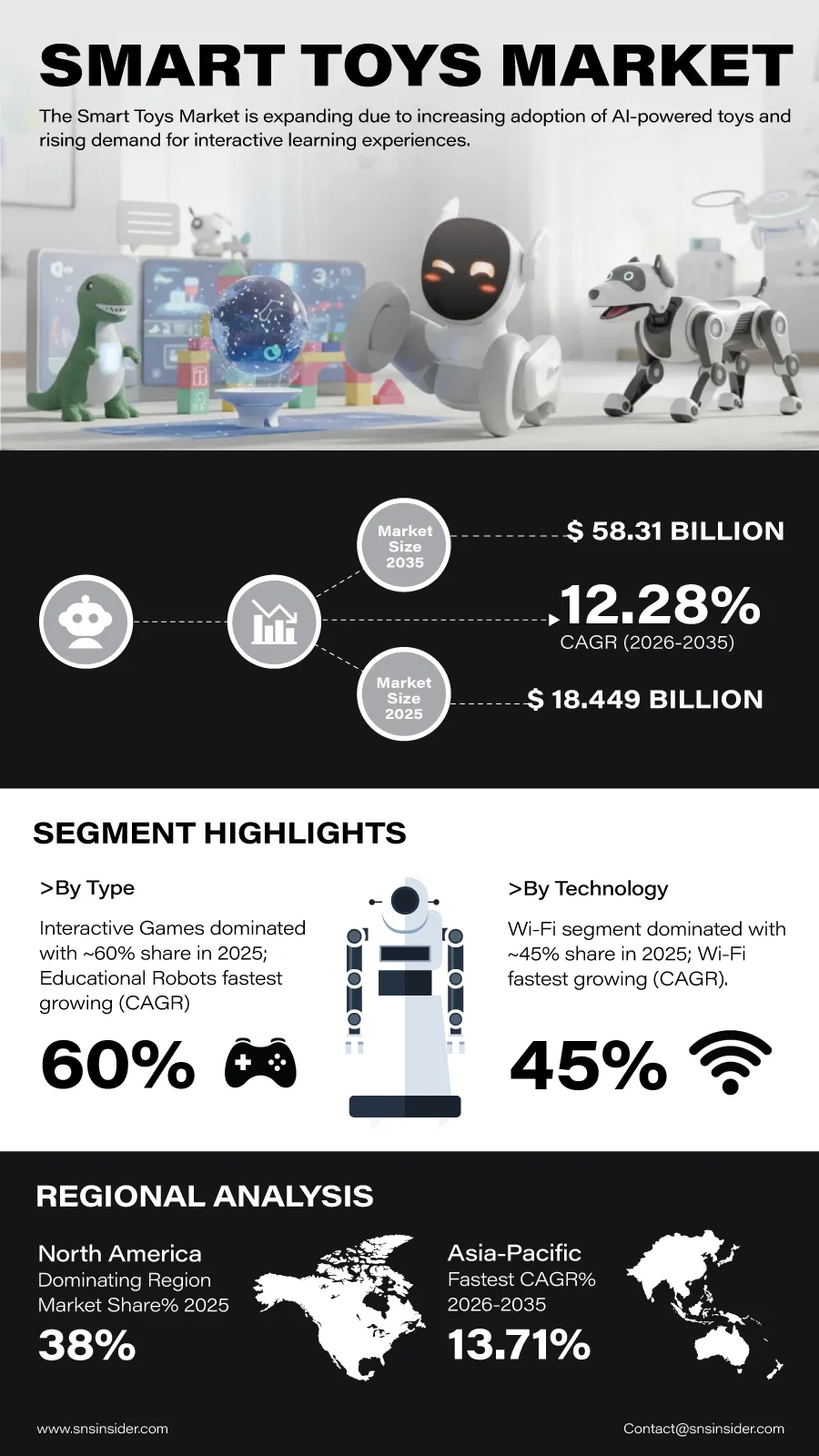
The global Smart Toys Market is poised for significant expansion over the coming decade as parents, educators, and technology companies increasingly embrace connected play experiences that blend entertainment with learning. According to a recent study by SNS Insider, the global Smart Toys Market size valued at USD 18.44 billion in 2025, is anticipated to grow to USD 58.31 billion by 2035, registering a CAGR of 12.28% over the 2026–2035 forecast period.
The rapid development of artificial intelligence, robotics, voice recognition technology, and wireless technology is revolutionizing traditional toys, giving rise to innovative educational robots that can adjust according to the child’s developmental stage. This has been made possible through the integration of technology in education.
To Get Detailed Insights on the Smart Toys Market – Request a Free Sample Report
Parents have also become increasingly keen on toys that foster education related to STEM and digital skills at an early age. In conjunction with higher disposable income levels, increasing access to the Internet, and availability of such toys through online retail platforms, all these developments further increase the demand for smart toys worldwide.
Technology-Driven Learning Creates New Growth Opportunities
Advancements in technology are presenting new possibilities for manufacturers to offer extremely engaging play solutions that transcend traditional toys. The integration of IoT features, AR features, AI features, and the use of accompanying mobile applications is enabling children to benefit from customized content, timely notifications, and adaptive learning programs.
Subscriptions of education platforms, cloud-based learning modules, and digital interactive ecosystems are being increasingly adopted by manufacturers in order to enable continued engagement even long after the initial sale. The use of digital services is providing further income opportunities for companies.
Increasing collaboration among toy manufacturers, educational organizations, and technology developers is also contributing toward innovation by helping create products for use in classroom settings as well as at homes.
Key Market Insights Highlight Shifting Demand Patterns
By type, Interactive Games held around 60% of global market revenue in 2025 owing to strong consumer demand for app-connected entertainment, immersive storytelling, and engaging gameplay experiences. Educational Robots are projected to emerge as the fastest-growing segment through 2035 as parents and schools increasingly prioritize coding, robotics, and STEM-focused learning.
Based on end user, the school-going segment dominated with 39% of market revenue in 2025 while also registering the fastest growth during the forecast period. Rising adoption of AI-enabled educational toys in both classrooms and households continues to support long-term demand within this age group.
By technology, Wi-Fi-enabled smart toys led with 45% share of market revenue in 2025 due to their ability to deliver seamless connectivity, software updates, multiplayer functionality, and personalized learning experiences. Continued expansion of broadband infrastructure and connected devices is expected to reinforce this segment's leadership over the coming years.
In terms of distribution channel, Online and E-commerce Stores segment held approximately 58% of market revenue in 2025 while maintaining the fastest growth through 2035. Digital shopping platforms continue to benefit from wider product selection, competitive pricing, customer reviews, and convenient home delivery services.
An Infographic Representation of the Global Smart Toys Market
AI and Connected Play Continue to Transform Children's Entertainment
Artificial intelligence is reshaping the future of children's entertainment by enabling toys to respond intelligently to individual learning styles and behavioral patterns. Adaptive learning algorithms, speech recognition, interactive storytelling, and real-time feedback are creating more engaging experiences that encourage sustained educational development.
On the other hand, manufacturers are also working on enhancing cybersecurity, parental control, and privacy protections as they strive to meet the growing expectations of consumers in regard to children’s safety. Secure digital ecosystems will undoubtedly become very important in helping to build consumers' trust in these types of products.
Regional Markets Demonstrate Strong Growth Potential
North America will have a market share of around 38% in 2025 due to high consumer expenditure, digitalization, widespread use of connected devices, and focus on early childhood education. Retail strength and developed e-commerce sites are further strengthening the regional dominance.
Meanwhile, The Asia Pacific region is expected to witness the fastest growth rate, with a CAGR of around 13.71% up to 2035. The growing trend toward urbanization, increased disposable income, higher internet penetration rate, educational programs in STEM subjects, and the presence of a young population base are offering significant potential for smart toys makers.
As educational technologies become increasingly integrated into children's daily lives, demand for intelligent play solutions is expected to accelerate across both developed and emerging markets.
Industry Participants Focus on Innovation and Interactive Learning
The playing field is continually changing as manufacturers who are market leaders make huge investments in AI, robots, digital media, and learning technologies to offer distinctiveness in their product portfolio. Through strategic alliances with technology vendors, education providers, and software vendors, the industry has managed to develop personalized play experiences for children globally.
Key companies operating in the global Smart Toys Market include LEGO Group, Mattel, Inc., Hasbro, Inc., Spin Master Corp., VTech Holdings Ltd., Sphero, Inc., UBTECH Robotics Corp., Playmobil (Brandstätter), Bandai Namco, LeapFrog Enterprises, Inc., WowWee Group Ltd., TOSY Robotics, LittleBits, ZURU Inc., Anki, Silverlit Toys, Makeblock Co., Ltd., Digital Dream Labs, Particula Ltd., and Wonder Workshop, Inc.
An SNS Insider analyst Sakshi Kale commented, “The convergence of artificial intelligence, connected technologies, and educational content is redefining children's play experiences worldwide. Companies that prioritize safe digital ecosystems, personalized learning, and continuous product innovation will be best positioned to capture the expanding opportunities within the global smart toys market.”
About the Author

Get in touch