
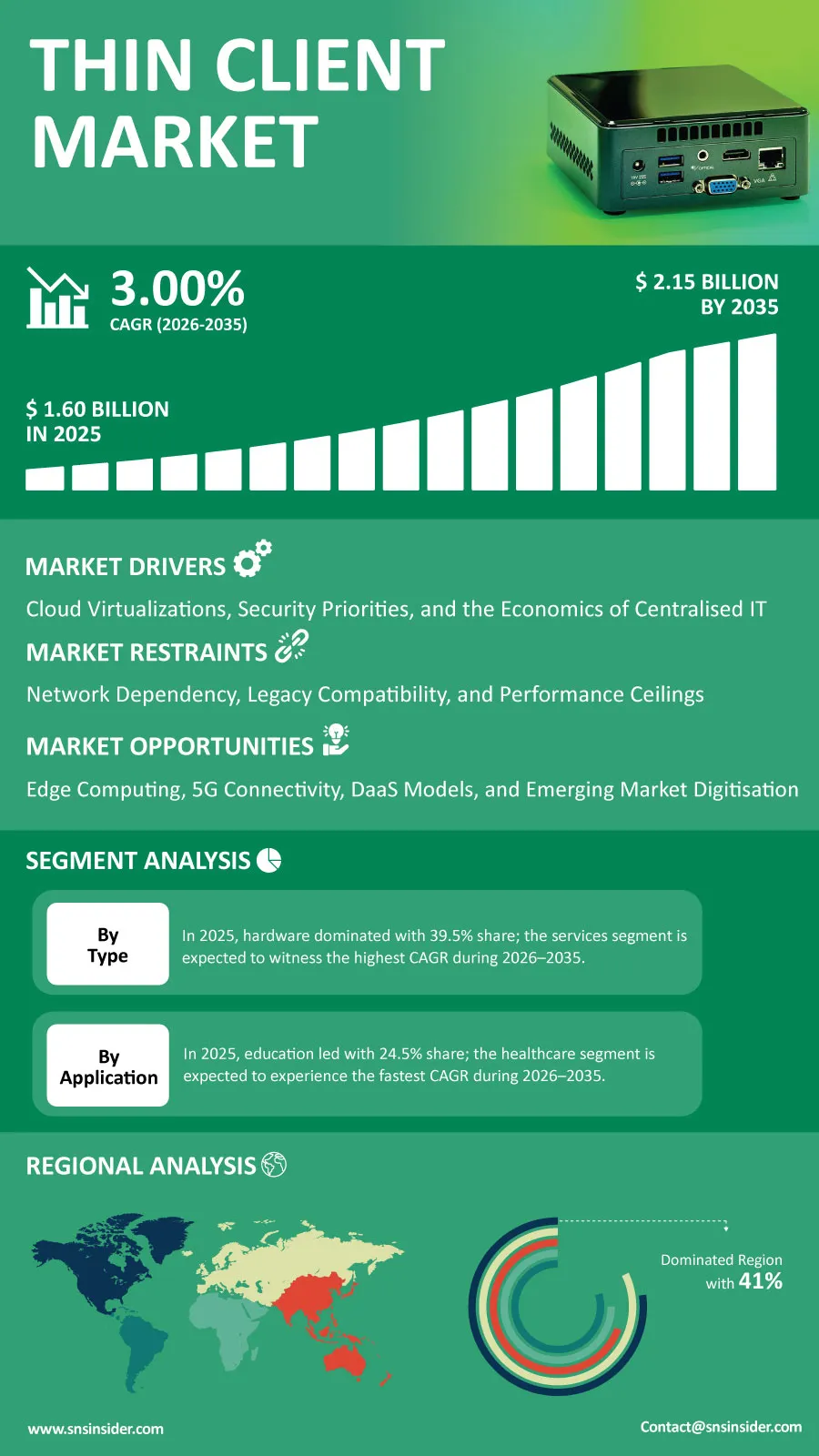
The global Thin Client Market is witnessing steady transformation as enterprises rethink endpoint computing around centralized infrastructure, cloud platforms, and stronger cybersecurity requirements. According to a recent study by SNS Insider, the global Thin Client Market size valued at USD 1.60 billion in 2025, is anticipated to grow to USD 2.15 billion by 2035, registering a CAGR of 3.00% over the 2026–2035 forecast period.
Transition towards VDI and application hosting in the cloud results in constant demand for low-weight endpoint devices that could offer secure access to centralized computational resources. The increasing evaluation of thin client technology by organizations from financial services, healthcare, education, and public sector becomes a trend amid their efforts to streamline IT management and reduce infrastructure expenses.
Also, the increasing normalization of hybrid working contributes to the changing approaches towards endpoints. Companies look for such environments where they would be possible for employees to work with corporate applications securely from different places while keeping minimal data on their endpoints.
To Get Detailed Insights on the Thin Client Market – Request a Sample Report
Centralized IT Strategies Open New Growth Opportunities
VDI and Desktop as a Service trends provide a favorable atmosphere for thin clients providers. Centralized management enables IT personnel to control applications, security policy, updates, and users' access via common infrastructure and thus alleviates the administrative load of managing large numbers of traditional PCs.
Energy efficiency is also an important reason for adopting thin client technology. Thin client devices consume much less power than traditional PCs, which makes them popular among companies that want to save on operational costs and become more sustainable in terms of energy consumption.
The emergence of edge computing, 5G connectivity, and subscription-based Device-as-a-Service models is also expanding the addressable market. These developments are creating opportunities for vendors to develop compact, portable, and remotely managed endpoints suitable for distributed workplaces, healthcare facilities, logistics operations, and industrial environments.
Key Market Insights Highlight Shifting Demand Patterns
By type, hardware is expected to account for 39.5% of global market revenue in 2025, reflecting continued demand for endpoint replacement and new VDI deployments across enterprise environments. Meanwhile, the services segment is projected to register the fastest growth through 2035 as organizations increasingly outsource endpoint management, cloud integration, security administration, and infrastructure support.
Based on form factor, standalone thin clients are anticipated to hold 48.7% of market revenue in 2025. Their broad compatibility with conventional workplace monitors and peripherals makes them suitable for offices, contact centers, educational institutions, and government facilities. Mobile thin clients are forecast to experience the fastest growth as hybrid work and distributed operations increase demand for portable access to centrally hosted applications.
In terms of application, education is expected to lead with a 24.5% market share in 2025. Schools and universities benefit from centralized endpoint administration, simplified software deployment, and lower hardware maintenance requirements. Healthcare is projected to be the fastest-growing application segment as hospitals seek secure access to electronic health records while strengthening controls over sensitive patient information.
Security and Remote Management Remain Key Priorities
Thin clients are becoming more popular in scenarios where companies seek to lower exposure of endpoint data. The low capacity and centralized approach used by thin clients may be effective in decreasing the likelihood of threats posed by lost or stolen computers.
Another benefit of using thin clients comes from their integration with cloud computing. This allows for centralized management and deployment of endpoint machines, thus simplifying workforce management.
North America Leads with 41% Revenue Share While Asia Pacific Advances at an 11.4% CAGR
North America is expected to make up around 41% of the total market revenue share by 2025, with its well-established enterprise IT infrastructure, proven adoption of VDI, and robust demand from financial services as well as the healthcare sector. The United States still makes up the major source of regional revenue, while Canada is benefitting from its digital transformation in the public sector.
The fastest-growing regional market in 2035 is expected to be Asia Pacific, showing a CAGR of 11.4%. Digital transformation activities, investments in cloud infrastructure, education modernization, and enterprise IT infrastructure upgrades have created demand in China, India, Japan, South Korea, and Southeast Asian countries.
Europe continues to grow steadily with enterprises focusing on data protection, centralization of IT operations, and modernization of infrastructure due to compliance requirements. On the other hand, opportunities for growth are expected in the Middle East, Africa, and Latin America due to government digitization, financial services modernization, and education technology investments.
Industry Participants Focus on Cloud Integration and Security
Competition in the global Thin Client Market remains active as vendors focus on improving Virtual Desktop Infrastructure (VDI) compatibility, endpoint security, remote management, and cloud connectivity. Manufacturers and software providers are increasingly developing solutions that combine hardware, operating systems, management platforms, and support services to address the evolving requirements of enterprise customers.
Key companies operating in the global Thin Client Market include Dell Technologies, HP Inc., Lenovo Group Limited, IGEL Technology, NComputing, 10ZiG Technology, Samsung Electronics, Fujitsu Limited, Acer Inc., VXL Instruments, Wyse Technology, Stratodesk, Atrust Computer Corporation, Chip PC Technologies, ClearCube Technology, Neoware, Prostar Computer Inc., Praim, LG Electronics, and VIA Technologies.
An SNS Insider analyst Sushant Kadam commented, “The continued migration toward centralized computing, cloud-hosted applications, and secure hybrid work environments is supporting long-term demand for thin client solutions. Vendors that combine energy efficiency with strong endpoint security, simplified management, and flexible cloud integration will be well positioned to capture opportunities as organizations modernize their digital workplaces.”
About the Author

Get in touch




