
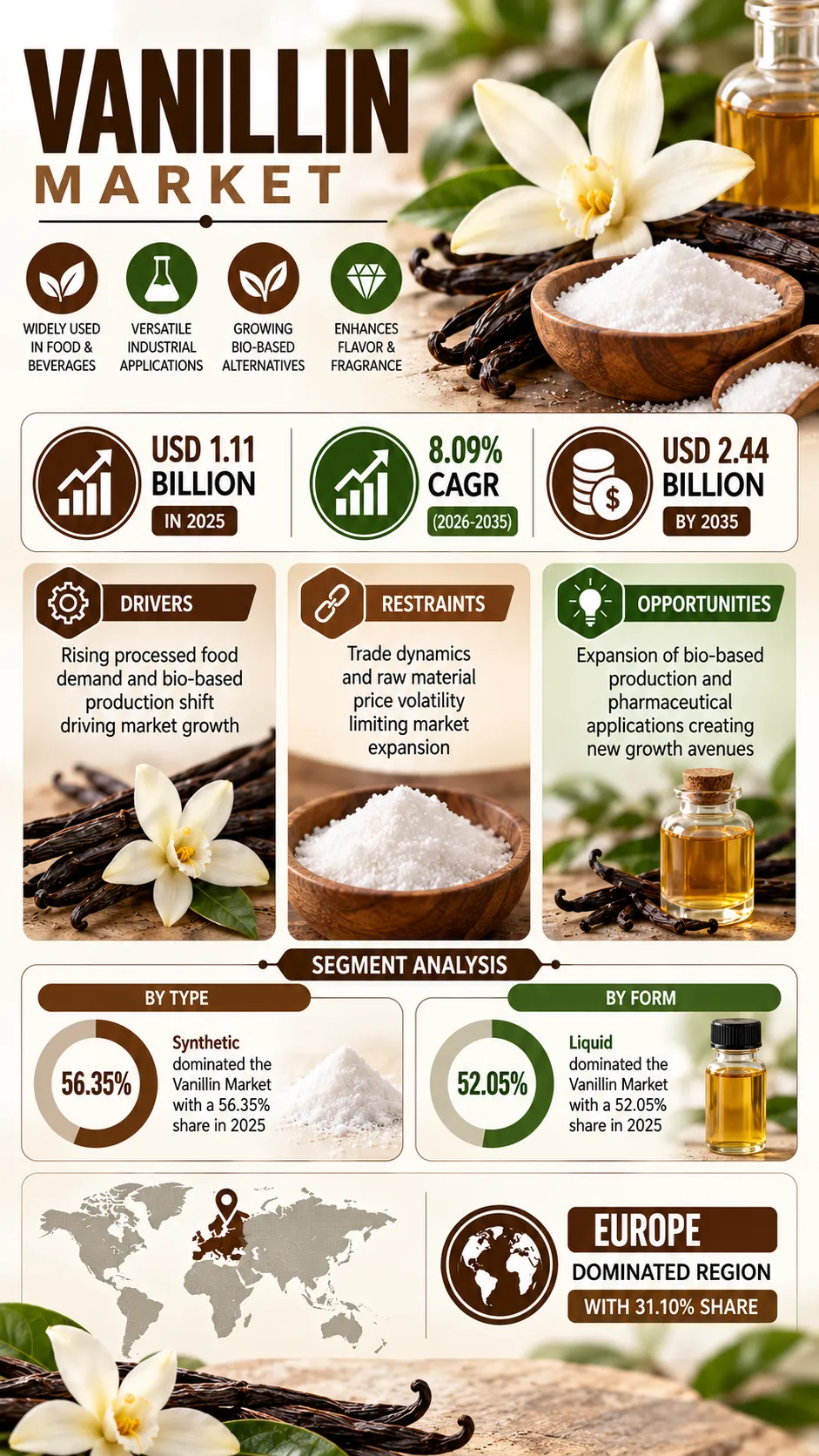
The global Vanillin Market is set for significant expansion as processed food demand and bio-based production innovation continue to reshape flavor ingredient sourcing worldwide. “According to a recent study by SNS Insider, the global Vanillin Market size valued at USD 1.119 billion in 2025, is anticipated to grow to USD 2.443 billion by 2035, registering a CAGR of 8.09% over the 2026–2035 forecast period.”
There have been notable changes within flavor ingredient production technology over time, due to which many manufacturers who aim at improving sustainability and cost-competitiveness of their products can take advantage of this trend. This includes the need for more advanced bio-based fermentation and lignin valorization techniques that will provide food and pharmaceutical companies with the ability to access natural, sustainably sourced vanillin. This applies in situations where vanillin supports bakery, dairy, beverage, and pharmaceutical applications. Manufacturers are constantly working hard to ensure that their vanillin products perform better than before in order to meet various clean-label and regulatory requirements.
To Get Detailed Insights on the Vanillin Market – Request a Sample Report
Bio-Based Production Creates New Demand
The vanillin market has evolved from a primarily synthetic, petrochemical-derived flavor ingredient to an increasingly diversified category spanning conventional and bio-based natural production. The growing investment in fermentation technology, lignin valorization, and certification programs across manufacturers of all sizes has required the development of more sustainable and cost-competitive vanillin products.
New production and sourcing techniques can increase natural ingredient purity, improve supply chain sustainability, and allow for expansion into increasingly diverse pharmaceutical, personal care, and functional food applications. This gives manufacturers the possibility to meet growing regulatory and consumer demand for clean-label, naturally derived flavor ingredients.
Collaboration among vanillin producers, biotech firms, and certification agencies is increasing due to the rising demand for creating future solutions for sustainable and biobased flavor ingredients supply chains.
Key Market Findings Highlight High-Growth Segments
The synthetic type captured the majority of all segments in terms of market share of vanillin at 56.35% of overall revenue in 2025 because of its low price and regular supply. The highest growth rate of 8.42% CAGR during 2021-2031 will be seen in the natural vanillin segment on account of increasing consumer inclination toward sustainability.
By form, liquid vanillin held a dominant 52.05% share of total market revenue in 2025 due to its processing benefits in industrial food manufacturing. Liquid vanillin also carries the highest growth forecast at an 8.22% CAGR through 2031, reflecting its dual leadership in both market share and growth rate.
Based on application, food and beverage generated a 66.10% share of market revenue in 2025 thanks to vanillin's essential role standardizing flavor profiles across bakery, confectionery, and dairy manufacturing. On the other hand, pharmaceuticals will be the segment recording the fastest revenue growth at a 10.18% CAGR, supported by expanding therapeutic applications and regulatory approvals.
Regional revenue trends reflect Europe's mature flavor industry leadership alongside Asia Pacific's accelerating growth trajectory, driven by strong domestic demand, ongoing industrial upgrades, and growing alignment with global sustainability standards across the region's expanding manufacturing base.
Sustainability, Bioactivity, and Cost Competitiveness Gain Importance
In this regard, food, beverage, and pharmaceutical manufacturers have been looking at vanillin products that would deliver more sustainable sourcing while requiring less cost premium relative to conventional synthetic alternatives.
Innovation in fermentation technology, lignin valorization, and certification program development has been making it possible for companies to come up with products that appeal to increasingly clean-label-focused food and pharmaceutical manufacturers. In addition to that, increasing emphasis on therapeutic and bioactive properties is also making it possible for suppliers to find solutions that expand vanillin's reach beyond traditional flavoring applications. Such trends are likely to become even more prominent in the future.
Europe Emerges as the Largest Market with 31.10% Regional Revenue Share Amid Rising Bio-Based Vanillin Adoption
The Europe region represented the largest share of regional market revenue in 2025 at 31.10%, owing to the region's mature flavor industry and continued growth through bio-based vanillin adoption. On the other hand, Asia Pacific is set to post a 9.30% CAGR through 2031, forecast to post the highest CAGR globally, driven by strong domestic demand and ongoing industrial upgrades across manufacturing hubs in China and India.
Leading Companies Drive Innovation and Competition
The environment continues to stay very dynamic since players continue innovating on bio-based production technology and sustainable sourcing as well as forming partnerships in order to enhance their position in the industry. Some of the major companies that operate in the global vanillin market are Borregaard, Solvay, Camlin Fine Sciences, dsm-firmenich, FUJIFILM Wako Pure Chemical Corporation, Givaudan, International Flavors & Fragrances, KOUGEN SANGYO, Kunshan Asia Aroma Corp., and Lesaffre.
An SNS Insider analyst Parry Kardani commented, "The growing shift toward bio-based, sustainably sourced vanillin is creating unprecedented demand for fermentation and lignin valorization technology. Manufacturers that successfully combine natural sourcing innovation, cost competitiveness, and pharmaceutical application expertise will be best positioned to capitalize on emerging opportunities across food, beverage, and therapeutic segments."
About the Author

Get in touch




