
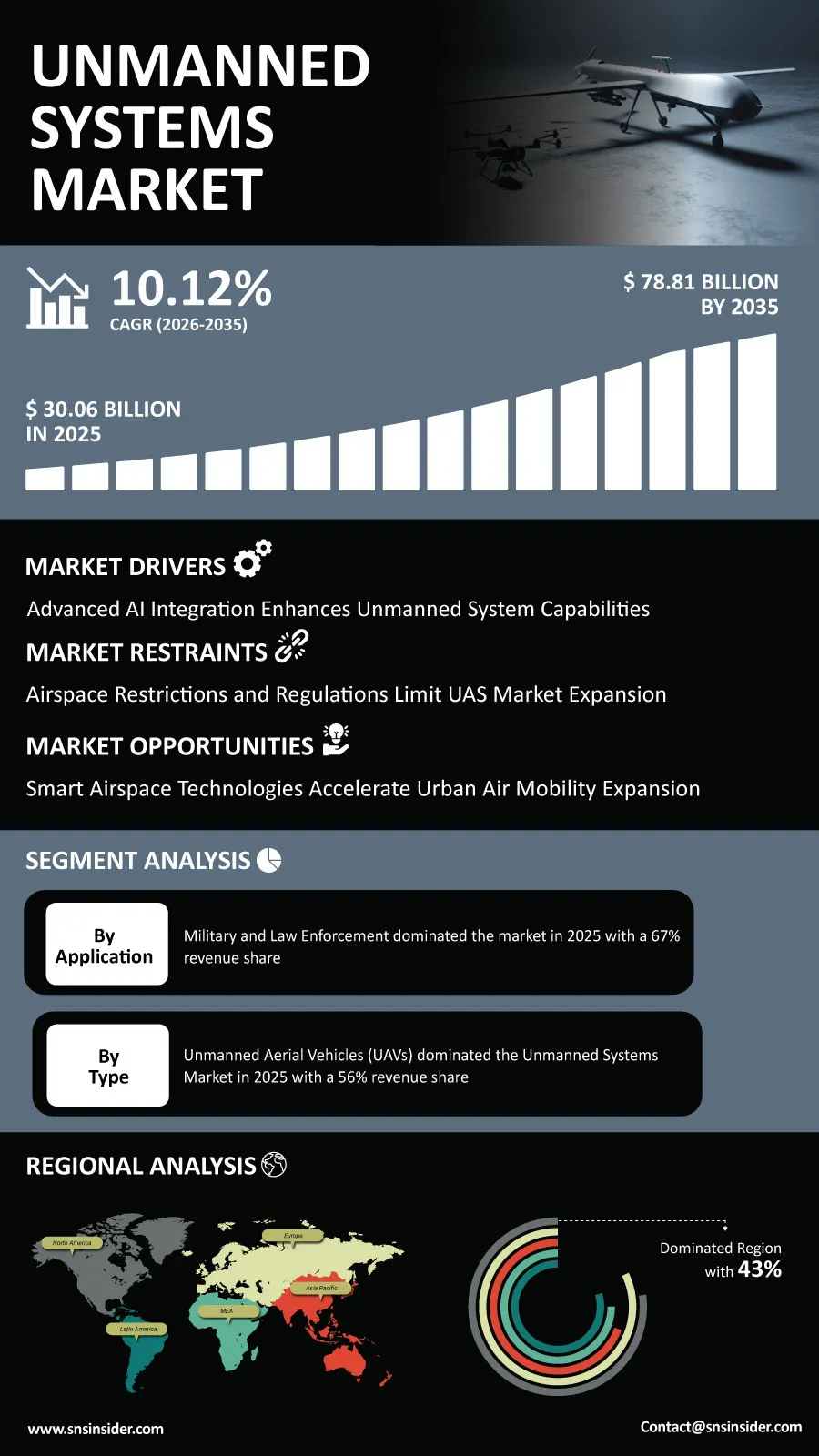
The global market for Unmanned Systems is about to enter a new era of technological innovation since governments and companies are using more autonomous systems to enhance efficiency, safety, and decision-making. “According to a recent study by SNS Insider, the global Unmanned Systems Market size valued at USD 30.06 billion in 2025, is anticipated to grow to USD 78.81 billion by 2035, registering a CAGR of 10.12% over the 2026–2035 forecast period.”
Increased use of unmanned smart platforms in areas such as defense, public safety, industrial inspection, agriculture, and transportation continues to define the evolution of automation around the globe. Companies are becoming more inclined to using aerial, ground, and marine autonomous platforms for undertaking tasks that are repetitive, dangerous, and require heavy amounts of data input.
Advancements in artificial intelligence, machine vision, edge computing, communication infrastructure, and autonomous navigation keep improving the features of unmanned platforms.
To Get Detailed Insights on the Unmanned Systems Market – Request a Sample Report
Autonomous Innovation and Digital Infrastructure Create New Growth Opportunities
The development of digital infrastructures by both public and private entities has accelerated the commercialization of autonomous technologies on a global scale. Smart cities, intelligent transportation systems, and logistics ecosystems have created high demand for unmanned platforms that can provide inspection, monitoring, response, and delivery capabilities.
There is increasing use of unmanned systems in the energy sector, utility companies, mining operations, offshore drilling, and other infrastructure operations. The capability to gather reliable operational data and minimize the risk for workers due to exposure to dangerous environments has made autonomous solutions an important business proposition.
The rapid development of autonomous navigation software, advanced communication technology, and unmanned traffic management systems will likely play a key role in the adoption of autonomous vehicles in the future transportation and industrial ecosystems.
Key Market Insights Highlight Shifting Demand Patterns
On the basis of applications, the Military and Law Enforcement segment held close to 67% of market revenue in 2025 owing to increasing investment in surveillance, reconnaissance, border security, and national security programs. On the other hand, the Commercial segment is expected to be the fastest-growing segment during 2025–2035 owing to adoption of automation in logistics, agriculture, construction, and energy operations.
According to type, the Unmanned Aerial Vehicles (UAVs) segment accounted for close to 56% of market revenue in 2025 owing to wide usage in both military and commercial operations. The Unmanned Ground Vehicles (UGVs) segment is expected to be the fastest-growing segment over the forecast period owing to increasing demand for autonomous mobility in defense, disaster relief, and industrial material handling operations.
According to technology, the Semi-Autonomous segment held close to 50% of market revenue in 2025 due to its established operational reliability and regulatory acceptance. On the contrary, the Fully Autonomous segment is expected to grow at the fastest pace owing to companies' preference for more operational freedom through decision-making using AI technology.
Artificial Intelligence and Advanced Robotics Transform Autonomous Operations
Innovation continues to be a vital part of the competitive development of the unmanned systems industry. There are still investments being made into intelligent navigation, real time data analysis, high-end sensors and communication architecture that ensure operational accuracy within increasingly difficult surroundings.
Thanks to the incorporation of machine learning algorithms, sensor fusion, cloud computing and edge computing capabilities, it is possible for the unmanned systems to process information in an efficient manner and react to the changes in operational circumstances. These innovations will lead to greater efficiency in defense, industrial automation, logistics, environmental monitoring, and emergency response operations.
Collaboration between tech companies, software developers, defense institutions, and industrial businesses is speeding up the process of commercialization of future generation autonomous systems.
North America Held 43% of the Unmanned Systems Market Share in 2025; Asia Pacific Projected to Register the Fastest CAGR Through 2035
North America held a share of about 43% of the market revenue of the world in 2025, driven by high defense spending, good research facilities, regulatory advancements, and the implementation of autonomous technologies on a wide commercial scale. The US still leads the innovations in the region due to large investments in the field of aerospace, robotics, and next-generation autonomous solutions.
Asia Pacific is expected to witness the fastest growth in the market over the forecast period till 2035 due to the rising defense modernization efforts along with investments in the development of industrial automation, agriculture, and intelligent infrastructures. China, India, Japan, and South Korea are continuously working on improving manufacturing capabilities and autonomous technology innovations.
The European region also enjoys great market momentum due to the increasing use of autonomous technologies in various applications including defense modernization, transportation, industrial inspection, and environmental monitoring.
Industry Participants Focus on Autonomous Intelligence and Platform Innovation
The environment continues to be extremely dynamic with top firms continuing to enhance their investment in areas such as artificial intelligence, autonomous systems, robotics, secure communication, and advanced sensor technology. Partnership, innovation in products and platform improvement continue to be among the top concerns with the rising global demand for intelligent unmanned systems.
Key companies operating in the global Unmanned Systems Market include Northrop Grumman, Lockheed Martin Corporation, Teledyne Technologies Inc., BAE Systems, DJI, Thales, Israel Aerospace Industries (IAI), Boeing, General Dynamics Corporation, Textron Inc., L3Harris Technologies Inc., Elbit Systems Ltd., AeroVironment, Inc., SAAB AB, Kratos Defense & Security Solutions, Inc., Bluefin Robotics, Schiebel Group, QinetiQ Group plc, Kongsberg Gruppen, and FLIR Systems, Inc.
An SNS Insider analyst Sakshi Kale commented, "Growing demand for intelligent automation across defense, industrial operations, logistics, and public infrastructure is positioning unmanned systems as a critical component of future digital transformation. Continued advances in autonomous software, AI-enabled navigation, and integrated sensing technologies will create substantial long-term opportunities for companies investing in next-generation unmanned platforms."
About the Author

Get in touch




