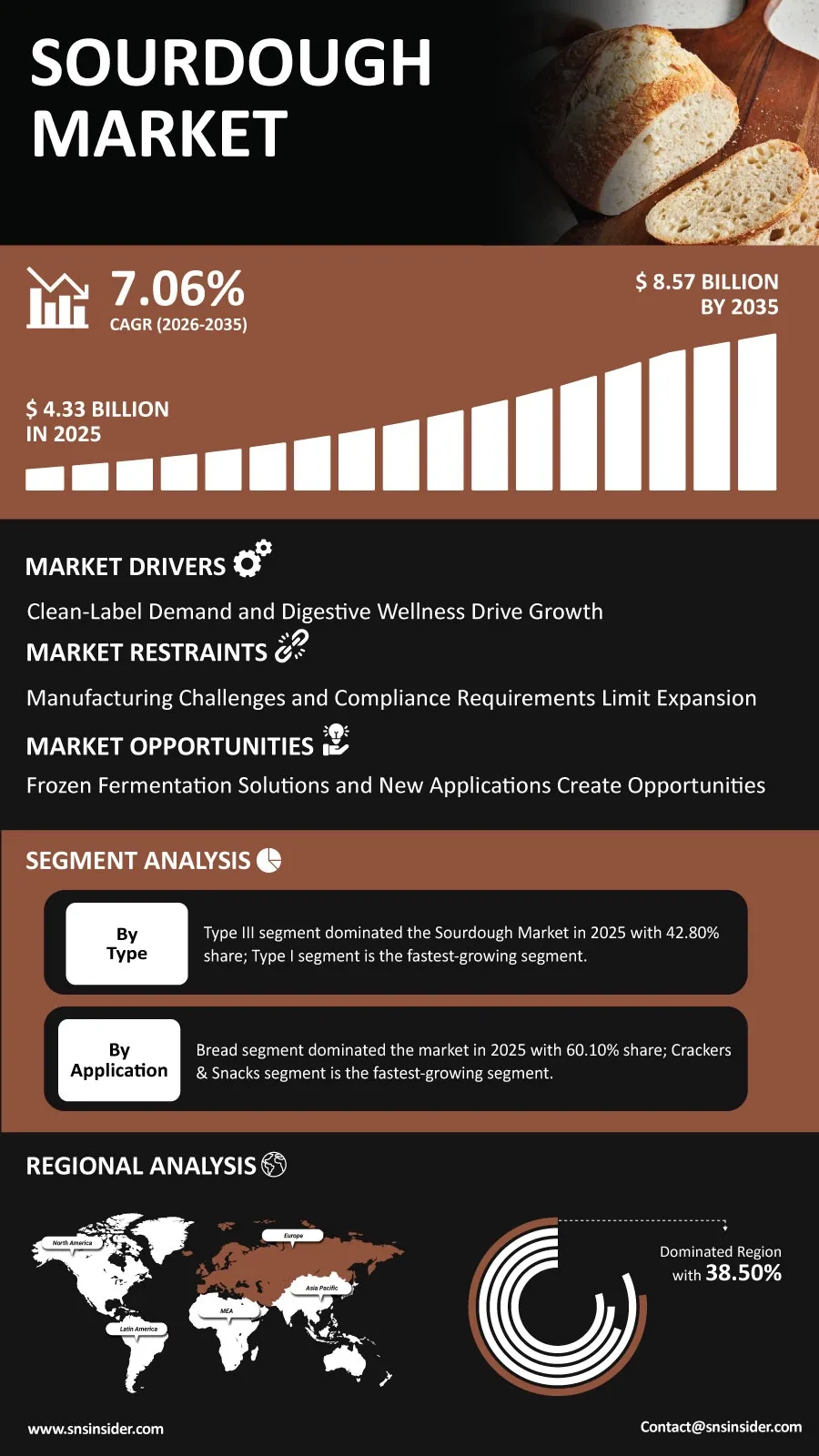
The global Sourdough Market is set for steady expansion as bakeries and industrial producers worldwide continue embracing naturally fermented, clean-label bread products. “According to a recent study by SNS Insider, the global Sourdough Market size valued at USD 4.33 billion in 2025, is anticipated to grow to USD 8.57 billion by 2035, registering a CAGR of 7.06% over the 2026-2035 forecast period.”
There have been notable changes within sourdough production and formulation over time, due to which many manufacturers aiming at improving consistency and scalability can take advantage of this trend. This includes the need for more standardized, purpose-built fermentation systems that will provide bakers with the ability to meet rising demand without compromising authentic flavor and texture. This applies in situations where sourdough is used for artisanal bread production, industrial bakery manufacturing, and functional snack formulation purposes.
Manufacturers are constantly working to ensure that their sourdough products perform better than before in order to meet various needs of artisanal and industrial bakery customers.
To Get Detailed Insights on the Sourdough Market – Request a Sample Report
Clean-Label Fermentation Ecosystems Create New Demand
The sourdough market has evolved from basic artisanal bread production to more advanced industrial and functional food use cases. The growing investment in controlled-inoculum fermentation, frozen pre-fermented bases, and organic sourcing for a variety of applications has required the development of more efficient and reliable production systems.
New approaches to sourdough production can increase consistency, improve shelf stability, and allow for broader application versatility across bread, snack, and functional food sectors. This gives manufacturers the possibility to be more effective when reaching health-conscious and artisanal-focused consumers and doing better product differentiation.
Bakery ingredient suppliers, industrial bakers, and artisanal producers are increasingly cooperating thanks to the growing interest in developing future solutions for scalable, authentic fermentation.
Key Market Findings Highlight High-Growth Segments
The Type III category has been dominant in the Sourdough Market, contributing a revenue share of 42.80% in 2025, as it is well accepted for its stability and compatibility with industrial bread production.
The Type I category has been forecasted to experience the highest rate of growth because of increasing consumer preference for traditional, freshly maintained starter fermentation.
On the basis of application, bread was the biggest revenue contributor in 2025, accounting for 60.10%, because of sourdough’s foundational role in bakery culture. Crackers & snacks is anticipated to show the highest growth as more manufacturers diversify sourdough into better-for-you snack formats.
By distribution channel, supermarkets & hypermarkets accounted for 50% of market revenue in 2025, owing to convenient retail bake-off programs. On the other hand, the foodservice/bakery cafes segment is expected to grow at the highest rate driven by the expansion of premium artisanal bakery chains.
Authenticity, Scalability, and Innovation Gain Importance
In this regard, manufacturers have been looking at production methods that would make their products more authentic, more scalable, and more consistent.
Innovation in controlled-inoculum fermentation, frozen pre-fermented bases, and organic sourcing has been making it possible for companies to come up with products that can meet increasingly demanding consumer and regulatory expectations. In addition to that, increasing emphasis on functional formulation and premium bakery cafe expansion is also making it possible for companies to find solutions that optimize consumer trust.
Such trends are likely to become even more prominent in the future.
Europe Emerges as the Largest Market Amid Deep-Rooted Fermentation Traditions
The Europe region represented the largest share of global market revenue in 2025, accounting for approximately 38.50% of global revenue, owing to Germany’s rye tradition and Italy’s protected lievito madre designations. In addition, Asia Pacific is expected to be the fastest-growing market during the forecast period, growing at approximately 8.90% CAGR, propelled by expanding premium bakery chains across Japan, South Korea, and China.
On the other hand, North America represented a significant share of global market revenue in 2025, aided by strong retail bake-off programs and rising demand for artisanal, health-conscious bread products.
Leading Companies Drive Innovation and Competition
The environment continues to stay dynamic since players continue innovating on fermentation technology and production capacity as well as forming partnerships and pursuing acquisitions in order to enhance their position in the industry.
Some of the major companies that operate in the global sourdough market are Puratos Group NV, Lesaffre et Compagnie, Lallemand Inc., Aryzta AG, CSM Bakery Solutions, GoodMills Innovation GmbH, AB Mauri (Associated British Foods plc), Ireks GmbH.
An SNS Insider Analyst Parry Kardani commented, “The rapid evolution of standardized, scalable sourdough fermentation technology is creating unprecedented demand for authentic, clean-label bakery products. Manufacturers that successfully combine fermentation consistency, organic sourcing, functional innovation, and advanced production capabilities will be best positioned to capitalize on emerging opportunities across artisanal and industrial bakery applications.”
About the Author

Get in touch