
As per the SNS Insider report titled, Ultrasound AI Market Size, Share & Segmentation Analysis, by Component, Technology, Application/Modality, End Use & Region | Global Forecast 2026–2035 “The global Ultrasound AI Market is estimated at USD 2.09 billion in 2025 and is expected to reach USD 22.03 billion by 2035, growing at a CAGR of 26.62% over the forecast period of 2026–2035.”
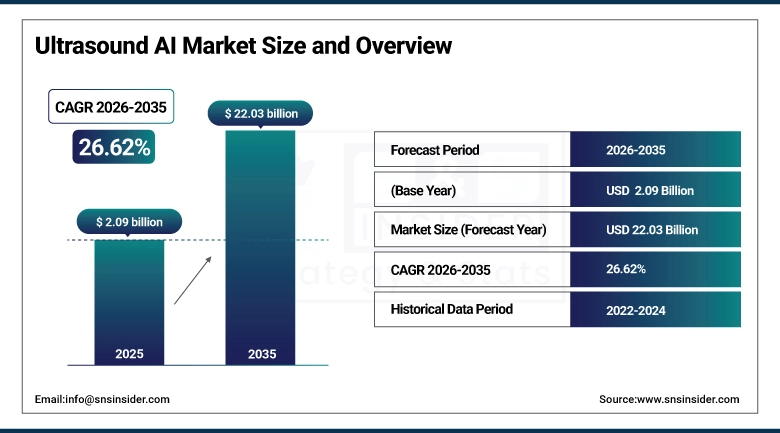
The global ultrasound AI market is rapidly growing as the result of widespread use of artificial intelligence-enabled imaging technologies. Ultrasound technology combined with AI is providing higher quality images, faster interpretation, and immediate decision-making in the area of cardiology, obstetrics, radiology, and emergency medicine. The rising need for automatic imaging technologies, the increasing number of chronic conditions, and growing digitalization in healthcare industry are among factors that stimulate market growth.
Growing Integration of Artificial Intelligence in Diagnostic Imaging Accelerates Market Expansion
Increased occurrences of cardiovascular conditions, cancerous conditions, and maternal disorders have led to an increase in the need for sophisticated imaging equipment that provides accurate and prompt diagnosis. AI-based ultrasound machines are being used to ensure streamlined workflows, automation of images capturing, and support in identifying abnormalities in images. There has been a focus on reducing variability in the diagnostic process and mitigating labor shortage issues using intelligent imaging systems.
With advancements in machine learning and deep learning approaches, there have been significant changes in how the ultrasound diagnostic process is conducted, as the technology enables automated measurement, image processing, and analysis. In cardiology and echocardiography processes, AI-based ultrasound diagnostic tools are facilitating fast and accurate assessment of the condition of patients. There has also been substantial investment in portable ultrasound machines.
However, issues related to data privacy concerns, difficulties in integration with current healthcare information technology platforms, and costly implementation of artificial intelligence-based imaging solutions may hamper growth in some developing countries.
Key Report Highlights
- By component, hardware dominated the market with a 48% share in 2025, while software is projected to grow at the fastest CAGR during the forecast period.
- By technology, machine learning accounted for a 38% market share in 2025, whereas deep learning is expected to emerge as the fastest-growing segment.
- By application/modality, cardiology/echocardiography held the largest market share of 38% in 2025, while obstetrics & gynecology is anticipated to witness the fastest growth over 2026–2035.
- By end use, hospitals led the market with a 46% share in 2025, while diagnostic imaging centers are projected to grow at the highest CAGR.
- Regionally, North America dominated the ultrasound AI market with a 45.54% share in 2025, while Asia Pacific is expected to register the fastest CAGR of 28.57% during the forecast period.
Regional Outlook
In 2025, North America led the market of AI ultrasound with a market share of 45.54% from the total share of revenues. Factors boosting the growth of the regional market include the dominance of key medical imaging vendors, fast adoption of technology-related health solutions and robust healthcare infrastructure. Further, in the region, the US leads in terms of the AI ultrasound market due to investments made in AI applications in radiology and POCUS devices.
The market in Asia Pacific is anticipated to grow at the highest rate of 28.57% from 2026 to 2035. Factors driving growth in the market include better health care infrastructure, increased utilization of artificial intelligence in imaging techniques, and increasing preference for economic diagnostic methods in countries, such as China, India, Japan, and South Korea. Initiatives taken by governments to make health care digitized and increase investment in intelligent medical devices are aiding the market’s expansion.
Recent Industry Developments:
- In February 2025, GE Healthcare expanded its AI-enabled ultrasound portfolio with advanced automation capabilities designed to improve cardiac imaging workflows and diagnostic accuracy.
- In January 2025, Siemens Healthineers introduced upgraded deep learning algorithms for ultrasound imaging applications aimed at enhancing image quality and clinical decision support.
- In September 2024, Butterfly Network Inc. announced enhancements to its portable ultrasound platform integrating artificial intelligence features for real-time image interpretation and workflow optimization.
Leading Companies in the Ultrasound AI Market:
- GE Healthcare
- Koninklijke Philips N.V.
- Siemens Healthineers
- EchoNous Inc.
- UltraSight
- iCardio.ai
- Sonio SAS
- Koios Medical
- Samsung Medison
- Fujifilm Holdings Corporation
- Clarius Mobile Health
- Caption Care
- Us2.ai
- Butterfly Network Inc.
- NovaSignal Corporation
- Esaote S.p.A.
- Mindray Medical
- Analogic Corporation
- Hitachi Medical Systems
- Bracco Imaging
About the Author

Get in touch




