
3D Machine Vision Market Report Scope & Overview:
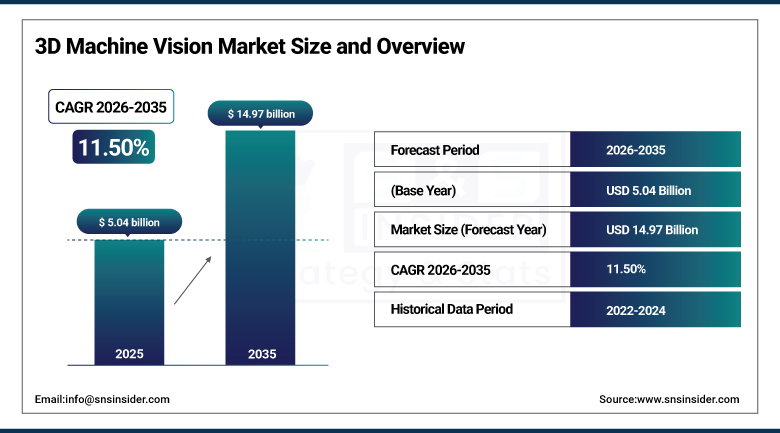
The 3D Machine Vision Market size was valued at USD 5.04 Billion in 2025 and is expected to reach USD 14.97 Billion by 2035, growing at a CAGR of 11.50% from 2026 to 2035.
The 3D Machine Vision Market is experiencing strong growth owing to the automation of manufacturing companies, rising demands for accuracy in inspection, and usage of artificial intelligence (AI)-enabled vision systems. In addition to that, growing application in the automotive industry, electronics, and semiconductor manufacturing is fueling the market demand. There are also advancements being made in 3D imaging sensors, deep learning algorithms, and real-time processing which are contributing towards the increase in the efficiency of the systems. Moreover, there is a move towards the concept of Industry 4.0 and smart factories, leading to the adoption of these vision systems.
According to the International Federation of Robotics, global industrial robot installations have reached around 500,000+ units annually, with strong demand from automotive, electronics, and semiconductor industries that rely heavily on machine vision for precision inspection and guidance. According to the International Data Corporation (IDC), worldwide spending on robotics and AI-enabled automation systems continues to grow at double-digit rates, driven by Industry 4.0 adoption and smart factory transformation.
To Get more information on 3D Machine Vision Market - Request Free Sample Report
3D Machine Vision Market Trends
-
Rising adoption of industrial automation and Industry 4.0 initiatives driving demand for 3D machine vision systems in manufacturing and quality inspection processes
-
Growing use of robotics in production lines requiring advanced 3D vision for object recognition, guidance, and precision handling applications
-
Increasing demand for high-accuracy inspection and measurement solutions in automotive, electronics, and semiconductor industries improving product quality and defect detection
-
Expanding application in logistics and warehousing operations supporting automated sorting, packaging, and dimension measurement systems
-
Continuous advancements in imaging sensors, AI-based vision algorithms, and depth-sensing technologies enhancing speed, accuracy, and real-time decision-making capabilities
U.S. 3D Machine Vision Market Size Outlook:
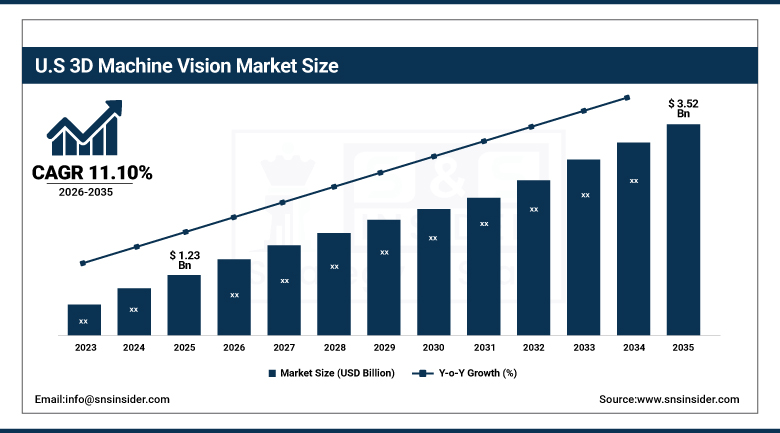
The U.S. 3D Machine Vision Market was valued at approximately USD 1.23 Billion in 2025 and is expected to reach approximately USD 3.52 Billion by 2035, growing at a CAGR of approximately 11.10%.
The United States is the world's most commercially advanced 3D machine vision market within North America, driven by the domestic presence of Cognex Corporation, Teledyne Technologies, and National Instruments whose 3D vision system and software products define the North American competitive landscape, the advanced manufacturing base whose aerospace, automotive, medical device, and semiconductor sectors create demanding quality inspection requirements that 3D vision's precision measurement capabilities are uniquely positioned to satisfy, and the most commercially active logistics automation market globally whose e-commerce fulfillment infrastructure requires large-scale deployment of 3D vision-guided robotic sorting, dimension measurement, and automated storage systems.
KEYENCE Corporation launched a Vision Sensor With Built-in AI in March 2025, incorporating deep learning defect detection trained directly on the production line without requiring external programming expertise, enabling manufacturers to deploy AI-enhanced 3D inspection capability without specialist vision system integration resources.
3D Machine Vision Market Segment Analysis
-
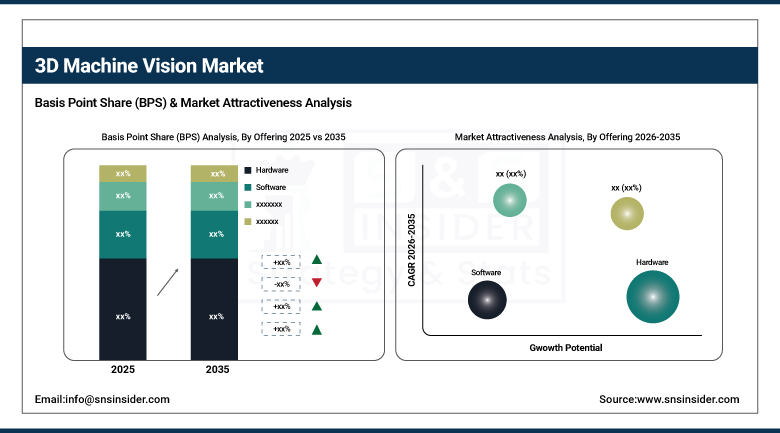
By Offering, Hardware segment dominated the 3D Machine Vision Market in 2025 with 58% share; Software segment is the fastest growing segment.
-
By Product, PC Based segment dominated the market in 2025 with 61% share; Smart Camera Based segment is the fastest growing segment.
-
By Application, Quality Assurance & Inspection segment dominated the market in 2025 with 49% share; Measurement segment is the fastest growing segment.
-
By End Use, Automotive segment dominated the market in 2025 with 33% share; Electronics & Semiconductor segment is the fastest growing segment.
By Offering, Hardware segment dominates the 3D Machine Vision Market, Software segment expected to grow fastest
The Hardware segment dominated the 3D Machine Vision Market in 2025 because of the extensive use of cameras, sensors, processors, and imaging systems that constitute the fundamental components of machine vision solutions. The industries require highly sophisticated hardware solutions in order to provide high precision imaging, processing, and defect detection in automated assembly lines. Improvements in terms of sensors' accuracy, resolution, and processing speed have helped drive the adoption of this segment in the manufacturing setting. The growing automation in industries along with the need for high-speed quality control systems have further cemented its dominance.
The Software segment is the fastest growing in the 3D Machine Vision Market owing to the rising demand for advanced image processing, artificial intelligence (AI), and deep learning solutions in visual inspections. The modern manufacturing plants require intelligent software that can help interpret complex images and enhance the precision and facilitate predictive quality control. Machine vision integrated with AI, Internet of Things (IoT), and cloud solutions is further boosting the adoption rate of software solutions.
By Product, PC Based segment dominates the 3D Machine Vision Market, Smart Camera Based segment expected to grow fastest
The PC Based segment dominated the 3D Machine Vision Market in 2025 owing to the processing capabilities, flexibility, and capacity to manage complicated imaging processes. This technology is highly adopted in industries that require advanced image analysis, multicameras, and quick processing of information. The ability to scale up and integrate various software makes it useful in larger production facilities. High demand from the automotive, electronics, and industrial automation industries keeps it at the forefront of the segment.
The Smart Camera Based segment is the fastest growing in the 3D Machine Vision Market because of growing demand for cost-effective and compact vision systems. Smart cameras integrate all imaging, processing, and decision making functionalities into one single unit and are easy to install. The fast growth rate of the segment is attributed to increasing use of smart cameras in small and medium scale industries. Technological improvements in the field of AI and edge computing have played an important role in the growth of the segment.
By Application, Quality Assurance & Inspection segment dominates the 3D Machine Vision Market, Measurement segment expected to grow fastest
The Quality Assurance & Inspection segment dominated the 3D Machine Vision Market in 2025 owing to its crucial significance for maintaining product uniformity and compliance with industrial standards. There is a constant need to maintain zero defects and ensure accuracy while inspecting products. This has prompted the use of machine vision systems which enable high-speed and non-contact inspection. Increasing automation and stringent quality checks play an important role in the dominance of the category.
The Measurement segment is the fastest growing in the 3D Machine Vision Market because there is a rising requirement for precise dimensional inspection in various manufacturing processes. Industries are deploying 3D vision systems for measuring gauging and alignment in real-time. Technological improvements in sensors and AI-based calibration have enhanced the performance of this segment. Applications in the electronics industry and automotive components are propelling the fast growth of this segment.
By End Use, Automotive segment dominates the 3D Machine Vision Market, Electronics & Semiconductor segment expected to grow fastest
The Automotive segment dominated the 3D Machine Vision Market in 2025 owing to extensive automation in manufacturing, assembly, and quality control processes. These systems are extensively used in the automobile manufacturing process for detecting defects, aligning parts, inspection of welds, and guidance of robots. The sector’s emphasis on precision, safety, and efficiency has resulted in the adoption of machine vision technology on a large scale. Rising vehicle manufacturing along with integration of smart manufacturing solutions adds to the dominance of this segment.
The Electronics & Semiconductor segment is the fastest growing in the 3D Machine Vision Market owing to increasing requirement of highly precise inspection in the micro-scale manufacturing process. The machines play an important role in detecting defects in circuit boards, semiconductor wafers, and microchips. Fast-paced growth in consumer electronics and semiconductor manufacturing sector has increased the adoption of these systems. Increasing complexity of electronic products and demand for high accuracy inspection solutions are propelling the growth of this segment.
Regional Insights
|
Region |
Major Country |
Share within Region, 2025 (%) |
|---|---|---|
|
North America |
United States |
84.73% |
|
Europe |
Germany |
27.84% |
|
Asia Pacific |
China |
38.47% |
|
Middle East & Africa |
UAE |
22.84% |
|
Latin America |
Brazil |
43.84% |
North America 3D Machine Vision Market Insights
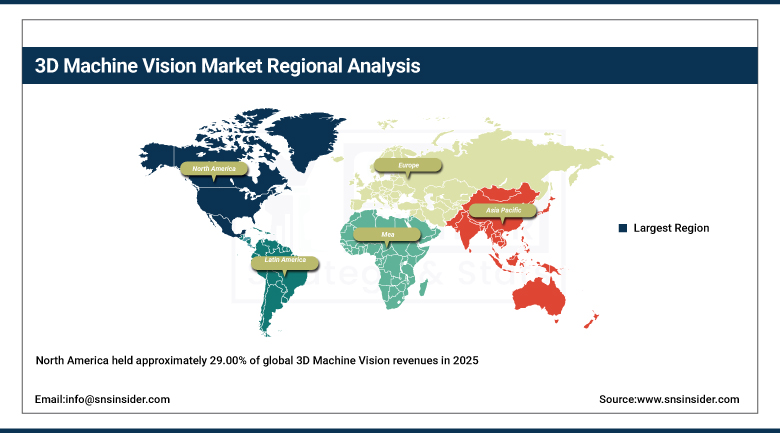
North America held approximately 29.00% of global 3D Machine Vision revenues in 2025. The United States accounts for approximately 84.73% of regional revenue through the domestic headquarters of Cognex Corporation and Teledyne Technologies, the most advanced manufacturing quality inspection culture globally including automotive, aerospace, and semiconductor sectors, and the world's most commercially active logistics automation market whose e-commerce fulfillment infrastructure creates large-scale 3D vision deployment.
The U.S. Department of Defence's investment in smart manufacturing through the Manufacturing USA institutes and DARPA programmes is stimulating advanced 3D vision adoption in defence component manufacturing and quality assurance applications.
Get Customized Report as per Your Business Requirement - Enquiry Now
Europe 3D Machine Vision Market Insights
Europe held approximately 26.00% of global 3D Machine Vision revenues in 2025. Germany accounts for approximately 27.84% of European revenues through its world-leading industrial automation and robotics ecosystem, the domestic headquarters of Basler AG, Isra Vision, SICK AG, and MVTec Software whose combined 3D vision product portfolios make Germany the most commercially significant European 3D machine vision market.
The German automotive sector's stringent inspection requirements at BMW, Mercedes-Benz, Volkswagen, and Bosch facilities create both large-volume domestic 3D vision procurement and reference applications that drive international adoption. France, Italy, and the Netherlands contribute meaningful European demand through their automotive, pharmaceutical, and food processing industries.
Asia Pacific 3D Machine Vision Market Insights
Asia Pacific is the largest and fastest-growing regional 3D Machine Vision market, projected to expand at a CAGR exceeding 13% through 2035. China accounts for approximately 38.47% of Asia Pacific revenues through its Made in China 2025 smart manufacturing initiative whose automation investment is the largest single national driver of 3D vision adoption, its world-leading electronics and consumer goods manufacturing base, and the growing Chinese automotive sector whose quality inspection investment creates large-volume local 3D vision procurement.
Japan and South Korea each contribute meaningful regional demand through their precision electronics, semiconductor, and automotive manufacturing industries. India is growing at approximately 10.40% CAGR through pharmaceutical quality inspection investment and automotive sector modernisation.
MEA & Latin America 3D Machine Vision Market Insights
Middle East and Latin America represent smaller but growing 3D Machine Vision markets where manufacturing modernisation and quality system investment are creating initial 3D vision adoption cycles. The UAE leads MEA revenues at approximately 22.84% of the regional total through its industrial diversification programme, growing food and pharmaceutical manufacturing inspection requirements, and the advanced manufacturing facilities being established under the UAE Industrial Strategy.
Saudi Arabia's Vision 2030 manufacturing development programme contributes secondary MEA demand. Brazil leads Latin American revenues at approximately 43.84% of the regional total through its automotive sector quality inspection investment, pharmaceutical packaging verification requirements, and food processing automation adoption.
Market Dynamics
Growth Drivers: Industry 4.0 and AI deep learning in 3D vision enable advanced inspection applications
Industry 4.0 smart manufacturing investment is creating greenfield 3D vision deployments in newly automated factories and retrofit installations in existing facilities whose quality, productivity, and traceability requirements exceed manual inspection capabilities. The economic case for 3D vision investment is strengthened by documented performance metrics: manufacturers report defect escape rate reductions of 60 to 90 percent, inspection cycle time reductions of 40 to 70 percent relative to manual inspection, and quality system cost reductions whose combined effect generates payback periods of 12 to 24 months for 3D vision inspection cells deployed on high-volume production lines.
AI and deep learning integration within 3D vision software is expanding the addressable application range of machine vision into inspection tasks whose defect diversity, surface complexity, or environmental variability previously exceeded rule-based algorithm capabilities, creating new commercial applications that were inaccessible to prior-generation systems.
Restraints: High system costs and complex integration expertise limit SME adoption and deployment scalability
High-accuracy 3D vision systems capable of sub-millimetre measurement at production line speeds in industrial environments require optical, mechanical, and processing engineering that creates system prices ranging from USD 5,000 to USD 500,000 per inspection station depending on measurement precision, field size, and processing complexity requirements. The total cost of a deployed 3D vision inspection system typically exceeds hardware purchase price by a factor of two to five when engineering, integration, programming, testing, and installation labour are included, creating total investment requirements that SMEs with limited capital budgets or single-product production lines may find difficult to justify against inspection alternatives.
The specialised skills required to develop, validate, and maintain 3D vision inspection programmes, including optical design knowledge, point cloud processing algorithms, and defect classification expertise, represent a talent scarcity whose effect constrains the velocity of new 3D vision application development across the industry.
Opportunities: E-commerce logistics automation and semiconductor packaging inspection create strong high-value growth opportunities
The global e-commerce logistics automation market whose warehouse robots, automated conveyor sortation, dimension scanning for volumetric pricing, and autonomous mobile navigation systems each require 3D vision-guided operation is creating a deployment scale for time-of-flight and structured light 3D cameras in logistics applications that substantially exceeds the historical concentration of 3D vision in precision manufacturing inspection. Each large automated fulfillment centre incorporates hundreds to thousands of 3D vision sensors for individual applications, creating aggregate system procurement at scales that make logistics the fastest-growing end user category by deployment unit volume.
Semiconductor advanced packaging inspection for 2.5D and 3D chip stacking architectures, whose wafer-level bump height, coplanarity, and interconnect geometry measurements require sub-micrometre 3D measurement accuracy, represents the highest technical specification and highest value per inspection station application segment whose growth is proportional to the advanced packaging adoption that AI chip production is driving.
Recent Developments:
-
2025: Cognex Corporation acquired OptoGenius, an AI-powered 3D vision software developer, integrating deep learning 3D defect detection trained from production data into Cognex's In-Sight product line to create AI-3D hybrid inspection platforms for automotive and electronics assembly quality control applications without manual defect specification programming.
-
2025: KEYENCE Corporation launched its Vision Sensor With Built-in AI incorporating on-sensor deep learning training from production line examples without specialist programming, achieving inspection stability against lighting and surface variation that conventional rule-based 3D inspection systems require controlled installation conditions to achieve.
-
2025: Omron secured a major contract to supply 3D vision systems for a global automotive assembly line, reinforcing its role in high-volume body-in-white and powertrain assembly 3D inspection with enhanced 3D sensing capabilities providing the measurement accuracy and throughput that automotive OEM quality specifications require.
3D Machine Vision Companies are:
-
Cognex Corporation
-
Basler AG
-
Teledyne Technologies Inc.
-
Sony Corporation
-
Intel Corporation
-
National Instruments (NI)
-
SICK AG
-
LMI Technologies
-
Hexagon AB
-
ZEISS Group
-
ISRA VISION (Atlas Copco)
-
Hikrobot (Hikvision)
-
Datalogic S.p.A.
-
IDS Imaging Development Systems
-
MVTec Software GmbH
-
Allied Vision Technologies
-
Photoneo s.r.o.
-
KUKA AG
3D Machine Vision Market Report Scope:
| Report Attributes | Details |
|---|---|
| Market Size in 2025 | USD 5.04 Billion |
| Market Size by 2035 | USD 14.97 Billion |
| CAGR | CAGR of 11.50% From 2026 to 2035 |
| Base Year | 2025 |
| Forecast Period | 2026-2035 |
| Historical Data | 2022-2024 |
| Report Scope & Coverage | Market Size, Segments Analysis, Competitive Landscape, Regional Analysis, DROC & SWOT Analysis, Forecast Outlook |
| Key Segments | • By Offering (Hardware, Software) • By Product (PC Based, Smart Camera Based) • By Application (Quality Assurance & Inspection, Positioning & Guidance, Measurement, Identification) • By End Use (Automotive, Pharmaceuticals & Chemicals, Electronics & Semiconductor, Pulp & Paper, Printing & Labeling, Food & Beverage ,Glass & Metal, Postal & Logistics, Others) |
| Regional Analysis/Coverage | North America (US, Canada), Europe (Germany, UK, France, Italy, Spain, Russia, Poland, Rest of Europe), Asia Pacific (China, India, Japan, South Korea, Australia, ASEAN Countries, Rest of Asia Pacific), Middle East & Africa (UAE, Saudi Arabia, Qatar, South Africa, Rest of Middle East & Africa), Latin America (Brazil, Argentina, Mexico, Colombia, Rest of Latin America). |
| Company Profiles | Cognex Corporation, Keyence Corporation, Basler AG, Teledyne Technologies Inc., Sony Corporation, Intel Corporation, National Instruments (NI), Omron Corporation, SICK AG, LMI Technologies, Hexagon AB, ZEISS Group, ISRA VISION (Atlas Copco), Hikrobot (Hikvision), Datalogic S.p.A., IDS Imaging Development Systems, MVTec Software GmbH, Allied Vision Technologies, Photoneo s.r.o., KUKA AG. |
Frequently Asked Questions
The quality assurance & inspection segment dominated the 3D Machine Vision Market in 2025.
The 3D Machine Vision Market is expected to grow at a CAGR of 11.50% from 2026 to 2035.
The 3D Machine Vision Market was valued at USD 5.04 Billion in 2025.
