
3D Printed Electronics Market Report Scope & Overview:
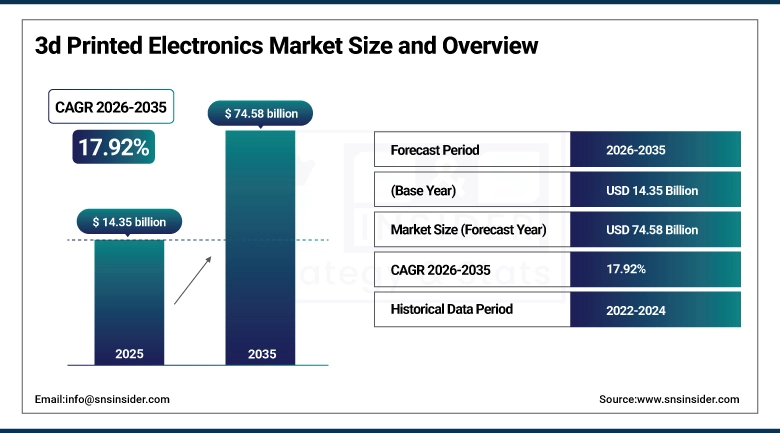
The 3D Printed Electronics Market size was valued at USD 14.35 Billion in 2025 and is projected to reach USD 74.58 Billion by 2035, growing at a CAGR of 17.92% during 2026–2035.
The 3D Printed Electronics Market is witnessing strong growth driven by advancements in additive manufacturing, conductive inks, and functional materials enabling Rapidly growing demand for 3D printed electronics due to technological breakthroughs in 3D printing technology, conductive ink, and functional materials has boosted the market demand in recent times. Growing demand for miniaturized, lightweight, and highly efficient electronic gadgets is driving the market ahead. Use of multiple material printing processes and recyclable materials is improving the process efficiency and increasing the sustainability of the printing process. Development of industrial grade 3D printers and advanced printing systems is supporting the growth in the market. Constant developments in semiconductor technology and flexible electronics are likely to increase market share during the forecast period.
HP introduced new polyamide materials for use in MJF process. The newly developed materials have increased reusability, reduced carbon emissions, and scalability in the production process..
To Get more information on 3D Printed Electronics Market - Request Free Sample Report
3D Printed Electronics Market Trends Highlights:
-
3D Printed Electronics Market is shifting from prototyping to full-scale industrial production, driven by demand for smart and connected devices.
-
Rapid adoption of conductive inks, aerosol jet printing, and hybrid PCB printing technologies is improving precision and design flexibility.
-
Strong growth in IoT, aerospace, automotive, and healthcare applications is expanding real-world deployment of printed electronics.
-
Increasing focus on miniaturization and lightweight electronic components is boosting integration of electronics directly into 3D structures.
-
Rising investments in advanced materials and functional polymers are accelerating innovation across the supply chain.
U.S. 3D Printed Electronics Market Size Outlook:
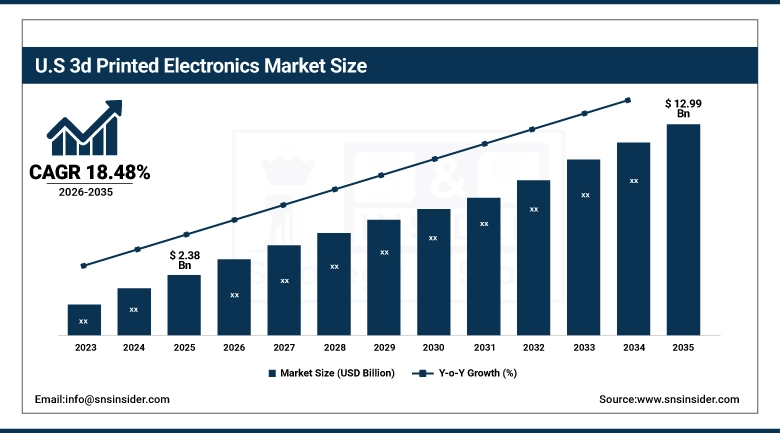
The U.S. 3D Printed Electronics Market was valued at USD 2.38 Billion in 2025 and is projected to reach USD 12.99 Billion by 2035, growing at a CAGR of 18.48% during 2026–2035, Fueled by robust technological advancements, cutting-edge R&D initiatives, and swift adoption in aerospace, healthcare, automotive, and defense sectors. Growing requirements for smaller, flexible, and better-performing electronic devices are contributing significantly to the market's expansion. Leading semiconductor and electronics firms operating in the country, coupled with substantial investments in additive manufacturing and IoT technologies, are propelling the country's dominance in the next-gen printed electronics space.
Market Drivers: Embedded Intelligence Through Printegrated Circuits in 3D Printed Electronics
The invention of "printegrated circuits" provides a huge potential within the 3D printed electronics sector since it allows the integration of microcontrollers and conductive material right into the printed object itself. This makes creating smart devices much simpler and more efficient in terms of assembling the electronics. In this case, there can be numerous applications for consumer electronics, Internet of Things (IoT) gadgets, robotics, educational materials and many other industries in which customization and embedded intelligence become crucial. Additionally, the technique makes prototyping faster and affordable, thus making advanced smart device manufacturing available not only to large companies but also to hobbyists and startups.
In June 2025 A new "printegrated circuits" solution allows embedding microcontrollers and conductive material directly into 3D printed objects, providing easier creation of interactive and smart devices.
Market Restraints: AI-driven 3D printing could enable fully autonomous smart factories that design, print, and test electronics in a single automated workflow.
The 3D Printed Electronics industry is experiencing impressive growth due to the increasing demand for smaller, flexible, and lighter electronic components for various applications like consumer goods, automobiles, medical devices, and aircraft. The fast development of IoT, wearable technology, and advanced sensors has boosted the uptake of printed electronics technology. Innovations in inkjet, screen printing, and hybrid printing techniques have enhanced the performance and efficiency of production. Moreover, the growing importance of sustainability in the manufacturing industry with respect to recyclable and environmentally friendly electronics will influence industry trends. Expensive materials and difficulties in mass production pose some major hurdles to market growth.
Market Opportunities: Water-Dissolvable 3D-Printed Electronics for Sustainable and Recyclable Device Innovation
The invention of water-soluble 3D printed electronics is a promising area for the production of environmentally friendly gadgets. It allows for the safe dismantling and recycling of electronic components, minimizing electronic waste while ensuring compliance with sustainability targets. Moreover, it provides growth opportunities in disposable sensors, medical devices, and other Internet of Things applications requiring short-lived gadgets. Lastly, it helps address growing environmental concerns and demands for eco-friendly manufacturing processes. Also, it opens up avenues for developing cost-effective recycling mechanisms and innovative material science.
In September 2025, Scientists at the University of Maryland have invented 3D-printed electronic circuits using polyvinyl alcohol that dissolve in water, allowing easy recycling of the devices and minimizing electronic waste.
3D Printed Electronics Market Segment Highlights:
-
By Printing Technology: Dominant – Screen Printing (36.30% in 2025 → 30.70% in 2035); Fastest Growing – Inkjet Printing (33.60% in 2025 → 38.40% in 2035)
-
By Material: Dominant – Inks (77.00% in 2025 → 69.00% in 2035); Fastest Growing – Polymers (13.00% in 2025 → 21.00% in 2035)
-
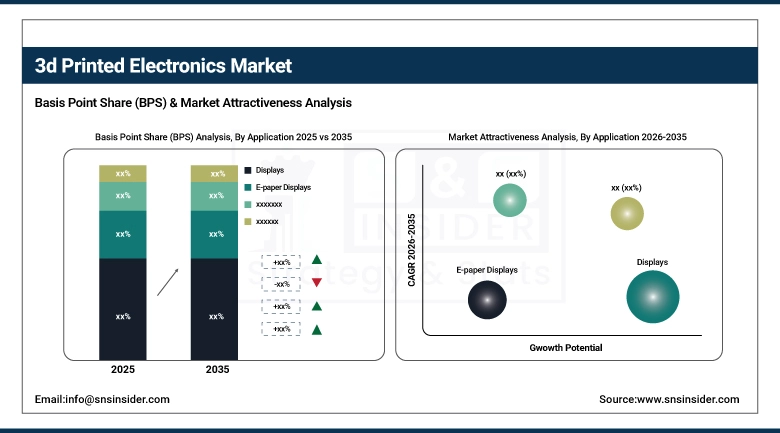
By Application: Dominant – Displays (29.60% in 2025 → 26.40% in 2035); Fastest Growing – Photovoltaic Cells (5.50% in 2025 → 9.50% in 2035)
-
By End Use Industry: Dominant – Automotive & Transportation (22.20% in 2025 → 24.00% in 2035); Fastest Growing – Consumer Electronics (16.20% in 2025 → 18.00% in 2035)
By Application: Displays (Dominant) and Photovoltaic Cells (Fastest-Growing)
In the Displays category (Dominant), it occupies the most considerable share because printed electronics are widely used in LCDs, OLEDs, e-paper displays, and flexible displays in consumer electronics and industrial applications. This segment’s dominance is attributed to its massive manufacturing capacity and regular advancements in display technology and energy efficiency. The Photovoltaic Cells category (Fastest-Growing), on the other hand, is experiencing exponential growth fueled by the growing deployment of printed solar cells, rising demand for renewable energy, and low-cost flexible solar panels.
By Printing Technology: Screen Printing (Dominant) and Inkjet Printing (Fastest-Growing)
Screen Printing segment (Dominant Segment) has the highest market share because of the wide use of screen printing technology in manufacturing high-volume and cost-efficient printed electronic parts which are highly reliable and well established in the industry. This segment is also dominated because of the advanced manufacturing process and substrate compatibility in manufacturing electronic parts. In contrast to this, Inkjet Printing segment (Fastest-Growing Segment) is growing rapidly because of its capability to provide precision, efficiency of materials used, and flexibility in design of complicated and miniature electronic circuitry.
By Material: Inks (Dominant) and Polymers (Fastest-Growing)
In the Inks (Dominant) segment, the highest market share is attained because of the significance of inks in printed electronics, especially conductive, dielectric, and functional inks used in circuit creation, electric conductivity, and efficient functioning. The growth in this segment is reinforced by high utilization in displays, RFID tags, and sensors. Conversely, the Polymers (Fastest-Growing) segment is recording robust growth because of the growing utilization in flexible electronics, lightweight parts, and wearable products fueled by the increasing need for flexible and affordable electronics products.
By End Use Industry: Automotive & Transportation (Dominant) and Consumer Electronics (Fastest-Growing)
Automotive & Transportation (Dominant) is the leading market share segment owing to the rising adoption of printed electronics in automobile display units, sensor devices, lighting systems, and ADAS technology. On the other hand, Consumer Electronics (Fastest-Growing) is experiencing rapid growth as a result of rising demand for smartphones, wearable electronics, IoT devices, and smart home electronics, where the role of printed electronic devices becomes increasingly critical.
3D Printed Electronics Market Regional Highlights:
-
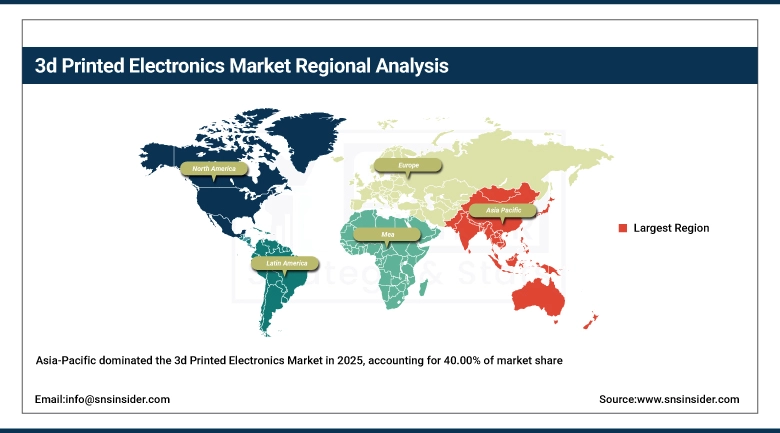
Asia-Pacific (Dominating & Fastest Growing – 40.00% in 2025 → 42.00% in 2035, CAGR 18.50%)
-
North America (25.18% in 2025 → 26.80% in 2035, CAGR 18.66%)
-
Europe (21.82% in 2025 → 20.20% in 2035, CAGR 17.01%)
-
Latin America (7.00% in 2025 → 5.00% in 2035, CAGR 13.96%)
-
Middle East & Africa (6.00% in 2025 → 6.00% in 2035, CAGR 17.92%)
Asia-Pacific 3D Printed Electronics Market Insights:
The Asia Pacific region is the dominating region in the 3D Printed Electronics Market on account of the presence of established electronics manufacturing hubs in China, Japan, South Korea, and India. The region is witnessing high demand owing to the rapid pace of industrial automation, rising production of consumer electronics, and the adoption of advanced additive manufacturing techniques. In addition, significant investments in research and development, government support, and the presence of large semiconductor and electronics companies are bolstering the growth in the region. Demand for IoT devices, wearable devices, and smaller electronics is further driving the market growth.
Get Customized Report as per Your Business Requirement - Enquiry Now
China 3D Printed Electronics Market Insights:
China is one of the dominating and rapidly growing markets for 3D printed electronics due to the presence of established manufacturing facilities and technological advancements.
North America 3D Printed Electronics Market Insights:
The North American market is experiencing significant growth in the global 3D Printed Electronics Industry owing to innovation, high R&D spend, and the quick adoption of manufacturing technologies. North America is also home to some leading aerospace, automotive, healthcare, and electronics players who have increasingly started using 3D printed electronics due to its unique benefits. Increasing use cases in IoT devices, wearable electronics, and smart medical devices drive market expansion. Moreover, the support of government policies, high research capability, and partnerships between institutions and industries are constantly fostering innovation in the region.
U.S. 3D Printed Electronics Market Insights:
The United States 3D Printed Electronics Industry is witnessing exponential growth and leads the regional market on account of innovation, R&D, and high adoption in aerospace, healthcare, automotive, and defense.
Europe 3D Printed Electronics Market Insights:
The Europe 3D Printed Electronics Market is anticipated to have a steady growth in the coming years owing to its excellent industrial automation, robust manufacturing capability, and growing demand for sustainable and effective manufacturing technologies. Europe is witnessing considerable investment in R&D activities, especially in the countries of Germany, France, and the UK, where there is a rapid integration of electronics, automotive, and aerospace industries with 3D printing technology. Additionally, rising need for energy-efficient products and miniature electronic components and sensors are contributing towards the market growth. Besides, favorable government policies supporting Industry 4.0 and digital manufacturing concepts are positioning Europe as an established player in the global 3D Printed Electronics Market.
Germany 3D Printed Electronics Market Insights:
Germany is one of the major markets for 3D printed electronics in Europe on account of its prominent automotive, industrial, and advanced manufacturing industries along with adoption of advanced additive manufacturing technologies.
Latin America 3D Printed Electronics Market Insights:
The Latin America 3D Printed Electronics Industry is witnessing a gradual rise owing to increased use of high-end manufacturing technologies along with growing investments in the electronics and industrial automation industries. Brazil and Mexico are the leading countries in the region owing to the development of their automotive, consumer electronics, and industrial industries. The market is getting benefitted due to the growth in the technological infrastructure, research & developments, and increasing integration of Internet of Things (IoT) enabled devices in the region. Even though at the initial stages, rising awareness about the benefits of additive manufacturing is propelling the market growth.
Brazil 3D Printed Electronics Market Insights:
Brazil accounts for the largest share of the 3D Printed Electronics Industry owing to the presence of a highly developed industrial sector and automobile industry in the country.
Middle East & Africa 3D Printed Electronics Market Insights:
The Middle East & Africa 3D Printed Electronics Market is witnessing significant momentum driven by growing investments into advanced manufacturing, adoption of smart technology, and rising demand for innovative electronic products. There are significant developments taking place within aerospace, automotive, and consumer electronics industries across the Middle East & Africa that have led to increasing requirements for light and high-performance 3D printed electronics products. Furthermore, the government's industrial diversification programs implemented by governments of countries such as the UAE and Saudi Arabia are contributing positively towards the growth of this market.
Saudi Arabia and the United Arab Emirates 3D Printed Electronics Market Insights:
The Saudi Arabia and United Arab Emirates are leading markets within the Middle East & Africa 3D Printed Electronics Industry due to robust investments in advanced manufacturing and smart technology, and government-led diversification programs.
3D Printed Electronics Market Competitive Landscape:
3D Systems is a leading additive manufacturing company providing advanced 3D printing systems, materials, and software for aerospace, automotive, healthcare, and industrial applications. Established in 1986 by Chuck Hull in Rock Hill, USA, it pioneered stereolithography technology and continues to innovate in industrial-grade printing and digital manufacturing solutions worldwide.
-
In Nov 2025 3D Systems launched its advanced SLA 825 Dual platform and upgraded materials portfolio at Formnext 2025, focusing on improved manufacturing efficiency, reduced manual labor, and high-precision industrial applications.
3D Printed Electronics Companies are:
-
Optomec
-
Voxel8
-
3D Systems
-
DuPont
-
BASF
-
Siemens
-
Autodesk
-
HP Inc.
-
Samsung Electronics
-
LG Electronics
-
Panasonic
-
Fujifilm
-
Xerox
-
Pragmatic Semiconductor
-
Electroninks
-
NovaCentrix
-
Neotech AMT
-
Voltera
| Report Attributes | Details |
|---|---|
| Market Size in 2025 | USD 14.35 Billion |
| Market Size by 2035 | USD 74.58 Billion |
| CAGR | CAGR of 17.92% From 2026 to 2035 |
| Base Year | 2025 |
| Forecast Period | 2026-2035 |
| Historical Data | 2022-2024 |
| Report Scope & Coverage | Market Size, Segments Analysis, Competitive Landscape, Regional Analysis, DROC & SWOT Analysis, Forecast Outlook |
| Key Segments | • By Printing Technology (Hardware, Software and Services) • By Material (SCARA Robots, Articulated Robots and Collaborative Robots) • By Application (Assembly Line, Material Handling, Welding, Sealing and Dispensing, Inspection and Testing and Machine Tending) • By End-User (Semiconductor Manufacturers, Consumer Electronics, Automotive, Telecommunications, Research & Development and Others) |
| Regional Analysis/Coverage | North America (US, Canada), Europe (Germany, UK, France, Italy, Spain, Russia, Poland, Rest of Europe), Asia Pacific (China, India, Japan, South Korea, Australia, ASEAN Countries, Rest of Asia Pacific), Middle East & Africa (UAE, Saudi Arabia, Qatar, South Africa, Rest of Middle East & Africa), Latin America (Brazil, Argentina, Mexico, Colombia, Rest of Latin America). |
| Company Profiles | Nano Dimension, Optomec, Voxel8, 3D Systems, Stratasys, DuPont, BASF, Siemens, Autodesk, HP Inc., Samsung Electronics, LG Electronics, Panasonic, Fujifilm, Xerox, Pragmatic Semiconductor, Electroninks, NovaCentrix, Neotech AMT, Voltera. |

Frequently Asked Questions
Asia-Pacific dominated the 3d Printed Electronics Market in 2025.
The “Screen Printing” segment dominated during the projected period.
Key drivers of the 3D Printed Electronics Market include demand for miniaturized flexible devices, growth in IoT and wearables, advancements in conductive materials and printing technologies, and cost-efficient rapid prototyping with reduced manufacturing waste.
The Market was valued at USD 14.35 Billion in 2025 and is projected to reach USD 74.58 Billion by 2035.
The Market is expected to grow at a CAGR of 17.92% during 2026–2035.
