
3D Printing in Healthcare Market Report Scope & Overview:
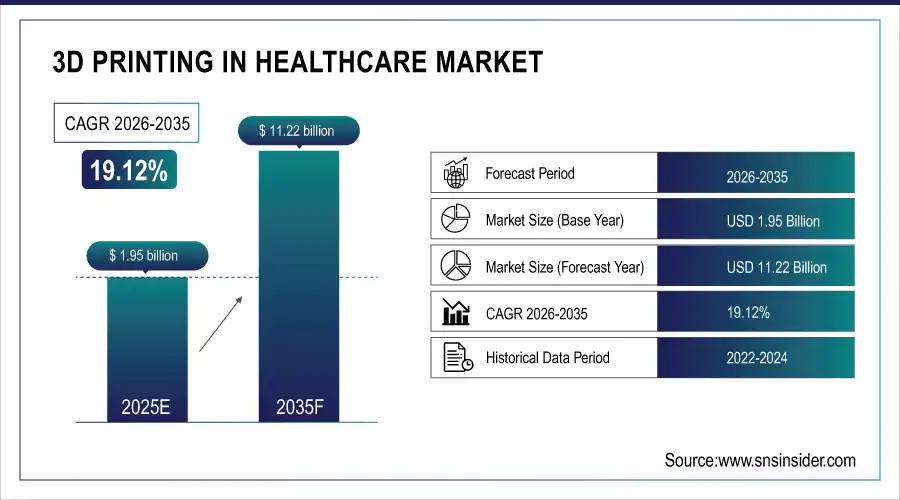
The 3D Printing in Healthcare Market Size is valued at USD 1.95 Billion in 2025 and is projected to reach USD 11.22 Billion by 2035, growing at a CAGR of 19.12% during the forecast period 2026–2035.
The 3D Printing in Healthcare Market analysis report explains about the technologies, material innovations, clinical integration and deployment through 2025. Advances in medical customization, increased demand for surgical accuracy and the growth of bioprinting are propelling usage across healthcare, leading to market growth breaking through expectations over the quarters.
3D-printed medical components reached 19.4 million units in 2025, driven by growing demand for patient-specific implants and surgical applications
To Get More Information On 3D Printing in Healthcare Market - Request Free Sample Report
3D Printing in Healthcare Market Trends:
-
The growing use of patient-specific implants (PSIs) and prosthetics is revolutionizing the way healthcare is delivered on an individual level.
-
Integration between bioprinting and tissue engineering is increasing regenerative medicine potential.
-
Recent developments in 3D-printed materials, such as biocompatible and antimicrobial options, are enhancing clinical results.
-
Hospitals and surgicenters are using 3D printed models for pre-operative planning, and medical education.
-
Rising cooperation between healthcare organizations, technological companies and research centers for the development of 3D printed medical is set to drive R&D in the industry.
-
Improved software and AI-based design tools are maximizing production precision while reducing treatment time.
U.S. 3D Printing in Healthcare Market Insights:
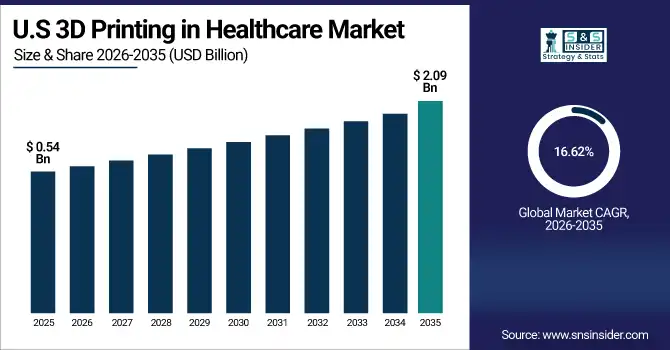
The U.S. 3D Printing in Healthcare Market is projected to grow from USD 0.54 Billion in 2025 to USD 2.09 Billion by 2035, at a CAGR of 16.62%. Growth is attributed to the increased adoption of patient specific implants, advanced 3D printing technologies and rapidly growing market for personalized medical products across hospitals and other research studies.
3D Printing in Healthcare Market Growth Drivers:
-
Growing demand for patient-specific implants and surgical models, enhancing treatment precision and personalized healthcare outcomes.
Growing demand for patient-specific implants and surgical models is a key driver of the 3D Printing in Healthcare Market growth. The market for personalized products is growing, and hospitals and clinics are also searching for bespoke health solutions to enhance surgery accuracy and patient results. Biocompatible materials and rapid prototyping and AI-driven design, are pushing up adoption. This momentum is reinforced by the recent partnerships between health organisations and tech companies, driving innovation and new market opportunities around the world.
Patient-specific 3D-printed implants exceeded 3.2 million units in 2025, driven by rising surgical precision and personalized treatment adoption.
3D Printing in Healthcare Market Restraints:
-
High equipment costs, complex regulatory approvals, and limited skilled workforce are constraining 3D printing adoption in healthcare.
High equipment costs, stringent regulatory approvals, and limited skilled workforce are key restraints for the 3D Printing in Healthcare Market. Big 3D printers and expensive material that restrict adoption to smaller hospitals and clinics, plus cumbersome compliance which delays product deployment. Moreover, lack of skilled labors to handle advance printing technology create problematic situation for the smooth running of the industry. Taken together, the problems described above hinder the development of the market and hamper broader adoption of 3D printing in health care applications.
3D Printing in Healthcare Market Opportunities:
-
Rising adoption of bioprinting and regenerative medicine offers opportunities for innovative patient-specific therapies and medical solutions.
Rising adoption of bioprinting and regenerative medicine presents significant opportunities for the 3D Printing in Healthcare Market. Patient-specific tissues, implants and surgical models are increasingly being required by hospitals and research institutes to benefit their patients. Progress in biomaterials, AI-aided design and joint innovation between medical and tech companies is increasing precision and personalization. A great opportunity exists for firms with a strong scalable high-quality bioprinting technology which enables them to tap into an increasing market demand and globalize their presence.
Bioprinted medical products accounted for 12% of new healthcare device launches in 2025, driven by rising demand for patient-specific therapies.
3D Printing in Healthcare Market Segmentation Analysis:
-
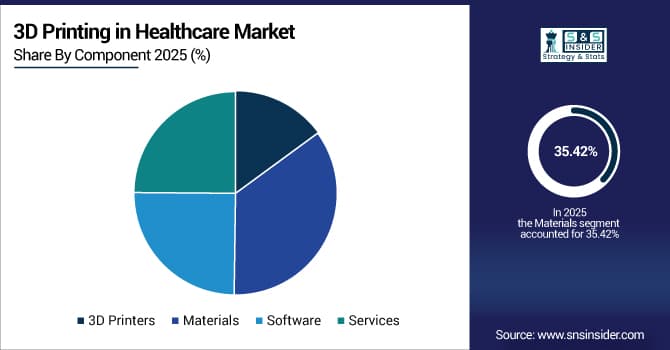
By Component, Materials held the largest market share of 35.42% in 2025, while 3D Printers are expected to grow at the fastest CAGR of 21.14% during 2026–2033.
-
By Technology, Stereolithography (SLA) dominated with a 32.58% share in 2025, while PolyJet is projected to expand at the fastest CAGR of 22.07% during the forecast period.
-
By Application, Prosthetics & Implants accounted for the highest market share of 30.75% in 2025, while Bioprinting is anticipated to record the fastest CAGR of 24.15% through 2026–2033.
-
By End User, Hospitals held the largest share of 40.28% in 2025, while Research & Academic Institutes are expected to grow at the fastest CAGR of 23.08% during 2026–2033.
By Component, Materials Dominate While 3D Printers Expand Rapidly:
Materials segment dominated the market since biocompatible polymers (such as plastics and resins) and metal powders are extensively used in medical sectors. Hospitals and clinics require pre-validated, high-quality materials for prosthetics implants and surgical models to guarantee patient safety. In 2025, material consumption exceeded 680 tons.
3D Printers is the fastest-growing segment, owing to increased exigency for development of faster, prototypes more complex and highly customizable machines. Improvements in desktop and industrial-scale printers are making the technology easier for smaller hospitals, research institutes, and other facilities to implement. In 2025, over 1,450 units were deployed.
By Technology, Stereolithography (SLA) Dominates While PolyJet Expands Rapidly:
Stereolithography (SLA) segment dominated the market owing to factors such as high accuracy, smooth surface finishes, fast printing speed and compatibility with several biocompatible resins. The health care industry commonly uses SLA for surgical models and dental implants due to its ability to maintain intricate geometric features with good resolution. In 2025, SLA machines exceeded 620 units.
PolyJet is the fastest-growing segment, as its material compatibility allows for multi-material printouts, production of more accurate and flexible patient-specific models. It has seen increased use in prosthetics, implants and medical training. In 2025, PolyJet printer deployments reached 210 units.
By Application, Prosthetics & Implants Dominate While Bioprinting Expands Rapidly:
Prosthetics & Implants segment dominated the market owing to surging demand for patient specific personalized medical devices. 3D printing is becoming increasingly popular in hospitals and surgical centers for improved accuracy during surgery and better outcomes. In 2025, prosthetic and implant units exceeded 3.2 million.
Bioprinting is the fastest-growing segment, driven by developments in regenerative medicine and tissue engineering. Research organizations and biotech firms are experimenting with 3D-printed organs and tissues for testing or therapy. In 2025, bioprinting applications reached 420,000 units.
By End User, Hospitals Dominate While Research & Academic Institutes Expand Rapidly:
Hospitals segment dominated the market as these are the major end-users who employ 3D printing for surgical models, implants, and prosthetics. Rising need for patient customized and precise surgeries contribute to the hospital segment. In 2025, over 1,200 hospitals integrated 3D printing technology.
Research & Academic Institutes are the fastest-growing segment, utilizing 3D printing for medical research, bioprinting experiments, and educating facilities. Partnerships with biotech companies and tech providers are fostering innovation in healthcare. In 2025, over 430 research and academic institutes implemented 3D printing applications.
3D Printing in Healthcare Market Regional Analysis:
North America 3D Printing in Healthcare Market Insights:
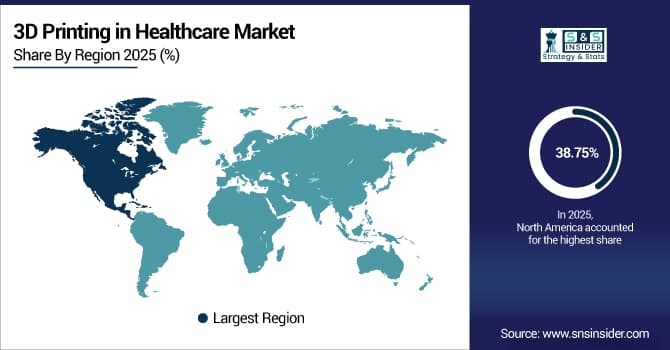
North America dominated the 3D Printing in Healthcare Market in 2025 with a 38.75% share, on account of rise use of patient-specific implants, surgical models, and prosthetics. State of the art biocompatible materials, precision 3D printers and AI-based design tools are speeding up adoption in hospitals and dental clinics. Robust relationships between medical centers and technology vendors and increasing research programs are promoting innovation and wide market presence among other factors keeping North America at its forefront in 3D printing in healthcare.
Get Customized Report as Per Your Business Requirement - Enquiry Now
U.S. 3D Printing in Healthcare Market Insights:
The U.S. 3D Printing in Healthcare Market is driven by the high acceptance of patient-specific implants, surgical models, and prosthetics. Leading edge biocompatible materials, AI-based design and high precision 3D printers are spurring innovation and partnerships between hospitals, research institutions and technology companies are broadening the scope of applications which is consolidating the country’s position in advanced healthcare 3D printing.
Asia-Pacific 3D Printing in Healthcare Market Insights:
The Asia-Pacific 3D Printing in Healthcare Market is the fastest-growing region, projected to expand at a CAGR of 22.16% during 2026–2035. Increasing medical infrastructure development, growing adoption of patient-specific implants and an increasing focus on the development of regenerative medicine in China, Japan, India, South Korea are some of the other factors supporting growth. Rapid tech developments, government sponsorship and hospital-technology provider tie-ins which have been bolstering the APAC in its healthcare 3D printing space.
China 3D Printing in Healthcare Market Insights:
The China 3D Printing in Healthcare Market is influenced by the rapid expansion of healthcare infrastructure, government support, and growing demand for patient-specific implants & surgical models. Domestic technology development, increased bioprinting research and collaborations between hospitals & tech firms will also help fuel rapid growth, making China a dominant force in the APAC healthcare 3D printing sector.
Europe 3D Printing in Healthcare Market Insights:
The Europe 3D Printing in Healthcare Market is witnessing expansion and expected to have a stable growth owing to the developed health care infrastructure and increased demand of patient specific implants, surgery models, prosthetics. Germany, France and UK are in lead positions for technological developments, development of biocompatible materials, AI-driven design solutions. Rising partnerships among hospitals, research institutions and technology developers drive innovation as regulatory support combined with availability of workforce play vital role in expediting healthcare 3D printing across Europe.
Germany 3D Printing in Healthcare Market Insights:
Germany is a key player in the 3D Printing in Healthcare Market, due to advanced medical infrastructure, and the presence of considerable research base. The market is also fueled on account of growing utilization for patient specific implants, customized surgical models and advancement in biocompatible materials. Additionally, hospitals and tech providers are partnering with AI-based printing solutions to spur market growth.
Latin America 3D Printing in Healthcare Market Insights:
The Latin America 3D Printing in Healthcare Market is developing with the increase in healthcare spending and expanding hospital infrastructure. Similarly, Brazil, Mexico and Argentina are at the forefront of national usage of patient-specific implants, surgical models and prosthetics. International technology providers working in collaborations, growing research activities and government initiatives are driving the regional market.
Middle East and Africa 3D Printing in Healthcare Market Insights:
The Middle East & Africa 3D Printing in Healthcare Market is growing with the increasing healthcare expenditure, upgradation of medical infrastructure and increasing use of patient-specific implants and surgical models. The key markets such as Saudi Arabia, UAE and South Africa are propelling the growth with advanced bioprinting research installations and technology integration projects.
3D Printing in Healthcare Market Competitive Landscape:
3D Printing in Healthcare Market Competitive Landscape:
Stratasys Ltd., headquartered in Eden Prairie, Minnesota, USA, is a leader in 3D printing and additive manufacturing technologies. Famed for Fused Deposition Modeling (FDM) and PolyJet 3D printing technologies, Stratasys leads the market in medical 3D printing with high-accuracy patient-specific models, surgical guides and prostheses. It has been the pioneer and leader in large medical market due to its constant innovation, rich materials selection, solid relationships with hospitals and research institutions.
-
In July 2025, Stratasys launched the H350 V1.5 printer with HighDef printing, enabling production-grade, patient-specific anatomical models. Earlier in June 2025, its P3 Silicone 25A material expanded biocompatible 3D printing for flexible medical components.
3D Systems Corporation, headquartered in Rock Hill, South Carolina, USA, is a trailblazer in 3D printing solutions, specializing in stereolithography (SLA), selective laser sintering (SLS), and bioprinting technologies. By providing the most precise and advanced surgical models, implants and devices to health care providers around the world, the company is at the forefront of enhancing patient outcome. Its R&D, network of service and strategic partnerships with hospitals and universities make it a trusted name, which in turn has helped the company establish wide-spread use, combined with market leadership.
-
In May 2025, 3D Systems enhanced its healthcare portfolio with advanced SLA and SLS printers for surgical models, dental applications, and patient-specific implants, improving workflow efficiency and adoption across hospitals and research institutes globally.
Materialise NV, headquartered in Leuven, Belgium, is a leading additive manufacturing software and service provider, renowned for its 3D printing solutions in healthcare. The company has a leading share of the market for patient-specific surgical guides, implants, and imaging technologies that facilitate increased accuracy in surgical procedures. Materialise’s strong software backbone, commitment to innovation and partnerships with medical institutions has positioned the company as a trusted leader in healthcare-focused 3D printing, accelerating progress at hospitals and research centers.
-
In April 2025, Materialise released Magics 2025, improving build-preparation times and enabling complex patient-specific parts. The update supported surgical models, implants, and large-scale additive manufacturing, boosting adoption in hospitals and research centers.
3D Printing in Healthcare Market Key Players:
Some of the 3D Printing in Healthcare Market Companies are:
-
Stratasys Ltd.
-
3D Systems Corporation
-
Materialise NV
-
Formlabs Inc.
-
EOS GmbH
-
SLM Solutions Group AG
-
Organovo Holdings, Inc.
-
Renishaw plc
-
GE Healthcare
-
EnvisionTEC (Desktop Metal)
-
Desktop Metal
-
Proto Labs
-
CELLINK (BICO Group)
-
Axial3D
-
Bio-Rad Laboratories
-
ExOne
-
Cyfuse Biomedical
-
Biogelx
-
3T RPD Ltd.
-
Rainbow Biosciences
| Report Attributes | Details |
|---|---|
| Market Size in 2025 | USD 1.95 Billion |
| Market Size by 2035 | USD 11.22 Billion |
| CAGR | CAGR of 19.12% From 2026 to 2035 |
| Base Year | 2025E |
| Forecast Period | 2026-2035 |
| Historical Data | 2022-2024 |
| Report Scope & Coverage | Market Size, Segments Analysis, Competitive Landscape, Regional Analysis, DROC & SWOT Analysis, Forecast Outlook |
| Key Segments | • By Component (3D Printers, Materials, Software, Services) • By Technology (Stereolithography, Fused Deposition Modeling, Selective Laser Sintering, PolyJet, Others) • By Application (Prosthetics & Implants, Surgical Planning & Modeling, Dental Applications, Bioprinting, Medical Devices, Others) • By End User (Hospitals, Surgical Centers, Dental Clinics, Research & Academic Institutes, Pharma & Biotech Companies) |
| Regional Analysis/Coverage | North America (US, Canada), Europe (Germany, UK, France, Italy, Spain, Russia, Poland, Rest of Europe), Asia Pacific (China, India, Japan, South Korea, Australia, ASEAN Countries, Rest of Asia Pacific), Middle East & Africa (UAE, Saudi Arabia, Qatar, South Africa, Rest of Middle East & Africa), Latin America (Brazil, Argentina, Mexico, Colombia, Rest of Latin America). |
| Company Profiles | Stratasys Ltd., 3D Systems Corporation, Materialise NV, Formlabs Inc., EOS GmbH, SLM Solutions Group AG, Organovo Holdings, Inc., Renishaw plc, GE Healthcare, EnvisionTEC (Desktop Metal), Desktop Metal, Proto Labs, CELLINK (BICO Group), Axial3D, Bio-Rad Laboratories, ExOne, Cyfuse Biomedical, Biogelx, 3T RPD Ltd., Rainbow Biosciences |
Frequently Asked Questions
North America dominated with a 38.75% share in 2025, while Asia-Pacific is the fastest-growing region, expected to expand at a CAGR of 22.16% during 2026–2035.
Materials dominated with a 35.42% share in 2025, while 3D Printers are projected to grow at the fastest CAGR of 21.14% during 2026–2035.
Growth is driven by increasing demand for patient-specific implants, surgical models, bioprinting, regenerative medicine and AI-enabled 3D printing technologies in healthcare.
The market is valued at USD 1.95 Billion in 2025 and is projected to reach USD 11.22 Billion by 2035.
The 3D Printing in Healthcare Market is expected to grow at a CAGR of 19.12% during 2026–2035.
