
Acetonitrile Market Report Scope & Overview:
The Acetonitrile Market was valued at USD 455.00 Million in 2025 and is expected to reach USD 807.18 Million by 2035, growing at a CAGR of 5.90% from 2026-2035.
The Acetonitrile Market is experiencing steady growth due to increasing demand from pharmaceutical manufacturing, analytical testing, and chemical synthesis. Acetonitrile is widely used as a solvent in high-performance liquid chromatography (HPLC), supporting pharmaceutical quality control, drug development, and laboratory research. Expansion of the pharmaceutical and biotechnology industries is increasing consumption of high-purity grades. Growing semiconductor manufacturing and electronics production are also creating opportunities for electronic-grade acetonitrile in specialized cleaning and processing applications. Additionally, rising agrochemical production and greater investment in chemical research are supporting broader industrial demand. Increasing requirements for reliable analytical testing across laboratories further strengthen market prospects.
⮞Bio-based supply is entering analytical chemistry. In April 2024, INEOS Nitriles launched INVIREO, a bio-based acetonitrile produced through an ISCC+-certified mass-balance route. The company says the product can reduce the carbon footprint by up to 90%, showing how leading producers are responding to laboratory demand for lower-carbon solvents.

To Get more information Acetonitrile Market - Request Free Sample Report
Acetonitrile Market Trends
-
Rising demand for high-purity and electronic grades for chromatography and semiconductor processing
-
Growth of dedicated recovery and purification capacity to turn by-product into usable solvent
-
Launch of bio-based and lower-carbon acetonitrile for laboratories
-
Use of acetonitrile-based electrolytes in advanced battery cells
-
Shifts in acrylonitrile capacity that reshape regional supply
U.S. Acetonitrile Market Outlook
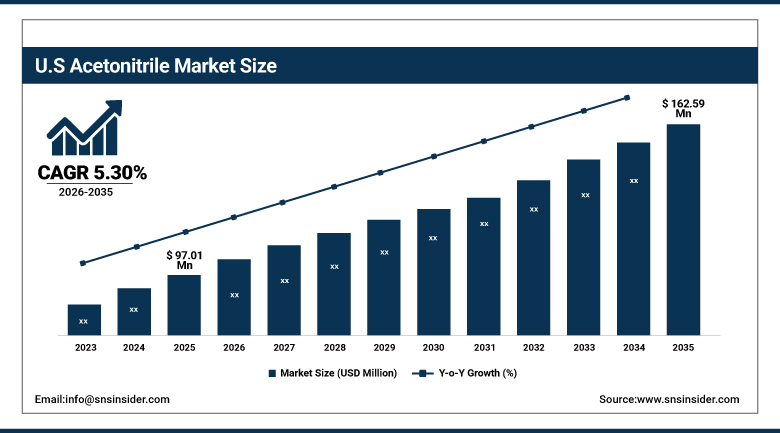
The U.S. Acetonitrile Market was valued at USD 97.01 Million in 2025 and is expected to reach USD 162.59 Million by 2035, growing at a CAGR of 5.30% from 2026-2035.
The U.S. Acetonitrile Market is supported by a large pharmaceutical and biotechnology sector, extensive analytical and contract testing laboratories, a growing semiconductor manufacturing base and local acrylonitrile production that supplies by-product feedstock. Demand is concentrated in high-purity grades for liquid chromatography and drug development, and supply is influenced by the operating rates of acrylonitrile plants on the Gulf Coast. Growth is moderated by feedstock volatility and by the maturity of the analytical market.
⮞Dedicated recovery capacity is improving local supply. In February 2026, Ascend Performance Materials opened a high-purity acetonitrile recovery and purification facility at its Chocolate Bayou site in Texas. The plant converts by-product streams from acrylonitrile production into high-purity solvent for analytical and electronic customers.
Acetonitrile Market Segment Analysis
-
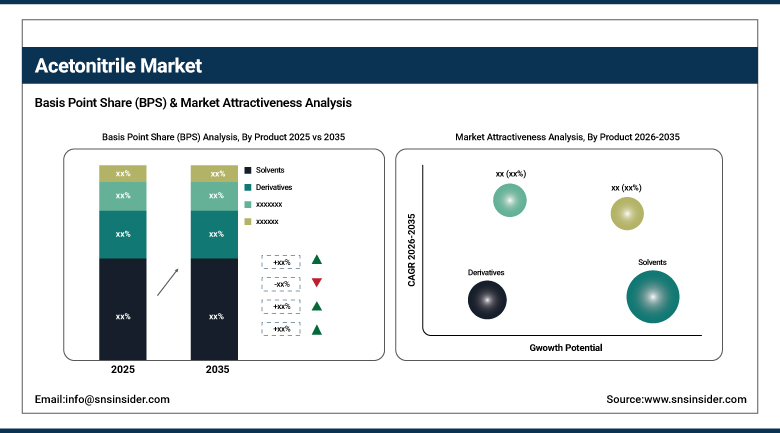
By Product, solvents held the leading position in the Acetonitrile Market in 2025, accounting for an estimated 61.7% share, while derivatives are projected to grow at the fastest pace, with a CAGR of 6.4%.
-
By Application, solvent use represented the largest market share in 2025 at approximately 38.73%, whereas chromatography is expected to expand most rapidly, registering a CAGR of 6.76%.
-
By End Use, pharmaceuticals accounted for the highest share in 2025 at around 41.91%, while electronics and semiconductors are anticipated to record the fastest growth, with a CAGR of 6.68%.
By Product, Solvents Dominate Acetonitrile Market; Derivatives to Register Fastest Growth.
Solvents dominate the Acetonitrile Market owing to the superior solvation power, low viscosity, and compatibility with a wide range of organic compounds. The broad usage of acetonitrile in the manufacture of pharmaceuticals, chemical synthesis, and in analytical laboratories contributes to the steady demand. In addition, the compound is very useful in high-performance liquid chromatography, as well as other techniques for separating compounds. Its chemical properties make acetonitrile highly effective in extraction and purification processes. Consumption in pharmaceutical, chemical, and laboratory industries helps strengthen the leadership of the solvents category in the market.
The derivatives segment is expected to grow rapidly due to the growing application of acetonitrile in the synthesis of specialty chemicals, intermediates for pharmaceuticals, and other value-added compounds. Increasing research and development activities in the pharmaceutical industry, the growth in the demand for advanced active ingredients, and the growth in specialty chemical industry open up avenues for the use of acetonitrile derivatives. Its function as a chemical intermediate makes acetonitrile valuable in reactions involving nitrile intermediates.
By Application, Solvents Dominate Acetonitrile Market; Chromatography to Register Fastest Growth.
Solvent applications account for the largest share of the Acetonitrile Market owing to the ability of the chemical compound to dissolve various organic compounds, low viscosity, and suitability in extraction and purification. Solvent is employed in various production industries including pharmaceutical and chemical synthesis and product recovery and purification. Its ability to dissolve a wide variety of organic compounds makes it suitable for various uses in laboratories and production industries. Well-established usage in chemical production coupled with the requirement for high purity solvents ensures continued consumption and the dominance of solvent applications.
Chromatography is expected to register the fastest growth as analytical testing becomes an integral part of pharmaceutical research, biotechnology, and analysis. The chemical compound is extensively used as the solvent in mobile phase in high-performance liquid chromatography owing to its low viscosity, miscibility with water, and performance in separation. Growth in the production of pharmaceutical products, quality assurance testing, food safety testing, and environmental testing is driving the demand for various analytical techniques such as liquid chromatography. Increasing requirements to identify impurities, quantitate active ingredients, and product quality testing is further boosting the demand for acetonitrile.
By End Use, Pharmaceuticals Dominate Acetonitrile Market; Electronics and Semiconductors to Register Fastest Growth.
Pharmaceuticals dominate the Acetonitrile Market since the chemical serves as a significant element of drug manufacturing, purification, and analytical tests. Manufacturers in the pharmaceutical industry utilize the chemical in its solvent form, whereas high purity grades of the chemical are used by analytical laboratories in chromatographic tests of drugs. Increasing demand for drugs, rising generic drugs manufacturing, and ongoing pharmaceutical research provide a stable demand. The high quality requirements also push consumers to use dependable and high-purity solvents. Established applications are the driving forces behind the pharmaceutical segment leadership.
Electronics and semiconductors are expected to record the fastest growth due to the growing fabrication of semiconductors, developments in the electronics industry, and demand for more sophisticated technologies in manufacturing that require high-purity chemicals. Acetonitrile could be used as a solvent in selected electronic chemical compositions, cleanings, and material research according to application-specific purity requirements. Growth in the semiconductor manufacturing capacities and advanced devices manufacturing creates a higher demand for controlled chemical substances. However, the adoption of the chemical is not universal for all stages of semiconductor fabrication.
Regional Analysis
|
Region |
Major Country |
Share within Region, 2025 (%) |
|
Asia Pacific |
China |
46.00 |
|
North America |
United States |
82.00 |
|
Europe |
Germany |
28.00 |
|
Latin America |
Brazil |
44.00 |
|
Middle East & Africa |
Saudi Arabia |
26.00 |
North America Acetonitrile Market Insights
North America is the second-largest region, growing at a CAGR of 5.30% during 2026-2035. The United States accounts for about 82.00% of regional demand, supported by Ascend Performance Materials, Avantor, Thermo Fisher Scientific and Solstice Advanced Materials, along with a large base of pharmaceutical research and contract testing. Canada and Mexico add demand through chemical processing and laboratory services. Mexico and Canada contribute demand through contract manufacturing and testing laboratories, and cross-border trade is supported by regional trade agreements and well-developed distribution networks.
Recent investments in recovery and purification capacity, including Ascend's Chocolate Bayou facility, have improved local availability of high-purity solvent. Semiconductor investment under national industrial policy programs is expected to raise demand for electronic grades. Supply remains dependent on acrylonitrile operating rates, and imports from Asia supplement local availability during tight periods, although buyers value local sources for continuity. Chip fabrication plants under construction across Arizona, Texas and New York are expected to increase use of electronic grades, while pharmaceutical hubs in New Jersey, Massachusetts and North Carolina sustain demand for chromatography solvents.
Europe Acetonitrile Market Insights
Europe is a mature region growing at a CAGR of 4.90% during 2026-2035. Germany, the United Kingdom, France, Italy and the Netherlands account for most demand, driven by pharmaceutical manufacturing, analytical laboratories and specialty chemicals. INEOS Nitriles, Merck KGaA and Alzchem Group supply regional customers, and distributors play an important role in serving laboratories. Spain, Belgium and Switzerland add pharmaceutical and contract research demand, and the region's large network of analytical laboratories supports steady purchases of chromatography solvents throughout the year.
Regulation under REACH and sustainability goals encourage the use of lower-carbon products, which is reflected in the introduction of bio-based acetonitrile. In April 2026, MilliporeSigma launched a bio-based HPLC acetonitrile. Limited local acrylonitrile capacity makes the region dependent on imports for part of its needs, and price volatility affects laboratories and drug makers, but strong pharmaceutical research sustains demand. Companies also work to reduce solvent waste through recycling programs, which moderates volume growth but supports demand for higher-value, certified products from established suppliers.
Asia Pacific Acetonitrile Market Insights
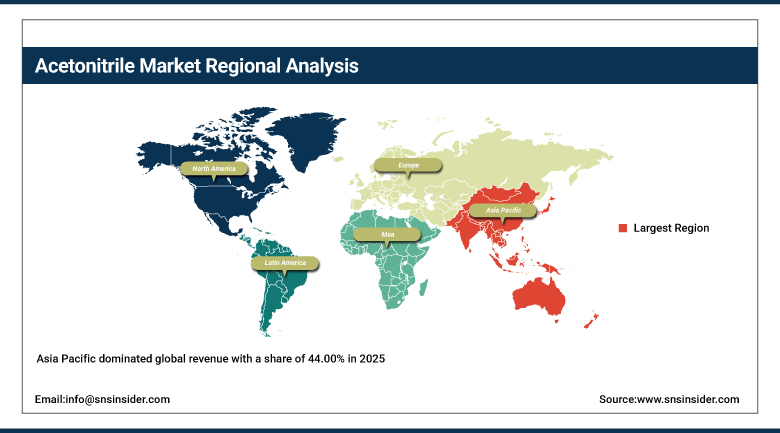
Asia Pacific dominated global revenue with a share of 44.00% in 2025 and is also projected to be the fastest-growing region, at a CAGR of 6.60% during 2026-2035. China leads regional output through producers such as Shanghai SECCO Petrochemical, PetroChina, ShengHong Petrochemical, Nantong Acetic Acid Chemical and Henan GP Chemicals, while Japan, South Korea, India and Taiwan add significant production and consumption. Taiwan and Singapore add specialized semiconductor and laboratory chemical demand, and international distributors maintain regional hubs to support customers.
Large acrylonitrile capacity in Asia provides abundant by-product feedstock, and a vast pharmaceutical and electronics manufacturing base supports demand. Asahi Kasei announced the end of acetonitrile production at its Kawasaki site in May 2025, and in India, Balaji Amines is upgrading its Chincholi plant toward 60 metric tons per day, with commissioning planned for fiscal year 2026-27. Regional policies on semiconductors and drug manufacturing support further expansion. Closure of older capacity in Japan is shifting supply toward other regional producers, which may alter trade flows and encourage investment in larger, more integrated plants in China and South Korea.
Get Customized Report as per Your Business Requirement - Enquiry Now
MEA & Latin America Acetonitrile Market Insights
In Latin America, Brazil leads on the strength of its pharmaceutical and agrochemical industries, followed by Mexico and Argentina. Regional demand grows at about 5.60% annually and is met largely by imports from North America and Asia, with distributors supplying laboratories and manufacturers. Expansion of generic drug production and quality control testing supports steady consumption. Colombia and Chile add demand through generic drug production and mining-related testing, while regional distributors help international producers meet registration requirements and customer service expectations.
In the Middle East and Africa, Saudi Arabia, the United Arab Emirates and South Africa lead through investment in pharmaceutical plants, laboratories and petrochemical infrastructure. Growth of about 5.40% annually is limited by small analytical markets and import dependence, although industrial diversification programs and expanding healthcare systems create selective opportunities for suppliers. Turkey and Egypt are growing as regional hubs for generic medicines and chemical processing, and investment in healthcare infrastructure across the Gulf is expected to raise demand for laboratory solvents and analytical services over the forecast period.
Market Dynamics
Growth Drivers: Pharmaceutical Analysis, Electronics Demand and Purification Capacity
Pharmaceutical development and quality control are the main drivers of the Acetonitrile Market. Liquid chromatography is a required step in testing drugs, and growth in generics, biologics and contract analytical services raises solvent consumption. Regulatory agencies demand extensive analytical documentation, which keeps laboratories purchasing high-purity solvent in regular volumes year after year. Growing environmental, food safety and forensic testing programs add further chromatography volumes. Each new fabrication plant or high-throughput laboratory adds a long-term source of recurring solvent purchases, and customers generally prefer to keep qualified suppliers to avoid revalidation work.
Electronics manufacturing provides a second growth path, as semiconductor, display and battery producers use ultra-clean acetonitrile in processing and electrolytes. Investment in recovery and purification capacity, such as Ascend's Chocolate Bayou plant, converts by-product into higher-value solvent and improves supply reliability for analytical and electronic customers. Government investment in local chip and battery manufacturing in several countries is also raising the base of customers for electronic grade solvent. Pharmaceutical firms in Asia are scaling up analytical capacity to support exports, which raises regional demand for certified high-purity grades.
Restraints: By-Product Supply Dependence and Price Volatility
Because most acetonitrile is a by-product of acrylonitrile production, its supply cannot easily be adjusted to demand. When acrylonitrile plants cut output or close, as in Asahi Kasei's announced end of acetonitrile production at Kawasaki, supply tightens and prices rise sharply. The shortage of 2008–09 showed how quickly analytical laboratories can be affected. Single-sourced supply chains increase risk for laboratories, which often respond by building inventories and signing longer contracts, adding working capital costs.
Price swings complicate budgeting for laboratories and manufacturers, and some buyers look for alternative solvents such as methanol or ethanol in chromatography. Environmental and safety regulations on a toxic, flammable solvent add compliance costs, and the energy needed to purify crude by-product to analytical grade is significant. Rising scrutiny of the toxicity of nitrile solvents and requirements for emissions control further add to costs for producers and for users with large-scale operations. Capacity closures in mature regions can also raise costs for local buyers who must rely on imports.
Opportunities: Bio-Based Products, Battery Electrolytes and Regional Capacity
Bio-based and lower-carbon acetonitrile offers a differentiated product for laboratories under sustainability pressure, as shown by INEOS Nitriles' INVIREO and MilliporeSigma's bio-based HPLC grade. Producers that secure certified supply can earn premium prices and strengthen relationships with pharmaceutical customers. Partnerships between producers and distributors can also give laboratories access to certified supply with traceable carbon data. Wider use of acetonitrile-based electrolytes in energy storage, if proven at scale, could add a new class of industrial customers.
Acetonitrile-based electrolytes for high-power batteries are an emerging use, with Asahi Kasei licensing its Acetolyte electrolyte technology to partners in Europe and China. Dedicated recovery capacity and expansion in India and Southeast Asia can also help reduce supply risk and capture growing regional demand. New plants in the United States, Europe and India are intended to shorten supply chains and reduce dependence on a small number of acrylonitrile producers. Expansion of solvent recovery services offered by distributors may further support circular supply models.
Recent Developments:
-
2026: MilliporeSigma launched a bio-based HPLC acetonitrile. The product gives laboratories a lower-carbon option for liquid chromatography.
-
2025: Asahi Kasei licensed its Acetolyte acetonitrile-containing electrolyte technology to EAS Batteries GmbH for an ultra-high-power lithium iron phosphate cell. The agreement extends acetonitrile use into advanced battery applications.
-
2025: Solstice Advanced Materials completed its spin-off from Honeywell. The separation creates an independent specialty materials company that supplies solvents and electronic chemicals.
-
2025: Avantor expanded its Singapore distribution hub. The expansion improves delivery of laboratory chemicals, including solvents, across Asia Pacific.
Acetonitrile Market Key Players
-
INEOS Nitriles
-
Asahi Kasei Corporation
-
Nova Molecular Technologies, Inc.
-
Tedia Company, LLC
-
Taekwang Industrial Co., Ltd.
-
Avantor, Inc.
-
Thermo Fisher Scientific Inc.
-
Alzchem Group AG
-
Ascend Performance Materials
-
Merck KGaA
-
Solstice Advanced Materials
-
Balaji Amines Limited
-
Alkyl Amines Chemicals Limited
-
PetroChina Company Limited
-
Formosa Plastics Corporation
-
Shanghai SECCO Petrochemical Co., Ltd.
-
Nantong Acetic Acid Chemical Co., Ltd.
-
Henan GP Chemicals Co., Ltd.
-
Imperial Chemical Corporation
-
ShengHong Petrochemical
Acetonitrile Market Report Scope:
| Report Attributes | Details |
|---|---|
| Market Size in 2025 | USD 455.00 Million |
| Market Size by 2035 | USD 807.18 Million |
| CAGR | CAGR of 5.90% From 2026 to 2035 |
| Base Year | 2025 |
| Forecast Period | 2026-2035 |
| Historical Data | 2022-2024 |
| Report Scope & Coverage | Market Size, Segments Analysis, Competitive Landscape, Regional Analysis, DROC & SWOT Analysis, Forecast Outlook |
| Key Segments | • By Product (Derivatives, Solvents) • By Application (Solvent, Chromatography, Organic Synthesis, Extraction, Others) • By End Use (Pharmaceuticals, Analytical Laboratories, Electronics and Semiconductors, Agrochemicals, Others) |
| Regional Analysis/Coverage | North America (US, Canada), Europe (Germany, UK, France, Italy, Spain, Russia, Poland, Rest of Europe), Asia Pacific (China, India, Japan, South Korea, Australia, ASEAN Countries, Rest of Asia Pacific), Middle East & Africa (UAE, Saudi Arabia, Qatar, South Africa, Rest of Middle East & Africa), Latin America (Brazil, Argentina, Mexico, Colombia, Rest of Latin America). |
| Company Profiles | INEOS Nitriles, Asahi Kasei Corporation, Nova Molecular Technologies, Inc., Tedia Company, LLC, Taekwang Industrial Co., Ltd., Avantor, Inc., Thermo Fisher Scientific Inc., Alzchem Group AG, Ascend Performance Materials, Merck KGaA, Solstice Advanced Materials, Balaji Amines Limited, Alkyl Amines Chemicals Limited, PetroChina Company Limited, Formosa Plastics Corporation, Shanghai SECCO Petrochemical Co., Ltd., Nantong Acetic Acid Chemical Co., Ltd., Henan GP Chemicals Co., Ltd., Imperial Chemical Corporation, ShengHong Petrochemical |

Frequently Asked Questions
Key players include INEOS Nitriles, Asahi Kasei Corporation, Nova Molecular Technologies, Inc., Tedia Company, LLC, Avantor, Inc., Thermo Fisher Scientific Inc., Ascend Performance Materials and Merck KGaA.
Key opportunities include bio-based acetonitrile, battery electrolytes, ultra-clean electronic grades and new recovery capacity in Asia Pacific and North America.
The major growth factor is rising pharmaceutical analysis and drug development, which depend on acetonitrile as the main mobile phase in liquid chromatography.
By Product, the solvents segment dominated the market in 2025.
Asia Pacific dominated the market with a share of 44.00% in 2025, driven by large acrylonitrile capacity and pharmaceutical and electronics manufacturing.
