
Activated Alumina Market Report Scope & Overview:
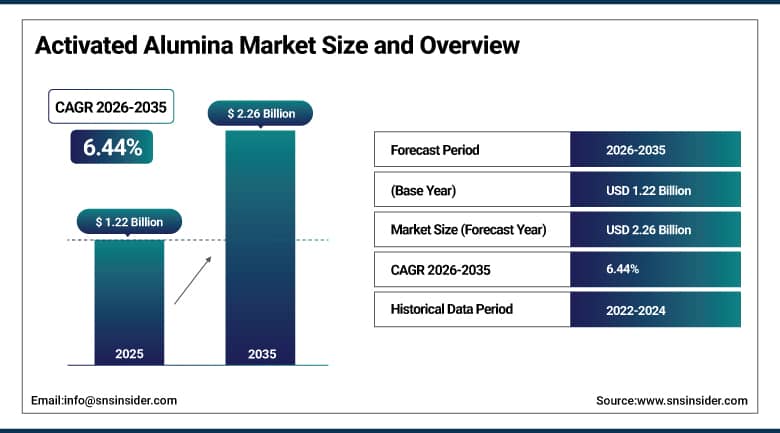
The Activated Alumina Market was valued at USD 1.22 billion in 2025 and is expected to reach USD 2.26 billion by 2035, growing at a CAGR of 6.44% from 2026–2035.
The activated alumina market is witnessing steady growth in the global market owing to the increasing demand for water purification solutions worldwide. The growing need for efficient adsorption and filtration materials is promoting the usage of activated alumina across various industries. Investments made by organizations in wastewater treatment infrastructure and environmental sustainability initiatives are contributing to market growth. Increasing developments in industrial processing and gas drying applications are playing a major role in driving the demand for activated alumina. Growth in chemical manufacturing activities and stringent water quality regulations are fueling the demand for activated alumina.
As per World Health Organization, at least two billion people around the world consume drinking water from sources which contain fecal matter contamination, while the concentration of fluoride beyond acceptable levels is found in groundwater reserves in many parts of the world.
According to United Nations, 73% of the world population enjoyed safely managed drinking water services in 2022. Activated alumina is extensively used for removal of contaminants like fluoride from water resources.
To Get More Information On Activated Alumina Market - Request Free Sample Report
Activated Alumina Market Trends:
-
Stricter fluoride contamination regulations in drinking water systems drive activated alumina adoption across municipal treatment facilities globally
-
Rising demand for high-purity industrial drying applications increases activated alumina usage in air separation and gas dehydration processes
-
Energy-saving processes in regeneration increase activated alumina efficiency in terms of its replacement by 25-30% within industrial applications
-
Increasing demands for hydrogen production and dehydration in refineries contribute to the increased demand for activated alumina
-
Integration of smart monitoring sensors in adsorption systems enhances efficiency tracking, optimizing activated alumina performance and operational uptime by 15–20%
-
Sustainability initiatives promote recycling and regeneration of activated alumina, reducing waste generation by 20–35% across industrial applications
U.S. Activated Alumina Market Size Outlook:
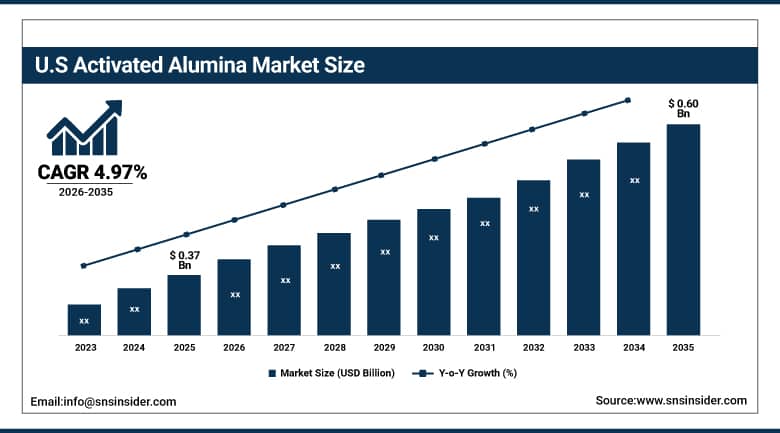
The U.S. Activated Alumina Market was valued at USD 0.37 billion in 2025 and is expected to reach around USD 0.60 billion by 2035, growing at a CAGR of 4.97% from 2026–2035.
The U.S. activated alumina market is growing consistently owing to increased demand in water treatment and air-drying applications. The usage of activated alumina in fluoride removal technology, catalyst support, and industrial desiccation processes has contributed to market growth in a consistent manner. Increased spending in the development of water purification plants has generated an increase in demand for efficient adsorbents. Development of chemical production facilities, oil & gas facilities, and pharmaceutical industries is further driving the demand for this product.
Under the regulations from the U.S. Environmental Protection Agency under the Safe Drinking Water Act, all community water systems that serve at least 25 people must satisfy the maximum contaminant levels, which include the fluoride level of 4.0 mg/L. The EPA's drinking water program addresses more than 150,000 public water systems across America, which serve the bulk of the American populace. Activated alumina is acknowledged by the EPA as a substance that can be used as an adsorbent of fluoride.
Activated Alumina Market Segment Analysis:
-
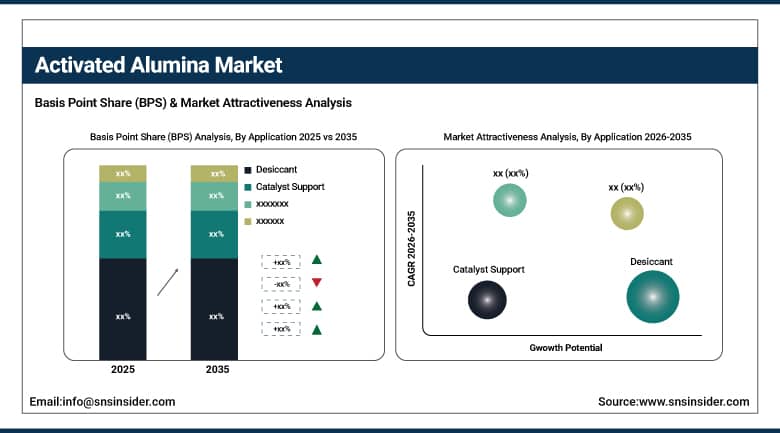
By Application, desiccant dominated the activated alumina market with 34.82% share in 2025; while catalyst support is the fastest growing segment with CAGR of 8.53% during 2026 to 2035.
-
By End Use, chemical industry dominated the activated alumina market with 36.48% share in 2025; while pharmaceutical industry is the fastest growing segment with CAGR of 9.53% during 2026 to 2035.
-
By Form, powder dominated the activated alumina market with 39.84% share in 2025; while pellets are the fastest growing segment with CAGR of 9.99% during 2026 to 2035.
-
By Type, activated alumina for water treatment dominated the activated alumina market with 38.52% share in 2025; while activated alumina for fluoride removal are the fastest growing segment with CAGR of 8.67% during 2026 to 2035.
By Application, desiccant dominated the Activated Alumina Market, while catalyst support is the fastest growing segment.
Desiccant segment captured the dominated market share based on revenue during the forecast period. This was attributed to increasing demand for moisture removal in applications such as industrial gas drying, air purification, and petrochemical processing. Activated alumina is extensively employed owing to high adsorption capacity and stability against heat. In addition, cost-effectiveness and longevity increase its usage in HVAC, compressed air drying, and dehydrating applications in various industries.
Catalyst support segment is expected to experience the fastest CAGR during the forecast period. The rising usage in applications such as petroleum refining, chemical synthesis, and emissions control will drive the market. Growth in the demand for catalytic action with enhanced stability and efficiency will favor usage in catalyst support applications. The growing investment in refinery modernization and clean fuel technologies will boost adoption.
By End Use, chemical industry dominated the Activated Alumina Market, while pharmaceutical industry is the fastest growing segment.
Chemical Industry Segment had the dominated revenue share in the activated alumina market in 2025. This is because of the increasing use of activated alumina in chemical processes. It acts as an adsorbent and a catalyst support in various refining operations. Other factors contributing to the increased usage of the product include its use in gas drying, dehydrating, and hydrogen peroxide production. The growing activities of chemical manufacturing and industrial processing continue driving demand.
Pharmaceutical Industry Segment is anticipated to witness fastest growth with CAGR from 2026 to 2035. The increase will be attributed to the rising need for highly pure filtration and drying agents in manufacturing medicines. Activated alumina finds widespread usage for purifying the raw material used for making medicines as well as eliminating impurities. In addition, increasing investments towards health care infrastructure and drug manufacturing capacity is fueling adoption.
By Form, powder dominated the Activated Alumina Market, while pellets are the fastest growing segment.
Powder Segment is expected to rule the activated alumina market with the dominated share in revenues earned in 2025. Factors like high surface area, high adsorbing efficiency, and availability in bulk quantities contribute to the dominance of the Powder Form. Powder form finds application in water treatment, desiccants, and catalyst support in various industries. The advantages associated with the Powder Form include cost-effectiveness, fast reaction rate, and usability in many purification systems. Industrial acceptance of the powder form and its flexibility make the segment dominant.
Pellet Segment is projected to experience the fastest CAGR between 2026 and 2035 owing to the advantages like higher mechanical strength, lesser pressure drop, and high longevity in industrial settings. Applications of Pellets include water treatment, air drying, and gas purification systems. Pellets exhibit improved flow characteristics and lower maintenance costs than powder. Increasing usage in the Chemical and Oil and Gas Industries makes this form popular among industries.
By Type, Activated Alumina for Water Treatment dominated the Activated Alumina Market, while Activated Alumina for Fluoride Removal is the fastest growing segment.
Activated Alumina for Water Treatment was the most dominant segment of the activated alumina market based on revenue generation in 2025. The main reason for its dominance is the extensive use of activated alumina in municipal and industrial water treatment plants. The increasing demand for clean water and stringent safety regulations have led to the increased use of this product in recent years. Its high efficacy rate in removing impurities and longer lifespan are also factors driving adoption.
The activated alumina for fluoride removal segment will witness the fastest CAGR during the forecast period, i.e., 2026 to 2035. The growth can be attributed to the rising problem of fluoride pollution in the groundwater supply around several regions. Growing health problems such as dental and skeletal fluorosis are causing a surge in demand. Government efforts to provide safe drinking water and water treatment in rural areas are further boosting market trends.
Regional Analysis:
|
Region |
Major Country |
Share within Region, 2025(%) |
|---|---|---|
|
North America |
United States |
86.42% |
|
Europe |
Germany |
26.10% |
|
Asia Pacific |
China |
41.20% |
|
Middle East & Africa |
UAE |
16.40% |
|
Latin America |
Brazil |
44.30% |
North America Activated Alumina Market Insights.
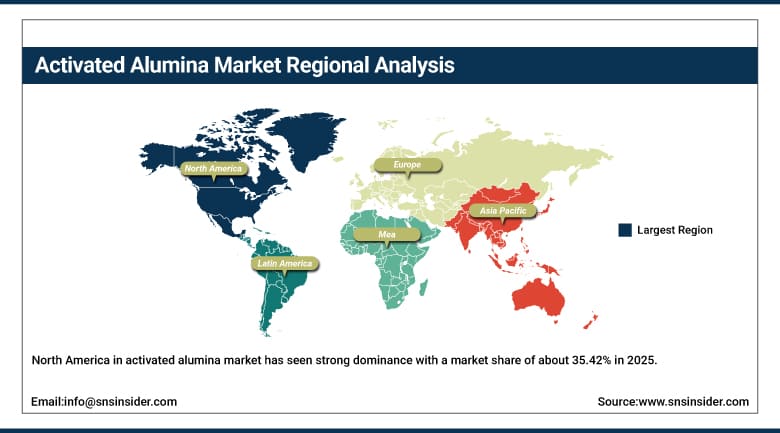
North America in activated alumina market has seen strong dominance with a market share of about 35.42% in 2025 due to robust water treatment investments. The region benefits from advanced industrial infrastructure and strict environmental regulations. Increasing demand for safe drinking water, air purification systems, and chemical processing applications is driving market expansion across the United States and Canada. Rising adoption in desiccant and fluoride removal applications is further supporting market leadership. Continuous government focus on clean water standards is strengthening market dominance.
According to US EPA Safe Drinking Water Act and drinking water statistics, about 85% of the US population receives water from community water systems serving 286 million people, with enforceable maximum contaminant level for fluoride set at 4 mg/L and secondary standard at 2 mg/L. Health Canada guidelines set fluoride at 1.5 mg/L. These regulatory thresholds drive deployment of activated alumina adsorption systems in North American water treatment facilities.
Get Customized Report as Per Your Business Requirement - Enquiry Now
Europe Activated Alumina Market Insights.
The Europe activated alumina market shows strong presence in 2025 due to strict environmental sustainability initiatives. Countries like Germany, France, United Kingdom, and Italy are key contributors to demand. High focus on water purification, industrial gas drying, and chemical processing applications is supporting steady market growth across the region. Increasing adoption in air treatment systems and catalyst support applications is further strengthening consumption. Expanding regulatory frameworks for clean water and emissions control is driving adoption.
According to the World Health Organization and United Nations Children’s Fund Joint Monitoring Programme, more than 95% of the population in Europe and Northern America has access to safely managed drinking water services.
As per the European Environment Agency, over 80% of urban wastewater in the European Union receives at least secondary treatment, with a rising share undergoing advanced purification processes. These measurable indicators support increasing adoption of adsorption-based filtration systems, including activated alumina applications for contaminant removal in water treatment infrastructure.
Asia Pacific Activated Alumina Market Insights.
Asia Pacific is positioned to register the fastest CAGR growth in the Activated Alumina market during the forecast period with a market share of about 8.27% in 2025. Rapid industrialization and urbanization are driving strong demand across China, India, Japan, South Korea, and Southeast Asia. Expanding water treatment infrastructure, chemical manufacturing, and oil and gas processing activities are significantly boosting adoption. Rising concerns over groundwater contamination and air purification needs are further accelerating market growth. Large scale infrastructure development supports strong regional demand.
According to UN-Water and World Health Organization, over 80% of global wastewater is discharged without adequate treatment, with rapidly urbanizing Asia-Pacific economies accounting for a majority share of municipal wastewater generation due to 60% of the world’s population residing in the region as per UN DESA. WHO sets maximum fluoride limit at 1.5 mg/L, and groundwater exceedances across multiple Asia-Pacific countries drive adoption of adsorption-based treatment systems using activated alumina in potable water infrastructure.
Middle East & Africa and Latin America Activated Alumina Market Insights.
The Middle East & Africa region along with Latin America is witnessing steady growth in the activated alumina market due to rising infrastructure development. Countries like UAE, Saudi Arabia, South Africa, Brazil, and Mexico are emerging as key demand centers. Increasing investments in water desalination, industrial processing, and oil and gas operations are supporting market expansion. Growing need for clean water access and air-drying applications is further boosting product adoption. Rising industrialization strengthens long term demand outlook.
According to United Nations DESA World Urbanization Prospects 2022, Latin America and the Caribbean has about 81% urban population, while Africa is about 43%, with Middle East higher around 64%. WHO reports 1.5 mg/L fluoride guideline for safe drinking water.
Market Dynamics:
Growth Drivers: Rising demand for clean water and strict global water quality regulations driving adoption across industries.
Increasing global focus on safe drinking water and wastewater treatment is significantly boosting activated alumina market growth. Strict government regulations on fluoride, arsenic, and industrial contaminants are increasing adoption in municipal and industrial water treatment systems. Growing urbanization and industrialization are intensifying water stress, leading to higher dependency on advanced adsorption materials. Expanding investments in water infrastructure projects across emerging and developed economies are further strengthening market demand. Continuous technological improvements in adsorption efficiency are also supporting widespread utilization across multiple end use sectors.
According to WHO/UNICEF Joint Monitoring Programme and UN-Water, 2.2 billion people lack safely managed drinking water services, and over 80% of global wastewater is discharged without adequate treatment, strengthening regulatory pressure under SDG 6 for universal access by 2030. The EU Drinking Water Directive and US EPA Safe Drinking Water Act set strict contaminant thresholds, driving adoption of adsorption-based purification technologies such as activated alumina in municipal and industrial water treatment, especially for fluoride and arsenic removal applications.
Restraints: Competition from alternative adsorbents and silica-based materials restricting widespread substitution across application areas.
Availability of alternative adsorbent materials such as silica gel, molecular sieves, and zeolites is creating competitive pressure in the market. These substitutes are often preferred in certain applications due to lower cost or specific performance advantages. In some industrial processes, switching costs and compatibility issues influence material selection decisions. Limited awareness in small scale industries also restricts adoption of activated alumina. Continuous innovation in alternative materials further challenges market penetration across cost sensitive and less regulated end use sectors.
Opportunities: Rising adoption in emerging economies and industrial modernization creating untapped market potential worldwide.
Rapid industrialization and urban development in emerging economies are generating strong demand for activated alumina. Expanding chemical, pharmaceutical, and energy sectors are increasing usage across multiple applications. Infrastructure development in Asia Pacific, Latin America, and Middle East regions is opening new growth avenues. Increasing focus on energy efficiency and environmental compliance is further supporting adoption. Growing awareness about water safety and air quality improvement is expected to unlock significant untapped opportunities across developing industrial markets.
As per UN DESA, the proportion of the world’s population living in urban areas is expected to rise to 68% by 2050, which in turn increases the water treatment needs of industries. FAO’s AQUASTAT estimates that industries consume around 19% of total freshwater withdrawals globally.
Recent Developments:
-
2026: BASF SE supported expanded activated alumina demand through integrated catalyst and adsorption systems aligned with global refinery decarbonization projects and hydrogen purification applications.
-
2024: Axens SA strengthened refinery catalyst and adsorption portfolio integration supporting hydrogen purification and gas treatment technology deployments worldwide.
-
2025: Honeywell International Inc. advanced UOP digital twin and modular dehydration systems for refinery decarbonization and process efficiency improvement.
-
2024: Nabaltec AG launched CO₂-reduced specialty alumina product line while advancing debottlenecking expansion at Schwandorf manufacturing facility Germany.
Activated Alumina Market Key Players are:
-
BASF SE
-
Honeywell International Inc.
-
Axens SA
-
Sorbead India
-
Huber Engineered Materials
-
CHALCO Shandong Advanced Material Co., Ltd.
-
Jiangsu Jingjing New Material Co., Ltd.
-
Shandong Zhongxin New Material Technology Co., Ltd.
-
AGC Chemicals Pvt. Ltd.
-
Almatis GmbH
-
Porocel International LLC
-
Sumitomo Chemical Co., Ltd.
-
Nabaltec AG
-
Shandong Boyang New Materials Co., Ltd.
-
Dynamic Adsorbents Inc.
-
Gongyi City Beishankou Water Purifying Materials Co., Ltd.
-
SASOL Limited
-
KNT Group
-
Activated Alumina Products Pvt. Ltd.
-
Pingxiang Xingfeng Chemical Packing Co., Ltd.
Activated Alumina Market Report Scope:
| Report Attributes | Details |
|---|---|
| Market Size in 2025 | USD 1.22 Billion |
| Market Size by 2035 | USD 2.26 Billion |
| CAGR | CAGR of 6.44% From 2026 to 2035 |
| Base Year | 2025 |
| Forecast Period | 2026-2035 |
| Historical Data | 2022-2024 |
| Report Scope & Coverage | Market Size, Segments Analysis, Competitive Landscape, Regional Analysis, DROC & SWOT Analysis, Forecast Outlook |
| Key Segments | • By Application (Desiccant, Catalyst Support, Fluoride Adsorbent, Water Treatment, Air Treatment) • By End Use (Chemical Industry, Pharmaceutical Industry, Food and Beverage Industry, Oil and Gas Industry, Water Treatment Facilities) • By Form (Powder, Granular, Pellets, Beads) • By Type (Activated Alumina for Fluoride Removal, Activated Alumina for Water Treatment, Activated Alumina for Air Drying, Activated Alumina for Catalyst Support) |
| Regional Analysis/Coverage | North America (US, Canada), Europe (Germany, UK, France, Italy, Spain, Russia, Poland, Rest of Europe), Asia Pacific (China, India, Japan, South Korea, Australia, ASEAN Countries, Rest of Asia Pacific), Middle East & Africa (UAE, Saudi Arabia, Qatar, South Africa, Rest of Middle East & Africa), Latin America (Brazil, Argentina, Mexico, Colombia, Rest of Latin America). |
| Company Profiles | BASF SE, Honeywell International Inc., Axens SA, Sorbead India, Huber Engineered Materials, CHALCO Shandong Advanced Material Co., Ltd., Jiangsu Jingjing New Material Co., Ltd., Shandong Zhongxin New Material Technology Co., Ltd., AGC Chemicals Pvt. Ltd., Almatis GmbH, Porocel International LLC, Sumitomo Chemical Co., Ltd., Nabaltec AG, Shandong Boyang New Materials Co., Ltd., Dynamic Adsorbents Inc., Gongyi City Beishankou Water Purifying Materials Co., Ltd., SASOL Limited, KNT Group, Activated Alumina Products Pvt. Ltd., Pingxiang Xingfeng Chemical Packing Co., Ltd. |
Frequently Asked Questions
The activated alumina market is expected to grow at a CAGR of 6.44% from 2026 to 2035.
The activated alumina market was valued at USD 1.22 billion in 2025.
Rising demand for clean water, strict water quality regulations, and increasing industrial adsorption applications are driving global activated alumina demand.
Rising demand for clean water, strict water quality regulations, and increasing industrial adsorption applications are driving global activated alumina demand.
Activated alumina for water treatment dominated the market in 2025 due to strong adoption in municipal and industrial purification systems.
North America dominated the activated alumina market due to rapid industrialization, strong water treatment infrastructure development, and high chemical industry demand.
