
AI Productivity Tools Market Report Scope & Overview:
The AI Productivity Tools Market has been constantly growing due to an increased use of AI-based automation, analytics, and collaboration solutions in enterprises. In addition, there is a rise in demand for optimization of workflows, decision making and efficiency, driven by the cloud deployment, integration with project management and CRM systems, and increasing digital transformation efforts. AI productivity tools are the software solutions that make use of artificial intelligence in order to automate repetitive tasks, optimize workflows, and help make decisions based on data. Such products, which include virtual assistants, robotic process automation platforms, and analytics software, are delivered to the user through cloud or hybrid delivery environment with minimal manual effort involved.
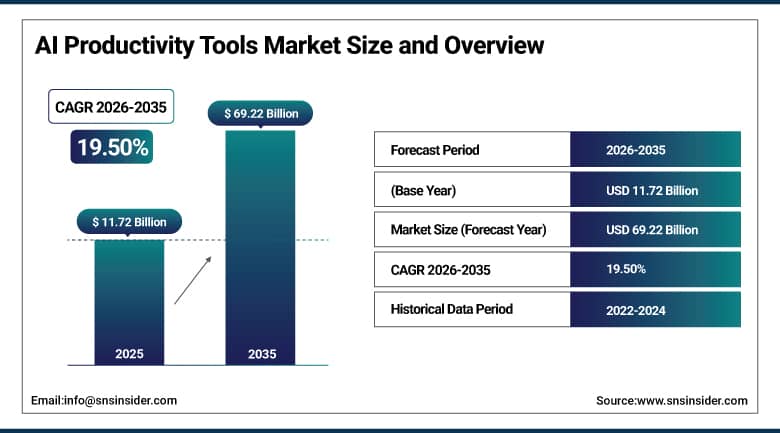
The AI Productivity Tools Market was valued at USD 11.72 Billion in 2025 and is expected to reach USD 69.22 Billion by 2035, growing at a CAGR of 19.50% from 2026 to 2035.
For instance, Microsoft reported over 400 million paid Copilot users across its productivity suite as of early 2026, with 70% of Fortune 500 companies leveraging it for enhanced decision-making, while Google Workspace’s Gemini AI tools reached 1 billion monthly active users in 2025, improving collaboration through real-time analytics and CRM integrations such as Salesforce.
To Get more information on AI Productivity Tools Market - Request Free Sample Report
AI Productivity Tools Market Trends
-
Rising demand for automation and efficiency in workplaces is driving the AI productivity tools market.
-
Growing adoption of AI-powered assistants, workflow automation, and task management solutions is boosting market growth.
-
Expansion across IT, BFSI, healthcare, and corporate sectors is fueling deployment.
-
Increasing focus on collaboration, time management, and data-driven decision-making is shaping adoption trends.
-
Advancements in NLP, machine learning, and predictive analytics are enhancing tool intelligence and usability.
-
Rising need for remote work enablement and digital transformation is supporting market expansion.
-
Collaborations between software vendors, enterprises, and AI technology providers are accelerating innovation and global adoption.
Key Market Highlights
|
Market Parameter |
Market Highlight / Data |
Key Growth Driver |
|---|---|---|
|
Largest Revenue Model |
Subscription based – 55.00% share in 2025 |
Predictable recurring payments, continuous updates, and cost efficiency for cloud-based tools. |
|
Fastest-Growing Revenue Model |
Usage based / Pay per use – CAGR |
Flexible pricing, lower upfront costs, and scalable experimentation across enterprises. |
|
Largest Tool Type |
Data Analytics Tools – 31.00% share in 2025 |
High demand for actionable insights, predictive analytics, and data-driven decision-making. |
|
Fastest-Growing Tool Type |
Code Generation Tools – CAGR |
Automated coding, faster development cycles, and reduced manual effort. |
|
Largest Offering |
Data Analytics – 26.00% share in 2025 |
Priority on analyzing large datasets to optimize processes and business strategies. |
|
Fastest-Growing Offering |
RPA – CAGR |
Rising adoption of automation to streamline repetitive tasks and reduce errors. |
|
Largest Industry Vertical |
Finance – 25.00% share in 2025 |
Extensive adoption for predictive analytics, fraud detection, risk management, and automation. |
|
Fastest-Growing Industry Vertical |
Healthcare – CAGR |
Increasing AI adoption in patient care, diagnostics, drug discovery, and hospital operations. |
|
Largest Deployment Model |
Cloud based – 65.00% share in 2025 |
Flexibility, scalability, real-time collaboration, and lower upfront infrastructure costs. |
|
Fastest-Growing Deployment Model |
Cloud based – CAGR |
Remote work adoption, digital transformation, and enhanced security and accessibility features. |
|
Largest Region |
North America – 36.00% share in 2025 |
Advanced technological infrastructure and widespread integration of AI in enterprises. |
|
Fastest-Growing Region |
Asia Pacific – 21.21% CAGR |
Rapid digital transformation, rising internet penetration, and growing SME adoption. |
U.S. AI Productivity Tools Market Outlook
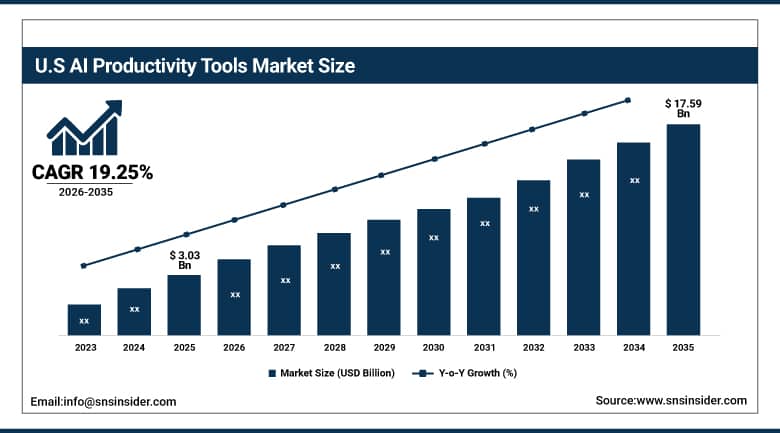
The U.S. AI Productivity Tools Market was valued at USD 3.03 billion in 2025 and is expected to reach USD 17.59 billion by 2035, growing at a CAGR of 19.25% from 2026-2035.
The U.S. AI Productivity Tools Market is growing due to increasing adoption of AI-driven automation, data analytics, and cloud-based collaboration tools, rising digital transformation initiatives, and high demand for efficiency, productivity, and decision-making optimization across enterprises.
According to PwC, agentic AI workflows are boosting productivity by up to 40% in U.S. digital firms through integrations with CRM systems and project management tools, demonstrating the tangible impact of AI on operational efficiency and enterprise performance.
Growth Drivers: Increasing adoption of AI-powered tools across businesses is accelerating efficiency, automation, and data-driven decision-making globally
Organizations are increasingly leveraging AI productivity tools to automate repetitive tasks, streamline workflows, and enhance collaboration. These tools, including virtual assistants, RPA platforms, and data analytics software, reduce human error and improve operational efficiency. The integration of AI into project management, customer relationship management, and document processing enables faster insights and better decision-making. Rising demand from SMEs and large enterprises, combined with growing awareness of AI benefits, drives widespread adoption. Businesses are investing in cloud-based and hybrid AI solutions, promoting scalability, cost-efficiency, and improved productivity across diverse industry verticals worldwide.
For example, Lloyds Banking Group saves 46 minutes per worker daily using Copilot’s Work IQ layer in targeted teams, reducing document processing errors.
Azure OpenAI empowers over 60,000 enterprises with custom AI tools for faster insights and operational efficiency.
Restraints: Concerns regarding data privacy, security, and regulatory compliance are restraining AI productivity tools market adoption
AI productivity tools often process sensitive business data, including customer information and financial records. Organizations worry about potential data breaches, unauthorized access, and compliance violations with global regulations such as GDPR. Cloud-based solutions, while convenient, raise additional security concerns. Fear of reputational damage and legal liabilities may prevent companies from fully adopting AI tools. Vendors need to ensure robust encryption, secure storage, and compliance certifications. These privacy and security apprehensions limit the willingness of businesses to integrate AI solutions, restraining market growth even as demand for automation and AI-driven insights continues to rise.
Highlighting these risks, over 20% of files uploaded to generative AI tools contain sensitive corporate data, with 4% of prompts exposing proprietary information, increasing breach risks in RPA and analytics workflows.
Nearly 19% of AI transactions were blocked by enterprise security during 2024–2025 monitoring, and 94.4% of large language models remain vulnerable to prompt injection, enabling data exfiltration from CRM-integrated assistants.
Opportunities: Expansion of cloud-based AI productivity solutions presents significant growth potential for global businesses seeking scalable tools
Cloud-based AI productivity tools enable remote access, collaboration, and seamless updates across organizations of all sizes. Businesses increasingly prefer subscription-based or usage-based models that reduce upfront costs while ensuring scalability. Integration with collaboration platforms, CRM systems, and analytics dashboards enhances workflow efficiency and data-driven decision-making. Rising adoption of remote work and digital transformation initiatives provides opportunities for AI vendors to offer tailored solutions for SMEs and large enterprises. Continuous development in cloud infrastructure and AI algorithms presents significant market opportunities to expand product offerings and drive global adoption of AI productivity tools.
AI Productivity Tools Market Segment Analysis
-
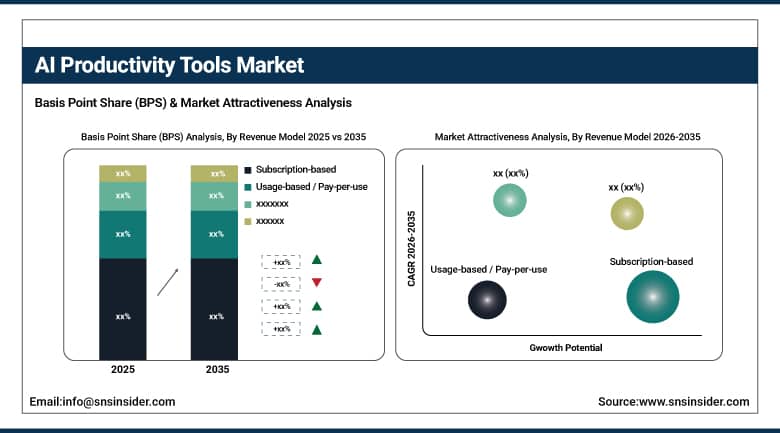
By Revenue Model, Subscription based dominated with ~55% share in 2025; Usage based / Pay per use fastest growing (CAGR).
-
By Tool Type, Data Analytics Tools dominated with ~31% share in 2025; Code Generation Tools fastest growing (CAGR).
-
By Offering, Data Analytics dominated with ~26% share in 2025; RPA fastest growing (CAGR).
-
By Industry Vertical, Finance dominated with ~25% share in 2025; Healthcare fastest growing (CAGR).
-
By Deployment Model, Cloud based dominated with ~65% share in 2025; Cloud based fastest growing (CAGR).
By Revenue Model, Subscription-based segment dominates the Market, Usage-based / Pay-per-use segment is expected to grow fastest
Subscription-based segment dominated the AI Productivity Tools Market in 2025 as businesses prefer predictable recurring payment models for cloud-based AI tools. These models provide continuous updates, scalability, and cost efficiency, making adoption easier for enterprises of all sizes, thereby increasing market penetration and ensuring long-term engagement with AI productivity solutions worldwide.
Usage-based / Pay-per-use segment is expected to grow fastest from 2026-2035 as organizations adopt flexible pricing models that charge according to actual usage. This approach reduces upfront costs, encourages SMEs and large enterprises to experiment with AI tools, and allows scalable deployment, fueling growth and broader adoption of AI productivity solutions globally.
By Tool Type, Data Analytics Tools segment dominates the Market, Code Generation Tools segment is expected to grow fastest
Data Analytics Tools segment dominated the AI Productivity Tools Market in 2025 due to high demand for actionable insights, predictive analytics, and data-driven decision-making. Integration with business intelligence, cloud platforms, and reporting tools enhances operational efficiency, simplifies analysis, and supports strategic planning, driving widespread adoption across enterprises seeking better decision-making and competitive advantage.
Code Generation Tools segment is expected to grow fastest from 2026-2035 as developers increasingly adopt AI to automate coding tasks, accelerate software development, and reduce manual effort. The demand for faster, error-free code, combined with AI-powered development platforms, drives productivity, innovation, and efficiency across industries, making code generation tools a rapidly expanding market segment.
By Industry Vertical, Finance segment dominates the Market, Healthcare segment is expected to grow fastest
Finance segment dominated the AI Productivity Tools Market in 2025 due to extensive adoption of AI for predictive analytics, fraud detection, risk management, and operational automation. These tools enhance efficiency, reduce errors, and optimize decision-making, making the finance sector a leading consumer of AI productivity tools globally, driving high market share and revenue.
Healthcare segment is expected to grow fastest from 2026-2035 as AI adoption increases in patient care, diagnostics, drug discovery, and hospital operations. AI productivity tools improve accuracy, efficiency, and decision-making, supporting personalized medicine and research. Rising demand for innovative healthcare solutions accelerates market growth and creates significant opportunities for AI tool providers.
By Offering, Data Analytics segment dominates the AI Productivity Tools Market RPA segment is expected to grow fastest
Data Analytics segment dominated the AI Productivity Tools Market in 2025 because organizations prioritize analyzing large datasets to optimize processes and improve business strategies. Advanced analytics tools with AI integration provide faster insights, trend forecasting, and better decision-making, supporting operational efficiency and strategic planning, thereby enhancing overall adoption and market share globally.
RPA segment is expected to grow fastest from 2026-2035 due to rising enterprise adoption of automation technologies to streamline repetitive tasks, reduce errors, and improve efficiency. AI-enabled RPA tools enhance productivity across finance, IT, healthcare, and manufacturing sectors, creating cost savings, freeing human resources for higher-value tasks, and driving rapid market expansion.
By Deployment Model, Cloud-based segment dominates the Market and is expected to grow fastest
Cloud-based segment dominated the AI Productivity Tools Market in 2025 due to its flexibility, scalability, and ease of access for businesses of all sizes. Organizations prefer cloud deployment for real-time collaboration, seamless updates, and lower upfront infrastructure costs. The segment is expected to grow fastest from 2026-2035 as enterprises increasingly adopt remote work, digital transformation, and AI-powered tools. Enhanced security features, integration with other software, and global accessibility further drive adoption, making cloud solutions the preferred choice for AI productivity tools.
Regional Insights
North America AI Productivity Tools Market Insights
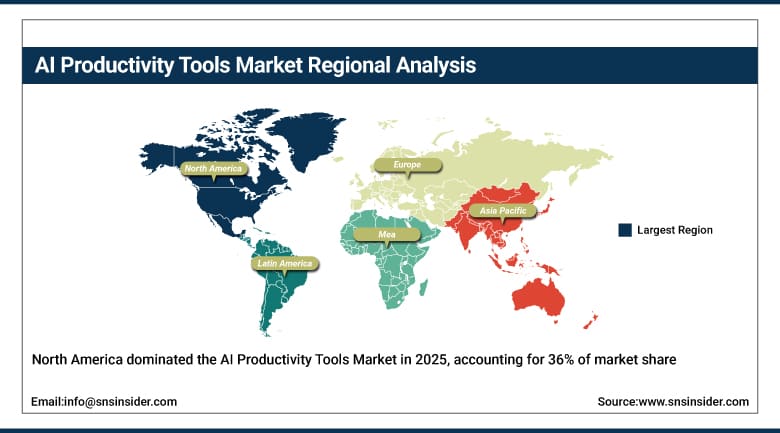
North America dominated the AI Productivity Tools Market with the highest revenue share of about 36% in 2025 due to advanced technological infrastructure, high digital adoption, and widespread integration of AI in enterprises. Strong presence of major technology companies, robust cloud services, and high investment in AI-driven productivity solutions drive market dominance. Organizations increasingly adopt AI tools for automation, analytics, and workflow optimization, further enhancing efficiency, decision-making, and competitiveness, making North America the leading region in the AI productivity tools market.
Get Customized Report as per Your Business Requirement - Enquiry Now
Asia Pacific AI Productivity Tools Market Insights
Asia Pacific segment is expected to grow at the fastest CAGR of about 21.21% from 2026-2035 due to rapid digital transformation, increasing internet penetration, and rising adoption of AI tools among SMEs and large enterprises. Governments’ focus on technology and innovation, combined with a growing skilled workforce and expanding IT infrastructure, supports AI productivity tool deployment. Rising demand for cloud-based solutions, automation, and data analytics further fuels growth, positioning Asia Pacific as the fastest-growing region globally.
Europe AI Productivity Tools Market Insights
Europe in the AI Productivity Tools Market is witnessing steady growth due to high adoption of AI-driven solutions across enterprises. Strong focus on digital transformation, data analytics, and workflow automation drives demand. Presence of established technology providers, supportive regulatory frameworks, and increasing investments in AI tools for project management, customer relationship management, and productivity enhancement further contribute to Europe’s market expansion.
Middle East & Africa and Latin America AI Productivity Tools Market Insights
The Middle East & Africa and Latin America AI Productivity Tools Market is growing steadily due to increasing digital transformation and adoption of AI solutions across enterprises. Rising demand for workflow automation, data analytics, and cloud-based productivity tools, combined with improving IT infrastructure, growing internet penetration, and supportive government initiatives, is driving market expansion in these regions.
AI Productivity Tools Market Competitive Landscape:
Salesforce, Inc.
Salesforce is a leading cloud-based CRM and enterprise software provider, focused on streamlining sales, marketing, service, and collaboration processes. Leveraging AI, Salesforce integrates intelligent automation, conversational assistants, and predictive analytics to improve productivity, efficiency, and customer engagement. Its platforms, including Customer 360 and Slack integrations, enable organizations to optimize workflows, make data-driven decisions, and enhance user experiences. Salesforce continuously innovates in AI-driven solutions to transform enterprise operations and enable smarter, automated business processes worldwide.
-
2023: Salesforce launched the next-generation Einstein Copilot, a conversational AI assistant built into its CRM, helping users automate tasks and gain actionable insights within daily workflows.
-
2025: Salesforce expanded its Agentforce platform, embedding AI agents for smarter automation and insights across Sales, Service, Slack, and Customer 360 enterprise applications.
Microsoft Corporation
Microsoft is a global technology leader providing software, cloud, and productivity solutions. Its Office suite, Teams, and cloud services integrate AI to enhance workflow efficiency, collaboration, and decision-making. Microsoft leverages AI for natural language processing, automation, and intelligent assistance, supporting enterprises in document management, data analysis, and communication. The company continues to expand AI capabilities across its productivity ecosystem, including Word, Excel, and PowerPoint, enabling businesses to accelerate operations and optimize workforce productivity using advanced AI-driven tools.
-
2024: Microsoft announced Copilot Pages and AI productivity enhancements for Word, Excel, and PowerPoint, enabling collaborative AI-assisted workflows across its core Office applications.
-
2025: Microsoft expanded AI productivity with enhanced Copilot features, including Agent Mode and Office Agent for smarter, natural-language workflows in Word and Excel.
Google LLC
Google develops cloud-based software, AI solutions, and productivity tools that enhance collaboration, research, and content creation. Google Workspace integrates AI-powered features such as Gmail, Docs, Sheets, and NotebookLM to automate tasks, improve decision-making, and accelerate workflows. Its AI-first approach emphasizes natural language understanding, multimodal reasoning, and contextual insights. Google focuses on democratizing AI for businesses, empowering teams with smarter, more efficient productivity tools, while continually enhancing research, note-taking, and knowledge synthesis through advanced AI technology.
-
2024: NotebookLM launched as an AI-first research and note tool, grounded in user documents to help synthesize insights and accelerate writing productivity.
-
2025: Google announced AI in Workspace is now included in all Business and Enterprise plans, integrating Gemini-powered tools in Gmail, Docs, Sheets, and NotebookLM.
OpenAI
OpenAI is a leading artificial intelligence research and deployment organization focused on creating general-purpose AI systems for productivity, creativity, and reasoning. Its GPT models provide natural language understanding, multimodal capabilities, and task automation. OpenAI develops AI agents, workflow automation tools, and platform integrations that improve efficiency for individuals and enterprises. Its solutions, such as ChatGPT and GPT‑4o, empower users to perform complex research, scheduling, content creation, and decision-making with advanced AI, supporting innovative, intelligent, and scalable productivity workflows globally.
-
2025: OpenAI released GPT‑4o and o3/o4‑mini upgrades, enabling deeper reasoning, multimodal understanding, and tool usage for complex productivity tasks across multiple domains.
-
2025: OpenAI introduced the ChatGPT Agent, automating workflows like scheduling, research, and presentations through multi-step task execution and AI-driven decision support.
Adobe Inc.
Adobe is a global software company specializing in creative, design, and digital document solutions. Its suite, including Photoshop, Illustrator, Acrobat, and Adobe Express, empowers users to design, edit, and collaborate efficiently. Adobe integrates AI features through generative AI and workflow assistants, enabling smarter image editing, graphic design, and PDF management. By embedding AI into productivity platforms, Adobe enhances creativity, automation, and operational efficiency, supporting individuals and enterprises in achieving faster, higher-quality outputs in digital content and creative projects.
-
2025: Adobe launched Photoshop, Adobe Express, and Acrobat inside ChatGPT, allowing users to edit images, design graphics, and manage PDFs directly through a conversational interface.
Key Players
-
Google LLC
-
OpenAI
-
Anthropic
-
Adobe Inc.
-
Salesforce Inc.
-
International Business Machines Corporation (IBM)
-
Notion Labs Inc.
-
Zapier Inc.
-
Jasper AI Inc.
-
ClickUp
-
Asana Inc.
-
Slack Technologies (Salesforce)
-
Atlassian
-
Otter.ai
-
Descript
-
Midjourney
-
Runway
-
Perplexity AI
| Report Attributes | Details |
|---|---|
| Market Size in 2025 | USD 11.72 Billion |
| Market Size by 2035 | USD 69.22 Billion |
| CAGR | CAGR of 19.50% From 2026 to 2035 |
| Base Year | 2025 |
| Forecast Period | 2026-2035 |
| Historical Data | 2022-2024 |
| Report Scope & Coverage | Market Size, Segments Analysis, Competitive Landscape, Regional Analysis, DROC & SWOT Analysis, Forecast Outlook |
| Key Segments | • By Tool Type (Code Generation Tools, Natural Language Processing Tools, Data Analytics Tools, Project Management Tools, Customer Relationship Management Tools) • By Revenue Model (Subscription-based, License-based / One-time license, Usage-based / Pay-per-use) • By Deployment Model (Cloud-based, On-premises, Hybrid) • By Industry Vertical (Healthcare, Finance, Manufacturing, Retail, IT and Telecom) • By Offering (Virtual Assistants, Document Management, RPA, Data Analytics, Others) |
| Regional Analysis/Coverage | North America (US, Canada), Europe (Germany, UK, France, Italy, Spain, Russia, Poland, Rest of Europe), Asia Pacific (China, India, Japan, South Korea, Australia, ASEAN Countries, Rest of Asia Pacific), Middle East & Africa (UAE, Saudi Arabia, Qatar, South Africa, Rest of Middle East & Africa), Latin America (Brazil, Argentina, Mexico, Colombia, Rest of Latin America). |
| Company Profiles | Microsoft, Google LLC, OpenAI, Anthropic, Adobe Inc., Salesforce Inc., International Business Machines Corporation (IBM), Notion Labs Inc., Zapier Inc., Grammarly Inc., Jasper AI Inc., ClickUp, Asana Inc., Slack Technologies (Salesforce), Atlassian, Otter.ai, Descript, Midjourney, Runway, Perplexity AI |
Frequently Asked Questions
The AI Productivity Tools Market is expected to grow at a CAGR of 19.50% from 2026 to 2035.
The AI Productivity Tools Market was valued at USD 11.72 billion in 2025.
Increasing adoption of AI-powered tools across businesses is accelerating efficiency, automation, and data-driven decision-making globally,
The Data Analytics Tools segment dominated the AI Productivity Tools Market in 2025.
North America dominated the AI Productivity Tools Market in 2025.
