
Smart Toys Market Report Scope & Overview:
The Smart Toys market is witnessing continuous growth owing to the increasing demand for interactive and educational toys that combine learning with entertainment around the globe. Moreover, the growth can be attributed to the rising adoption of AI, robotics, and app-connected play coupled with the growing focus on STEM education, skill development, and cognitive enhancement. The smart toys are technologically advanced play devices used by children to obtain engaging and educational experiences. The experiences obtained are delivered through connected apps, sensors, and voice-enabled features without the use of traditional play methods that can limit learning.
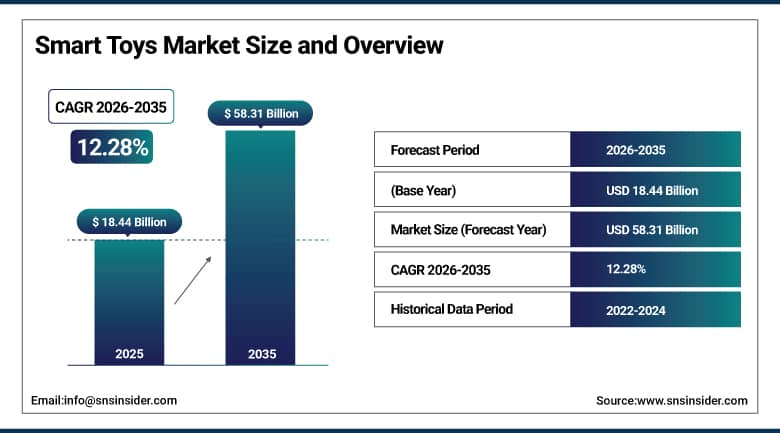
The Smart Toys Market was valued at USD 18.44 Billion in 2025 and is expected to reach USD 58.31 Billion by 2035, growing at a CAGR of 12.28% from 2026 to 2035.
For instance, LEGO’s AI-powered Spike Prime kits integrate robotics with app-based coding and are used in over 100 countries, supporting K–12 STEM curricula and enhancing hands-on learning experiences.
To Get more information on Smart Toys Market - Request Free Sample Report
Smart Toys Market Trends
-
Rising demand for interactive and educational toys is driving the smart toys market.
-
Growing adoption of AI, IoT, and voice-enabled technologies is enhancing play-based learning experiences.
-
Expansion across preschool, early learning, and STEM-focused segments is boosting market growth.
-
Increasing focus on child safety, personalization, and cognitive development is shaping adoption trends.
-
Advancements in AR/VR integration, sensors, and connectivity features are improving engagement and functionality.
-
Rising disposable income and parental spending on educational entertainment are supporting market expansion.
-
Collaborations between toy manufacturers, tech developers, and educational content providers are accelerating innovation and global deployment.
Key Market Highlights
|
Market Parameter |
Market Highlight / Data |
Key Growth Driver |
|---|---|---|
|
Largest Type |
Interactive Games – 60.00% share in 2025 |
High demand for engaging, fun, and app-integrated play experiences among children. |
|
Fastest-Growing Type |
Educational Robots – fastest CAGR |
Increasing focus on STEM learning, coding skills, and problem-solving among children. |
|
Largest End User |
School-going – 39.00% share in 2025 |
Rising focus on skill development, STEM education, and problem-solving activities. |
|
Fastest-Growing End User |
School-going – fastest CAGR |
Increasing adoption of educational and AI-enabled toys in schools and homes. |
|
Largest Technology |
Wi-Fi – 45.00% share in 2025 |
Real-time connectivity, interactive features, and app integration enhancing play experiences. |
|
Fastest-Growing Technology |
Wi-Fi – fastest CAGR |
Rising internet penetration, smart device adoption, and demand for connected play. |
|
Largest Distribution Channel |
Online/E-commerce Stores – 58.00% share in 2025 |
Convenience, wide product selection, competitive pricing, and easy comparison options. |
|
Fastest-Growing Distribution Channel |
Online/E-commerce Stores – fastest CAGR |
Rising digital penetration, e-commerce expansion, and strengthened online brand presence. |
|
Largest Region |
North America – 38.00% share in 2025 |
High disposable income and strong awareness of educational and interactive toys. |
|
Fastest-Growing Region |
Asia Pacific – 13.71% CAGR |
Rapid urbanization, rising disposable income, and growing smartphone penetration. |
U.S. Smart Toys Market Outlook
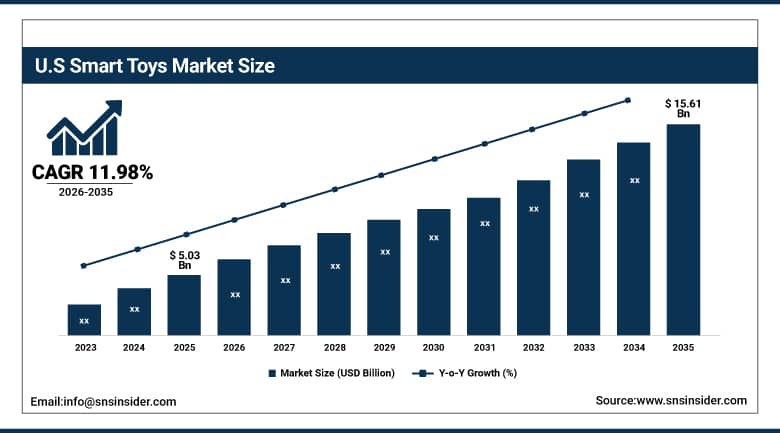
The U.S. Smart Toys Market was valued at USD 5.03 billion in 2025 and is expected to reach USD 15.61 billion by 2035, growing at a CAGR of 11.98% from 2026-2035.
The U.S. Smart Toys Market is growing due to rising demand for AI-enabled, interactive, and educational toys, increasing focus on STEM learning, and widespread adoption of connected devices and e-commerce platforms enhancing accessibility and engagement.
Smart Toys Market Growth Drivers:
-
Rising adoption of AI and robotics in toys is driving enhanced engagement and personalized learning experiences among children globally
Smart toys are increasingly integrating AI, robotics, and connectivity, providing interactive, adaptive, and educational play experiences. Parents are seeking toys that enhance cognitive skills, problem-solving, and creativity, making AI-driven smart toys more appealing. The growing popularity of STEM and STEAM-based learning at early ages further boosts demand. Additionally, smartphones and companion apps enable real-time interaction, content updates, and gamified learning. This integration of technology in play ensures long-term engagement, increased educational value, and customization, positioning smart toys as both entertainment and learning tools for children globally, fueling consistent market growth.
For example, LEGO’s Spike Essential robotics kit introduces AI coding for children aged 6+, with app updates providing personalized challenges in classrooms worldwide, while Sphero Mini robots offer a 2-hour battery life and integrate STEAM curricula via Bluetooth apps, supporting extended, hands-on learning experiences.
Smart Toys Market Restraints:
-
Concerns about data privacy and safety are hindering widespread adoption of connected smart toys among children
Connected smart toys often collect personal data, interact with apps, and connect via Wi-Fi or Bluetooth, raising parental concerns regarding privacy and cybersecurity. Fear of unauthorized access, hacking, or misuse of children’s data discourages adoption. Regulatory compliance and data protection laws add complexity for manufacturers, potentially limiting product launches in certain regions. Parents may prefer traditional toys over connected devices due to these safety concerns. Consequently, stringent privacy expectations and perceived risks associated with smart toys restrain market growth, even as technological innovation increases, requiring manufacturers to invest in secure systems and transparent data handling.
The FTC enforces COPPA on smart toys that collect data from children without parental consent, imposing fines of up to USD 40,000 per violation.
Notably, VTech’s 2015 data breach exposed sensitive information of 6 million children and 4 million parents globally, highlighting the critical need for stringent data privacy and security measures in AI-powered and connected toys.
Smart Toys Market Opportunities:
-
Expansion of IoT-enabled and app-connected smart toys presents massive growth potential in global children’s entertainment segments
The proliferation of Internet of Things (IoT) technology allows toys to interact with mobile apps, cloud platforms, and other smart devices. This connectivity enables personalized experiences, real-time updates, and gamified learning, appealing to both children and parents. The integration of augmented reality (AR), voice recognition, and AI further enhances play value. Emerging markets with increasing internet penetration and disposable income offer significant untapped potential. Companies can leverage these trends to develop subscription-based content, educational modules, and interactive games, creating recurring revenue streams while expanding market share and attracting tech-savvy, modern consumers worldwide.
Smart Toys Market Segment Highlights
-
By Type, Interactive Games dominated with ~60% share in 2025; Educational Robots fastest growing (CAGR).
-
By End-User, School-going segment dominated with ~39% share in 2025; School-going fastest growing (CAGR).
-
By Technology, Wi-Fi segment dominated with ~45% share in 2025; Wi-Fi fastest growing (CAGR).
-
By Distribution Channel, Online/E-commerce Stores segment dominated with ~58% share in 2025; Online/E-commerce Stores fastest growing (CAGR).
Smart Toys Market Segment Analysis
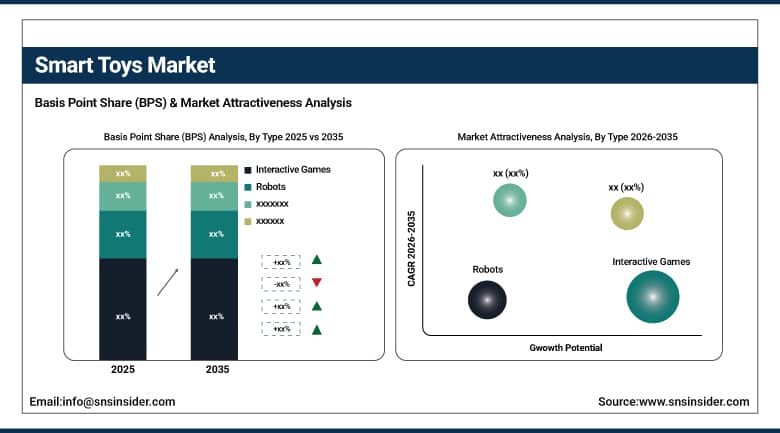
By Type, Interactive Games dominates the Market, Educational Robots segment is expected to grow fastest
Interactive Games segment dominated the Smart Toys Market in 2025 due to high consumer demand for engaging, fun, and app-integrated play experiences. These toys offer interactive storytelling, gamification, and connectivity with mobile devices, keeping children entertained for longer periods while providing social and cognitive engagement, driving higher adoption and revenue.
Educational Robots segment is expected to grow at the fastest CAGR from 2026-2035 owing to increasing focus on STEM learning, coding skills, and problem-solving among children. Rising parental preference for educational development, integration with AI and robotics, and adoption in schools and learning centers are fueling demand, making educational robots a rapidly expanding segment in the smart toys market.
By End-User, School-going segment dominates the Market and is expected to grow fastest
School-going segment dominated the Smart Toys Market in 2025 as children in this age group seek advanced learning, coding, and interactive play experiences. Rising focus on skill development, STEM education, and problem-solving activities drives demand. The segment is expected to grow fastest from 2026-2035 due to increasing adoption of educational and AI-enabled toys in schools and homes, coupled with parental preference for toys that combine entertainment with learning, enhancing cognitive and social skills.
By Technology, Wi-Fi segment dominates the Market and is expected to grow fastest
Wi-Fi segment dominated the Smart Toys Market in 2025 because it enables real-time connectivity, interactive features, and app integration, enhancing play experiences. Continuous content updates, multiplayer gaming, and remote learning functionalities make Wi-Fi-enabled toys highly preferred. The segment is expected to grow fastest from 2026-2035 as rising internet penetration, smart device adoption, and demand for connected, interactive play increase globally, encouraging manufacturers to focus on advanced Wi-Fi-enabled smart toys for children.
By Distribution Channel, Online/E-commerce Stores segment dominates the Market and is expected to grow fastest
Online/E-commerce Stores segment dominated the Smart Toys Market in 2025 due to convenience, wide product selection, competitive pricing, and easy comparison options. Parents increasingly prefer online shopping for smart toys, benefiting from home delivery and reviews. The segment is expected to grow fastest from 2026-2035 as digital penetration rises, e-commerce platforms expand, and brands strengthen online presence, providing targeted promotions, subscription services, and interactive content, further boosting sales and accessibility for consumers seeking innovative and educational smart toys.
Smart Toys Market Regional Analysis
North America Smart Toys Market Insights
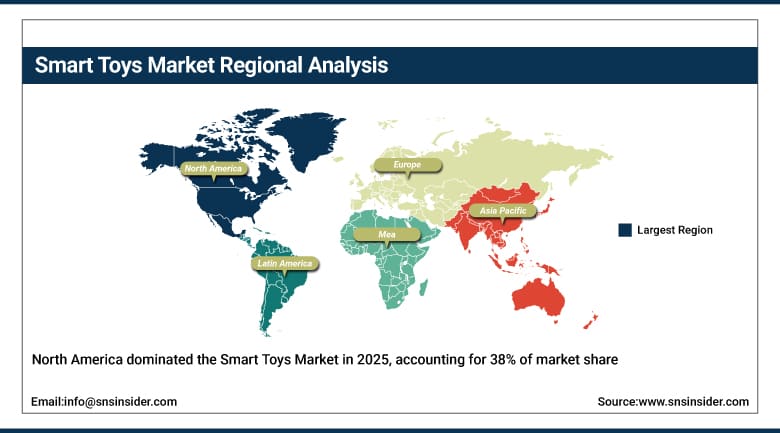
North America dominated the Smart Toys Market with the highest revenue share of about 38% in 2025 due to high disposable income, advanced technological infrastructure, and strong awareness among parents regarding educational and interactive toys. The region has widespread adoption of AI-enabled and connected devices, supported by well-established e-commerce platforms and retail networks. Additionally, increasing focus on STEM education and early childhood skill development drives demand, making North America a mature and leading market for smart toys globally.
Get Customized Report as per Your Business Requirement - Enquiry Now
Asia Pacific Smart Toys Market Insights
Asia Pacific segment is expected to grow at the fastest CAGR of about 13.71% from 2026-2035 owing to rapid urbanization, rising disposable income, and growing smartphone and internet penetration. Increasing parental awareness of educational and interactive toys, along with government initiatives promoting STEM learning, fuels adoption. Expanding e-commerce platforms and local manufacturing capabilities further support market growth. The combination of a large young population and rising interest in advanced, AI-enabled, and connected toys makes Asia Pacific the fastest-growing region.
Europe Smart Toys Market Insights
Europe Smart Toys Market is witnessing steady growth due to increasing adoption of interactive and educational toys among children. Rising focus on STEM learning, cognitive development, and skill-building is driving demand. Strong presence of established toy manufacturers, combined with advanced technological infrastructure and e-commerce penetration, supports market expansion. Additionally, government initiatives promoting digital learning and parental preference for safe, AI-enabled, and connected toys are contributing to the growth of Europe’s smart toys market.
Middle East & Africa and Latin America Smart Toys Market Insights
The Middle East & Africa and Latin America Smart Toys Market is growing steadily due to rising awareness of educational and interactive toys among parents. Increasing disposable income, urbanization, and smartphone penetration are driving adoption. E-commerce expansion and availability of AI-enabled and connected toys further support growth. Additionally, focus on STEM learning and skill development for children, along with entry of global and regional toy manufacturers, is boosting market demand in these regions.
Smart Toys Market Competitive Landscape:
LeapFrog Enterprises, Inc.
LeapFrog Enterprises, part of VTech, specializes in educational and interactive toys that promote early learning through technology. The company designs age-appropriate products combining fun and learning, integrating innovative software, hardware, and interactive content. LeapFrog focuses on STEM skills, literacy, and cognitive development, creating immersive play experiences that encourage creativity and exploration. Its products are designed for engagement, skill-building, and safe digital play, making it a trusted leader in the smart learning toy segment globally.
-
2023: LeapFrog showcased a new collection of learning and interactive toys at Toy Fair 2023, featuring tech-enhanced products promoting early learning and immersive play experiences for children.
-
2024: VTech and LeapFrog toys received top holiday toy honors, celebrating innovative interactive and educational products across multiple award categories.
LEGO Group
LEGO Group is a global leader in creative play and construction toys, inspiring imagination and learning through hands-on building experiences. The company blends traditional brick building with digital and interactive platforms to enhance creativity, problem-solving, and STEM education. LEGO emphasizes sustainability, technological innovation, and interactivity, connecting physical and digital play experiences. By integrating responsive features, smart play solutions, and immersive educational content, LEGO engages children of all ages while fostering cognitive, social, and creative development worldwide.
-
2025: The LEGO Group unveiled LEGO SMART Play, an interactive play platform that brings physical builds to life, incorporating responsive features to enhance creativity and engagement.
Mattel, Inc.
Mattel is a global toy company recognized for iconic brands such as Barbie, Hot Wheels, and Fisher-Price. The company combines traditional toys with innovative technology to deliver engaging, safe, and educational play experiences. Mattel invests in AI, digital platforms, and interactive solutions to create personalized and immersive play, supporting creativity, learning, and entertainment. Its strategic collaborations enable integration of advanced technology in toys, ensuring products remain relevant in evolving markets and resonate with children and families worldwide.
-
2025: Mattel announced a strategic collaboration with OpenAI to explore AI-enabled toys and enhanced interactive play experiences, enhancing engagement and innovation across its global product lines.
Hasbro, Inc.
Hasbro is a leading global toy and entertainment company, producing interactive and imaginative play experiences across multiple brands. It focuses on innovation, combining technology with storytelling and play to engage children and families. Hasbro emphasizes educational and dynamic play, using connected devices and AI-enhanced features in toys. The company integrates electronic companions, interactive systems, and responsive play elements, ensuring products foster creativity, social skills, and learning while aligning with trends in smart toys and next-generation play experiences.
-
2025: At Toy Fair 2025, Hasbro unveiled new interactive products, including Nano‑mals, electronic companions that react and connect, offering dynamic and immersive play experiences for children.
VTech
VTech is a global leader in electronic learning products, providing educational toys for infants, toddlers, and children. The company combines interactive hardware, age-appropriate software, and engaging content to enhance STEM skills, creativity, and cognitive development. VTech emphasizes safety, innovation, and learning through play, integrating smart technologies in its products. By offering interactive features, digital connectivity, and multi-category play experiences, VTech ensures children enjoy immersive educational play while supporting skill development, exploration, and fun learning worldwide.
-
2025: VTech introduced a new lineup of interactive learning toys at Toy Fair 2025, covering multiple age groups and play categories with engaging and educational features.
Key Players
-
LEGO Group
-
Mattel, Inc.
-
Spin Master Corp.
-
VTech Holdings Ltd.
-
Sphero, Inc.
-
UBTECH Robotics Corp.
-
Playmobil (Brandstätter)
-
Bandai Namco
-
LeapFrog Enterprises, Inc.
-
WowWee Group Ltd.
-
TOSY Robotics
-
ZURU Inc.
-
Anki
-
Silverlit Toys
-
Makeblock Co., Ltd.
-
Digital Dream Labs
-
Particula Ltd.
-
Wonder Workshop, Inc.
| Report Attributes | Details |
|---|---|
| Market Size in 2025 | USD 18.44 Billion |
| Market Size by 2035 | USD 58.31 Billion |
| CAGR | CAGR of 12.28% From 2026 to 2035 |
| Base Year | 2025 |
| Forecast Period | 2026-2035 |
| Historical Data | 2022-2024 |
| Report Scope & Coverage | Market Size, Segments Analysis, Competitive Landscape, Regional Analysis, DROC & SWOT Analysis, Forecast Outlook |
| Key Segments | • By Type (Robots, Interactive Games, Educational Robots) • By End-User (Toddlers, Preschoolers, School-going, Stripling) • By Technology (Wi-Fi, Bluetooth, RFID or NFC) • By Distribution Channel (Online/E-commerce Stores, Specialty Stores, Toy Shops) |
| Regional Analysis/Coverage | North America (US, Canada), Europe (Germany, UK, France, Italy, Spain, Russia, Poland, Rest of Europe), Asia Pacific (China, India, Japan, South Korea, Australia, ASEAN Countries, Rest of Asia Pacific), Middle East & Africa (UAE, Saudi Arabia, Qatar, South Africa, Rest of Middle East & Africa), Latin America (Brazil, Argentina, Mexico, Colombia, Rest of Latin America). |
| Company Profiles | LEGO Group, Mattel, Inc., Hasbro, Inc., Spin Master Corp., VTech Holdings Ltd., Sphero, Inc., UBTECH Robotics Corp., Playmobil (Brandstätter), Bandai Namco, LeapFrog Enterprises, Inc., WowWee Group Ltd., TOSY Robotics, LittleBits, ZURU Inc., Anki, Silverlit Toys, Makeblock Co., Ltd., Digital Dream Labs, Particula Ltd., Wonder Workshop, Inc. |
Frequently Asked Questions
The Smart Toys Market is expected to grow at a CAGR of 12.28% from 2026 to 2035.
The Smart Toys Market was valued at USD 18.44 billion in 2025.
Rising adoption of AI and robotics in toys is driving enhanced engagement and personalized learning experiences among children globally.
The Interactive Games segment dominated the Smart Toys Market in 2025.
North America dominated the Smart Toys Market in 2025.
