
Airport Moving Walkways Market Report Scope & Overview:
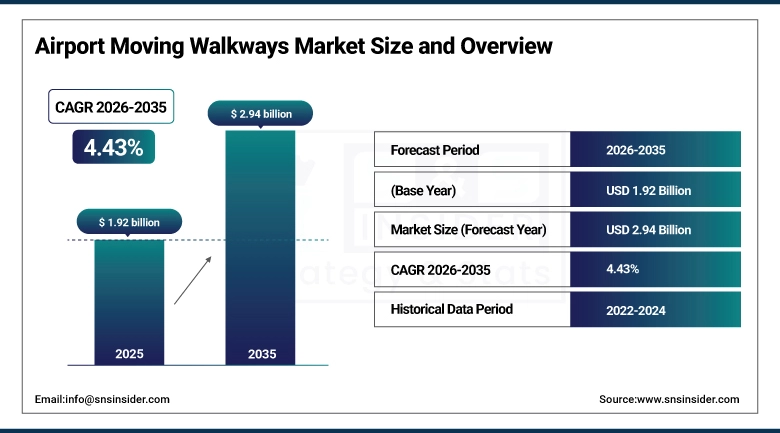
The Airport Moving Walkways Market was valued at USD 1.92 billion in 2025 and is expected to reach USD 2.94 billion by 2035, growing at a CAGR of 4.43% from 2026–2035.
The Airport Moving Walkways Market is growing at an impressive pace due to the rapid development of airport infrastructure, the growth of air traffic, and heavy investment in modernizing terminal facilities. The increased need for efficient passenger transport services, especially in big international airports, has resulted in the massive use of moving walkway installations that are energy-efficient and have higher capacities. There is also greater emphasis on passengers’ convenience, reduced transit time, and accessibility for the aged and disabled.
Recent developments include major airport modernization initiatives integrating AI-enabled passenger flow monitoring and IoT-based predictive maintenance systems into moving walkway infrastructure. Leading companies such as KONE, TK Elevator, Otis, and Schindler are focusing on smart mobility solutions featuring energy-regenerative drives, touchless safety systems, and real-time operational diagnostics to improve efficiency and reduce maintenance downtime.
Increasing investments in sustainable airport technologies, modernization of aging terminal infrastructure, and rising adoption of high-speed multi-level connectivity walkways are further reshaping competitive dynamics and driving long-term innovation within the global airport mobility ecosystem.
To Get more information on Airport Moving Walkways Market - Request Free Sample Report
Airport Moving Walkways Market Trends
-
Rising airport modernization projects are accelerating deployment of advanced moving walkway systems.
-
Increasing air passenger traffic is boosting demand for seamless terminal mobility solutions.
-
Growing adoption of IoT-enabled predictive maintenance is improving operational efficiency and uptime.
-
Rising focus on passenger comfort and accessibility is driving installation of high-speed walkway systems.
-
Increasing investments in greenfield airports and terminal expansions are supporting market growth.
-
Growing use of energy-efficient and regenerative drive systems is enhancing sustainability initiatives.
-
Expanding integration of smart sensors and touchless technologies is advancing intelligent airport mobility systems.
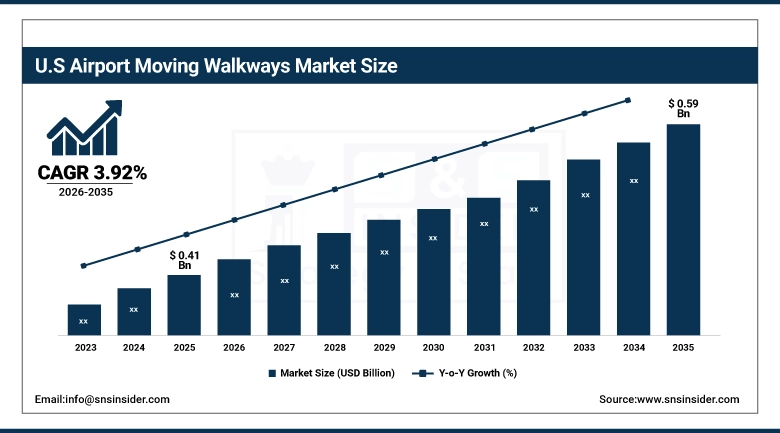
The U.S. Airport Moving Walkways Market was valued at USD 0.41 billion in 2025 and is expected to reach around USD 0.59 billion by 2035, growing at a CAGR of 3.92% from 2026–2035.
The US is the top regional market for airport moving walkways owing to its vast network of airport infrastructure, huge numbers of passengers, and constant improvements being made through airport terminal upgrade initiatives. This demand is also fueled by the expansion of international transit centers, improved efforts toward efficient passenger movement, and enhanced use of intelligent airport technologies at large airports like Atlanta, Dallas Fort Worth, Los Angeles, and Chicago.
Supporting this growth, airport authorities and mobility infrastructure providers are increasingly investing in energy-efficient and AI-enabled walkway systems to improve passenger flow and operational reliability.
Additionally, recent developments such as modernization projects at JFK Terminal One and expansion investments across major U.S. airports are accelerating deployment of connected and high-capacity passenger mobility systems.
Airport Moving Walkways Market Segment Highlights
-
By Product Type, Belt Type Moving Walkways dominated the Airport Moving Walkways Market with 34.71% share in 2025; Modular Pallet Walkways fastest growing CAGR.
-
By Installation Type, Horizontal Moving Walkways dominated the Airport Moving Walkways Market with 39.15% share in 2025; Multi-Level Connectivity Walkways fastest growing CAGR.
-
By Airport Type, International Airports dominated the Airport Moving Walkways Market with 44.37% share in 2025; Greenfield Airports fastest growing CAGR.
-
By Technology, Smart Sensor-Based Walkways dominated the Airport Moving Walkways Market with 31.28% share in 2025; AI-Based Passenger Flow Monitoring fastest growing CAGR.
-
By Service Type, New Installation dominated the Airport Moving Walkways Market with 42.78% share in 2025; Modernization & Retrofit fastest growing CAGR.
By Product Type, Belt Type Moving Walkways segment dominates the Airport Moving Walkways Market, Modular Pallet Walkways expected to grow fastest
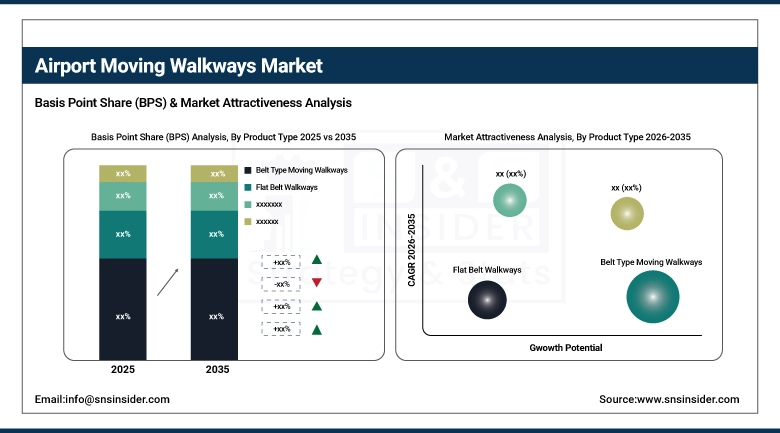
In 2025, the Belt Type Moving Walkways segment maintained its dominant position in the Airport Moving Walkways Market, accounting for 34.71% of total revenue. This leadership is primarily driven by widespread deployment across large international airports, smooth passenger transportation capabilities, and strong suitability for long-distance terminal connectivity applications.
From 2026 to 2035, the Modular Pallet Walkways segment is projected to record the highest CAGR of 6.45%. This fast growth is attributable to high levels of demand for scalable walkways, increased usage in new airport terminals, and heightened interest in modular designs that allow for easier maintenance and terminal expansion.
By Installation Type, Horizontal Moving Walkways segment dominates the Airport Moving Walkways Market, Multi-Level Connectivity Walkways expected to grow fastest
The Horizontal Moving Walkways segment held the largest share of 39.15% in 2025, as a result of its wide application along the corridors of airports, transit areas for passenger transfers, and other high traffic terminal routes. Many airports have now started to use horizontal walkways due to their effectiveness in facilitating faster movement and connecting different parts of the airport smoothly.
The Multi-Level Connectivity Walkways segment is expected to register the highest CAGR during the 2026–2035 forecast period. Growth is driven by increasing development of multi-terminal airports, rising investments in vertical passenger mobility infrastructure, and growing demand for seamless inter-floor transportation systems in large aviation hubs.
By Airport Type, International Airports segment dominates the Airport Moving Walkways Market, Greenfield Airports expected to grow fastest
In 2025, the International Airports segment accounted for the largest revenue share of 44.37% in the Airport Moving Walkways Market. The segment’s dominance is primarily attributed to high passenger traffic volumes, large terminal footprints, and continuous modernization of global transit hubs requiring efficient passenger transportation infrastructure.
The Greenfield Airports segment is projected to witness the fastest CAGR from 2026 to 2035. This growth is driven by rising investments in new airport construction projects across emerging economies, expanding aviation connectivity programs, and increasing government spending on smart airport infrastructure development.
By Technology, Smart Sensor-Based Walkways segment dominates the Airport Moving Walkways Market, AI-Based Passenger Flow Monitoring segment expected to grow fastest
In 2025, the Smart Sensor-Based Walkways segment maintained its dominant position in the Airport Moving Walkways Market, accounting for 31.28% of total revenue. Such dominance is reinforced through increased usage of automated safety sensors, monitoring systems, and intelligent traffic management facilities within contemporary airport terminals. There is growing emphasis on incorporating intelligent walkways that can ensure improved safety standards for passengers and minimal downtime for operations at the airports.
From 2026 to 2035, the AI-Based Passenger Flow Monitoring segment is projected to record the highest CAGR.
By Service Type, New Installation segment dominates the Airport Moving Walkways Market, Modernization & Retrofit segment expected to grow fastest
The New Installation segment maintained the highest share of 42.78% in 2025. This domination is fueled by extensive development initiatives involving airports, the growth in the building of greenfield airports, and investment in advanced passenger transport infrastructures. Airports have been introducing innovative moving walkways that will make the terminals more connected, convenient for passengers, and capable of handling larger volumes of air traffic.
The Modernization & Retrofit segment is projected to achieve the highest growth rate during 2026–2035.
Airport Moving Walkways Market Regional Analysis
|
Region |
Major Country |
Share within Region (%) |
|---|---|---|
|
North America |
United States |
27.45% |
|
Europe |
Germany |
15.44% |
|
Asia Pacific |
China |
38.74% |
|
Middle East & Africa |
UAE |
12.03% |
|
Latin America |
Brazil |
6.34% |
North America Airport Moving Walkways Market Insights
The North American region features a highly evolved ecosystem of aviation infrastructure, fueled by the constant efforts to modernize airports, investment in smart transportation system, and growing concerns regarding the efficiency of passenger transit in massive airport terminals. The region enjoys advantages owing to its significant international airports, sophisticated technologies for automation in airports, and wide-scale use of energy-efficient transport infrastructure in countries such as the United States and Canada. The North American market is dominated by the United States, fueled by terminal modernization, growth in air traffic, and investments in smart airport development projects.
JFK Terminal One redevelopment in New York announced multi-billion-dollar terminal expansion plans integrating advanced automated passenger mobility infrastructure and smart transit systems.
Dallas Fort Worth International Airport accelerated terminal modernization investments exceeding USD 4 billion, supporting deployment of intelligent passenger movement and connectivity technologies.
Get Customized Report as per Your Business Requirement - Enquiry Now
Asia Pacific Airport Moving Walkways Market Insights
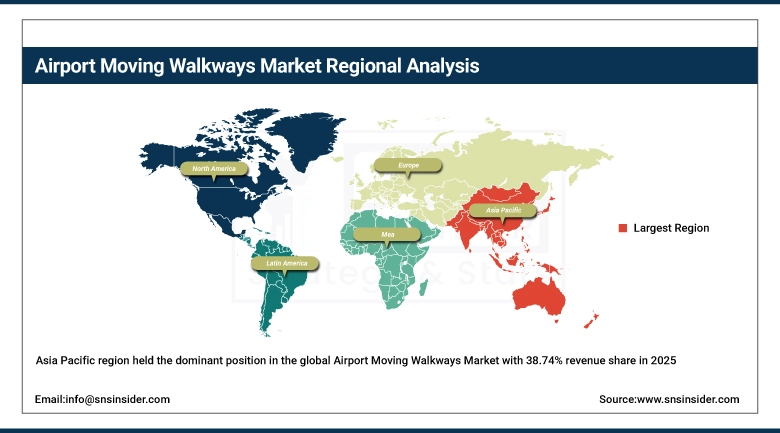
The Asia Pacific region held the dominant position in the global Airport Moving Walkways Market with 38.74% revenue share in 2025 and it is also projected to register the highest CAGR of 4.90% from 2026–2035, fueled by rapid airport infrastructure expansion, rising passenger traffic, and increasing investments in smart aviation mobility systems. Countries such as China, India, Japan, South Korea, Singapore, and those in Southeast Asia are becoming major contributors to market growth, with China and India leading large-scale greenfield airport construction and terminal expansion activities.
China continued expansion of large-scale aviation infrastructure projects with multiple new airport developments and smart terminal upgrades supporting advanced walkway deployment.
India’s Noida International Airport and Navi Mumbai International Airport projects are integrating next-generation passenger mobility systems to improve terminal transit efficiency and automation.
Europe Airport Moving Walkways Market Insights
The European region held a substantial share of the global Airport Moving Walkways Market in 2025 because of its highly developed airport infrastructure and sustainable mode of mobility systems, along with investments for smarter terminal facilities. Some of the leading economies in Europe that have embraced intelligent passenger movement systems include Germany, the UK, France, Italy, Spain, and other Nordic countries.
Heathrow Airport and Frankfurt Airport are increasing investments in energy-efficient terminal modernization programs focused on intelligent passenger transportation infrastructure.
European airports are rapidly adopting AI-enabled passenger flow monitoring and predictive maintenance technologies to reduce operational downtime and improve traveler experience.
Latin America, Middle East & Africa (LAMEA) Airport Moving Walkways Market Insights
The Airport Moving Walkways Market in the LAMEA region has been consistently growing owing to an increasing number of airport constructions, developments in tourism infrastructure, and growth in the commercial aviation industry. Many countries in the LAMEA region have made noteworthy contributions to the expansion of this market due to their airport modernizations and the establishment of global transit centers.
UAE airports are increasing investments in AI-driven smart terminal systems and sustainable airport infrastructure to support rising global transit passenger volumes.
Brazil is expanding airport concession and privatization projects, accelerating modernization of passenger mobility infrastructure across major aviation hubs. Mexico continues investments in airport expansion and terminal redevelopment programs to strengthen international tourism and regional air connectivity.
Airport Moving Walkways Market Growth Drivers:
-
Rising global airport modernization programs, surging air passenger traffic, and expansion of large-scale terminal infrastructure are driving strong demand for advanced airport moving walkway systems across international aviation hubs
Among the major forces impacting the Airport Moving Walkways Market, the first one can be considered the fast-changing nature of the global aviation infrastructure, in which modern airports are becoming smart transportation hubs that are capable of handling an ever-growing number of passengers thanks to their digital connections and increased capacity. As more people start traveling by planes domestically and abroad, the growing attention of airport administrators is being paid to the reduction of walking distances, as well as to improved passenger experience via the use of automated moving walkways.
Similarly, in Asia Pacific, greenfield airport projects such as Noida International Airport and Navi Mumbai International Airport are embedding high-capacity walkway systems from the design stage, reflecting a strong shift toward future-ready, fully automated airport ecosystems.
Recent modernization programs across major European hubs such as Heathrow Airport and Frankfurt Airport further highlight the transition toward intelligent, sensor-enabled walkway networks designed to improve safety, minimize downtime, and support seamless passenger movement across increasingly complex terminal layouts.
Airport Moving Walkways Market Restraints:
-
High installation complexity, strict airport safety compliance requirements, and high capital investment needs are limiting the rapid deployment of advanced moving walkway systems across airport terminals
The principal structure constraint for the Airport Moving Walkways Market involves the technically demanding aspects that relate to the process of system integration in airport settings, since installation necessitates coordination with the architectural features of the terminal, safety of passengers, and maintenance of continuous operation of the walkway system. Unlike regular infrastructure, installation of the moving walkway system demands compliance with rigorous aviation safety requirements, fire protection standards, vibration control standards, and accessibility standards, making the process technologically more challenging.
Airport Moving Walkways Market Opportunities:
-
Expansion of Smart Airport Infrastructure and Mega Terminal Development Creating New Opportunities for Advanced Automated Passenger Mobility and Moving Walkway Systems
Some of the main opportunities in the Airport Moving Walkways Market include extensive developments of the airport infrastructure facilities as well as upgrading of existing terminals into integrated mobility terminals. The growing global air traffic has meant that the authorities in airports have been focusing on designing efficient terminals that maximize mobility, minimize time spent transferring from one point to another as well as optimize the space. This has led to increased demand for moving walkway technologies that can be installed in these areas.
Recent Developments:
-
2026: JFK Terminal One redevelopment in the United States advanced its phased terminal expansion program, integrating next-generation moving walkway systems within long-haul passenger corridors to improve inter-terminal connectivity and reduce transfer congestion across one of North America’s busiest international gateways.
-
2026: Dallas Fort Worth International Airport (DFW) continued its large-scale terminal modernization program, deploying upgraded automated passenger mobility infrastructure, including high-capacity moving walkways and smart flow optimization systems to enhance passenger throughput efficiency across expanded terminals.
-
2025: Heathrow Airport (UK) and Frankfurt Airport (Germany) expanded their terminal refurbishment initiatives with deployment of energy-efficient and low-noise moving walkway systems, improving passenger circulation while aligning with stringent European sustainability and carbon-reduction targets in aviation infrastructure.
-
2025: India’s Noida International Airport and Navi Mumbai International Airport accelerated installation of advanced passenger mobility infrastructure, integrating high-capacity moving walkways within new terminal designs to support rising international traffic and future-ready smart airport operations.
Airport Moving Walkways Market Key Players
Some of the Airport Moving Walkways Market Companies
-
KONE Corporation
-
TK Elevator (Thyssenkrupp Elevator)
-
Otis Worldwide Corporation
-
Schindler Group
-
Mitsubishi Electric Corporation
-
Fujitec Co. Ltd.
-
Hitachi Ltd.
-
Toshiba Elevator and Building Systems Corporation
-
Hyundai Elevator Co. Ltd.
-
Stannah Lifts Holdings Ltd.
-
Sigma Elevator Company
-
Kleemann Hellas SA
-
Gulf Elevator & Escalator Co. Ltd.
-
Analogue Holdings Limited (ATAL Engineering Group)
-
SJEC Corporation
-
Sicher Elevator Co. Ltd.
-
Canny Elevator Co. Ltd.
-
Orona Group
-
Savaria Corporation
-
Stein Ltd.
Airport Moving Walkways Market Report Scope
| Report Attributes | Details |
|---|---|
| Market Size in 2025 | USD 1.92 Billion |
| Market Size by 2035 | USD 2.94 Billion |
| CAGR | CAGR of 4.43% From 2026 to 2035 |
| Base Year | 2025 |
| Forecast Period | 2026-2035 |
| Historical Data | 2022-2024 |
| Report Scope & Coverage | Market Size, Segments Analysis, Competitive Landscape, Regional Analysis, DROC & SWOT Analysis, Forecast Outlook |
| Key Segments | • By Product Type (Belt Type Moving Walkways, Pallet Type Moving Walkways, Flat Belt Walkways, Modular Pallet Walkways, Heavy-Duty Moving Walkways) • By Installation Type (Horizontal Moving Walkways, Inclined Moving Walkways, Indoor Installations, Outdoor Installations, Multi-Level Connectivity Walkways) • By Airport Type (International Airports, Domestic Airports, Greenfield Airports, Brownfield Airport Expansions, Military & Defense Airports) • By Technology (Smart Sensor-Based Walkways, Energy-Efficient Systems, IoT-Enabled Predictive Maintenance, AI-Based Passenger Flow Monitoring, Touchless Safety & Control Systems) • By Service Type (New Installation, Modernization & Retrofit, Annual Service Contracts, Spare Parts & Aftermarket Services) |
| Regional Analysis/Coverage | North America (US, Canada), Europe (Germany, UK, France, Italy, Spain, Russia, Poland, Rest of Europe), Asia Pacific (China, India, Japan, South Korea, Australia, ASEAN Countries, Rest of Asia Pacific), Middle East & Africa (UAE, Saudi Arabia, Qatar, South Africa, Rest of Middle East & Africa), Latin America (Brazil, Argentina, Mexico, Colombia, Rest of Latin America). |
| Company Profiles | KONE Corporation, TK Elevator (Thyssenkrupp Elevator), Otis Worldwide Corporation, Schindler Group, Mitsubishi Electric Corporation, Fujitec Co. Ltd., Hitachi Ltd., Toshiba Elevator and Building Systems Corporation, Hyundai Elevator Co. Ltd., Stannah Lifts Holdings Ltd., Sigma Elevator Company, Kleemann Hellas SA, Gulf Elevator & Escalator Co. Ltd., Analogue Holdings Limited (ATAL Engineering Group), SJEC Corporation, Sicher Elevator Co. Ltd., Canny Elevator Co. Ltd., Orona Group, Savaria Corporation, Stein Ltd. |

Frequently Asked Questions
The Belt Type Moving Walkways segment dominated the Airport Moving Walkways Market in 2025.
Asia Pacific dominated the Airport Moving Walkways Market in 2025.
Rapid expansion of airport infrastructure modernization, rising global air passenger traffic, and increasing adoption of smart, energy-efficient passenger mobility systems are the primary growth drivers of the Airport Moving Walkways Market.
The Airport Moving Walkways Market was valued at USD 1.92 billion in 2025.
The Airport Moving Walkways Market is expected to grow at a CAGR of 4.43% from 2026 to 2035.
