
Aircraft Hangar Market Report Scope & Overview:
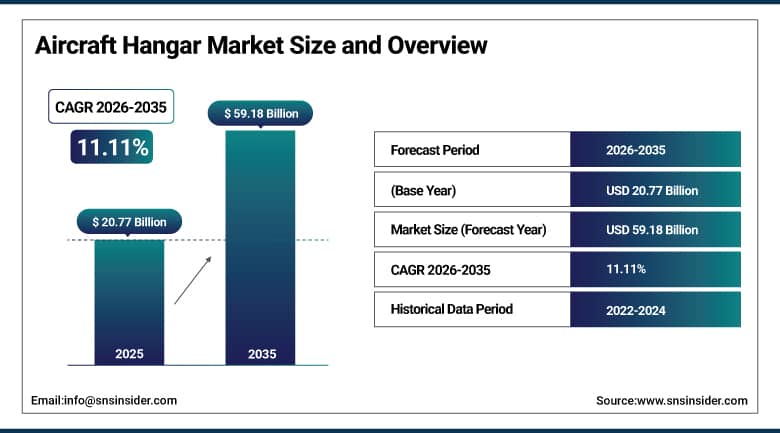
The Aircraft Hangar Market was valued at USD 20.77 Billion in 2025 and is projected to reach USD 59.18 Billion by 2035, growing at a CAGR of 11.11% from 2026 to 2035.
The Aircraft Hangar Market is experiencing growth owing to increasing air traffic passengers in the world, larger fleets of aircraft, and investments in upgrading airports. There is increasing need for hangars to cater for storing, maintaining, repairing, and overhauling of aircraft. Modular hangars, sustainable building materials, automation, and Internet of Things (IoT)-enabled monitoring systems have become key drivers of growth within this market. Further, there is increasing budget in defense, development of general aviation, and deployment of drones and specialized aircraft. This has created huge opportunities in hangar market in civil, military, and industrial aviation industry.
In February 2026, the revised NFPA 409 Standard for Aircraft Hangars raised the height requirement of structural doors for group I, II, and III hangars to 35 feet from 28 feet for modern wide-body aircrafts. The revision also facilitated adoption of SFFF/F3 foam as an alternative to AFFF in fire protection systems.
To Get More Information On Aircraft Hangar Market - Request Free Sample Report
Aircraft Hangar Market Trends:
-
Growing aircraft fleet expansion and rising air travel demand are increasing investments in new hangar facilities to support aircraft storage, maintenance, repair, and overhaul (MRO) operations.
-
Increasing adoption of modular, pre-engineered, and fabric-based hangar structures is improving construction speed, cost efficiency, and scalability for airports, airlines, and private aviation operators.
-
Rising focus on sustainable aviation infrastructure is driving demand for energy-efficient hangar designs, solar-integrated systems, advanced insulation materials, and environmentally friendly construction solutions.
-
Expansion of defense aviation programs, private aircraft ownership, and business aviation activities is creating opportunities for specialized hangar facilities with advanced security and operational capabilities.
-
Integration of smart technologies, including IoT-based monitoring, automated maintenance systems, and digital facility management solutions, is enhancing hangar efficiency, safety, and asset utilization.
U.S. Aircraft Hangar Market Outlook:
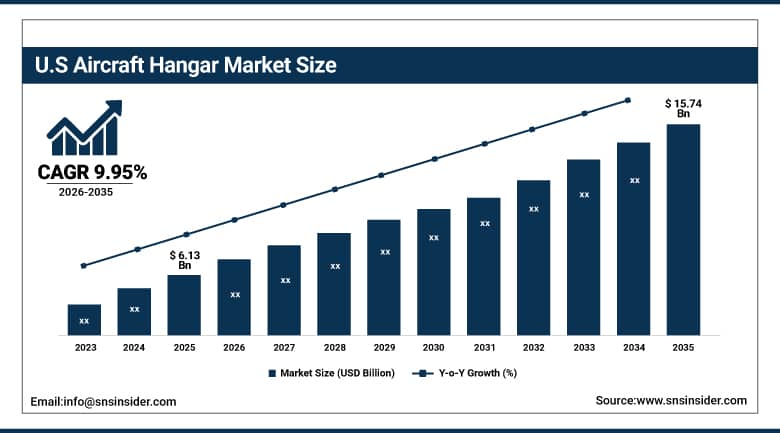
The U.S. Aircraft Hangar Market was valued at USD 6.13 billion in 2025 and is projected to reach USD 15.74 billion by 2035, expanding at a CAGR of 9.95% during 2026–2035.
The U.S. aircraft hangar market is expected to witness growth due to the increase in commercial aviation fleet size, aircraft MRO services, and the demand for state-of-the-art hangars. The increasing usage of wide-body aircraft, aircraft cargo conversion, and the rise in private aviation is expected to contribute towards the development of large hangar facilities. In addition to this, there is an increasing focus among airlines, airports, and MRO service providers to have state-of-the-art hangars having advanced maintenance technologies and automated hangars. The initiatives of government towards airport modernization, military defense aviation upgrades, and the need for effective storage and maintenance facilities for aircraft are adding to the growth of the market.
In May 2026, Ascent Aviation Services launched two 90,000 square foot wide-body hangar maintenance hangars through the investment of USD 70 million, which increases its capacity at Marana facility for Boeing 777-300ER passenger-to-freighter conversion program. The initiative is expected to make the facility one of the largest non-OEM aircraft modification centers in North America.
Aircraft Hangar Market Segment Analysis:
-
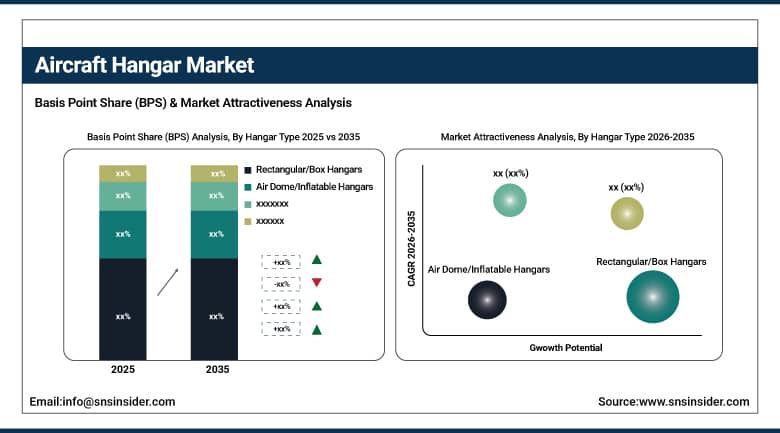
By Hangar Type, Rectangular/Box Hangars dominated the Aircraft Hangar Market with a 38.40% share in 2025, while Air Dome/Inflatable Hangars are expected to register the fastest growth with a CAGR of 15.18% from 2026–2035.
-
By Construction Type, Pre-Engineered Buildings (PEB) dominated the Aircraft Hangar Market with a 34.60% share in 2025, while Modular Hangars are the fastest-growing construction type segment with a CAGR of 13.77% from 2026–2035.
-
By Material, Steel dominated the Aircraft Hangar Market with a 55.40% share in 2025, while Architectural Fabric Membranes are expected to witness the fastest growth with a CAGR of 13.60% from 2026–2035.
-
By End User, Airlines & Airport Authorities dominated the Aircraft Hangar Market with a 36.80% share in 2025, while MRO Service Providers are the fastest-growing end user segment with a CAGR of 12.04% from 2026–2035.
-
By Application, Commercial Aviation dominated the Aircraft Hangar Market with a 48.70% share in 2025, while UAV & Drone Operations are expected to register the fastest growth with a CAGR of 14.95% from 2026–2035.
By Hangar Type, Rectangular/Box Hangars dominated the Aircraft Hangar Market, while Air Dome/Inflatable Hangars are expected to register the fastest growth during the forecast period 2026–2035
Rectangular/Box Hangars dominated the Aircraft Hangar Market with a market share of around 38.40% in 2025. The growth drivers for this segment are the ability to accommodate various types of aircraft, aircraft storage capacity and efficient maintenance operations. Airlines, MROs and airports like this type of hangars for their flexibility, efficiency and use in heavy maintenance operations. Growth in aircraft fleet, growth in investment in airports and demand for aircraft repair and servicing facilities around the world is driving the use of rectangular/box hangars. Improvements in hangar design and efficient space utilisation are contributing to the growth of the segment.
Air Dome/Inflatable Hangars are projected to grow as the fastest CAGR of 15.18% during the forecast period 2026 to 2035. The segment is driven by factors such as fast deployment, lower construction costs and demand for flexible aviation infrastructures. These hangars have been widely used for temporary aircraft storage, military, emergency services and remote aircraft facilities. Innovation in durable fabric materials, lightweight hangar design, and weather resistance capability have increased their use in the aviation industry. The segment is expected to grow in the coming years due to demand for low cost and quick deployment hangar facilities.
By Construction Type, Pre-Engineered Buildings (PEB) dominated the Aircraft Hangar Market, while Modular Hangars are expected to register the fastest CAGR during the forecast period 2026–2035
Pre-Engineered Buildings (PEB) dominated the Aircraft Hangar Market in terms of market revenue share at 34.60% in 2025. The growth of the segment is attributed to the benefits associated with pre-engineered buildings including quick construction, cost savings, durability, and customizations. PEB hangars have been increasingly used in commercial airports, military airports, and MRO facilities owing to less installation time and maintenance needs. The growing emphasis on aircraft hangar construction, airport modernization, and green constructions is contributing towards the adoption of pre-engineered hangars. Advancements in structural engineering and manufacturing are aiding the growth of the segment.
Modular Hangars are estimated to record the fastest CAGR of 13.77% between 2026 and 2035. The growth of the segment is being driven by the rise in the demand for flexible, expandable, and easy-to-install aviation infrastructure. Modular hangars help in expanding the storage and maintenance capacities without much operational disruptions. Adoption of the product among MRO service providers, defense establishments, and regional airports has been aiding market growth. The growing need for temporary facilities, cost-effective construction methods, and prefabricated construction is likely to drive opportunities for modular hangar manufacturers.
By Material, Steel dominated the Aircraft Hangar Market, while Architectural Fabric Membranes are expected to register the fastest CAGR during the forecast period
Steel dominated the aircraft hangar market with a revenue share of 55.40% in 2025. Steel is the dominant material, thanks to its strength, durability, structural reliability and ability to build large aviation facilities. The application of steel hangars is extensively used in commercial aircrafts, defence and maintenance, repair and overhaul purposes because of the ability of these structures to withstand heavy loads and environmental conditions. The growing need to expand aircraft fleet size and build new airports and aviation facilities is driving the increasing demand for steel hangar structures.
Architectural Fabric Membranes segment is expected to grow as the fastest CAGR of 13.60% between 2026 and 2035. Light weight construction, less installation requirements and increasing demand for energy-efficient aviation facilities are the key drivers for the growth of this segment. Fabric membrane hangars are flexible, can be assembled quickly and allow for better daylight penetration, making them suitable for both permanent and temporary aviation applications. The market is expected to be driven by increasing adoption in military operations, general aviation and remote locations.
By End User, Airlines & Airport Authorities dominated the Aircraft Hangar Market, while MRO Service Providers are expected to register the fastest CAGR during the forecast period 2026–2035
Airlines & Airport Authorities dominated the aircraft hangar market with a revenue share of around 36.80%. The growth of this segment is driven by factors such as the increase in the size of the aircraft fleet, development of airport infrastructure, and growing demand for hangars for aircraft storage and maintenance purposes. To improve efficiency, reduce aircraft downtime and enable an increase in air traffic, airlines and airport authorities are building new hangar facilities.
MRO Service Providers segment is anticipated to record the fastest CAGR of 12.04% during the forecast period. The growth of the segment is primarily attributed to the increasing trend of outsourcing aircraft maintenance services, higher aircraft utilisation rates, and the demand for specialised hangar infrastructure. MRO service providers are investing in hangar infrastructure to carry out aircraft maintenance and modification operations. Growing aircraft age, growing aircraft maintenance needs and investment in aviation aftermarket are some of the opportunities for MRO hangars globally.
By Application, Commercial Aviation dominated the Aircraft Hangar Market, while UAV & Drone Operations are expected to register the fastest CAGR during the forecast period 2026–2035
Commercial Aviation dominated the aircraft hangar market with the largest share of revenue in 2025, accounting for 48.70%. The growth of the commercial aviation hangar market is driven by the rising passenger traffic, increasing airline fleet size, increasing aircraft deliveries and investments in airport infrastructure. Commercial airlines need advanced hangars for aircraft storage and maintenance. The increasing demand for narrow body and wide body aircraft maintenance facilities and airport expansion projects will drive the market growth in the upcoming years. Investments in commercial aviation hangar facilities will be spurred by a focus on reducing aircraft turnaround time and improving operational efficiency.
UAV & Drone Operations segment is projected to register the fastest CAGR of 14.95% during 2026-2035. This growth is attributed to increasing adoption of unmanned aerial vehicles in defence applications, logistics, surveillance, agricultural applications and other commercial uses. The dedicated drone hangar facility will see increased demand due to the increasing expansion of the drone delivery service, autonomous aviation technologies, and military UAVs.
Regional Analysis:
|
Region |
Major Country |
Share within Region, 2025 (%) |
|---|---|---|
|
North America |
United States |
84.11% |
|
Europe |
Germany |
28.50% |
|
Asia Pacific |
China |
36.90% |
|
Latin America |
Brazil |
46.27% |
|
Middle East & Africa |
UAE |
25.11% |
North America Aircraft Hangar Market Insights
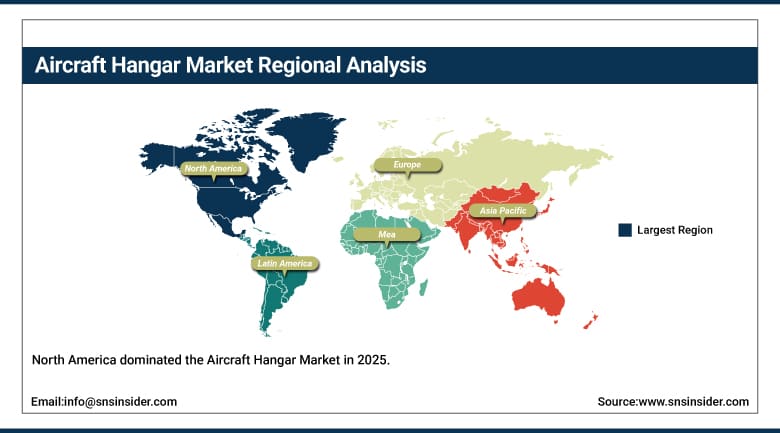
North America region in Aircraft Hangar Market is projected to grow at the fastest CAGR of 10.69% during 2026-2035. The regional growth is fueled by strong aviation infrastructure, expanding aircraft fleet expansion, increasing need for aircraft maintenance, repair and overhaul (MRO) facilities and ongoing investments in commercial, cargo and military aviation infrastructure. The area is well served by the presence of major airlines, aircraft manufacturers, defence organisations and MRO service providers.
The U.S. Aircraft Hangar Market continues to expand with rising demand for aircraft maintenance facilities, fleet modernisation programmes, and the establishment of advanced aviation infrastructure. The growth of MRO service providers, cargo aviation operations and defence aviation programmes is creating strong demand for new and upgraded hangar facilities. Canada is also experiencing steady growth, driven by growing aviation activities, expansion of airport infrastructure and growing demands for aircraft storage and maintenance solutions. The forecast period is expected to witness continuous growth with the rising number of aircraft deliveries, the development in hangar construction technology, and the increasing aviation.
Get Customized Report as Per Your Business Requirement - Enquiry Now
Europe Aircraft Hangar Market Insights
Europe contributed significantly to the global Aircraft Hangar Market in 2025 owing to the presence of a highly developed aviation industry, aircraft manufacturing companies, robust MRO networks, and the demand for aircraft maintenance infrastructure. The region is witnessing an increased investment in airport facilities, fleet growth, and advanced hangars for meeting the demands for both commercial and defense aviation activities. Germany, the UK, France, and Italy are the major contributors to this segment as the region is witnessing an increased focus on efficient aircraft servicing and maintenance.
Germany is a key contributor to the Aircraft Hangar Market in Europe owing to its highly developed aerospace sector, developed aviation infrastructure, and the increasing demand for MRO services. The UK and France contribute considerably in terms of airline expansion operations and investments in defense aviation and airports. The growth rate of the market in Europe is projected to be modest during the forecast period due to rising aircraft fleets, sustainable aircraft infrastructure development, and increasing adoption of advanced hangars.
Asia Pacific Aircraft Hangar Market Insights
The Asia Pacific region has emerged as the fastest-growing region in the Aircraft Hangar Market with a CAGR of 12.90% for 2026 to 2035. The rapid expansion of commercial aviation, rise in air passenger traffic, growth in the number of aircraft fleets, and investment in developing airport infrastructures have been some of the key drivers that have fueled the regional market growth. The rising activities in the aviation sector in nations such as China, India, Japan, and other countries of Southeast Asia have resulted in an increase in the demand for storage, maintenance, and repair facilities of aircrafts.
China has become one of the major players in the Asia Pacific Aircraft Hangar Market due to the growing aviation industry, growing number of aircrafts, and development of many airports. India and other emerging markets have also witnessed growth in the aviation industry due to improved air connectivity, increased procurement of aircrafts, and various government initiatives for expansion of aviation infrastructures.
Middle East & Africa and Latin America Aircraft Hangar Market Insights
The Middle East & Africa and Latin America Aircraft Hangar Market is registering slow yet steady growth owing to investments in aviation industry, growth in fleet sizes of airlines and increased demands for aircraft maintenance and hangar facilities. The Latin American countries are registering the adoption of aircraft hangar solutions owing to increasing aviation connectivity, commercial aircraft fleets, and modern airport facilities. Brazil continues to be a strong player in the Latin American market on account of the growing aviation industry, increasing operations, and need for maintenance infrastructure.
The Middle East & Africa market is being driven by the growth of aviation hubs, expansion plans of airlines, and modernization of airport facilities. Countries like UAE and Saudi Arabia are investing in aviation infrastructure in terms of construction of airports and maintenance facilities. Growth in the Latin American and Middle East & Africa markets is further driven by increasing activities of cargo aviation and defense aviation requirements and infrastructure. However, factors like high construction costs, lack of aviation infrastructure in developing economies, and complex regulations could hinder the growth of the market in some regions.
Market Dynamics:
Growth Drivers: Increasing aircraft fleet expansion and rising demand for advanced aviation infrastructure driving market growth
The Aircraft Hangar Market is showing robust growth owing to the rise in the number of aircraft fleets around the globe, the growth in air passengers, and the demand for maintenance, repair, and overhaul (MRO) services for aircraft. Airlines, airports, and MRO service providers are spending on new hangar construction facilities in order to meet their needs for storing and maintaining aircraft. The trend of advanced hangar construction is gaining popularity with modular hangars, prefabricated buildings, and other innovative hangar management technologies that increase efficiency. Moreover, rising investments in defense aviation, cargo aircraft, and airport modernization are aiding the market further.
Restraints: High construction costs and complex regulatory requirements limiting market expansion
One of the major restraints in the growth of the market is the high cost associated with the construction and maintenance of hangars. “The cost of such projects is higher than usual due to the use of specialised building materials and advanced engineering, the availability of sufficient land, as well as compliance with aviation safety requirements. However, hangar construction projects take a long time to complete because of the lengthy approval process, environmental considerations and issues relating to space available at the airport. Small airports and aviation companies may have a hard time setting up hangars due to financial limitations.
Opportunities: Expansion of MRO facilities and adoption of advanced hangar technologies
Rising investments in MRO infrastructure, airport infrastructure projects and application of innovative construction techniques are anticipated to drive robust growth potential for the Aircraft Hangar Market. The need for more effective aircraft maintenance operations is increasing, which results in increased use of smart hangars including digital monitoring systems, automation technologies and energy-efficient hangars. Cost-effective and scalable infrastructure is gaining importance in aviation companies. Modular hangars, sustainable construction materials and flexible aircraft hangar systems are a few examples of this.
The global aircraft hangar market is expected to experience a significant growth rate during the forecast period. This is due to the emergence of developing economies such as Asia Pacific, Latin America and Middle East & Africa region providing new growth potential for the global aircraft hangar market. This is because of increasing air connectivity, growing aircraft purchases and rising government investments in aviation infrastructure. The airlines are expanding their operations by forming strategic tie-ups with the airlines, airports and MROs to develop hangar solutions. The demand for advanced aircraft hangar solutions is expected to be driven by increasing modernisation in aviation, cargo transportation, defence aviation, and sustainable airports.
Recent Developments:
-
2025: DHL Express announced plans to develop an $85.1 million regional aircraft maintenance hangar to support Boeing 777 and 767 freighter maintenance operations, featuring solar panels to generate a significant portion of facility power.
-
2026: EirTrade Aviation received planning approval for a 10,500 m² aircraft hangar expansion facility in Ireland, designed for narrow-body aircraft disassembly and Part 145 MRO services with sustainable building features.
-
2025: Willis Lease Finance Corporation (WLFC) inaugurated its second hangar facility valued at £13.5 million (US$18 million), designed to support next-generation narrow-body aircraft maintenance operations, including Boeing 737 and Airbus A320 families.
-
2026: TOBIN Consulting Engineers was appointed as the lead integrated design team for three aircraft hangar projects at Casement Aerodrome, supporting military aviation infrastructure modernization in Ireland.
Aircraft Hangar Market key players are:
-
ABM Industries Incorporated
-
AAR Corp.
-
AECOM
-
Airbus S.A.S.
-
AMAC Aerospace AG
-
Boeing Global Services
-
Corgan Associates, Inc.
-
Daher Aerospace
-
Gulfstream Aerospace Corporation
-
Hensel Phelps Construction Co.
-
Liebherr Aerospace
-
Lockheed Martin Corporation
-
MRO Holdings
-
Rubb Buildings Ltd.
-
StandardAero
-
Stellar Aviation Group
-
Turner Construction Company
-
Vinci Construction
-
Walbridge
-
Willis Lease Finance Corporation (WLFC)
Aircraft Hangar Market Report Scope:
| Report Attributes | Details |
|---|---|
| Market Size in 2025 | USD 20.77 Billion |
| Market Size by 2035 | USD 59.18 Billion |
| CAGR | CAGR of 11.11% From 2026 to 2035 |
| Base Year | 2025 |
| Forecast Period | 2026-2035 |
| Historical Data | 2022-2024 |
| Report Scope & Coverage | Market Size, Segments Analysis, Competitive Landscape, Regional Analysis, DROC & SWOT Analysis, Forecast Outlook |
| Key Segments | • By Hangar Type (T-Hangars, Rectangular/Box Hangars, Open Bay Hangars, Air Dome/Inflatable Hangars, Others) • By Construction Type (Pre-Engineered Buildings (PEB), Steel Frame Structures, Concrete Hangars, Modular Hangars, Framed Fabric Structures, Air-Supported Dome Structures) • By Material (Steel, Aluminum, Architectural Fabric Membranes, Composite Materials, Others) • By End User (Airlines & Airport Authorities, MRO Service Providers, Aircraft Manufacturers (OEMs), Defense & Military Organizations, Government & Emergency Services, Others) • By Application (Commercial Aviation, Military Aviation, Cargo & Logistics, Helicopter Operations, UAV & Drone Operations, Emergency & Temporary Infrastructure) |
| Regional Analysis/Coverage | North America (US, Canada), Europe (Germany, UK, France, Italy, Spain, Russia, Poland, Rest of Europe), Asia Pacific (China, India, Japan, South Korea, Australia, ASEAN Countries, Rest of Asia Pacific), Middle East & Africa (UAE, Saudi Arabia, Qatar, South Africa, Rest of Middle East & Africa), Latin America (Brazil, Argentina, Mexico, Colombia, Rest of Latin America). |
| Company Profiles | ABM Industries Incorporated, AAR Corp., AECOM, Airbus S.A.S., AMAC Aerospace AG, Boeing Global Services, Corgan Associates, Inc., Daher Aerospace, Gulfstream Aerospace Corporation, Hensel Phelps Construction Co., Liebherr Aerospace, Lockheed Martin Corporation, MRO Holdings, Rubb Buildings Ltd., StandardAero, Stellar Aviation Group, Turner Construction Company, Vinci Construction, Walbridge, Willis Lease Finance Corporation (WLFC) |

Frequently Asked Questions
The Aircraft Hangar Market is expected to grow at a CAGR of 11.11% from 2026 to 2035.
The Aircraft Hangar Market was valued at USD 20.77 billion in 2025.
The major growth factor driving the Aircraft Hangar Market is increasing aircraft fleet expansion, rising MRO facility demand, aviation infrastructure investments, and advancements in modern hangar construction technologies.
The Rectangular/Box Hangars segment dominated the Aircraft Hangar Market in 2025, accounting for approximately 38.40% market share.
North America dominated the Aircraft Hangar Market in 2025, accounting for approximately 35.09% market share.
