
Onboard Weight and Balance System Market Report Scope & Overview:
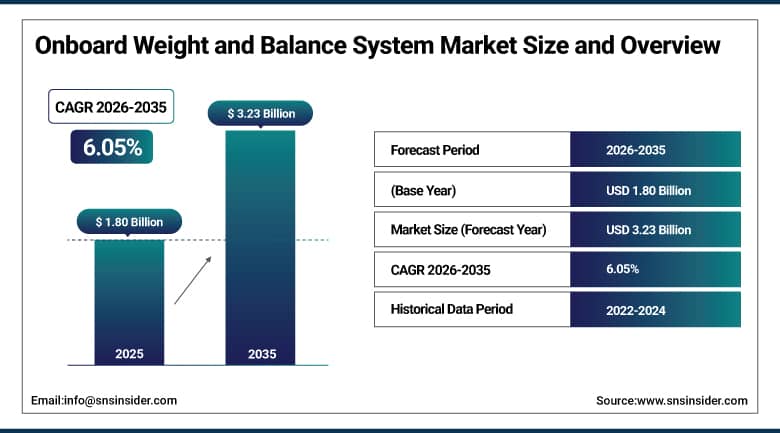
The Onboard Weight and Balance System Market was valued at USD 1.80 billion in 2025 and is expected to reach USD 3.23 billion by 2035, growing at a CAGR of 6.05% from 2026-2035.
The Onboard Weight and Balance System Market is witnessing steady growth as a result of rising need for accurate monitoring of the aircraft’s weight and balance to improve the safety of flights, fuel consumption, and performance. The onboard weight and balance system provides up-to-date information about the loading state of the aircraft to assist the operator in optimizing the loading pattern and keeping the right center-of-gravity range. The growing trend of commercial aviation operations, aircraft modernization, and digital technologies for aircraft is driving the need for weight and balance solutions. In addition, the increasing focus on fuel savings, optimization of the payload, and lowering operating costs is promoting the implementation of automated weighing and balance systems. The developments in sensor technology, wireless communications, avionics integration, and real-time analytics are adding to increased accuracy and reliability of the systems.
IATA reports that airlines are seeking lower fuel consumption, reduced emissions, and improved passenger/cargo load factors, encouraging manufacturers and DCS providers to improve weight-and-balance data accuracy.
To Get More Information On Onboard Weight and Balance System Market - Request Free Sample Report
Onboard Weight and Balance System Market Trends:
-
Rising focus on aircraft safety is driving adoption of onboard weight and balance systems for accurate load management.
-
Increasing commercial aircraft deliveries are expanding demand for automated weight and balance monitoring technologies.
-
Growing adoption of real-time aircraft data is improving weight estimation, balance assessment, and operational decision-making.
-
Advancements in sensor and avionics technologies are enhancing measurement accuracy, reliability, and system integration.
-
Increasing fuel-efficiency requirements are encouraging airlines to optimize aircraft loading and reduce unnecessary fuel consumption.
U.S. Onboard Weight and Balance System Market Outlook:
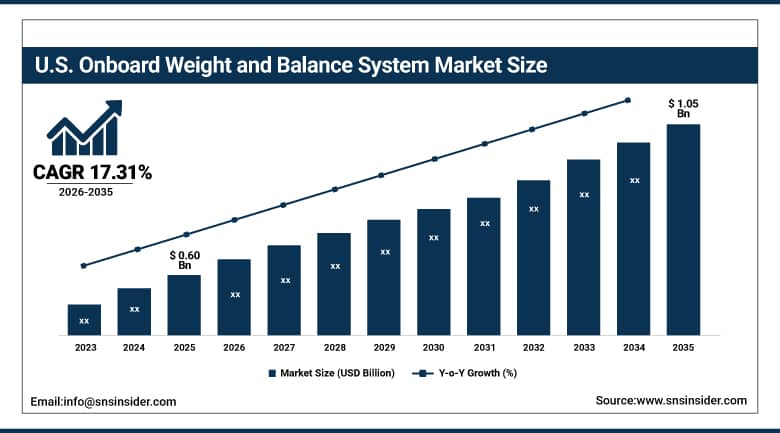
The U.S. Onboard Weight and Balance System Market was valued at USD 0.60 billion in 2025 and is expected to reach USD 1.05 billion by 2035, growing at a CAGR of 17.31% from 2026-2035.
The U.S. Onboard Weight and Balance System Market as weight and balance systems are experiencing rapid growth in response to growing requirements for the real-time and accurate measurement of aircraft weight and balance data to ensure flight safety, fuel efficiency, and aircraft performance. Weight and balance systems are necessary to provide data about the loading status of an aircraft that will allow airlines to distribute payloads safely within center of gravity limits. The growing number of commercial aircraft operations, modernization of aircraft fleets, and the development of new technologies in the aviation industry are the reasons for the growing demand for sophisticated weighing and balancing systems. Moreover, a growing emphasis on fuel efficiency and cost savings will also lead to the integration of automatic systems for measuring and managing weight information.
FAA's NextGen modernization has expanded digital communications, information sharing, surveillance, and automation; Data Comm en-route services operated across all 20 U.S. Air Route Traffic Control Centers in 2025.
Onboard Weight and Balance System Market Segment Analysis:
-
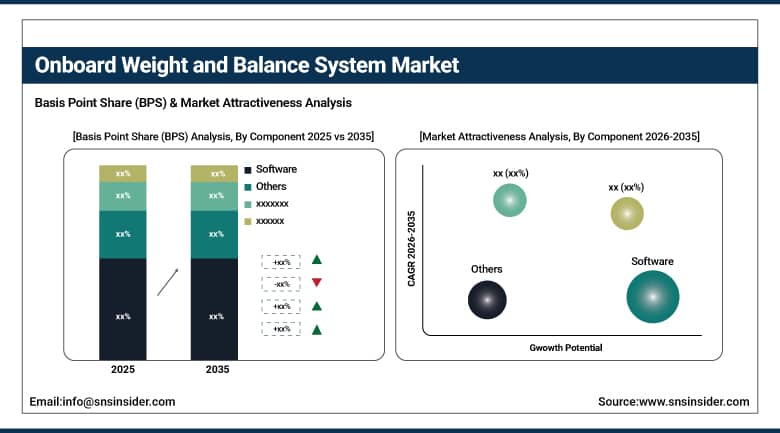
By Component, Software dominates the Onboard Weight and Balance System Market with 41% share in 2025; Software is expected to grow at the fastest CAGR of 6.50% from 2026–2035.
-
By Platform, Commercial Aircraft dominate the Onboard Weight and Balance System Market with 48% share in 2025; UAVs are expected to grow at the fastest CAGR of 15.43% from 2026–2035.
-
By Application, Passenger Aircraft dominate the Onboard Weight and Balance System Market with 72% share in 2025; Cargo Aircraft are expected to grow at the fastest CAGR of 7.33% from 2026–2035.
-
By End-User, Airlines dominate the Onboard Weight and Balance System Market with 39% share in 2025; MROs are expected to grow at the fastest CAGR of 7.30% from 2026–2035.
By Component, Software dominates the Onboard Weight and Balance System Market, Software grows fastest.
Software dominated the Onboard Weight and Balance System Market with the highest revenue share of about 41% in 2025, as it is key to the determination of aircraft weight, balance, and loading. Software-based systems allow for real-time computation, proper loading, and connection with avionic systems of the aircraft, enhancing safety and efficiency of operations in modern aircraft.
Software is expected to grow at the fastest CAGR of 6.50% from 2026–2035, backed up by increasing digitalization of air transportation and increasing incorporation of advanced avionics systems and load management systems. The continuous upgrade of software ensures improved precision, real-time monitoring, data management, and efficiency. The increasing popularity of technologies related to connected aircraft and predictive analytics is also driving the demand for software.
By Platform, Commercial Aircraft dominate the Onboard Weight and Balance System Market, UAVs grow fastest.
Commercial Aircraft dominated the Onboard Weight and Balance System Market with the highest revenue share of about 48% in 2025, motivated by higher aircraft usage rates, commercial aircraft fleets, and strict weight and balance control standards. The systems facilitate safe loading, improved fuel efficiency, and efficient flight operations, while rising air traffic volume and fleet upgrades keep up the demand in commercial aviation.
UAVs are expected to grow at the fastest CAGR of 15.43% from 2026–2035, supported by an increasing trend in the application of unmanned aircraft for surveillance, logistics, mapping, inspection, agricultural purposes, and military operations. With growing payload sophistication and requirements for stable performance in flight, there is a rising need for weight and balance management. The development of autonomous aircraft systems only reinforces this requirement.
By Application, Passenger Aircraft dominate the Onboard Weight and Balance System Market, Cargo Aircraft grow fastest.
Passenger Aircraft dominated the Onboard Weight and Balance System Market with the highest revenue share of about 72% in 2025, due to the fact that there are many large fleets of commercial airliners around the world and the number of flights daily. It is important for passenger safety, fuel efficiency, and aircraft performance. Increased need for flights, fleet growth, and aircraft development reinforce the usage in passenger aviation.
Cargo Aircraft are expected to grow at the fastest CAGR of 7.33% from 2026–2035, The reason for this is increasing activities in the air cargo industry, e-commerce, and demand for efficient logistics. The aircraft used to transport cargo have different loads and configurations, which makes it very important for correct weight and balance calculations. There is also an increase in the number of aircraft used.
By End-User, Airlines dominate the Onboard Weight and Balance System Market, MROs grow fastest.
Airlines dominated the Onboard Weight and Balance System Market with the highest revenue share of about 39% in 2025, motivated by the large number of aircraft that they possess as well as the continuous need for efficient flights. Airline companies require proper weight and balance management for better performance of the plane. The rise in passenger numbers and the increase in fleet numbers further drives the needs of airlines.
MROs are expected to grow at the fastest CAGR of 7.30% from 2026–2035, The need for such MRO services is justified by increased maintenance needs of the aircraft, increased aging of aircraft fleets, and the increase in the operations of aviation. MROs are increasingly needing to have high-level capability to diagnose, calibrate, and weight management to help with maintenance of aircraft.
Regional Analysis:
|
Region |
Major Country |
Share within Region, 2025 (%) |
|---|---|---|
|
North America |
United States |
91.0% |
|
Europe |
Germany |
24.0% |
|
Asia Pacific |
China |
38.0% |
|
Middle East & Africa |
UAE |
22.0% |
|
Latin America |
Brazil |
35.0% |
North America Onboard Weight and Balance System Market Insights
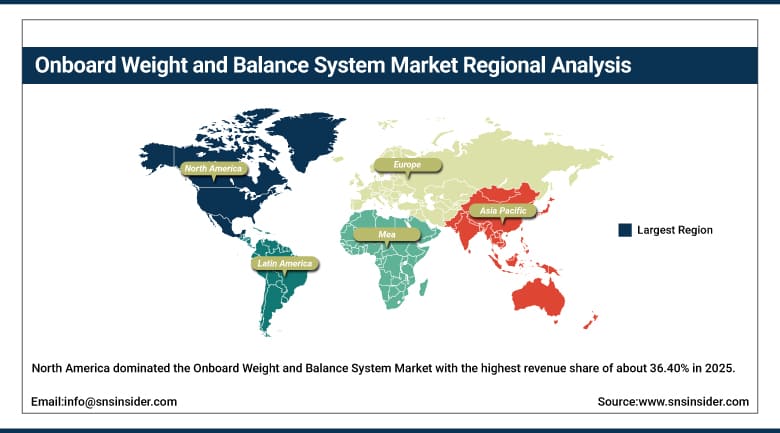
North America dominated the Onboard Weight and Balance System Market with the highest revenue share of about 36.40% in 2025, It is driven by active aircraft fleet movement, modern aviation infrastructure, and stringent requirements on flight safety. Digital aircraft technology, aircraft fleet modernization, and weight and balance technology adoption also boost regional demand for precise aircraft loading data.
The U.S. Onboard Weight and Balance System Market accounted for a market share of 91.0%, backed up by a substantial number of commercial and military fleets, robust aviation infrastructure, and high aircraft safety standards. Substantial funding for fleet upgrades, digital avionics, and connected aircraft is pushing the uptake of such systems. Increasing focus on precise payload management, fuel efficiency, and optimization continues to boost demand.
Get Customized Report as Per Your Business Requirement - Enquiry Now
Europe Onboard Weight and Balance System Market Insights
Europe is witnessing steady growth in the Onboard Weight and Balance System Market, supported by extensive commercial aviation operations, aircraft modernization, and stringent safety and operational requirements. Both airlines and aircraft operators are making use of digital loading technology in order to optimize load efficiency, fuel consumption, and payload management. Increased investments in avionics and aviation infrastructure contribute to regional market growth.
The Germany Onboard Weight and Balance System Market accounted for a market share of 24.0%, supported by strong presence of the aviation industry, efficient airplane production industry, and safety regulations. Modernization of aircraft fleet and use of digital avionics is driving demand for precise weight and balance systems. Attention to fuel efficiency, payload management, and safety enhances market growth potential.
Asia Pacific Onboard Weight and Balance System Market Insights
Asia Pacific is expected to grow at the fastest CAGR of about 7.32% from 2026–2035, Due to the fast growth in the use of commercial airlines, the increase in passenger movements, and the size of aircraft fleets. The market growth is being fueled due to the increasing use of modern aircraft, development of aviation infrastructure, and growing use of avionics technology.
The China Onboard Weight and Balance System Market accounted for a market share of 38.0%, backed by the fast growth in the aviation industry, passenger traffic, and increase in commercial airline fleets. The growth in airport infrastructure, modernization of fleets, and the use of advanced avionics is boosting the demand for the global cockpit display systems market. The focus on aircraft safety and fuel efficiency also aids market growth.
Middle East & Africa and Latin America Onboard Weight and Balance System Market Insights
Middle East & Africa and Latin America are experiencing growing demand for onboard weight and balance systems, supported by expanding airline fleets, increasing air passenger traffic, and aviation infrastructure development. Fleet modernization and increased attention to aircraft safety, fuel economy, and cargo management have encouraged the adoption of such systems. Increased investments made by airlines and operators in avionics and aircraft monitoring technologies will promote the growth of regional markets.
The UAE Onboard Weight and Balance System Market accounted for a market share of 22.0%, supported by the robust aviation industry, increasing airline fleet size, and constant investments in state-of-the-art aircraft and airport facilities. There is significant focus on flight safety, efficiency, fuel management, and avionics technology, which is driving the adoption of these systems. Commercial aviation growth and increased aircraft development will continue to drive demand.
Market Dynamics:
Growth Drivers: Stringent aviation safety requirements are driving adoption of accurate digital weight monitoring solutions.
The importance of adherence to weight and balance standards for safety is that if there is too much weight or the center of gravity is not correct, then it will have implications for the performance and handling of the aircraft. The regulation requires operators to have precise information on load calculation and weight and balance. A digital approach will minimize reliance on manual calculations through the integration of sensor input and aircraft information, passenger, luggage, cargo, and fuel information. The trend towards certified digital systems has been growing in recent years.
Restraints: High installation and certification costs can limit adoption across smaller aircraft operators.
On-board weight and balance systems can entail the use of special sensors, data acquisition system, avionics integration, software, calibration, testing, and certification. As such, retrofitting the systems into an existing aircraft can be costly in terms of engineering and installation costs, especially for old aircrafts that have a legacy avionics architecture. Operators who do not have a large number of aircrafts or cannot afford to upgrade their fleet may consider upgrading other critical systems first, and then consider installing the weight management systems in the future.
Opportunities: Increasing digitalization of airline operations creates opportunities for integrated weight management software.
Integration between electronic flight bags, flight operation systems, aircraft data, maintenance solutions, and operational analytics is growing among airlines. Weight and balance software solutions can be integrated into such ecosystems via automatic analysis of data on passengers, baggage, cargo, fuel, and aircraft configuration and performing calculations that comply with requirements for weight and balance. Current market research suggests that software solutions form a substantial part of onboard weight and balance products driven by aviation digitalization and the development of cloud-connected operational ecosystems. The competitive advantage of vendors includes automation, integration, analytics, predictability, and connectivity.
Recent Developments:
-
2026 : Curtiss-Wright Corporation was selected by Boeing to supply MOSA-aligned mission computers for the C-17 fleet modernization program, supporting upgraded aircraft flight-deck computing and avionics capabilities.
-
2026 : Safran continued advancing next-generation aircraft systems following its acquisition of Collins Aerospace’s flight-control and actuation activities, strengthening its portfolio of flight-control technologies and associated sensing systems.
-
2026 : Honeywell Aerospace outlined increased investment in aircraft technology, including retrofit, modification and upgrade solutions supporting greater electrification, autonomy, safety and next-generation aircraft platforms.
-
2025 : Boeing continued development of onboard aircraft weight-and-balance technology through its patented approach using landing-gear pressure, load and aircraft-attitude measurements to calculate aircraft gross weight and center of gravity.
Onboard Weight and Balance System Market key players are:
-
Honeywell International Inc.
-
Collins Aerospace
-
SAFRAN S.A.
-
Airbus S.A.S.
-
Boeing Company
-
Curtiss-Wright Corporation
-
Lufthansa Systems
-
Aviweight Ltd.
-
Aviobook (Thales Group)
-
Moog Inc.
-
General Electric Company (GE Aerospace)
-
Teledyne Controls LLC
-
Ultra Electronics Holdings plc
-
Meggitt PLC
-
Siemens AG
-
Intercomp Company
-
AVL List GmbH
-
Aviatronics Ltd.
-
Accelya
-
Swiss AviationSoftware Ltd.
Onboard Weight and Balance System Market Report Scope:
| Report Attributes | Details |
|---|---|
| Market Size in 2025 | USD 1.80 Billion |
| Market Size by 2035 | USD 3.23 Billion |
| CAGR | CAGR of 6.05% From 2026 to 2035 |
| Base Year | 2025 |
| Forecast Period | 2026-2035 |
| Historical Data | 2022-2024 |
| Report Scope & Coverage | Market Size, Segments Analysis, Competitive Landscape, Regional Analysis, DROC & SWOT Analysis, Forecast Outlook |
| Key Segments | • By Component (Hardware, Software, Services, Others) • By Platform (Commercial Aircraft, Military Aircraft, Business Jets, Helicopters, Cargo Aircraft, UAVs, Others) • By Application (Passenger Aircraft, Cargo Aircraft, Others) • By End-User (OEMs, Airlines, MROs, Others) |
| Regional Analysis/Coverage | North America (US, Canada), Europe (Germany, UK, France, Italy, Spain, Russia, Poland, Rest of Europe), Asia Pacific (China, India, Japan, South Korea, Australia, ASEAN Countries, Rest of Asia Pacific), Middle East & Africa (UAE, Saudi Arabia, Qatar, South Africa, Rest of Middle East & Africa), Latin America (Brazil, Argentina, Mexico, Colombia, Rest of Latin America). |
| Company Profiles | Honeywell International Inc., Collins Aerospace, SAFRAN S.A., Airbus S.A.S., Boeing Company, Curtiss-Wright Corporation, Lufthansa Systems, Aviweight Ltd., Aviobook (Thales Group), Moog Inc., General Electric Company (GE Aerospace), Teledyne Controls LLC, Ultra Electronics Holdings plc, Meggitt PLC, Siemens AG, Intercomp Company, AVL List GmbH, Aviatronics Ltd., Accelya, and Swiss AviationSoftware Ltd. |
Frequently Asked Questions
Key players in the Onboard Weight and Balance System Market include Honeywell International Inc., Collins Aerospace, SAFRAN S.A., Curtiss-Wright Corporation, and Lufthansa Systems, among others.
Key opportunities in the Onboard Weight and Balance System Market include aircraft fleet modernization, adoption of digital weight and balance software, integration of real-time analytics, and growing demand for fuel-efficient aviation operations.
The market is driven by rising air traffic, aircraft fleet expansion, stringent aviation safety requirements, fleet modernization, and increasing adoption of digital weight and balance technologies.
The Software segment dominated the Onboard Weight and Balance System Market, accounting for approximately 41.20% market share.
The North America region dominated the Onboard Weight and Balance System Market in 2025 with a 36.40% share, driven by growing aircraft fleet modernization and increasing demand for flight safety and operational efficiency.
