
Airport Sleeping Pods Market Report Scope & Overview:
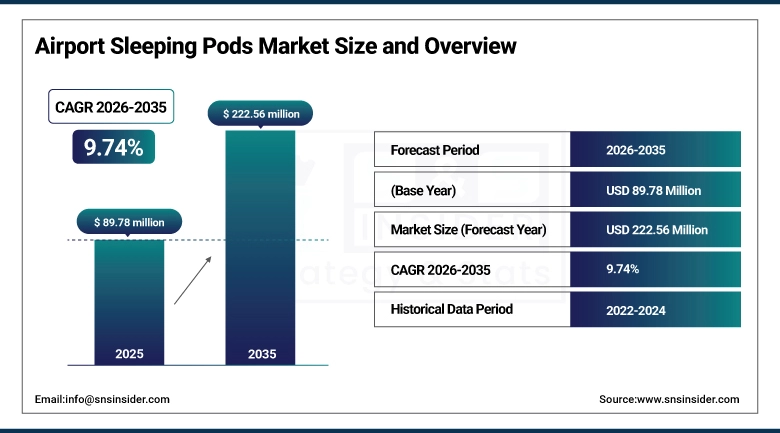
The Airport Sleeping Pods Market was valued at USD 89.78 million in 2025 and is expected to reach USD 222.56 million by 2035, growing at a CAGR of 9.74% from 2026–2035.
The Airport Sleeping Pods Market is experiencing high growth owing to the fast increase in worldwide air passenger traffic, the increasing trend toward long-haul and transit flights, and the rising preference for micro-hospitality services in the airport that improves passenger satisfaction during layover and delay time in flights. The increased focus on generating non-aeronautical revenues by airports is further propelling the installation of sleeping pods in the airport premises.
Supporting this trend, Airports Council International (ACI) has reported sustained growth in global passenger traffic recovery and expansion of international hub airports, particularly across Asia-Pacific and the Middle East, which is directly driving investment in passenger comfort infrastructure such as sleeping pods, capsule cabins, and modular rest zones.
In parallel, the ongoing IATA Airport Experience Program and Smart Airport modernization initiatives are encouraging airports to adopt digital-first passenger service ecosystems, including automated booking systems, IoT-enabled smart pods, and contactless micro-stay solutions. This is further strengthening the adoption of standardized, tech-enabled sleeping pod infrastructure across major global airports.
To Get more information on Airport Sleeping Pods Market - Request Free Sample Report
Airport Sleeping Pods Market Trends
-
Rising air passenger traffic and long-haul travel demand is increasing adoption of airport sleeping pods across global hubs.
-
Growing focus on non-aeronautical airport revenue is accelerating deployment of pay-per-use pod systems.
-
Rapid smart airport transformation is driving integration of IoT-enabled, contactless sleeping pod solutions.
-
Increasing flight delays and layover durations are boosting demand for short-term rest infrastructure.
-
Expanding airline-airport partnerships are improving accessibility of integrated passenger rest services.
-
Rising preference for privacy, hygiene, and comfort is shifting users from lounges to enclosed sleeping pods.
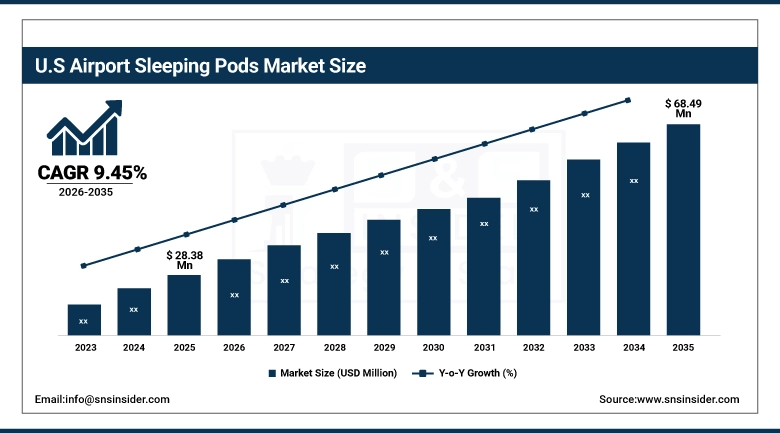
The U.S. Airport Sleeping Pods Market was valued at USD 28.38 million in 2025 and is expected to reach around USD 68.49 million by 2035, growing at a CAGR of 9.45% from 2026–2035.
The United States dominates the global airport sleeping pods market due to its highly developed airport infrastructure, strong presence of major international hubs, and early adoption of airport micro-hospitality solutions such as sleeping pods and sleep cabins across high-traffic terminals.
Supporting this growth, U.S. airport authorities are actively reshaping terminal design strategies to prioritize passenger dwell-time monetization and comfort-based infrastructure, leading to wider deployment of sleeping pods in high-traffic hubs such as JFK, LAX, Atlanta, and Dallas–Fort Worth.
Airport Sleeping Pods Market Segment Highlights
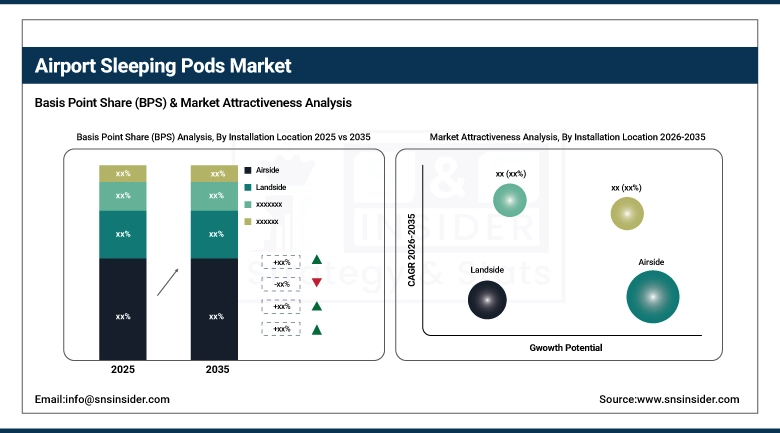
• By Installation Location, Airside (Departure Gates / Transit Zones) dominated the Airport Sleeping Pods Market with 48.76% share in 2025; Airport Hotel / Hybrid Zones are fastest growing CAGR
• By Product Type, Single Sleeping Pods (Capsule Pods) dominated the Airport Sleeping Pods Market with 55.15% share in 2025; Convertible Lounge Pods are fastest growing CAGR
• By Application, Transit / Layover Sleep (4–12 Hours) dominated the Airport Sleeping Pods Market with 35.85% share in 2025; Business Travel Recovery are fastest growing CAGR
• By End User, Airports (Direct Operators) dominated the Airport Sleeping Pods Market with 42.24% share in 2025; Third-Party Pod Service Providers are fastest growing CAGR.
• By Business Model, Pay-Per-Use Model dominated the Airport Sleeping Pods Market with 44.51% share in 2025; Subscription-Based Access Model are fastest growing CAGR
• By Technology Level, Basic / Manual Pods dominated the Airport Sleeping Pods Market with 40.51% share in 2025; AI-Integrated Pods are fastest growing CAGR.
By Installation Location, Airside (Departure Gates / Transit Zones) segment dominates the Airport Sleeping Pods Market, Airport Hotel / Hybrid Zones expected to grow fastest
In 2025, the Airside (Departure Gates / Transit Zones) segment maintained its dominant position in the Airport Sleeping Pods Market, accounting for 48.76% of total revenue. These leadership roles can be attributed to the presence of many passengers within transit points, as well as strong demand among long-distance and transit passengers, and the maximum potential for money generation while in transit. Moreover, installing these facilities airside will ensure that they are fully occupied since they provide access to departing and transit passengers.
From 2026 to 2035, the Airport Hotel / Hybrid Zones segment is projected to record the highest CAGR. The fast development is fueled by the increasing number of airport projects incorporating micro-hospitality facilities, the growing need for flexibility in the form of sleep-and-stay services, and the increased appreciation of hybrid environments combining pod facilities and small hotels.
By Product Type, Single Sleeping Pods (Capsule Pods) segment dominates the Airport Sleeping Pods Market, Convertible Lounge Pods expected to grow fastest
In 2025, the Single Sleeping Pods (Capsule Pods) segment maintained its dominant position in the Airport Sleeping Pods Market, accounting for 55.15% of total revenue. This dominance is driven by their space-efficient design, low installation cost, and high suitability for high-traffic airport terminals where rapid turnover and compact footprint are critical.
From 2026 to 2035, the Convertible Lounge Pods segment is projected to record the highest CAGR. Growth will be spurred by greater demand for adaptable seating-to-bed facilities, increased emphasis on luxury experience in passengers, and improvements by airports in providing modular facilities that adapt to changing passenger traffic and dwell time.
By Application, Transit / Layover Sleep (4–12 Hours) segment dominates the Airport Sleeping Pods Market, Business Travel Recovery segment expected to grow fastest
In 2025, the Transit / Layover Sleep (4–12 Hours) segment maintained its dominant position in the Airport Sleeping Pods Market, accounting for 35.85% of total revenue. The dominance in this case is attributable to an increase in the number of international connections, long stay times at major airports, and the preference of passengers for shorter sleep periods rather than lounges at the airport or overnight stays at hotels.
From 2026 to 2035, the Business Travel Recovery segment is projected to record the highest CAGR. The growth will be facilitated by the increase in corporate travel recovery after global disruption, focus on productivity and rest of passengers, and adoption of premium sleeping technology by regular business travelers to avoid fatigue during their travels.
By End User, Airports (Direct Operators) segment dominates the Airport Sleeping Pods Market, Third-Party Pod Service Providers expected to grow fastest
The Airports (Direct Operators) segment maintained the highest end-user share of 42.24% in 2025. It is mainly driven by growing investments made in enhancing passenger experience by airports, heavy concentration on non-aeronautical revenues, and direct ownership of terminal infrastructure that facilitates extensive installation of sleeping pods at international airports. Airports have now started to concentrate more on micro hospitality offerings in connection with their terminal upgrades and capacity augmentation plans.
The Third-Party Pod Service Providers segment is projected to achieve the highest growth rate during 2026–2035,
By Business Model, Pay-Per-Use Model segment dominates the Airport Sleeping Pods Market, Subscription-Based Access Model expected to grow fastest
The Pay-Per-Use Model segment held the largest share of 44.51% in 2025. Such dominance is justified by the high priority that passengers attach to brief rest periods with instant availability, simple transactions using online payments, and high compatibility with airport settings characterized by temporary stays where flexibility is crucial. The dominant solution also fits well with airport policies aimed at improving space usage efficiency.
The Subscription-Based Access Model segment is projected to register the highest CAGR during 2026–2035.
By Technology Level, Basic / Manual Pods segment dominates the Airport Sleeping Pods Market, AI-Integrated Pods expected to grow fastest
The Basic / Manual Pods segment maintained the dominant share of 40.51% in 2025. Such kind of leadership can be credited to the relatively cheaper costs of installation, airport suitability, and the ease of implementation within developed and developing countries. Such systems will continue being favored within heavily trafficked airports because of simplicity, reliability, and quickness in deployment.
The AI-Integrated Pods segment is projected to record the highest growth rate during 2026–2035.
Airport Sleeping Pods Market Regional Analysis
|
Region |
Major Country |
Share within Region (%) |
|---|---|---|
|
North America |
United States |
37.09% |
|
Europe |
Germany |
32.89% |
|
Asia Pacific |
China |
23.44% |
|
Middle East & Africa |
UAE |
4.04% |
|
Latin America |
Brazil |
2.54% |
North America Airport Terminal Operations Market Insights
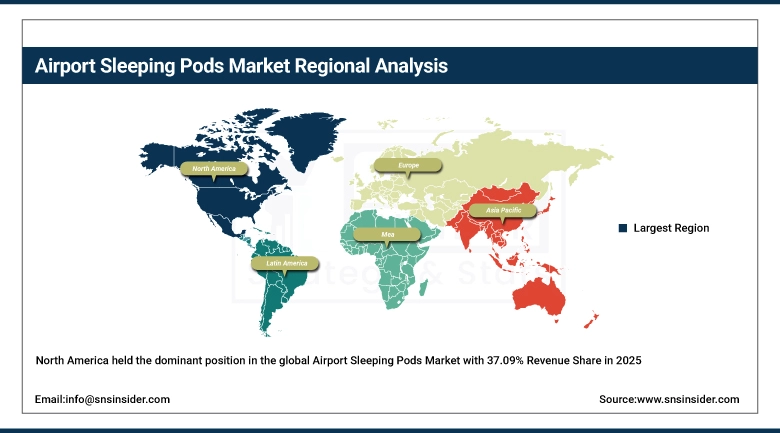
North America held the dominant position in the global Airport Sleeping Pods Market with 37.09% Revenue Share in 2025 is projected to be boosted by extensive airport infrastructure, robust passenger movement through key international airports, and the early adoption of airport micro-hospitality and passenger comfort innovations. The region is fortunate enough to have sleeping pods extensively utilized in major airports like Atlanta, JFK, Los Angeles, and Dallas–Fort Worth, with operators focusing on generating revenues from non-airline sources and improving the quality of service for premium passengers. The U.S. leads the regional market share, fueled by the popularity of long-haul travel, extensive layovers, and quick adoption of digital airports services ecosystems.
Supporting this dominance, the Federal Aviation Administration (FAA) and major U.S. airport authorities are actively promoting passenger experience modernization programs that encourage the integration of modular rest infrastructure, including sleeping pods, sleep cabins, and automated micro-stay units. This is significantly accelerating adoption across both domestic and international terminals, particularly in congested hub airports.
Additionally, increasing investments by U.S. airport operators in smart terminal transformation programs are driving deployment of IoT-enabled sleeping pods integrated with mobile booking platforms, real-time occupancy tracking, and contactless access systems. This is enhancing operational efficiency while improving passenger dwell-time monetization strategies across major airports.
Get Customized Report as per Your Business Requirement - Enquiry Now
Asia Pacific Airport Sleeping Pods Market Insights
The Asia Pacific region is projected to register the highest CAGR of 10.42% from 2026–2035, In 2025, Europe accounted for a large portion of the world market due to its well-established air transport network, dense international connectivity, and emphasis on innovation in the passenger experience at key airports. Nations like Germany, the UK, France, the Netherlands, and Spain have been the primary innovators in this area, and sleeping pods are being introduced into terminals in lounges, transition areas, and micro-hospitality zones.
Supporting this growth, aviation authorities such as the Civil Aviation Administration of China (CAAC) and India’s Airports Authority of India (AAI) are prioritizing modernization of airport terminals with enhanced passenger comfort facilities, including capsule-style sleeping pods and modular rest zones. These initiatives are strongly aligned with the region’s push toward smart airport development and passenger experience optimization.
Additionally, the rapid expansion of aviation hubs in Singapore, Dubai-linked Asia routes, and Indian metro airports is accelerating adoption of cost-efficient, high-density sleeping pod installations, particularly in transit-heavy terminals where layover optimization is critical.
Europe Airport Sleeping Pods Market Insights
In 2025, Europe accounted for a large portion of the world market due to its well-established air transport network, dense international connectivity, and emphasis on innovation in the passenger experience at key airports. Nations like Germany, the UK, France, the Netherlands, and Spain have been the primary innovators in this area, and sleeping pods are being introduced into terminals in lounges, transition areas, and micro-hospitality zones.
Supporting this position, the European Union Aviation Safety Agency (EASA) and airport regulatory frameworks across Europe are encouraging standardization of passenger comfort infrastructure, indirectly supporting adoption of modular sleeping solutions. Airports such as Frankfurt, Heathrow, and Amsterdam Schiphol are increasingly incorporating automated rest pods as part of broader terminal digitalization and passenger flow optimization initiatives.
Additionally, growing investments in airport sustainability programs and space optimization strategies are driving demand for compact, energy-efficient sleeping pod systems, particularly those integrated with smart booking and access control technologies.
Latin America, Middle East & Africa (LAMEA) Airport Sleeping Pods Market Insights
The Airport Sleeping Pods Market in LAMEA is growing at a consistent pace due to slow but certain modernization of airport facilities, high levels of international air travel, and increased spending on tourism aviation facilities. Some countries that have emerged as important players in this market include Brazil, Mexico, South Africa, Saudi Arabia, United Arab Emirates, and Qatar.
Supporting this growth, governments in the Middle East—especially in the UAE General Civil Aviation Authority (GCAA) and Saudi Arabia’s aviation modernization programs—are heavily investing in world-class airport infrastructure under initiatives such as Vision 2030, which includes enhancement of passenger comfort services like sleeping pods, sleep cabins, and premium rest zones.
Additionally, increasing participation of global airport operators and hospitality concession companies is accelerating technology transfer and deployment of modular sleeping solutions in emerging markets, particularly in high-traffic transit airports and newly developed aviation megaprojects.
Airport Sleeping Pods Market Growth Drivers:
-
Rising global air passenger traffic, rapid airport modernization programs, and accelerating adoption of AI-enabled automation technologies are driving strong demand for integrated airport terminal operations systems worldwide
The main structural factor impacting the Airport Terminal Operations Market is the steady rise in demand for air travel services around the globe along with major investments being made in smart airport facilities and digitization of airport terminals. With the steady increase in passenger numbers, both in developing and developed nations, there is mounting pressure on airports to become more efficient in terms of operations, minimize congestion, and offer an overall better experience to passengers.
Additionally, regulatory and institutional support from aviation authorities such as the Federal Aviation Administration (FAA) and the International Civil Aviation Organization (ICAO) is reinforcing airport digitalization efforts through modernization frameworks, safety compliance standards, and operational efficiency guidelines.
Recent smart airport initiatives at major hubs such as Singapore Changi Airport, Hartsfield–Jackson Atlanta International Airport, and Dubai International Airport further demonstrate the rapid integration of AI-driven operations, biometric passenger processing, and automated baggage systems, strengthening the long-term growth trajectory of the market.
Airport Sleeping Pods Market Restraints:
-
High operational complexity and integration challenges in managing multi-layered airport terminal systems are increasing implementation costs and limiting scalability across smaller and mid-sized airports
Complexity is the main constraint within the Airport Terminal Operations Market since there are several interconnected systems involved in the operations such as passenger boarding, luggage handling, security checks, and airside activities. The modern terminal uses an interplay of artificial intelligence technologies, biometrics for identification, IoT infrastructure, and operational systems. Therefore, to be effective, there needs to be a seamless integration between the different systems, which can be technologically difficult and require substantial investment.
Airport Sleeping Pods Market Opportunities:
-
Expansion of smart airport infrastructure programs and large-scale terminal modernization projects is creating strong opportunities for advanced, fully integrated airport terminal operations platforms
The key opportunity in the Airport Terminal Operations Market is the prevailing trend across the world towards developing smart airport ecosystems by redefining airports as digital and data-enabled operations centers. With increasing investments being made in building greenfield airports as well as expanding existing airports, there is a growing need to implement advanced airport operations solutions, which enable integrating the entire process of passenger boarding, luggage handling, security checks, and resource management in one comprehensive platform. There is growing demand for such cloud-based and scalable systems that support seamless operations for handling large volumes of passengers.
Recent Developments:
• 2026: Major global airport operators advanced deployment of fully integrated smart terminal platforms, expanding AI-enabled passenger flow management, biometric boarding systems, and real-time baggage tracking solutions across high-traffic hubs in North America, Asia-Pacific, and the Middle East, significantly improving terminal efficiency and reducing congestion at peak travel periods.
• 2026: Leading aviation technology providers including Amadeus IT Group and SITA expanded next-generation Airport Operations Control Center (AOCC) solutions, integrating predictive analytics and digital twin capabilities for proactive disruption management, resource optimization, and improved coordination between airlines, ground handlers, and airport authorities.
• 2025: Several major international airports, including Dubai International Airport and Singapore Changi Airport, accelerated rollout of end-to-end contactless passenger processing systems, incorporating biometric identity verification, e-gate boarding, and automated self-service baggage drop systems to enhance throughput efficiency and passenger experience.
• 2025: North American airport infrastructure modernization programs expanded significantly, with major hubs such as Atlanta Hartsfield–Jackson and Los Angeles International Airport implementing upgraded AI-based security screening systems and intelligent baggage handling automation, strengthening operational resilience and reducing processing delays across terminal operations.
Airport Sleeping Pods Market Key Players
Some of the Airport Sleeping Pods Market Companies
-
GoSleep
-
Minute Suites
-
Sleepbox
-
Napcabs
-
YOTELAir (Yotel)
-
Sleep ‘n Fly (Airport Dimensions)
-
SnoozeCube
-
9h Nine Hours
-
JetQuay
-
ZzzleepandGo
-
Aerotel
-
CapsuleTransit
-
Snooze at My Space
-
MetroNaps
-
Restworks
-
Podtime
-
RelaxBox
-
iGA Sleepod
-
CabinSpacey
-
AviaTor Sleep Pods
Airport Sleeping Pods Market Report Scope:
| Report Attributes | Details |
|---|---|
| Market Size in 2025 | USD 89.78 Million |
| Market Size by 2035 | USD 222.56 Million |
| CAGR | CAGR of 9.74% From 2026 to 2035 |
| Base Year | 2025 |
| Forecast Period | 2026-2035 |
| Historical Data | 2022-2024 |
| Report Scope & Coverage | Market Size, Segments Analysis, Competitive Landscape, Regional Analysis, DROC & SWOT Analysis, Forecast Outlook |
| Key Segments | • By Installation Location (Airside / Departure Gates & Transit Zones, Landside / Arrival Terminals, Airport Lounges & VIP Areas, Airport Hotel / Hybrid Zones) • By Product Type (Single Sleeping Pods / Capsule Pods, Double / Family Pods, Premium Sleeper Cabins, Convertible Lounge Pods, Smart / IoT-Enabled Pods) • By Application (Short-Term Rest (1–4 Hours), Transit / Layover Sleep (4–12 Hours), Flight Delay Accommodation, Business Travel Recovery, Long-Haul Passenger Rest) • By End User (Airports / Direct Operators, Airline Partnerships, Airport Lounge Operators, Third-Party Pod Service Providers, Airport Hospitality Concessionaires) • By Business Model (Pay-Per-Use Model, Subscription-Based Access Model, Revenue-Sharing Partnerships, Airport-Owned & Operated Model, Franchise / Licensed Operators) • By Technology Level (Basic / Manual Pods, Smart Pods (Digital Booking & Access Control), IoT-Enabled Pods (Sensors & Automation), AI-Integrated Pods (Predictive Usage & Dynamic Pricing)) |
| Regional Analysis/Coverage | North America (US, Canada), Europe (Germany, UK, France, Italy, Spain, Russia, Poland, Rest of Europe), Asia Pacific (China, India, Japan, South Korea, Australia, ASEAN Countries, Rest of Asia Pacific), Middle East & Africa (UAE, Saudi Arabia, Qatar, South Africa, Rest of Middle East & Africa), Latin America (Brazil, Argentina, Mexico, Colombia, Rest of Latin America). |
| Company Profiles | GoSleep, Minute Suites, Sleepbox, Napcabs, YOTELAir (Yotel), Sleep ‘n Fly (Airport Dimensions), SnoozeCube, 9h Nine Hours, JetQuay, ZzzleepandGo, Aerotel, CapsuleTransit, Snooze at My Space, MetroNaps, Restworks, Podtime, RelaxBox, iGA Sleepod, CabinSpacey, AviaTor Sleep Pods |

Frequently Asked Questions
North America dominated the Airport Sleeping Pods Market in 2025.
The Airside (Departure Gates / Transit Zones) segment dominated the Airport Sleeping Pods Market in 2025.
Rapid growth in global air passenger traffic, increasing smart airport modernization programs, and accelerating adoption of AI-driven automation, biometric processing, and digital terminal operations platforms are the primary growth drivers of the Airport Terminal Operations Market.
The Airport Sleeping Pods Market was valued at USD 89.78 Million in 2025.
The Airport Sleeping Pods Market is expected to grow at a CAGR of 9.74% from 2026 to 2035.
