
Animal-based Protein Supplements Market Report Scope & Overview:
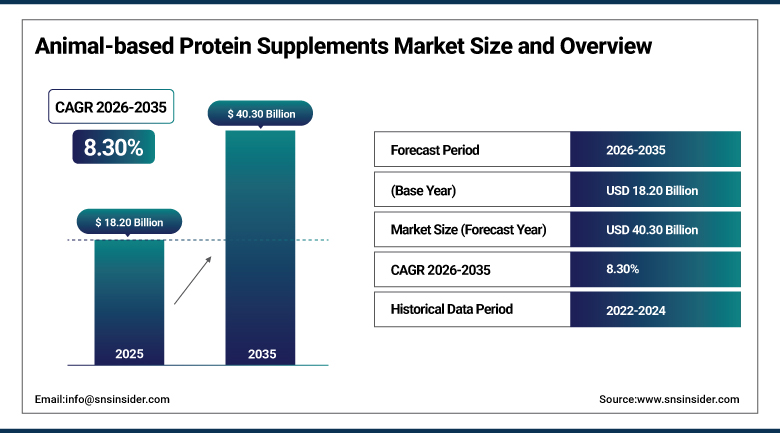
The Animal-based Protein Supplements Market was valued at USD 18.20 Billion in 2025 and is expected to reach USD 40.30 Billion by 2035, growing at a CAGR of 8.30% from 2026 to 2035.
Protein has quietly become one of the most negotiated words on a food label, and animal-derived sources, whey, casein, collagen, egg, are where most of that negotiation still lands. The World Health Organization puts the average adult's protein requirement at roughly 0.66 grams per kilogram of body weight daily, rising to 0.9-1.1 grams for healthy older adults, and that gap between recommended intake and typical dietary consumption is largely what supplement brands have built their businesses around. Gym-goers were the original audience, but the customer base has widened considerably: older adults managing muscle loss, people recovering from illness or surgery, and consumers simply trying to eat less processed food while hitting a protein target are all buying into the category now.
In August 2025, Vital Proteins LLC entered the ready-to-drink category with a Collagen & Protein Shake delivering 30 grams of protein and 10 grams of collagen peptides per serving, extending its portfolio beyond powdered formats into convenience-focused beverages.
To Get more information Animal-based Protein Supplements Market - Request Free Sample Report
Animal-based Protein Supplements Market Trends
-
Ready-to-drink formats are pulling share away from powders as convenience becomes the deciding factor for younger buyers.
-
Collagen-and-whey hybrid blends are appearing on shelves as brands chase both muscle-recovery and skin-health claims at once.
-
Clinical and medical nutrition brands are adding higher-protein formulations aimed at older adults managing age-related muscle loss.
-
Flavor collaborations with mainstream food brands are becoming a common way for protein powder makers to reach non-gym shoppers.
-
Retailers are giving more shelf space to protein products outside the traditional supplement aisle, including dairy cases and snack sections.
U.S. Animal-based Protein Supplements Market Outlook
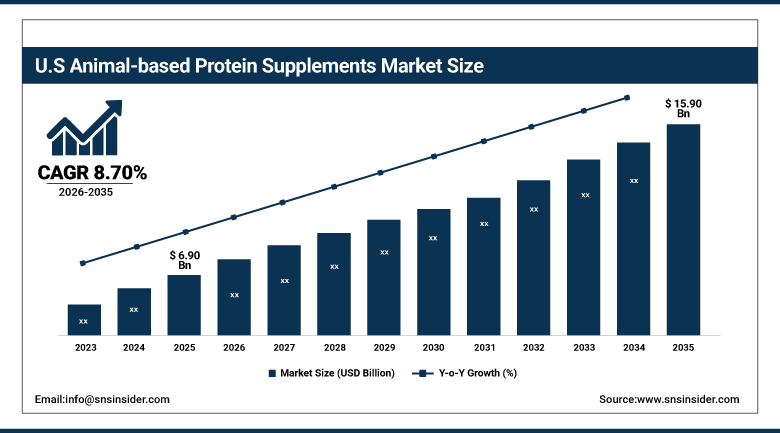
The U.S. Animal-based Protein Supplements Market was valued at USD 6.90 Billion in 2025 and is projected to reach USD 15.90 Billion by 2035, growing at a CAGR of 8.70% during 2026-2035.
The U.S. is where most of the category's product experimentation happens first, and it shows in how fast shelf formats are multiplying, protein sodas, frozen waffles, cereal collaborations, none of which existed in this category a few years ago. Retail chains have responded by carving out more permanent protein sections rather than tucking these products into a single supplement aisle. Clinical nutrition is a quieter but steady growth line here too, as hospitals and long-term care providers lean more on higher-protein formulations to manage recovery and age-related muscle loss among older patients. Meanwhile, mainstream grocery and club-store distribution keeps expanding, which has done more to grow the category's reach than any single new product launch.
In late 2025, BellRing Brands, Inc. introduced a sparkling protein soda line under its Premier Protein brand, delivering 15 grams of whey protein isolate per can, marking the company's first major departure from its traditional shake and powder formats.
Animal-based Protein Supplements Market Segment Analysis
-
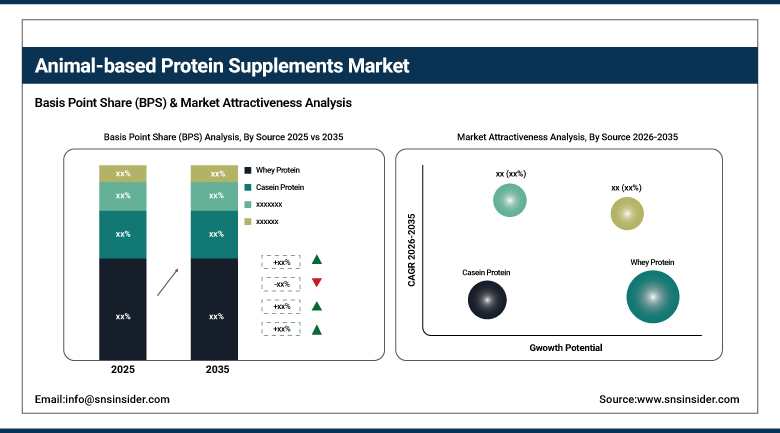
By Source, Whey Protein segment dominated the Animal-based Protein Supplements Market in 2025 with 64% share; Collagen Protein segment is the fastest-growing segment.
-
By Form, Protein Powder segment dominated the market in 2025 with 66% share; RTD Shakes segment is the fastest-growing segment.
-
By Application, Sports Nutrition segment dominated the market in 2025 with 69% share; Clinical Nutrition segment is the fastest-growing segment.
-
By Distribution Channel, Supermarkets & Hypermarkets segment dominated the market in 2025 with 37% share; Online Retail segment is the fastest-growing segment.
By Source, Whey Protein Leads the Animal-based Protein Supplements Market While Collagen Protein Gains Ground Fastest
Whey's dominance with a market share of 64% in 2025 comes down to something fairly simple: it works fast, and the science backing it is about as settled as sports nutrition science gets. It is a complete protein, rich in the branched-chain amino acids that drive muscle protein synthesis, and it absorbs quickly enough to matter for post-workout recovery. Decades of dairy processing infrastructure also mean whey concentrate and isolate are cheaper to produce at scale than most alternatives, which keeps it the default choice for everything from bodybuilding powders to mainstream ready-to-drink shakes.
Collagen's rise has less to do with muscle building and more to do with the beauty-and-wellness crowd discovering protein supplements for the first time. Marketed around joint support, skin elasticity, and hair and nail health, collagen peptides have pulled in a customer base that whey powders never really reached, people who would not call themselves gym-goers but are happy to stir a scoop into their morning coffee. That crossover appeal is why collagen brands are now expanding into RTD shakes and functional beverages.
By Form, Protein Powder Dominates While RTD Shakes Emerge as the Fastest-Growing Format
Protein Powder dominated the market in 2025 with 66% share and it still leads on format because it is the most flexible option available, it can be mixed into shakes, baked into recipes, or added to oatmeal, and a single tub typically works out cheaper per gram of protein than bars or ready-to-drink alternatives. Serious gym-goers in particular tend to stick with powder because it lets them control dosing precisely, something harder to do with pre-portioned formats.
RTD Shakes are growing fastest simply because they remove the one friction point powder never solved, you still have to mix it. A canned or bottled shake works for someone grabbing breakfast on the way out the door, and that convenience factor has pulled in a much broader, less fitness-focused buyer than the category traditionally attracted. Cold-chain retail distribution through convenience stores and grocery coolers has expanded right alongside this shift.
By Application, Sports Nutrition Dominates While Clinical Nutrition Registers the Fastest Growth
Sports Nutrition dominated the market with 69% ,arket share in 2025, and it is not just competitive athletes driving that, recreational gym-goers and the broader fitness-conscious public now make up most of the volume. Post-workout recovery is still the primary use case, but pre-workout and everyday protein-supplementation habits have become just as common, which has widened the addressable market well beyond serious lifters.
Clinical Nutrition is climbing fastest as healthcare providers pay closer attention to protein intake in recovery and aging care, sarcopenia, post-surgical recovery, and general malnutrition risk in older adults are all conditions where higher protein intake has become a standard part of care plans. Hospital and long-term care procurement of medical-grade protein formulations is growing alongside this shift, and it is a steadier, less trend-driven growth line than sports nutrition.
By Distribution Channel, Supermarkets & Hypermarkets Dominates While Online Retail Registers the Fastest Growth
Supermarkets & Hypermarkets held the largest distribution share of 37% in 2025 mostly because that is where protein products have migrated as they have gone mainstream, a shopper picking up groceries can now toss a tub of whey or a case of RTD shakes into the same cart without a special trip to a supplement store. Retailers have responded by expanding dedicated protein sections, which has reinforced this channel's lead rather than eroding it.
Online Retail is growing fastest as subscription models and direct-to-consumer brands make it easier for repeat buyers to reorder without thinking about it, and bulkier products like protein powder tubs benefit from home delivery in a way lighter goods do not. Brand-specific apps and loyalty programs have also made it easier for supplement companies to build repeat purchase habits online than they ever could in physical retail.
Regional Analysis
|
Region |
Country |
Share (2025) |
|
North America |
United States |
86.20% |
|
Asia Pacific |
China |
31.50% |
|
Europe |
Germany |
24.60% |
|
Middle East & Africa |
UAE |
17.40% |
|
Latin America |
Brazil |
26.80% |
North America Animal-based Protein Supplements Market Insights
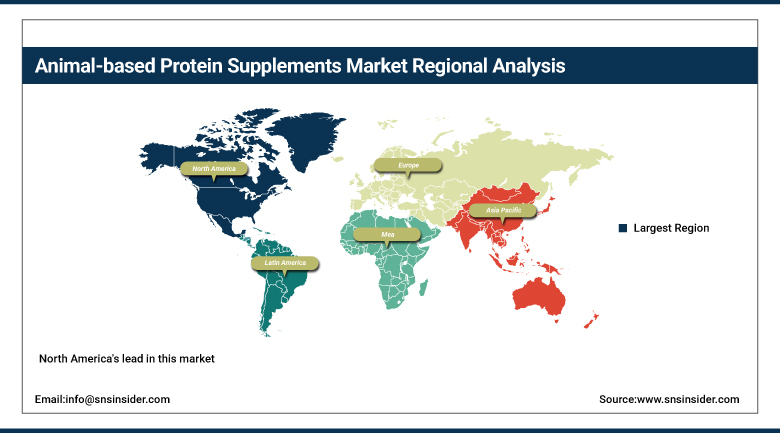
North America's lead in this market is not new, and it is not really about to change either, decades of gym culture, an established supplement retail infrastructure, and now a widening clinical-nutrition customer base all reinforce each other. What has shifted more recently is who is buying: the stereotypical bodybuilder customer is now a smaller slice of a much bigger pie that includes older adults, casual fitness enthusiasts, and people simply trying to eat higher-protein diets without much thought about sports performance at all.
The United States accounts for approximately 86.20% of the North American market, reflecting its large fitness-conscious population and extensive supplement retail and e-commerce infrastructure. Canada contributes a smaller but steadily growing share, supported by rising sports nutrition participation and expanding grocery distribution of protein products.
Get Customized Report as per Your Business Requirement - Enquiry Now
Asia Pacific Animal-based Protein Supplements Market Insights
Asia Pacific's growth story looks different from North America's, this is less about an already-large market getting bigger and more about a market that is still forming. Rising disposable incomes, growing gym membership numbers in urban centers, and a generational shift toward Western-style fitness culture are all converging in countries where protein supplementation barely existed as a retail category a decade ago. China's scale alone makes it the region's largest market, but growth rates across Southeast Asia and India suggest the region's center of gravity could shift over the next decade.
China holds roughly 31.50% of the Asia Pacific market, driven by rapid growth in urban gym culture and expanding e-commerce access to imported and domestic protein brands. India and Southeast Asian markets are growing at a notably faster clip, supported by young populations and rising health awareness among urban middle-class consumers.
Europe Animal-based Protein Supplements Market Insights
Europe's market is mature relative to Asia Pacific but still has meaningful room to grow, particularly as clinical nutrition gains traction alongside the more established sports nutrition segment. Regulatory scrutiny around health claims is tighter here than in North America, which has actually pushed European brands toward more clinically substantiated formulations rather than slowing the category down.
Germany leads the European market with a 24.60% share, supported by its strong fitness culture and well-established sports nutrition retail base. The United Kingdom and France follow, with the UK's growth tied to online retail expansion and France's driven by rising clinical nutrition adoption among its aging population.
Middle East & Africa and Latin America Animal-based Protein Supplements Market Insights
The Middle East & Africa region is growing off a smaller base, concentrated mainly in Gulf state urban centers where fitness culture and disposable incomes have both risen quickly. Latin America's growth follows a similar arc, with Brazil's well-established gym culture giving it a head start over most of the region.
The UAE occupies a dominant position in the Middle East & Africa market with a 17.40% market share, backed up by high membership of gyms and fitness-conscious expatriates. The share of Brazil in the Latin America market is 26.80%, owing to its long-established fitness and bodybuilding culture, while Mexico adds through its organized retail and ecommerce.
Market Dynamics
Growth Drivers: Widening Consumer Base and Clinical Adoption Driving Market Growth
What is really driving this market is not just more gym-goers buying more protein, it is the customer base itself getting broader every year. Older adults managing muscle loss, people recovering from illness, and everyday consumers chasing a protein target on a nutrition label are now buying products that used to be marketed almost exclusively to athletes, and that shift alone accounts for a large share of the category's growth.
Product format innovation is reinforcing this trend, since RTD shakes, protein sodas, and functional snacks make the category accessible to people who never would have bought a tub of powder in the first place.
Restraints: Raw Material Cost Volatility and Plant-Based Competition Limiting Market Expansion
Dairy commodity prices, whey concentrate in particular, have swung significantly over the past few years, and that volatility makes it hard for brands to hold retail pricing steady without squeezing margins. Collagen sourcing, largely dependent on bovine and marine byproducts, carries similar supply chain exposure tied to livestock and fisheries markets rather than manufacturing capacity.
Plant-based protein alternatives are also chipping away at growth in some consumer segments, particularly among younger and more environmentally conscious buyers who see animal-derived proteins as less sustainable, even where the nutritional case for whey or collagen remains stronger on paper.
Opportunities: Functional Blends and Healthy-Aging Formulations Creating New Growth Avenues
The clearest growth opportunity right now sits at the intersection of protein and other functional benefits, collagen-whey blends marketed for both recovery and skin health, or protein formulations fortified with vitamin D and calcium for bone support in older adults. Brands that can credibly make more than one health claim at once are finding it easier to justify premium pricing.
Healthy-aging formulations aimed specifically at older adults represent a still-underdeveloped opportunity, given how directly WHO's higher protein recommendations for older populations map onto an aging global demographic. Partnerships between supplement brands and healthcare providers or senior living operators could open a distribution channel that barely exists today.
Recent Developments:
-
August 2025: Vital Proteins LLC launched a ready-to-drink Collagen & Protein Shake delivering 30 grams of protein and 10 grams of collagen peptides per serving.
-
Late 2025: BellRing Brands, Inc. introduced a sparkling protein soda line under its Premier Protein brand, featuring 15 grams of whey protein isolate per can.
-
2025: Dymatize, a BellRing Brands portfolio brand, partnered with Dunkin' to expand its ISO100 protein powder line with new donut-inspired flavors.
-
2025: Glanbia plc's Optimum Nutrition brand rolled out its "The Optimum Advantage" campaign across more than 100 markets while expanding its Isopure Protein Water lineup.
Animal-based Protein Supplements Market key players are:
-
Glanbia plc
-
BellRing Brands, Inc.
-
Nestlé Health Science
-
Abbott Laboratories
-
Herbalife Nutrition Ltd.
-
GNC Holdings, LLC
-
Iovate Health Sciences International Inc.
-
MusclePharm Corporation
-
Nutrabolt
-
Arla Foods Ingredients Group P/S
-
Fonterra Co-operative Group Limited
-
Kerry Group plc
-
Hilmar Cheese Company, Inc.
-
Agropur Cooperative
-
Vital Proteins LLC
-
Amway Corporation
-
The Vitamin Shoppe, Inc.
-
Nutraceutical International Corporation
-
Isagenix International LLC
-
Ajinomoto Co., Inc.
Animal-based Protein Supplements Market Report Scope:
| Report Attributes | Details |
|---|---|
| Market Size in 2025 | USD 18.20 Billion |
| Market Size by 2035 | USD 40.30 Billion |
| CAGR | CAGR of 8.30% From 2026 to 2035 |
| Base Year | 2025 |
| Forecast Period | 2026-2035 |
| Historical Data | 2022-2024 |
| Report Scope & Coverage | Market Size, Segments Analysis, Competitive Landscape, Regional Analysis, DROC & SWOT Analysis, Forecast Outlook |
| Key Segments | • By Source (Whey Protein, Casein Protein, Collagen Protein, Egg Protein, Others) • By Form (Protein Powder, RTD Shakes, Protein Bars, Capsules & Tablets) • By Application (Sports Nutrition, Clinical Nutrition, Weight Management, Functional Food & Beverage) • By Distribution Channel (Supermarkets & Hypermarkets, Specialty Stores, Online Retail, Pharmacies & Drugstores) |
| Regional Analysis/Coverage | North America (US, Canada), Europe (Germany, UK, France, Italy, Spain, Russia, Poland, Rest of Europe), Asia Pacific (China, India, Japan, South Korea, Australia, ASEAN Countries, Rest of Asia Pacific), Middle East & Africa (UAE, Saudi Arabia, Qatar, South Africa, Rest of Middle East & Africa), Latin America (Brazil, Argentina, Mexico, Colombia, Rest of Latin America). |
| Company Profiles | Glanbia plc, BellRing Brands, Inc., Nestlé Health Science, Abbott Laboratories, Herbalife Nutrition Ltd., GNC Holdings, LLC, Iovate Health Sciences International Inc., MusclePharm Corporation, Nutrabolt, Arla Foods Ingredients Group P/S, Fonterra Co-operative Group Limited, Kerry Group plc, Hilmar Cheese Company, Inc., Agropur Cooperative, Vital Proteins LLC, Amway Corporation, The Vitamin Shoppe, Inc., Nutraceutical International Corporation, Isagenix International LLC, Ajinomoto Co., Inc. |

Frequently Asked Questions
Key players in the Animal-based Protein Supplements Market include Glanbia plc, BellRing Brands, Inc., Nestlé Health Science, Abbott Laboratories, Herbalife Nutrition Ltd., GNC Holdings, LLC among others.
Ans: Development in cost oKey opportunities include premium whey, collagen, clinical nutrition, functional foods, sports nutrition, and convenient formats.f improvements and expansion in worries connected with the killing of animals is the restrains/challenges faced by the animal-based protein supplements market.
The market is driven by a widening consumer base beyond athletes, rising clinical nutrition adoption among aging populations, and expanding RTD and functional product formats.
The Whey Protein segment dominated the Animal-based Protein Supplements Market in 2025.
The North America region dominated the Animal-based Protein Supplements Market in 2025, accounting for approximately 44% of global market share.
