
Ulva Lactuca Market Report Scope & Overview:
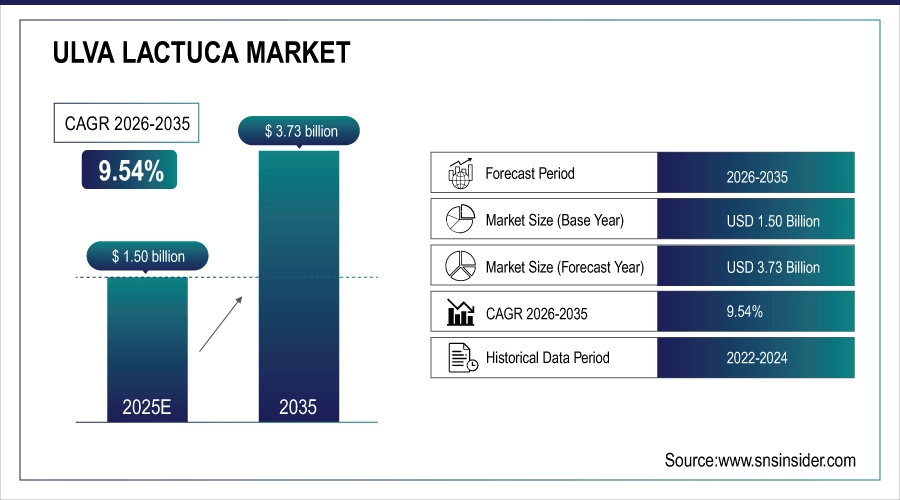
The Ulva Lactuca Market size was valued at USD 1.50 Billion in 2025 and is projected to reach USD 3.73 Billion by 2035, growing at a CAGR of 9.54% during 2026–2035.
The Ulva Lactuca market is witnessing robust growth due to rising demand for sustainable seaweed across food, nutraceutical, cosmetic, and aquaculture industries. Innovations in cultivation, hatchery, and processing technologies are enhancing production efficiency, quality, and scalability. The market benefits from increasing investments in research, development of bioactive extracts, and value-added products. Sustainability and circular economy practices are driving environmentally responsible expansion. Growing awareness of Ulva’s nutritional, functional, and industrial applications, combined with supportive policies and advanced production techniques, is creating significant opportunities for long-term market development and positioning key regions as leaders in commercial seaweed production.
Seagriculture EU 2026, Gothenburg: The 2026 conference will feature an exclusive Nordic SeaFarm site visit, highlighting sustainable seaweed cultivation, processing innovations, EU-funded research, and strategies to scale Europe’s seaweed industry sustainably.
Ulva Lactuca Market Size and Forecast:
-
Market Size in 2025: USD 1.50 Billion
-
Market Size by 2035: USD 3.73 Billion
-
CAGR (2026–2035): 9.54%
-
Base Year: 2025
-
Forecast Period: 2026–2035
-
Historical Data: 2022–2024
To Get more information on Ulva Lactuca Market - Request Free Sample Report
Ulva Lactuca Market Highlights:
-
Seagriculture EU 2026 will be held in Gothenburg, Sweden (16–18 June 2026), positioning the European seaweed sector for deeper collaboration, innovation, and sustainable growth
-
The event includes a site visit to Nordic SeaFarm’s cultivation, hatchery, and processing facilities, showcasing real-world seaweed production and technology
-
Sessions will address key challenges in scaling seaweed cultivation, biostimulants and biomaterials, industry financing, regulatory adaptation, and ecosystem contributions
-
The conference offers trade shows, poster presentations, and networking opportunities that can foster partnerships and product commercialization
-
Themes emphasize survival and scale of the seaweed industry, highlighting sustainability, circular economy solutions, and long-term sector resilience
-
Research on Ulva lactuca ulvan reveals strong biochemical, antimicrobial, antioxidant, and potential therapeutic properties, indicating diversified future applications for seaweed derived ingredients
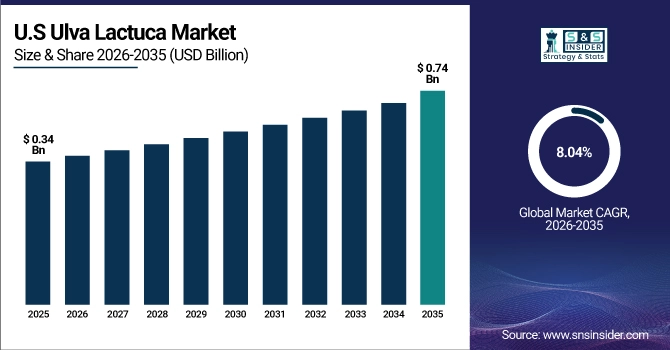
The U.S. Ulva Lactuca Market size was valued at USD 0.34 Billion in 2025 and is projected to reach USD 0.74 Billion by 2035, growing at a CAGR of 8.04% during 2026–2035. Expansion is driven by rising demand for sustainable food ingredients, nutraceuticals, and cosmetic applications, alongside increased investments in cultivation, processing technologies, and supply chain development across the country.
Ulva Lactuca Market Drivers:
The growing focus on sustainable food systems and environmental conservation is driving the Ulva Lactuca market. Ulva’s applications in aquaculture feed provide a sustainable alternative to fish-based ingredients, reducing pressure on marine ecosystems and enhancing seafood quality. Its use in biofertilisers and biostimulants supports circular agriculture by improving soil health, reducing nutrient loss, and promoting crop growth. Additionally, Ulva cultivation contributes to climate change mitigation by sequestering carbon and supporting blue economy initiatives. Rising demand for eco-friendly, multifunctional products and increasing investment in large-scale seaweed farming are further propelling market growth and creating new commercial opportunities.
In September 2025, European Commission: A new EU study highlights Ulva and other algae’s potential in sustainable aquaculture feed, biofertilisers, climate mitigation, and circular economy applications, while noting production challenges and the need for expanded farming.
Ulva Lactuca Market Restraints:
-
Environmental and Supply Challenges Limit Ulva Lactuca Market Expansion
The Ulva Lactuca market faces several key restraints despite growing demand. Seasonal and environmental factors, including water temperature fluctuations, pollution, and climate change, can disrupt cultivation and reduce yield. High initial investment and operational costs for aquaculture infrastructure limit small-scale producer participation. Additionally, regulatory challenges, including varying quality standards and export restrictions, can hinder market expansion. Supply chain inefficiencies, such as limited processing facilities and logistical constraints, impact timely delivery and product consistency. These factors collectively constrain large-scale production and slow the adoption of Ulva Lactuca-based food, nutraceutical, and cosmetic products globally.
Ulva Lactuca Market Opportunities:
-
Enhanced Cultivation and Consumer Demand Drive Ulva Lactuca Market Growth
Rising initiatives in seaweed cultivation are creating significant opportunities for the Ulva Lactuca market. Improved farming techniques and knowledge transfer to producers enhance yield and quality, leading to increased availability. Growing consumer demand for food, nutraceuticals, cosmetics, and animal feed drives the development of value-added products such as dried seaweed, noodles, vegetable rolls, and cosmetic formulations. Expansion of supply chains and processing technologies supports scalable production, resulting in Ulva Lactuca becoming a high-value, sustainable ingredient with strong revenue potential across diverse global applications.
In April 2025 – Department of Fisheries, Thailand: The Department of Fisheries is accelerating seaweed production, including Ulva (sea lettuce), promoting it as a “food of the future” through BCG-aligned policies, research collaborations, and value-added product development for food, cosmetics, and pharmaceuticals.
Ulva Lactuca Market Segment Highlights:
-
By Type: Dominant – Fresh Ulva Lactuca (39.50% in 2025 → 35.50% in 2035); Fastest-Growing – Dried Ulva Lactuca (31.00% in 2025 → 39.00% in 2035)
-
By Application: Dominant – Food Industry (34.80% in 2025 → 33.20% in 2035); Fastest-Growing – Pharmaceuticals (15.30% in 2025 → 17.70% in 2035)
-
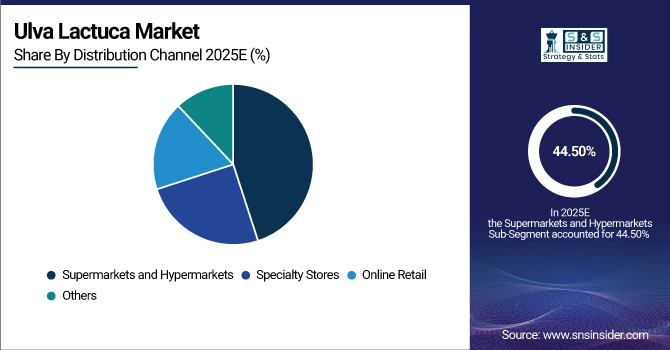
By Distribution Channel: Dominant – Supermarkets and Hypermarkets (44.50% in 2025 → 40.50% in 2035); Fastest-Growing – Online Retail (26.00% in 2025 → 34.00% in 2035)
-
By End-User: Dominant – OEMs / Manufacturers (39.80% in 2025 → 38.20% in 2035); Fastest-Growing – Retailers (25.30% in 2025 → 27.70% in 2035)
Ulva Lactuca Market Segment Analysis:
By Distribution Channel, Supermarkets/Online Retail Dominating and Fastest-Growing
Supermarkets and Hypermarkets remain the dominant distribution channel in the Ulva Lactuca market, due to extensive reach, established retail networks, and consumer convenience. Online Retail is the fastest-growing channel, fueled by rising e-commerce adoption, growing awareness of sustainable seaweed products, and increasing digital purchasing trends globally.
By Type, Fresh/Dried Dominating and Fastest-Growing
Fresh Ulva Lactuca remains the dominant segment in the Ulva Lactuca market, driven by strong demand for food, nutraceutical, and cosmetic applications, established supply chains, and high consumer preference for fresh seaweed. The Dried Ulva Lactuca segment is the fastest-growing, supported by expanding applications in processed foods, supplements, and long-term storage products.
By Application, Food/Pharmaceuticals Dominating and Fastest-Growing
The Food Industry remains the dominant application segment in the Ulva Lactuca market, driven by high demand in culinary, nutraceutical, and cosmetic uses, established supply chains, and consistent consumer preference. The Pharmaceuticals segment is the fastest-growing, supported by increasing incorporation of Ulva Lactuca in supplements, functional foods, and health-related products.
By End-User, OEMs/Retailers Dominating and Fastest-Growing
OEMs and Manufacturers remain the dominant end-user segment in the Ulva Lactuca market, driven by large-scale processing, food production, and nutraceutical integration. Retailers are the fastest-growing segment, supported by expanding direct-to-consumer sales, increased product availability, and growing consumer demand for fresh, processed, and packaged seaweed products.
Ulva Lactuca Market Regional Highlights:
-
North America: 30.20% → 34.00%, CAGR 10.84%
-
Europe: 25.30% → 27.70%, CAGR 10.53%
-
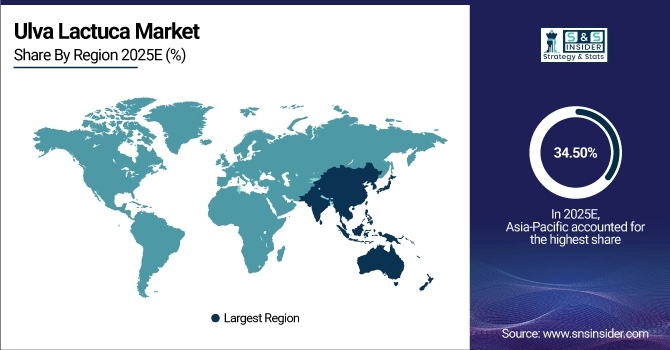
Asia-Pacific: 34.50% → 30.20%, CAGR 8.08%
-
Latin America: 5.10% → 4.00%, CAGR 6.88%
-
Middle East & Africa: 4.90% → 4.10%, CAGR 7.59%
Ulva Lactuca Market Regional Analysis:
Asia-Pacific Ulva Lactuca Market Insights:
The Asia-Pacific Ulva Lactuca market dominates globally, driven by rising demand in food, nutraceuticals, and cosmetic applications. Strong aquaculture infrastructure, supportive government policies, and growing awareness of sustainable seaweed products have fueled market growth. Leading countries such as China, Japan, and South Korea spearhead production and innovation in the region.
Get Customized Report as per Your Business Requirement - Enquiry Now
China Ulva Lactuca Market Insights:
China leads the North America Ulva Lactuca market, supplying high-quality seaweed products for food, nutraceuticals, and cosmetic industries, supported by advanced cultivation techniques and strong export capabilities.
North America Ulva Lactuca Market Insights:
The North America Ulva Lactuca market is experiencing robust growth due to rising demand for sustainable and nutritious food ingredients, expanding nutraceutical and cosmetic applications, and growing consumer awareness of the environmental and health benefits of seaweed. Investments in cultivation, processing technologies, and supply chain expansion are further driving market development.
U.S. Ulva Lactuca Market Insights:
The U.S. Ulva Lactuca market is expanding steadily, supported by increasing adoption in food, nutraceutical, and cosmetic industries. Rising consumer preference for sustainable, plant-based ingredients, combined with advanced cultivation methods and strengthened supply chains, is driving consistent market growth and fostering innovation in seaweed-derived products across the country.
Europe Ulva Lactuca Market Insights:
The Europe Ulva Lactuca market is growing moderately, driven by increasing demand for sustainable food ingredients, nutraceuticals, and cosmetics. Supportive regulatory frameworks, research initiatives, and rising consumer awareness of seaweed’s health and environmental benefits are contributing to steady market expansion across major European countries.
Germany Ulva Lactuca Market Insights:
Germany’s Ulva Lactuca market is expanding steadily, fueled by growing demand in food, nutraceutical, and cosmetic applications. Strong consumer preference for sustainable and healthy ingredients, combined with advanced cultivation technologies and supportive regulatory policies, is driving consistent growth and encouraging innovation in seaweed-based products across the German market.
Latin America Ulva Lactuca Market Insights:
The Latin America Ulva Lactuca market is witnessing steady growth, supported by increasing adoption in food, nutraceutical, and cosmetic industries. Rising awareness of sustainable and plant-based ingredients, coupled with expanding seaweed cultivation initiatives and government support, is driving market development across key countries in the region.
Brazil Ulva Lactuca Market Insights:
Brazil is the dominant country in the Ulva Lactuca market, leading regional production and consumption. Strong demand for sustainable food ingredients, nutraceuticals, and cosmetic applications, combined with favorable cultivation conditions and government support for seaweed farming, drives Brazil’s leadership and continued growth in the Latin American seaweed sector.
Middle East & Africa (MEA) Ulva Lactuca Market Insights:
The Middle East & Africa Ulva Lactuca market is growing gradually, driven by rising interest in sustainable food, nutraceutical, and cosmetic applications. Increasing awareness of seaweed’s health and environmental benefits, coupled with emerging cultivation initiatives and supportive government policies, is steadily expanding market opportunities across the region.
Saudi Arabia Ulva Lactuca Market Insights:
Saudi Arabia is typically the dominant country in the Middle East & Africa Ulva Lactuca market, leading seaweed production and consumption through supportive policies, sustainable cultivation, and growing demand in food and nutraceutical sectors.
Ulva Lactuca Market Competitive Landscape:
Nordic SeaFarm, established in 2018 in Sweden, is a pioneering seaweed company focused on the sustainable cultivation and commercialisation of Ulva lactuca and other seaweeds. The company develops innovative seaweed products for food, nutraceuticals, and biomaterials, promoting a regenerative and environmentally friendly approach to marine farming and ingredient development.
-
In June 2024, Nordic SeaFarm, a pioneering Swedish company, is advancing the sustainable cultivation and commercialisation of seaweed, promoting product innovation and a regenerative future for the algae sector.
Ocean Harvest Technology, founded in 2004 and based in Ireland, is a leading producer of seaweed-based solutions, including Ulva lactuca. The company develops sustainable ingredients for animal feed, agriculture, and nutraceuticals, focusing on innovation, environmental responsibility, and improving feed efficiency through high-quality, natural seaweed products.
-
In March 2025, Ocean Harvest Technology published an article in Feed & Additive Magazine highlighting seaweed as a sustainable solution to enhance feed efficiency in animal nutrition, reflecting the company’s innovation in sustainable Ulva lactuca and other seaweed applications.
Ulva Lactuca Market Key Players:
-
Nordic SeaFarm
-
Connemara Seaweed Company
-
Qingdao Haixingyuan Biotechnology Co., Ltd
-
Kainos Ingredients
-
Gelymar S.A.
-
Seaweed Solutions
-
BioCare Copenhagen
-
Acadian Seaplants Limited
-
Green Sea Farms
-
NoriSea
-
Algama
-
Seaweed & Co.
-
FMC Corporation
-
Cargill, Incorporated
-
Algaia S.A.
-
Seakura Ltd.
-
Irish Seaweeds
-
Maine Coast Sea Vegetables
| Report Attributes | Details |
|---|---|
| Market Size in 2025 | USD 1.50 Billion |
| Market Size by 2035 | USD 3.73 Billion |
| CAGR | CAGR of 9.54% From 2026 to 2035 |
| Base Year | 2025 |
| Forecast Period | 2026-2035 |
| Historical Data | 2022-2024 |
| Report Scope & Coverage | Market Size, Segments Analysis, Competitive Landscape, Regional Analysis, DROC & SWOT Analysis, Forecast Outlook |
| Key Segments | • By Type(Fresh Ulva Lactuca, Dried Ulva Lactuca, Processed Ulva Lactuca) • By Application (Food Industry, Cosmetics and Personal Care, Pharmaceuticals, Nutraceuticals and Agriculture) • By Distribution Channel(Online Retail, Specialty Stores, Supermarkets and Hypermarkets and Others) • By End-User(OEMs / Manufacturers, Retailers, Research & Development Institutes and Other Commercial Users) |
| Regional Analysis/Coverage | North America (US, Canada), Europe (Germany, UK, France, Italy, Spain, Russia, Poland, Rest of Europe), Asia Pacific (China, India, Japan, South Korea, Australia, ASEAN Countries, Rest of Asia Pacific), Middle East & Africa (UAE, Saudi Arabia, Qatar, South Africa, Rest of Middle East & Africa), Latin America (Brazil, Argentina, Mexico, Colombia, Rest of Latin America). |
| Company Profiles | Major global players in the Ulva Lactuca market include Ocean Harvest Technology, Nordic SeaFarm, Connemara Seaweed Company, Qingdao Haixingyuan Biotechnology Co., Ltd., Kainos Ingredients, Gelymar S.A., Marinova Pty Ltd, Seaweed Solutions, BioCare Copenhagen, Acadian Seaplants Limited, Green Sea Farms, NoriSea, Algama, Seaweed & Co., FMC Corporation, Cargill, Incorporated, Algaia S.A., Seakura Ltd., Irish Seaweeds, and Maine Coast Sea Vegetables. |

Frequently Asked Questions
North America dominated the Ulva Lactuca Market in 2025.
The “Fresh Ulva Lactuca” segment dominated during the projected period.
Rising demand for natural, nutrient-rich products in food, cosmetics, pharmaceuticals, and nutraceuticals is driving the Ulva Lactuca market.
The Ulva Lactuca Market size was USD 1.50 Billion in 2025 and is expected to reach USD 3.73 Billion by 2035.
The Ulva Lactuca Market is expected to grow at a CAGR of 9.54% from 2026-2035.
