
Automated Microbiology Market Report Scope & Overview:
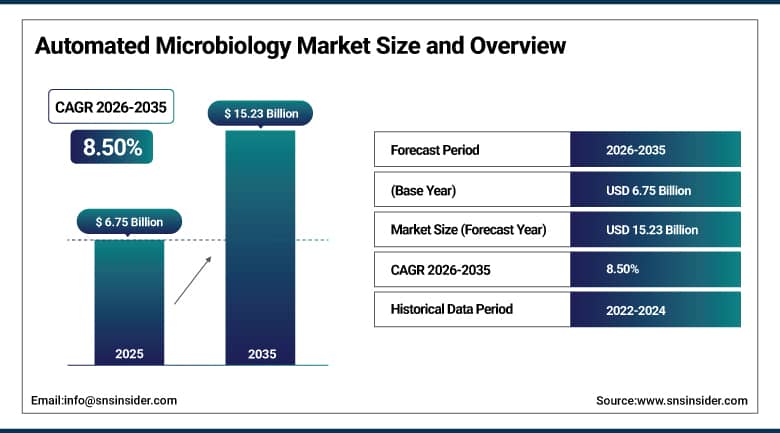
The Automated Microbiology Market was valued at USD 6.75 billion in 2025 and is expected to reach USD 15.23 billion by 2035, growing at a CAGR of 8.50% from 2026-2035.
The Automated Microbiology Market is witnessing strong growth the growth of this market is attributed to the rising need for quick, precise, and efficient tests on microbes in clinical diagnostics, pharmaceutical industry and food safety applications. The use of automation in microbiology helps in the process of preparation of the sample, microbial identification, antimicrobial susceptibility testing, and contamination monitoring to enable efficiency in laboratoried processes. The increasing number of infectious disease cases and the fear of antimicrobial resistance in pathogens are compelling the healthcare providers to adopt new technology for diagnosis of diseases. Moreover, stringent quality control in the pharmaceuticals and biotech industries is another factor boosting the need for automation in microbial testing. Innovations in artificial intelligence, robotics, molecular diagnostics, and automated data analysis are enhancing testing precision and processing time.
⮞CLSI published M67 in October 2025, providing recommendations for verification and implementation of laboratory automation in medical microbiology, including specimen processing, plate transport, incubation, imaging, and digital analysis.
To Get More Information On Automated Microbiology Market - Request Free Sample Report
Automated Microbiology Market Trends:
-
Growing demand for rapid microbial testing is increasing adoption of automated microbiology systems across clinical and pharmaceutical laboratories.
-
Rising prevalence of infectious diseases is expanding demand for automated pathogen identification and antimicrobial susceptibility testing.
-
Increasing laboratory automation is improving testing accuracy, workflow efficiency, and turnaround times across microbiology laboratories.
-
Advancements in artificial intelligence and digital imaging are enhancing microbial detection, colony counting, and result interpretation.
-
Growing pharmaceutical quality control requirements are supporting automated microbial testing across drug manufacturing and sterile production facilities.
U.S. Automated Microbiology Market Outlook:
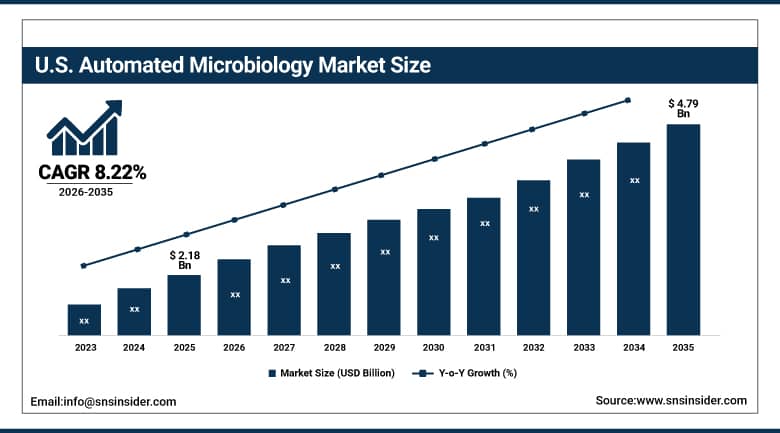
The U.S. Automated Microbiology Market was valued at USD 2.18 billion in 2025 and is expected to reach USD 4.79 billion by 2035, growing at a CAGR of 8.22% from 2026-2035.
The U.S. Automated Microbiology Market is witnessing strong growth the increase in the need for fast, accurate, and efficient microbial testing in clinical diagnostics, pharmaceutical production, and food safety. The automation of the process of testing helps in identifying microbes and testing the effectiveness of drugs. The rise in the number of infections being tested and the fear of antibiotics developing antibiotic resistance encourages medical institutions to use advanced technology in diagnosing patients. Besides, the quality control needs in the pharmaceutical and biotechnology industries fuel the need for the technology to be used in America. Developments in laboratory robotics, molecular diagnostics, artificial intelligence, and automated data analysis are making testing more accurate and faster. Growing investment in modernizing laboratories, growth in biopharmaceutical production, and the rising need for prompt diagnoses results further boost the adoption of the technology.
⮞In January 2026, bioMérieux acquired Accellix, a U.S. company specializing in rapid, automated flow-cytometry solutions for cell and gene therapy quality control. This demonstrates commercial investment in automated testing for advanced therapies.
Automated Microbiology Market Segment Analysis:
-
By Product Type, Automated Microbiology Analyzers dominate the Automated Microbiology Market with 37% share in 2025; Automated Microbiology Analyzers are expected to grow at the fastest CAGR of 9.43% from 2026–2035.
-
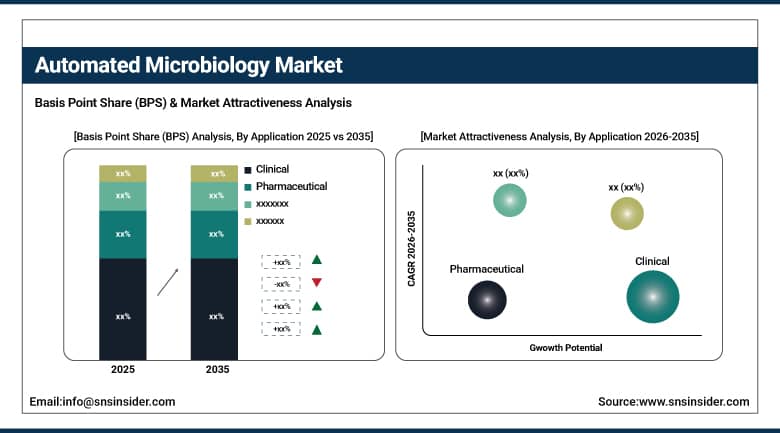
By Application, Clinical dominates the Automated Microbiology Market with 48% share in 2025; Pharmaceutical is expected to grow at the fastest CAGR of 10.40% from 2026–2035.
-
By End User, Hospitals and Clinics dominate the Automated Microbiology Market with 32% share in 2025; Food and Beverage Companies are expected to grow at the fastest CAGR of 11.94% from 2026–2035.
-
By Automation Level, Fully Automated dominates the Automated Microbiology Market with 58% share in 2025; Fully Automated is expected to grow at the fastest CAGR of 8.76% from 2026–2035.
-
By Sample Type, Blood dominates the Automated Microbiology Market with 35% share in 2025; Food is expected to grow at the fastest CAGR of 10.45% from 2026–2035.
By Application, Clinical dominates the Automated Microbiology Market, Pharmaceutical grows fastest.
Clinical dominated the Automated Microbiology Market with the highest revenue share of about 48% in 2025, motivated by the need for identifying microbes and assessing their susceptibility to antimicrobials. Hospital and laboratories use automatic devices for identification and susceptibility testing of microbes. This is further motivated by the increased burden of infections, concerns about antimicrobial resistance, and the need for quick diagnostic outcomes.
Pharmaceutical is expected to grow at the fastest CAGR of 10.40% from 2026–2035, driven by the increasing need for microbial quality control during the manufacture and development of drugs. Automated microbiology systems help in contamination detection, sterility testing, environment monitoring, and safety testing of products. Increasing production of biologics, increasing quality standards, and rising investments in the pharmaceuticals manufacturing industry are set to drive the market growth during the forecast period.
By Product Type, Automated Microbiology Analyzers dominate the Automated Microbiology Market and grow fastest.
Automated Microbiology Analyzers dominated the Automated Microbiology Market with the highest revenue share of about 37% in 2025, based on their ability to provide quick, accurate, and standardized identification and susceptibility testing of microorganisms. Such automated systems allow reduction of labor-intensive laboratory procedures, making the process more efficient. The need for prompt pathogen identification and faster laboratory workflows stimulates the use of such technologies.
Automated Microbiology Analyzers are expected to grow at the fastest CAGR of 9.43% from 2026–2035, driven by the increase in automation in laboratories, increasing testing demands for infections diseases, and advancements in microbial identification technology. The incorporation of imaging techniques, software analysis, and automation in sample analysis increases efficiency in laboratories. Increasing demand for increased speed, reduced human errors, and management of high numbers of samples will propel segment growth.
By End User, Hospitals and Clinics dominate the Automated Microbiology Market, Food and Beverage Companies grow fastest.
Hospitals and Clinics dominated the Automated Microbiology Market with the highest revenue share of about 32% in 2025, Driven by high throughput of clinical samples and the need to diagnose infections. Automation systems assist health organizations in pathogen identification, conducting susceptibility testing, and reducing lab turnaround time. The rise in hospital admissions, infectious disease surveillance, and antimicrobial resistance has fueled demand within the healthcare sector.
Food and Beverage Companies are expected to grow at the fastest CAGR of 11.94% from 2026–2035, Motivated by increased food safety demands, microbial quality standards, and contamination prevention measures. Automated microbiology systems help conduct testing for ingredients, finished goods, and manufacturing environments. The growing need for detecting pathogens quickly, ensuring better quality assurance, and compliance with food safety regulations will further drive their acceptance.
By Automation Level, Fully Automated dominates the Automated Microbiology Market and grows fastest.
Fully Automated systems dominated the Automated Microbiology Market with the highest revenue share of about 58% in 2025, They are driven by the fact that they have the capability of reducing manual handling, improving uniformity of testing processes, and processing large sample sizes effectively. They streamline the laboratory workflow and reduce repetitive laboratory processes. There is increased need for laboratories to be more productive and accurate with limited staff.
Fully Automated systems are expected to grow at the fastest CAGR of 8.76% from 2026–2035, backed by the rising demands of higher throughput testing, faster testing, and integration of lab processes. Improvements in robotics, information handling, and automated interpretation will result in greater efficiency. Clinical, pharmaceutical, and industrial microbiology testing needs are anticipated to drive labs to automate their processes fully.
By Sample Type, Blood dominates the Automated Microbiology Market, Food grows fastest.
Blood dominated the Automated Microbiology Market with the highest revenue share of about 35% in 2025, Driven by extensive blood culture testing to diagnose bloodstream infection and sepsis. The automated system continuously monitors the cultures and assists the laboratories in identifying the growth of microbes. Increased burden of infections, the need for accurate diagnosis, and proper antimicrobial therapy justify the continued use of these systems.
Food is expected to grow at the fastest CAGR of 10.45% from 2026–2035, This trend has been fueled by stringent food safety standards and an increasing need for fast microbial analysis. Automation is used to determine the presence of pathogens and assess contamination of raw materials, finished goods, and the manufacturing environment. An increase in food production, packaged food consumption, and quality control considerations are likely to drive this trend.
Regional Analysis:
|
Region |
Major Country |
Share within Region, 2025 (%) |
|---|---|---|
|
North America |
United States |
85.0% |
|
Europe |
Germany |
24.0% |
|
Asia Pacific |
China |
31.0% |
|
Middle East & Africa |
UAE |
12.0% |
|
Latin America |
Brazil |
28.0% |
North America Automated Microbiology Market Insights
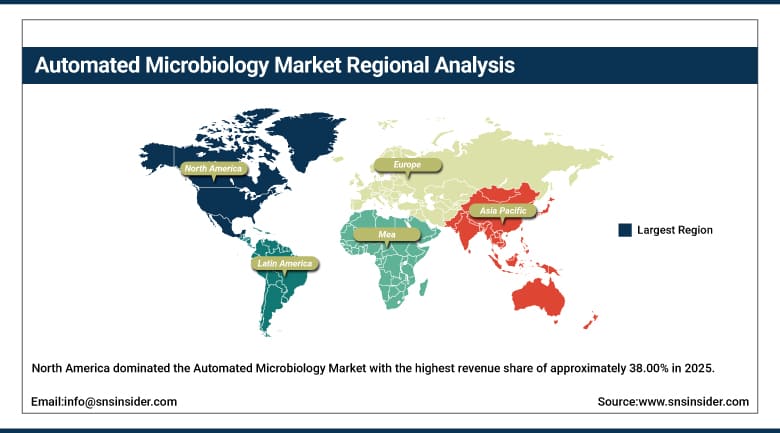
North America dominated the Automated Microbiology Market with the highest revenue share of approximately 38.00% in 2025, Fuelled by sophisticated health care infrastructure, existing diagnostic labs, and robust pharmaceuticals and biotech sectors. The high uptake of automated technology solutions, extensive R&D, and the necessity for rapid and precise identification of microorganisms and antimicrobial susceptibility testings also fuel the regional dominance.
The U.S. Automated Microbiology Market accounted for a market share of 85.0% in 2025, backed up by an advanced healthcare infrastructure, well-developed diagnostic laboratories, as well as pharmaceutical and biotech industries. The need for quick identification of microbes and their susceptibility to antibiotics, as well as efficient lab operations, motivates the introduction of automation.
Get Customized Report as Per Your Business Requirement - Enquiry Now
Europe Automated Microbiology Market Insights
Europe’s Automated Microbiology Market is supported by established clinical diagnostic laboratories, strong pharmaceutical manufacturing, and increasing emphasis on infection control. Automation is favored by demand for quick identification of microorganisms and accurate laboratory tests. Investment in the modernization of the healthcare industry, microbiology studies, and the production of pharmaceutical products also helps to facilitate the use of automation systems.
The Germany Automated Microbiology Market accounted for a market share of 24.0% in 2025, Driven by traditional clinical labs, highly developed pharmaceuticals manufacturing industry and robust research facilities in microbiology. Growing requirement of microbial identification and testing drives the trend towards automation. Moreover, investment made in upgrading the laboratory, infection prevention and pharmaceuticals quality assurance further develops the market.
Asia Pacific Automated Microbiology Market Insights
Asia Pacific is expected to grow at the fastest CAGR of approximately 9.12% from 2026 to 2035, driven by increasing healthcare infrastructure, increasing need for infectious diseases testing, and increasing production of pharmaceuticals and biotech products. Increased investment in diagnostics labs, increased recognition of antimicrobial resistance issues, and the need for fast and accurate microbial testing is contributing towards automation adoption. The modernization of healthcare in China, India, Japan, and other countries is expected to further boost growth.
The China Automated Microbiology Market accounted for a market share of 31.0% in 2025, Backed up by an increase in the health care infrastructure, the need for testing of infectious diseases, and the need to manufacture more pharmaceuticals and biotechnology products. Investments in diagnostic laboratories and the growing need for quick microbial analysis are driving the adoption of automation.
Middle East & Africa and Latin America Automated Microbiology Market Insights
The Middle East and Africa and Latin America Automated Microbiology Markets are supported by improving laboratory infrastructure, rising demand for infectious disease diagnostics, and growing pharmaceutical quality-control requirements. Investments in healthcare modernization and laboratory capabilities are encouraging automation adoption. Increasing attention to infection prevention, testing efficiency, and reliable microbial identification is expected to support gradual market expansion across both regions.
The UAE Automated Microbiology Market accounted for a market share of 12.0% in 2025, Driven by investment in healthcare infrastructure, diagnostic labs, and advanced technologies for testing. Increasing demand for quick and accurate diagnosis and identification of infectious diseases spurs the use of automation systems in laboratories. Modernization of healthcare, expansion of laboratory services, and importance of infection control also propel market growth.
Market Dynamics:
Growth Drivers: Increasing Demand for Rapid Microbial Testing Drives Automated Microbiology Adoption
The need for fast and accurate testing of microorganisms has been fueling the usage of automated microbiology systems in laboratories of hospitals, pharmaceutical companies, and food testing organizations. Conventional methods of testing microorganisms involve several laborious and lengthy processes such as repetitive activities and prolonged incubation period. Automated incubators, colony counters, microbial identification systems, and laboratory analyzers are some examples of devices that make testing faster and less laborious. It is very important for hospitals and other diagnostic centers to identify the infectious microorganisms promptly in order to take decisions for better treatment options. The need of testing microorganisms by pharmaceutical companies for quality and sterility checks is also contributing to adoption of automated technology in testing processes.
Restraints: High Equipment Costs and Maintenance Expenses Restrict Adoption Across Smaller Laboratories
The high costs associated with automation equipment used in microbiology may be a limitation where the facilities concerned have limited budgets. Incubation equipment, colony counters, microbial identification equipment, and testing machines may all require considerable investment of money in acquiring the equipment, installing the equipment, setting up the computer program, and making other laboratory alterations. Maintenance costs such as calibration, servicing, replacement of supplies, contracts for repair services, and training of personnel may add up to make the total cost of ownership very expensive. Smaller laboratories may find it harder to justify their costs in terms of the established manual methods that may not have been improved much by automated systems.
Opportunities: Expansion of Pharmaceutical Quality Control Creates Opportunities for Automated Microbiology Systems
The growing manufacturing of pharmaceuticals and biotech products presents the opportunity to have automated microbiology systems that are involved in quality control and contamination monitoring. The companies need reliable methods to measure the levels of microorganism contamination in the raw materials, the end products, the manufacturing environment, and production utilities. An increase in production of biologics, sterile injectables, vaccines, and other sensitive pharmaceutical products will make the microbiological quality evaluation more significant. Automated systems can enable standardization of work processes, data logging, and management of repetitive testing activities. There is also an opportunity in environmental monitoring, microbial limit testing, sterility testing, and rapid microbial detection, based on the capability of a particular system. In the case when the company needs to increase its efficiency, it can use technology to decrease the amount of manual labor and ensure traceability.
Recent Developments:
-
2026 : Bruker Corporation launched its MyGenius PRO® fully automated sample-to-answer molecular diagnostics system at ESCMID Global 2026, supporting high-throughput infectious disease testing with continuous sample loading and random-access operation.
-
2026 : Becton, Dickinson and Company (BD) received U.S. FDA 510(k) clearance for its BACTEC™ FXI blood culture system, featuring automated processing and approximately three-hour faster detection than the previous-generation system.
-
2026 : bioMérieux SA launched SMARTBIOME™, a microbiology-based solution combining DNA sequencing and bioinformatics to help food manufacturers identify spoilage patterns and improve product-quality monitoring.
-
2025 : Rapid Micro Biosystems, Inc. continued expanding adoption of its Growth Direct® automated microbial quality-control platform, supporting faster microbial detection and streamlined quality-control workflows in pharmaceutical manufacturing.
Automated Microbiology Market key players are:
-
Thermo Fisher Scientific Inc.
-
Danaher Corporation
-
Becton, Dickinson and Company (BD)
-
bioMérieux SA
-
Abbott Laboratories
-
Merck KGaA
-
Agilent Technologies, Inc.
-
Sysmex Corporation
-
Bio-Rad Laboratories, Inc.
-
Revvity, Inc. (formerly PerkinElmer)
-
HORIBA, Ltd.
-
DiaSorin S.p.A.
-
Neogen Corporation
-
Rapid Micro Biosystems, Inc.
-
Bruker Corporation
-
Tecan Group AG
-
Roche Diagnostics International Ltd.
-
QIAGEN N.V.
-
Illumina, Inc.
-
Luminex Corporation
Automated Microbiology Market Report Scope:
| Report Attributes | Details |
|---|---|
| Market Size in 2025 | USD 6.75 Billion |
| Market Size by 2035 | USD 15.23 Billion |
| CAGR | CAGR of 8.50% From 2026 to 2035 |
| Base Year | 2025 |
| Forecast Period | 2026-2035 |
| Historical Data | 2022-2024 |
| Report Scope & Coverage | Market Size, Segments Analysis, Competitive Landscape, Regional Analysis, DROC & SWOT Analysis, Forecast Outlook |
| Key Segments | • By Product Type (Automated Incubators, Automated Colony Counters, Automated Microbiology Analyzers, Automated Media Preparation Systems) • By Application (Clinical, Food and Beverage, Pharmaceutical, Environmental) • By End User (Hospitals and Clinics, Reference Laboratories, Research Institutions, Food and Beverage Companies, Pharmaceutical Companies) • By Automation Level (Semi-Automated, Fully Automated) • By Sample Type (Blood, Urine, Tissue, Food, Water) |
| Regional Analysis/Coverage | North America (US, Canada), Europe (Germany, UK, France, Italy, Spain, Russia, Poland, Rest of Europe), Asia Pacific (China, India, Japan, South Korea, Australia, ASEAN Countries, Rest of Asia Pacific), Middle East & Africa (UAE, Saudi Arabia, Qatar, South Africa, Rest of Middle East & Africa), Latin America (Brazil, Argentina, Mexico, Colombia, Rest of Latin America). |
| Company Profiles | Thermo Fisher Scientific Inc., Danaher Corporation, Becton, Dickinson and Company (BD), bioMérieux SA, Abbott Laboratories, Merck KGaA, Agilent Technologies, Inc., Sysmex Corporation, Bio-Rad Laboratories, Inc., Revvity, Inc. (formerly PerkinElmer), HORIBA, Ltd., DiaSorin S.p.A., Neogen Corporation, Rapid Micro Biosystems, Inc., Bruker Corporation, Tecan Group AG, Roche Diagnostics International Ltd., QIAGEN N.V., Illumina, Inc., and Luminex Corporation. |

Frequently Asked Questions
Key players in the Automated Microbiology Market include bioMérieux SA, BD (Becton, Dickinson and Company), Thermo Fisher Scientific Inc., Danaher Corporation, and Bruker Corporation, among others.
Key opportunities in the Automated Microbiology Market include increasing adoption of automated microbial identification systems, growing demand for rapid pathogen detection, and expansion of pharmaceutical quality-control and clinical diagnostic laboratories.
The market is driven by rising demand for faster and more accurate microbial testing, increasing laboratory automation, and growing needs for infection control, pharmaceutical quality assurance, and food safety testing.
The Automated Microbiology Analyzers segment dominated the Automated Microbiology Market, accounting for approximately 37.00% market share.
The North America region dominated the Automated Microbiology Market in 2025 with a 38.00% share, driven by advanced laboratory infrastructure and growing demand for rapid microbial testing.
