
Recombinant DNA Technology Market Report Scope & Overview:
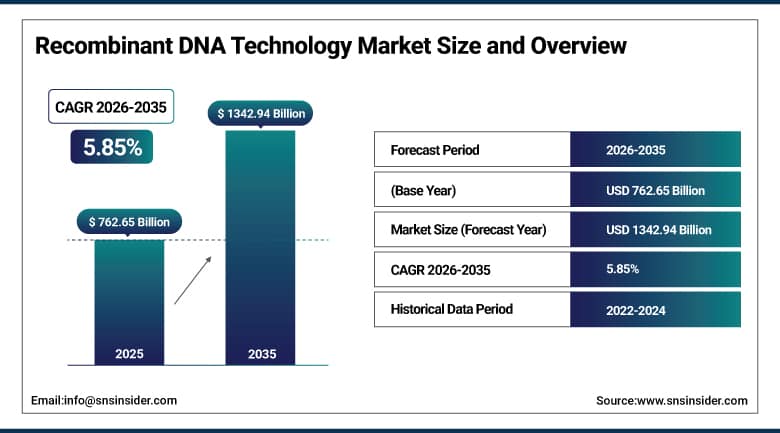
The Recombinant DNA Technology Market was valued at USD 762.65 billion in 2025 and is expected to reach USD 1342.94 billion by 2035, growing at a CAGR of 5.85% from 2026-2035.
The Recombinant DNA Technology Market is witnessing steady growth because of the increasing need for genetically engineered products in pharmaceuticals, biotechnology, agriculture, and industry. With the help of recombinant DNA technology, one can manufacture therapeutic proteins, vaccines, insulin, and genetically engineered organisms for the advancement of disease treatment and prevention and agriculture. Increasing research activities and production of biopharmaceutical products have resulted in an increase in the use of genetic engineering technologies. Moreover, the growing need for targeted therapy and gene-based therapy and vaccines has opened up avenues for the technological firms. Improvements in gene editing, molecular cloning, DNA synthesis, and expression systems have made the process more efficient.
⮞The WHO's 2026 report on biological standardization covers vaccines, biotherapeutics, diagnostics, and cell and gene therapies, emphasizing standards that support product quality, safety, and efficacy.
To Get More Information On Recombinant DNA Technology Market - Request Free Sample Report
Recombinant DNA Technology Market Trends:
-
Growing demand for biologics and therapeutic proteins is increasing adoption of recombinant DNA technology across pharmaceutical and biotechnology industries.
-
Rising development of gene therapies and personalized medicines is expanding applications of genetic engineering in advanced treatments.
-
Increasing vaccine research and production is supporting recombinant DNA technology adoption across infectious disease prevention and therapeutic development.
-
Advancements in gene editing and DNA synthesis are improving genetic modification accuracy and research efficiency.
-
Growing investments in biopharmaceutical manufacturing are accelerating recombinant protein production and large-scale genetic engineering applications.
U.S. Recombinant DNA Technology Market Outlook:
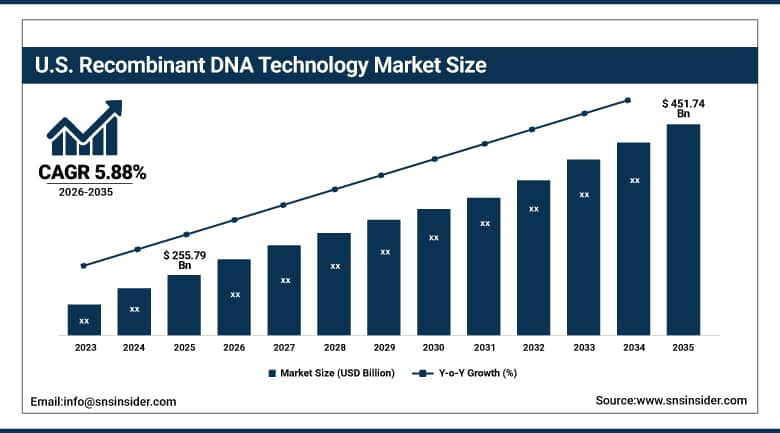
The U.S. Recombinant DNA Technology Market was valued at USD 255.79 billion in 2025 and is expected to reach USD 451.74 billion by 2035, growing at a CAGR of 5.88% from 2026-2035.
The U.S. Recombinant DNA Technology Market is witnessing growth as a result of high demand for genetic engineering in pharmaceuticals, biotechnology, agriculture, and medical research. Recombinant DNA technology helps produce therapeutic proteins, vaccines, insulin, and other genetically engineered products. Higher levels of investments in research and manufacture of biopharmaceutical products are leading to increased use of genetic engineering technologies throughout the country. High demand for biologics, gene therapy, and personalized medicine creates prospects for advanced genetic engineering solutions. Recent advancements in DNA synthesis, molecular cloning, gene editing, and recombinant protein expression help improve research efficiency and develop new products. Besides, there is strong biotechnology infrastructure, government support for research, and collaboration between pharmaceutical companies and universities that promote innovation. Applications in disease research, vaccines production, and therapeutic products creation should continue to drive market growth in the US.
⮞The FDA's U.S.-licensed vaccine list includes recombinant products such as Shingrix, Gardasil 9, hepatitis B vaccines, and Nuvaxovid. These products demonstrate established commercial applications of recombinant antigens and related biotechnology processes in preventive healthcare.
Recombinant DNA Technology Market Segment Analysis:
-
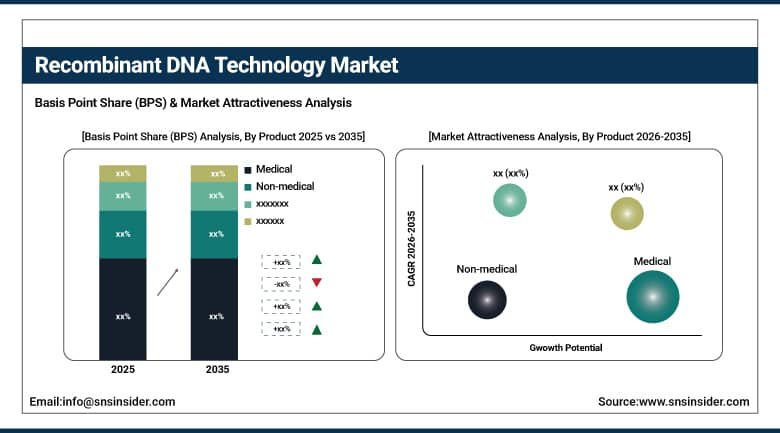
By Product, Medical dominates the Recombinant DNA Technology Market with 78% share in 2025; Non-medical is expected to grow at the fastest CAGR of 6.46% from 2026–2035.
-
By Component, Expression System dominates the Recombinant DNA Technology Market with 62% share in 2025; Cloning Vector is expected to grow at the fastest CAGR of 6.21% from 2026–2035.
-
By Application, Food & Agriculture dominates the Recombinant DNA Technology Market with 18% share in 2025; Health & Disease is expected to grow at the fastest CAGR of 5.73% from 2026–2035.
-
By End Use, Biotechnology and Pharmaceutical Companies dominate the Recombinant DNA Technology Market with 60% share in 2025; Biotechnology and Pharmaceutical Companies are expected to grow at the fastest CAGR of 6.25% from 2026–2035.
By Product, Medical dominates the Recombinant DNA Technology Market, Non-medical grows fastest.
Medical dominated the Recombinant DNA Technology Market with the highest revenue share of about 78% in 2025, due to wide-ranging applications for therapeutic proteins, vaccines, insulin production, and genetic diseases. Growing needs for biologics, gene therapy, and personalization of medicine make adoption more feasible. Growing pharmaceutical research investments and increasing biotech capabilities make it likely that the medical sector will remain the leading market.
Non-medical is expected to grow at the fastest CAGR of 6.46% from 2026–2035, Backed by the rising use of recombinant DNA technology in agriculture, food industry, biotechnology industry, and environmental management systems. The genetically modified plants, genetically engineered microbes, and enzymes hold chances of achieving greater efficiency. The rising need for biological techniques and advancements in genetic engineering will help drive the use of genetic engineering outside medicine.
By Component, Expression System dominates the Recombinant DNA Technology Market, Cloning Vector grows fastest.
Expression System dominated the Recombinant DNA Technology Market with the highest revenue share of about 62% in 2025, Motivated by the critical importance of the process in the production of recombinant proteins, enzymes, hormones, and many other biological compounds. Expression systems facilitate the ability to regulate gene expression using bacteria, yeasts, mammals, and various other host systems.
Cloning Vector is expected to grow at the fastest CAGR of 6.21% from 2026–2035, due to growing developments in the area of genetic engineering, gene manipulation and molecular cloning. Vectors for cloning make it possible to transfer and amplify the required DNA fragments in appropriate host cells. Growing research in biotechnology and synthetic biology, along with advancements in vector technology, may contribute to rising demand.
By Application, Food & Agriculture dominates the Recombinant DNA Technology Market, Health & Disease grows fastest.
Food & Agriculture dominated the Recombinant DNA Technology Market with the highest revenue share of about 18% in 2025, backed by its uses in improving crops, pest resistance, nutrition, and agricultural efficiency. Genetic modification using recombinant DNA technology allows the creation of genetically modified plants and microbes. The increasing need for improving food production and agricultural efficiency supports the use of this technology.
Health & Disease is expected to grow at the fastest CAGR of 5.73% from 2026–2035, Fuelled by increasing use in disease studies, gene testing, vaccines, and drug development. Recombinant DNA technology assists scientists in studying disease mechanisms and developing biological materials for treatment and prevention purposes. Increasing spending on precision medicine, genetic disorders, and biotech research will ensure growth in the healthcare sector.
By End Use, Biotechnology and Pharmaceutical Companies dominate the Recombinant DNA Technology Market and grow fastest.
Biotechnology and Pharmaceutical Companies dominated the Recombinant DNA Technology Market with the highest revenue share of about 60% in 2025, They are driven by the wide application of genetic engineering in the development of drugs, manufacture of vaccines, and protein synthesis. These firms spend heavily on research and commercial production. Growing demand for biological drugs and increasing therapeutic pipelines help them dominate the market.
Biotechnology and Pharmaceutical Companies are expected to grow at the fastest CAGR of 6.25% from 2026–2035, backed by growing investments in biologics, genetherapy, recombinant vaccines, and personalized medicine. The rising number of clinical trials and need for engineered therapeutics is driving further adoption of the recombinant DNA technology. Improvements in genetic engineering, production technologies, and pipeline products are anticipated to drive the adoption rate in pharmaceutical and biotechnology companies.
Regional Analysis:
|
Region |
Major Country |
Share within Region, 2025 (%) |
|---|---|---|
|
North America |
United States |
86.0% |
|
Europe |
Germany |
24.0% |
|
Asia Pacific |
China |
31.0% |
|
Middle East & Africa |
UAE |
12.0% |
|
Latin America |
Brazil |
28.0% |
North America Recombinant DNA Technology Market Insights
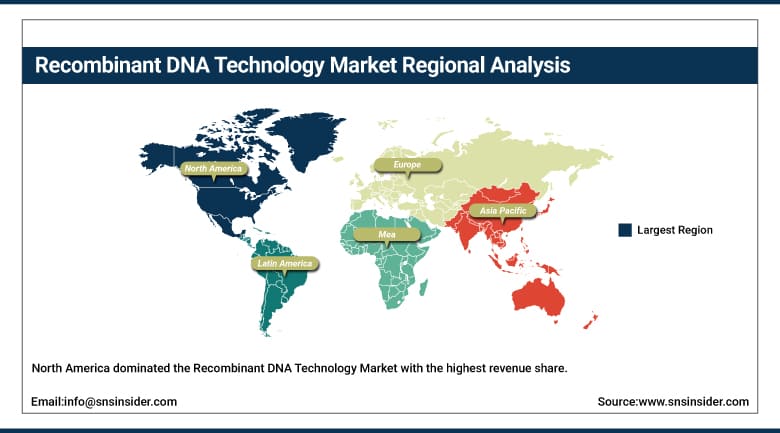
North America dominated the Recombinant DNA Technology Market with the highest revenue share of approximately 39.00% in 2025, Powered by biotechnology infrastructures, research funding, and the presence of pharmaceuticals. Strong research institutes, biotech companies, and genetic engineering drive their dominance. Increasing demand for biologicals, recombinants, vaccines, and gene therapy products bolsters the growth of the market.
The U.S. Recombinant DNA Technology Market accounted for a market share of 86.0% in 2025, facilitated by the presence of sophisticated biotechnology infrastructure, research funds, and the presence of a well-established pharmaceutical industry. The high demand for recombinant proteins, vaccines, gene therapies, and genetically modified goods spurs adoption. Existing biotech firms, research organizations, and growing investment in genetic engineering contribute to market expansion.
Get Customized Report as Per Your Business Requirement - Enquiry Now
Europe Recombinant DNA Technology Market Insights
Europe’s Recombinant DNA Technology Market is supported by established biotechnology research, pharmaceutical manufacturing, and strong academic research networks. Growing expenditure on genetic engineering, recombinant protein production, and vaccine research is a key driving factor for adopting technologies. Other factors include research support, highly developed lab facilities, and increasing demands for innovative biologics and personal medicines in major European countries.
The Germany Recombinant DNA Technology Market accounted for a market share of 24.0% in 2025, pushed forward by existing pharmaceutical and biotech industries, well-developed research skills, and growing investment in genetic engineering technologies. The demand for recombinant proteins, biological medicines, and vaccines facilitates the use of technologies. Highly developed laboratory systems and interaction between research organizations and biotech firms also facilitate the market development.
Asia Pacific Recombinant DNA Technology Market Insights
Asia Pacific is expected to grow at the fastest CAGR of approximately 7.04% from 2026 to 2035, Driven by growing biotechnology industries, increased pharmaceutical research, and rising demand for recombinant vaccines and therapeutics. Support from the government for life sciences, increased healthcare infrastructure, and development in contract research and manufacturing facilities is making it attractive. Genetic engineering research is increasing in China, India, Japan, and South Korea.
The China Recombinant DNA Technology Market accounted for a market share of 31.0% in 2025, backed by biotechnology research growth, growth in pharmaceutical manufacturing, and rising investment in genetic engineering. The need for recombinant proteins, vaccines, and biologics fuels the adoption. Government backing of biotechnology innovation, increase in research facilities, and emphasis on the development of advanced therapeutics help in expanding the market.
Middle East & Africa and Latin America Recombinant DNA Technology Market Insights
The Middle East and Africa and Latin America Recombinant DNA Technology Markets are supported by increasing investments in biotechnology research, pharmaceutical manufacturing, and healthcare infrastructure. The growing interest in vaccines, therapeutic proteins, and genetic engineering applications is providing opportunities. Collaborations in research, modernization of laboratories, and initiatives aimed at developing domestic capabilities for biopharmaceuticals are likely to spur the development of the markets.
The UAE Recombinant DNA Technology Market accounted for a market share of 12.0% in 2025, Driven by investment in research on biotechnology, healthcare facilities, and pharmaceuticals. Increased interest in biologic drugs, vaccines, and genetic engineering technology is facilitating acceptance. Collaboration in research, laboratory upgrade, and enhancing life sciences capacity in the region are some of the other factors that help in developing the market.
Market Dynamics:
Growth Drivers: Growing Demand for Biopharmaceuticals Drives Recombinant DNA Technology Adoption
Increasing demand for biopharmaceuticals is supporting the adoption of recombinant DNA technology across pharmaceutical and biotechnology industries. The technology helps to manufacture therapeutic proteins, recombinant hormones, vaccines, enzymes, and many other biological products by means of genetic engineering. More utilization of insulin, monoclonal antibodies, growth factors, and vaccines made by using genetic engineering is driving companies towards the development of more advanced techniques of genetic engineering and protein expression. The pharmaceutical companies are also utilizing the technology of recombinant DNA to create new drugs for treating chronic diseases, rare disorders, and infections. Better techniques of host cell engineering, vector development, and protein expression help scientists to improve product yields and production efficiency. With the increasing significance of biologics in the healthcare industry, the need for recombinant DNA tools, reagents, and enzymes is rising.
Restraints: High Development Costs and Complex Production Processes Restrict Technology Adoption
In some cases, there may be significant cost involved in developing and implementing recombinant DNA technology. Appropriate workflows for cloning, gene expression, purification, and analysis need to be developed in order to get accurate results. Commercial production may further involve additional cost for bioreactors, downstream processing, quality control, and validation of processes. Recombinant proteins that will be used for treatment may have extensive characterization and safety evaluations done in addition to other things that are associated with regulation of this process. This may extend the period of time during which development takes place and also increase the risks involved financially. Yields of recombinant products depend on many factors including host organisms used, expression system, and other conditions of the process.
Opportunities: Expanding Gene Therapy and Advanced Biologics Development Creates Growth Opportunities
The expansion of research related to gene therapy and advanced biologics offers many promising market opportunities for recombinant DNA service providers. Recombinant DNA techniques are useful in building genetic constructs, vectors, proteins, and study of genes. The increased research into inherited disorders, cancer, and other diseases will continue to drive the pharmaceutical and biotechnology industries toward designing drugs that will specifically target certain biological processes. Recombinant DNA techniques are also useful in generating viral vectors as well as other biological elements utilized in gene therapy and cell therapy production processes. Any advancement in the areas of genetic engineering, vector design, and protein generation can increase efficiency of these research and manufacturing processes. Even though there are clinical developments and commercialization activities based on certain products' safety and efficacy, increased investments in advanced biologics provide opportunities for molecular biology reagent suppliers.
Recent Developments:
-
2026 : GenScript Biotech Corporation launched its TurboCHO™ Protein Expression Kit, enabling researchers to produce research-grade antibodies in as little as five business days and accelerating recombinant protein expression workflows.
-
2026 : Lonza Group AG expanded its DNA-to-IND development offering to complex biologics, including bispecific antibodies and Fc-fusion proteins, using advanced vector technology to accelerate recombinant biologic development and manufacturing.
-
2026 : New England Biolabs, Inc. launched its EnClose® Cell-free dbDNA Synthesis Kit in collaboration with Touchlight, supporting DNA and RNA therapeutic development through cell-free DNA synthesis technology.
-
2025 : Thermo Fisher Scientific Inc. continued advancing recombinant DNA research and bioproduction through its gene synthesis, cloning, and molecular biology reagent portfolio, supporting genetic engineering and recombinant protein development.
Recombinant DNA Technology Market key players are:
-
Thermo Fisher Scientific Inc.
-
GenScript Biotech Corporation
-
Amgen Inc.
-
Pfizer Inc.
-
F. Hoffmann-La Roche Ltd.
-
Novartis AG
-
Sanofi S.A.
-
Merck KGaA
-
Eli Lilly and Company
-
Novo Nordisk A/S
-
GSK plc
-
New England Biolabs, Inc.
-
Lonza Group AG
-
Biogen Inc.
-
Regeneron Pharmaceuticals, Inc.
-
Gilead Sciences, Inc.
-
Vertex Pharmaceuticals Incorporated
-
CRISPR Therapeutics AG
-
Agilent Technologies, Inc.
-
Bio-Rad Laboratories, Inc.
Recombinant DNA Technology Market Report Scope:
| Report Attributes | Details |
|---|---|
| Market Size in 2025 | USD 762.65 Billion |
| Market Size by 2035 | USD 1342.94 Billion |
| CAGR | CAGR of 5.85% From 2026 to 2035 |
| Base Year | 2025 |
| Forecast Period | 2026-2035 |
| Historical Data | 2022-2024 |
| Report Scope & Coverage | Market Size, Segments Analysis, Competitive Landscape, Regional Analysis, DROC & SWOT Analysis, Forecast Outlook |
| Key Segments | • By Product (Medical [Therapeutic Agent, Human Protein, Vaccine], Non-medical [Biotech Crops, Specialty Chemicals, Other Non-medical Products]) • By Component (Expression System [Mammalian, Bacteria, Yeast, Baculovirus / Insect, Other Expression Systems], Cloning Vector) • By Application (Food & Agriculture, Health & Disease [Human, Animal], Environment, Other Applications) • By End Use (Biotechnology and Pharmaceutical Companies, Academic & Government Research Institutes, Other End Uses) |
| Regional Analysis/Coverage | North America (US, Canada), Europe (Germany, UK, France, Italy, Spain, Russia, Poland, Rest of Europe), Asia Pacific (China, India, Japan, South Korea, Australia, ASEAN Countries, Rest of Asia Pacific), Middle East & Africa (UAE, Saudi Arabia, Qatar, South Africa, Rest of Middle East & Africa), Latin America (Brazil, Argentina, Mexico, Colombia, Rest of Latin America). |
| Company Profiles | Thermo Fisher Scientific Inc., GenScript Biotech Corporation, Amgen Inc., Pfizer Inc., F. Hoffmann-La Roche Ltd., Novartis AG, Sanofi S.A., Merck KGaA, Eli Lilly and Company, Novo Nordisk A/S, GSK plc, New England Biolabs, Inc., Lonza Group AG, Biogen Inc., Regeneron Pharmaceuticals, Inc., Gilead Sciences, Inc., Vertex Pharmaceuticals Incorporated, CRISPR Therapeutics AG, Agilent Technologies, Inc., and Bio-Rad Laboratories, Inc. |

Frequently Asked Questions
Key players in the Recombinant DNA Technology Market include Thermo Fisher Scientific Inc., Merck KGaA, GenScript Biotech Corporation, Danaher Corporation, and Takara Bio Inc., among others.
Key opportunities in the Recombinant DNA Technology Market include growing demand for recombinant biologics, increasing adoption of gene therapy and genetic engineering, and expanding applications in vaccine development and precision medicine.
The market is driven by rising demand for biopharmaceuticals, increasing research in genetic engineering, and growing applications of recombinant DNA technology in disease treatment, vaccine production, and agricultural biotechnology.
The Medical segment dominated the Recombinant DNA Technology Market, accounting for approximately 78.00% market share.
The North America region dominated the Recombinant DNA Technology Market in 2025 with a 39.00% share, driven by strong biotechnology research and increasing investments in genetic engineering.
