
Protein Sequencing Market Report Scope & Overview:
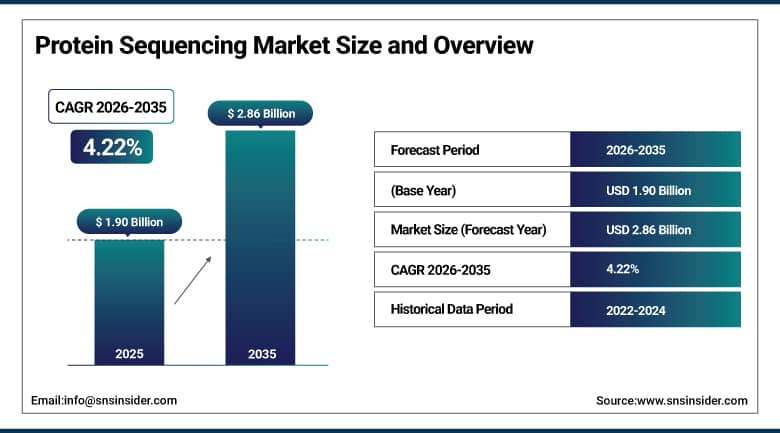
The Protein Sequencing Market was valued at USD 1.90 billion in 2025 and is expected to reach USD 2.86 billion by 2035, growing at a CAGR of 4.22% from 2026-2035.
The Protein Sequencing Market is witnessing steady growth in order to meet the rising requirements for advanced proteomic research, precision medicine, and discovery of biomarkers. Protein sequencing instruments help in identifying the sequence of amino acids, determining the structure of proteins, and understanding their function and can be used in drug discovery, disease diagnostics, and development of therapies. Increasing interest in biotech and pharmaceutical research is leading to the adoption of more advanced methods of analysis. Rising demand for biological products such as monoclonal antibodies and other protein-based drugs is also contributing to an increase in the requirement of protein characterization. Technological advancements in mass spectrometry, next-generation sequencing, and automated analysis systems are helping to achieve better sequencing accuracy and efficiency.
⮞On October 8, 2026, Quantum-Si announced that its Proteus development program had demonstrated detection of 19 amino acids. The company is working to incorporate this capability into a developmental sequencing kit, with detection of all 20 amino acids remaining a stated goal.
To Get More Information On Protein Sequencing Market - Request Free Sample Report
Protein Sequencing Market Trends:
-
Rising demand for proteomics research is driving adoption of advanced protein sequencing technologies across life sciences.
-
Increasing investments in drug discovery are expanding protein sequencing applications in therapeutic development and biomarker identification.
-
Growing adoption of mass spectrometry is improving protein identification, characterization, and sequencing accuracy.
-
Advancements in next-generation sequencing technologies are enabling faster and more efficient protein analysis.
-
Increasing demand for personalized medicine is supporting protein sequencing for disease diagnosis and targeted treatment development.
U.S. Protein Sequencing Market Outlook:
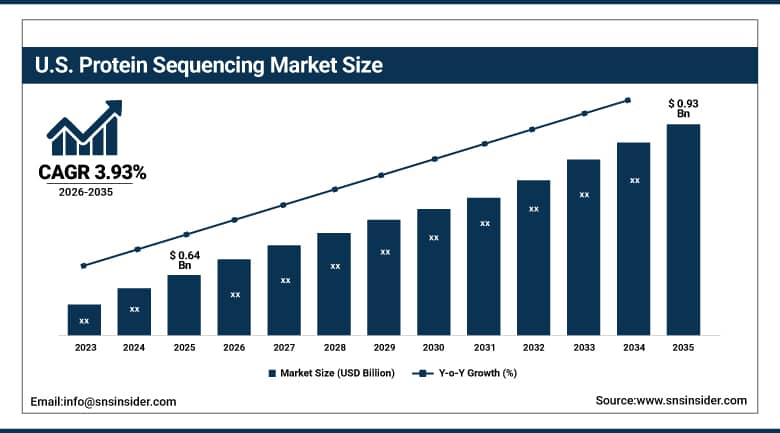
The U.S. Protein Sequencing Market was valued at USD 0.64 billion in 2025 and is expected to reach USD 0.93 billion by 2035, growing at a CAGR of 3.93% from 2026-2035.
The U.S. Protein Sequencing Market is witnessing steady growth the growing investment in the field of proteomics, precision medicines, and biotechnology innovations in the United States. The protein sequencing technologies allow scientists to discover amino acid sequences, understand protein structure and mechanism of diseases and also develop medicines. Growing research and development activities of pharmaceuticals and biotechnologies are increasing the demand for accurate protein sequencing. Moreover, growing development of biologics such as monoclonal antibodies and other protein based medicines is also providing opportunities for development of novel sequencing technologies. The technological advancements in the field of mass spectrometry, automation technologies and next generation sequencing are enhancing the accuracy, productivity and efficiency of analytical systems. The strong infrastructure of research and development, fundings for life sciences and collaboration between universities and pharmaceuticals & biotech companies are also driving the growth of market.
⮞The U.S. National Institutes of Health funds research involving mass spectrometry, protein structure, and proteomics methods. For example, an NIH-funded University of Washington project received approximately USD 1.37 million for fiscal year 2026 to develop a mass-spectrometry method for characterizing protein structure and its relationship to biological function.
Protein Sequencing Market Segment Analysis:
-
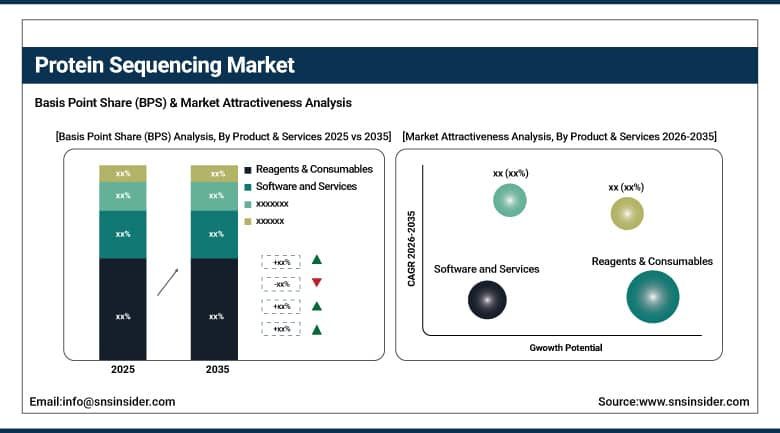
By Product & Services, Reagents & Consumables dominate the Protein Sequencing Market with 42% share in 2025; Reagents & Consumables are expected to grow at the fastest CAGR of 4.77% from 2026–2035.
-
By Technology, Mass Spectrometry dominates the Protein Sequencing Market with 52% share in 2025; Next Generation Sequencing is expected to grow at the fastest CAGR of 5.08% from 2026–2035.
-
By Application, Biotherapeutics & Biologics Characterization dominates the Protein Sequencing Market with 32% share in 2025; Proteomics & Biomarker Discovery is expected to grow at the fastest CAGR of 5.42% from 2026–2035.
-
By End User, Pharmaceutical & Biotechnology Companies dominate the Protein Sequencing Market with 45% share in 2025; CROs & CDMOs are expected to grow at the fastest CAGR of 5.18% from 2026–2035.
By Product & Services, Reagents & Consumables dominate the Protein Sequencing Market and grow fastest.
Reagents & Consumables dominated the Protein Sequencing Market with the highest revenue share of about 42% in 2025, motivated by their key importance in the process of sample preparation, protein separation, and sequencing. These reagents are constantly in demand for regular tests conducted in laboratories. Repetitive purchases, growing proteomics research, and demands for protein characterization in pharma and biotech labs account for their strong market position.
Reagents & Consumables are expected to grow at the fastest CAGR of 4.77% from 2026–2035, Fuelled by rising demand for protein sequencing testing as well as repeat purchases. Growth in biopharmaceutical research, increased spending on proteomics research and rising need for sample preparation is anticipated to drive future purchases. Development in sequencing technology and specialized reagents is anticipated to propel segment growth over the forecast period.
By Technology, Mass Spectrometry dominates the Protein Sequencing Market, Next Generation Sequencing grows fastest.
Mass Spectrometry dominated the Protein Sequencing Market with the highest revenue share of about 52% in 2025, powered by its high sensitivity, precision, and capability of identifying and characterizing complex proteins. The technique offers protein identification, analysis of post-translational modifications, and characterization of biotherapeutics. The wide application of the technique in proteomic research, drug discovery studies, and assessment of biologic products enhances its acceptance.
Next Generation Sequencing is expected to grow at the fastest CAGR of 5.08% from 2026–2035, facilitated by technology advances that allow for high throughput analysis of genetic data associated with protein expression and identification. The growing role of sequencing data in proteomics, biomarkers research, and personalized medicine will expand its applications. Advances in sequencing technologies and research methods will hopefully stimulate the use of the technique in life science labs.
By Application, Biotherapeutics & Biologics Characterization dominates the Protein Sequencing Market, Proteomics & Biomarker Discovery grows fastest.
Biotherapeutics & Biologics Characterization dominated the Protein Sequencing Market with the highest revenue share of about 32% in 2025, Motivated by the requirement of confirming protein identity, amino acid sequences, and protein characteristics of biological drugs. Protein sequencing is useful in developing products, quality control, and regulation. With growing development of monoclonal antibodies, recombinant proteins, and other biologics, it adds more emphasis on the requirement of proper characterization of biological drugs.
Proteomics & Biomarker Discovery is expected to grow at the fastest CAGR of 5.42% from 2026–2035, driven by increasing research on disease-related proteins and molecular biology mechanisms. Proteomics sequencing provides an opportunity for scientists to find markers and analyze biological processes associated with diagnostics and drug development. Growing interest in precision medicine, oncology research, and proteomics technologies will increase usage in educational facilities, biotech and pharmaceutical companies.
By End User, Pharmaceutical & Biotechnology Companies dominate the Protein Sequencing Market, CROs & CDMOs grow fastest.
Pharmaceutical & Biotechnology Companies dominated the Protein Sequencing Market with the highest revenue share of about 45% in 2025, backed by an abundance of protein sequencing for pharmaceutical research and development, biologics development, quality control, and product analysis. Such companies need accurate techniques to assess therapeutic proteins. Growing biologics pipeline, research efforts, and strict quality requirements further solidify their dominant market position.
CROs & CDMOs are expected to grow at the fastest CAGR of 5.18% from 2026–2035, Driven by rising trends in the outsourcing of specialized analytical testing, protein characterization, and biopharmaceutical development. These companies offer advanced equipment and expertise without the necessity for clients to create expensive in-house facilities. Rising pipelines of biologicals, flexibility in research capacity, and the need for faster development processes will drive growth in the segment.
Regional Analysis:
|
Region |
Major Country |
Share within Region, 2025 (%) |
|---|---|---|
|
North America |
United States |
86.0% |
|
Europe |
Germany |
25.0% |
|
Asia Pacific |
China |
30.0% |
|
Middle East & Africa |
UAE |
12.0% |
|
Latin America |
Brazil |
27.0% |
North America Protein Sequencing Market Insights
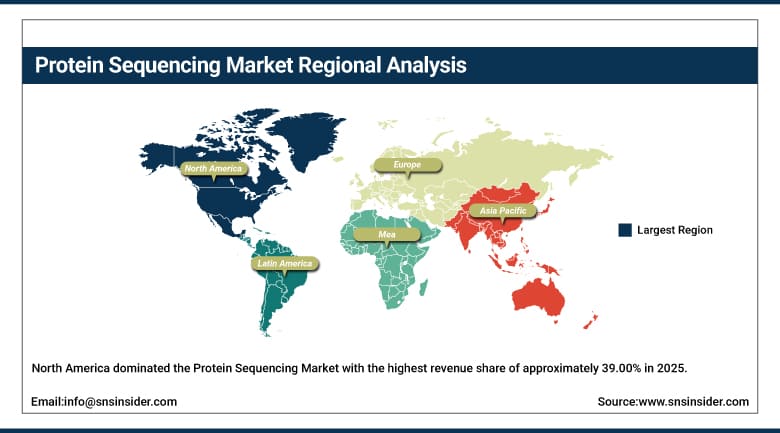
North America dominated the Protein Sequencing Market with the highest revenue share of approximately 39.00% in 2025, These regions have been enabled by high investments in the field of proteomics research, sophisticated biotechnology infrastructure, and the presence of a pharmaceutical industry. Top-notch research organizations, sequencing technology vendors, and increasing demand for precision medicine and drug discovery add to the regional dominance in protein sequencing technologies.
The U.S. Protein Sequencing Market accounted for a market share of 86.0% in 2025, backed up by huge investment in proteomics research, biotechnology facilities, and robust pharmaceutical industry presence. The key players in research organizations and technology providers fuel the adoption process. Rising demand for biomarker identification, precision medicine, and drug development contributes to the growth of the market.
Get Customized Report as Per Your Business Requirement - Enquiry Now
Europe Protein Sequencing Market Insights
Europe’s Protein Sequencing Market is supported by established life sciences research, growing proteomics investments, and strong pharmaceutical and biotechnology industries. There is growing use of protein sequencing in academic institutions and research facilities for biomarker discovery, research into diseases, and therapeutic development. There are more collaborative research projects, better analytic facilities, and increased attention being paid to precision medicine.
The Germany Protein Sequencing Market accounted for a market share of 25.0% in 2025, The drivers include the presence of an existing pharmaceutical and biotechnology industry, well-developed capabilities for research in academia, and growing investments in proteomics. Protein sequencing is used in research laboratories and institutes for the identification of biomarkers, studying diseases, and developing therapies.
Asia Pacific Protein Sequencing Market Insights
Asia Pacific is expected to grow at the fastest CAGR of approximately 5.62% from 2026 to 2035, Driven by increasing efforts in biotech research, growing investment in pharmaceuticals, and rising interest in proteomics and precision medicines. Upgrades in research facilities, growing government funding for the life science industry, and increased use of advanced analytical techniques have been boosting demand. Growing research activity in China, India, Japan, and South Korea is also boosting regional growth.
The China Protein Sequencing Market accounted for a market share of 30.0% in 2025, Backed by an increased amount of research conducted in biotechnology, growing investments in pharmaceuticals, and high demand for the latest technologies of proteomics. The government's support of life sciences, improved facilities for research, and the increased use of precision medicine are other factors that support the adoption of the technology.
Middle East & Africa and Latin America Protein Sequencing Market Insights
The Middle East and Africa and Latin America Protein Sequencing Markets are developing through growing investments in biotechnology research, academic laboratories, and healthcare infrastructure. There is a growing demand for molecular diagnosis, biomarker detection, and treatment. Continuous improvement in laboratory skills, collaborative research work, and availability of sophisticated analysis instruments is likely to facilitate market growth in both regions.
The UAE Protein Sequencing Market accounted for a market share of 12.0% in 2025, Powered by investments in health care infrastructure, biotechnology research, and advanced lab technology. Increasing demand for molecular research, biomarkers, and personalized medicine is driving the use of advanced analytical technologies. Research partnerships, laboratory upgrades, and improvements in life science capabilities contribute to market growth.
Market Dynamics:
Growth Drivers: Growing Proteomics Research and Drug Discovery Investments Drive Market Demand
The growing investments into the field of proteomics research and drug discovery are driving the market for protein sequencing. More pharmaceutical and biotechnology companies are exploring the structural, sequence, and functional properties of various proteins to know about the causes of disease and to find possible treatment targets. Protein sequencing helps researchers to analyze various complex proteins, post translational modifications, and biologics. The increasing developments of monoclonal antibodies, recombinant proteins, and other proteins for treatment purposes are also contributing to the growing requirement for protein sequencing. The universities and research institutes are also conducting more proteomics studies to explore cellular mechanisms and biomarkers of diseases. As the research programs are becoming more focused towards precision medicine and molecular biology, there is an increasing demand for sophisticated sequencing equipment and reagents.
Restraints: High Instrumentation Costs and Technical Expertise Requirements Limit Market Adoption
The prohibitive expense of sophisticated analytical equipment coupled with the need for expert knowledge on how to use such equipment could act as obstacles to the adoption of protein sequencing. The sophisticated mass spectrometers, protein sequencers, sample preparation tools, and associated software could be expensive. Besides the equipment itself, there would be costs incurred in maintenance, calibration, consumables, upgrading of equipment, and training personnel. Analyzing the complicated data produced by such sequencing could require the involvement of experts in analytical chemistry, proteomics, bioinformatics, and molecular biology. Such difficulties would push laboratories into outsourcing their sequencing tasks instead of developing them in-house. Outsourcing is an option that would cut the costs associated with purchasing equipment. However, it could also result in other costs and delays. Suppliers have to address this problem by making such technologies more user-friendly.
Opportunities: Expansion of Precision Medicine and Biomarker Research Creates New Market Opportunities
Increased awareness of precision medicine and biomarker research is paving the way for protein sequencing technologies. Scientists are now studying protein-level differences that play a role in the process of disease onset, therapy efficacy, and biological variability in order to find new diagnostic and treatment biomarkers. Protein sequencing can offer molecular data that would be used for disease-related protein characterization and therapeutic mechanism research. New advances in the field of proteomics research are also inspiring scientists to study isoforms, variants, and post-translational modifications of proteins that might affect their biological activity. Pharmaceutical and biotech companies, hospitals, and research institutions could become possible customers of protein sequencing technologies. However, although further clinical translation would require additional work with validation and regulations, growing investment in personalized healthcare research would create more opportunities for these technologies.
Recent Developments:
-
2026 : Quantum-Si Incorporated presented interim Proteus™ platform results in September 2026, reporting improvements in sequencing scale, accuracy, peptide identification, and protein sequence coverage compared with its Platinum® Pro system.
-
2026 : Thermo Fisher Scientific Inc. continued advancing proteomics capabilities through its integrated mass spectrometry and protein-analysis portfolio, supporting protein characterization, identification, and biomarker research.
-
2026 : Bruker Corporation advanced its proteomics technologies through improvements to its mass spectrometry and analysis software portfolio, supporting enhanced protein sequencing, top-down proteomics, and single-cell protein analysis.
-
2025 : GenScript Biotech Corporation continued expanding its protein characterization and analytical services for biopharmaceutical research, supporting sequence analysis and protein development workflows.
Protein Sequencing Market key players are:
-
Thermo Fisher Scientific Inc.
-
Agilent Technologies, Inc.
-
Shimadzu Corporation
-
Bruker Corporation
-
Waters Corporation
-
Merck KGaA
-
Bio-Rad Laboratories, Inc.
-
Danaher Corporation
-
F. Hoffmann-La Roche Ltd.
-
Eurofins Scientific SE
-
GenScript Biotech Corporation
-
Rapid Novor, Inc.
-
Charles River Laboratories International, Inc.
-
Creative Proteomics
-
Protein Metrics, Inc.
-
Alphalyse A/S
-
Bioinformatics Solutions Inc.
-
Selvita S.A.
-
Proteome Factory AG
-
Quantum-Si Incorporated
Protein Sequencing Market Report Scope:
| Report Attributes | Details |
|---|---|
| Market Size in 2025 | USD 1.90 Billion |
| Market Size by 2035 | USD 2.86 Billion |
| CAGR | CAGR of 4.22% From 2026 to 2035 |
| Base Year | 2025 |
| Forecast Period | 2026-2035 |
| Historical Data | 2022-2024 |
| Report Scope & Coverage | Market Size, Segments Analysis, Competitive Landscape, Regional Analysis, DROC & SWOT Analysis, Forecast Outlook |
| Key Segments | • By Product & Services (Instruments, Reagents & Consumables, Software and Services) • By Technology (Mass Spectrometry, Edman Degradation, Next Generation Sequencing, Others) • By Application (Biotherapeutics & Biologics Characterization, Proteomics & Biomarker Discovery, Drug Discovery & Target Validation, Genetic Engineering & Synthetic Biology, Others) • By End User (Pharmaceutical & Biotechnology Companies, CROs & CDMOs, Academic & Research Institutes, Others) |
| Regional Analysis/Coverage | North America (US, Canada), Europe (Germany, UK, France, Italy, Spain, Russia, Poland, Rest of Europe), Asia Pacific (China, India, Japan, South Korea, Australia, ASEAN Countries, Rest of Asia Pacific), Middle East & Africa (UAE, Saudi Arabia, Qatar, South Africa, Rest of Middle East & Africa), Latin America (Brazil, Argentina, Mexico, Colombia, Rest of Latin America). |
| Company Profiles | Thermo Fisher Scientific Inc., Agilent Technologies, Inc., Shimadzu Corporation, Bruker Corporation, Waters Corporation, Merck KGaA, Bio-Rad Laboratories, Inc., Danaher Corporation, F. Hoffmann-La Roche Ltd., Eurofins Scientific SE, GenScript Biotech Corporation, Rapid Novor, Inc., Charles River Laboratories International, Inc., Creative Proteomics, Protein Metrics, Inc., Alphalyse A/S, Bioinformatics Solutions Inc., Selvita S.A., Proteome Factory AG, and Quantum-Si Incorporated. |

Frequently Asked Questions
Key players in the Protein Sequencing Market include Thermo Fisher Scientific Inc., Agilent Technologies, Inc., Shimadzu Corporation, Bruker Corporation, and Waters Corporation, among others.
Key opportunities in the Protein Sequencing Market include advancements in mass spectrometry technologies, increasing demand for protein characterization in drug discovery, and growing investments in proteomics research and personalized medicine.
The market is driven by rising demand for proteomics research, increasing biopharmaceutical development, and growing applications of protein sequencing in disease research, biomarker discovery, and therapeutic development.
The Reagents & Consumables segment dominated the Protein Sequencing Market, accounting for approximately 42.00% market share.
The North America region dominated the Protein Sequencing Market in 2025 with a 39.00% share, driven by strong proteomics research and increasing investments in biotechnology.
