
Bacterial Vaginosis Diagnostics Market Report Scope & Overview:
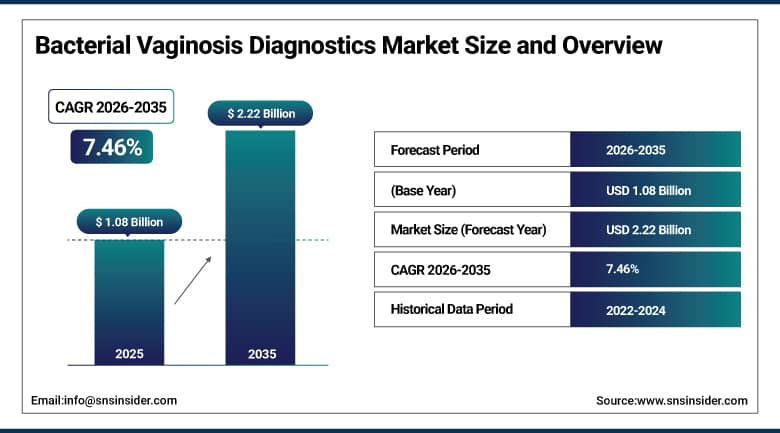
The Bacterial Vaginosis Diagnostics Market was valued at USD 1.08 Billion in 2025 and is expected to reach USD 2.22 Billion by 2035, growing at a CAGR of 7.46% from 2026-2035.
The Bacterial Vaginosis Diagnostics Market will see traction due to the high global prevalence of bacterial vaginosis, growing awareness of women’s health, and the clear link between untreated BV and complications such as preterm birth and higher risk of sexually transmitted infections. Diagnosis is shifting from subjective methods such as Amsel criteria and Nugent scoring toward multiplex PCR panels that detect BV, vulvovaginal candidiasis, and trichomoniasis from a single swab. CLIA-waived molecular tests are bringing accurate results to clinics within an hour or less. Self-collected swabs and rapid point-of-care platforms are further widening access to testing for women across all care settings.
In June 2026, bioMérieux submitted a dual 510(k) and CLIA waiver application to the FDA for its BIOFIRE SPOTFIRE Vaginitis Panel, an automated multiplex PCR test that detects the most common causes of vaginitis, including bacterial vaginosis, in about 20 minutes at the point of care, marking its entry into women’s health.
To Get More Information On Bacterial Vaginosis Diagnostics Market - Request Free Sample Report
Bacterial Vaginosis Diagnostics Market Trends:
-
Rising shift from Amsel criteria and Nugent scoring to multiplex PCR vaginal panels.
-
Growing availability of CLIA-waived molecular tests delivering results at the point of care.
-
Increasing use of self-collected vaginal swabs to improve testing access and privacy.
-
Expanding high-throughput automated platforms for large laboratory vaginitis testing.
-
Growing consumer interest in vaginal microbiome testing through telehealth services.
-
Rising clinical evidence linking rapid BV testing to more appropriate treatment decisions.
U.S. Bacterial Vaginosis Diagnostics Market Outlook:
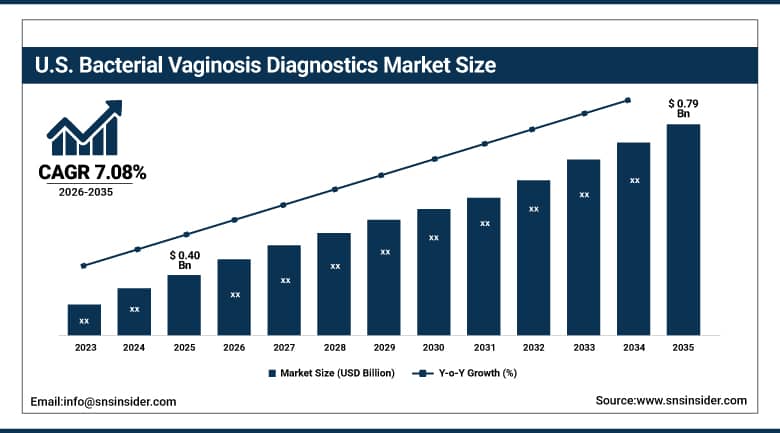
The U.S. Bacterial Vaginosis Diagnostics Market was valued at USD 0.40 Billion in 2025 and is expected to reach USD 0.79 Billion by 2035, growing at a CAGR of 7.08% from 2026-2035.
The U.S. Bacterial Vaginosis Diagnostics Market will grow, as a result of the high prevalence of the condition (which is observed in almost three out of every ten women of reproductive age) and the high level of awareness among clinicians regarding the inadequacy of current techniques in diagnosing the condition. The guidelines issued by the CDC identify molecular testing as an accurate technique for the diagnosis of vaginitis, thereby encouraging the use of PCR panels. Some of the major diagnostics players, such as BD, Hologic, Cepheid, and QuidelOrtho, are located in the United States.
In 2024, Cepheid received FDA clearance with a CLIA waiver for its Xpert Xpress MVP multiplex vaginal panel, allowing testing in near-patient settings with results in about an hour. A 2026 randomized study found that rapid in-office testing with Xpert Xpress MVP increased appropriate treatment and reduced over-treatment compared with usual care.
Bacterial Vaginosis Diagnostics Market Segment Analysis:
-
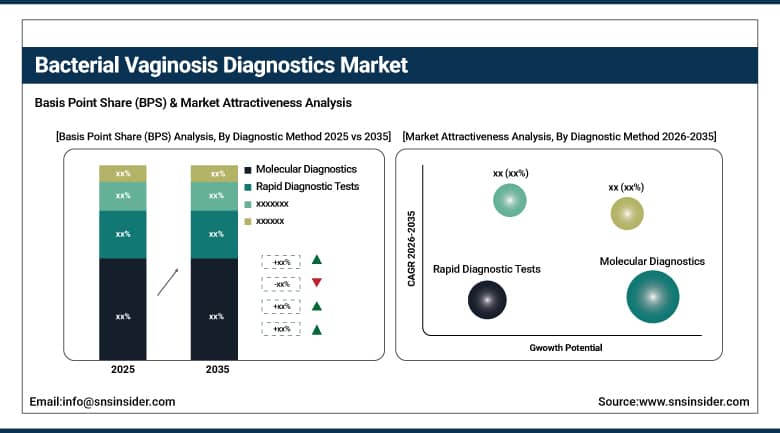
By Diagnostic Method, the Molecular Diagnostics segment dominated the Bacterial Vaginosis Diagnostics Market with approximately 38.64% share in 2025, while the Rapid Diagnostic Tests segment is the fastest growing with a CAGR of approximately 9.18%.
-
By Testing Setting, the Laboratory-Based Testing segment dominated the Bacterial Vaginosis Diagnostics Market with approximately 68.42% share in 2025, while the Point-of-Care Testing segment is the fastest growing with a CAGR of approximately 9.87%.
-
By Sample Collection, the Clinician-Collected segment dominated the Bacterial Vaginosis Diagnostics Market with approximately 72.36% share in 2025, while the Self-Collected segment is the fastest growing with a CAGR of approximately 10.12%.
-
By End User, the Diagnostic Laboratories segment dominated the Bacterial Vaginosis Diagnostics Market with approximately 44.91% share in 2025, while the Clinics segment is the fastest growing with a CAGR of approximately 8.54%.
By Diagnostic Method, Molecular Leads, While Rapid Tests Grow Fastest
The molecular diagnostics segment dominated the Bacterial Vaginosis Diagnostics Market in 2025, In comparison with older methodologies like Amsel criteria and Nugent scoring, PCR-based tests are more precise and objective. The multiplex molecular panels can detect the presence of important BV-related bacterial strains, such as Gardnerella vaginalis and Atopobium vaginae, at the same time analyzing the composition of beneficial Lactobacillus strains. Besides, many multiplex panels include testing for vulvovaginal candidiasis and trichomoniasis based on the single vaginal swab, thus providing the opportunity to identify co-infections. Popular diagnostic kits that are frequently used are BD Vaginal Panel, Hologic Aptima BV, and Cepheid Xpert Xpress MVP.
Rapid diagnostic tests are the fastest-growing diagnostic method, as clinicians increasingly want results during the same patient visit to avoid delayed or incorrect treatment. Traditional office-based methods such as wet mount microscopy and whiff tests are subjective and depend heavily on clinician experience, often leading to misdiagnosis. New rapid molecular platforms, including CLIA-waived systems that deliver results in 20 to 60 minutes, combine speed with laboratory-level accuracy. Low-cost rapid tests that detect sialidase activity or vaginal pH are also used in resource-limited settings. Growing clinical evidence that rapid testing improves appropriate treatment rates is expected to accelerate adoption throughout the forecast period.
By Testing Setting, Laboratory-Based Leads, While Point-of-Care Grows Fastest
The laboratory-based testing segment dominated the Bacterial Vaginosis Diagnostics Market in 2025, the hospitals and reference laboratories process many vaginal swab specimens on the automated molecular platforms. Automated molecular platforms such as BD COR, Hologic Panther, and Roche cobas allow the labs to conduct vaginitis panels in conjunction with the STI tests using one specimen, which is quite efficient and also helps in reducing costs per test. Networks like Quest Diagnostics and Labcorp offer access to these panels via physicians' offices across the country. Due to reimbursement, quality systems, and the ability to perform complicated tests, this market segment has a commanding market position.
Point-of-care testing is the fastest-growing setting, driven by rising demand for fast, accurate results that allow clinicians to diagnose and treat patients in a single visit. CLIA-waived molecular systems such as Cepheid’s Xpert Xpress MVP and bioMérieux’s planned BIOFIRE SPOTFIRE Vaginitis Panel bring PCR-level accuracy to physician offices, urgent care centers, and women’s health clinics. Faster results help reduce the common practice of empiric treatment, which often leads to repeated visits and unnecessary antibiotic use. Expanding urgent care networks, growing retail health clinics, and stronger clinical evidence supporting rapid testing are expected to drive strong growth in this segment worldwide.
By End User, Diagnostic Laboratories Lead, While Clinics Grow Fastest
The diagnostic laboratories segment dominated the Bacterial Vaginosis Diagnostics Market in 2025, Most molecular tests performed to diagnose vaginitis infections are done by independent and reference labs, on behalf of the order placed by obstetricians, gynecologists, and general practitioners. Independent laboratories employ systems which allow them to process several thousand samples in one day with the help of wide test menus, including vaginitis tests alongside those of chlamydia, gonorrhea, and trichomoniasis infections. Good ties between independent labs and physician practices, along with insurance companies, have made their testing cost-effective, as well as increased their dominance globally through the whole forecast period.
The clinics segment is the fastest-growing end user, supported by the rapid adoption of CLIA-waived point-of-care molecular tests in obstetrics and gynecology practices, family planning clinics, urgent care centers, and sexual health clinics. Clinics benefit from same-visit diagnosis, which improves patient satisfaction, reduces follow-up appointments, and supports more appropriate prescribing of antibiotics and antifungals. The growth of women’s health-focused clinic chains and telehealth services that combine virtual visits with self-collected swab kits is also expanding testing in outpatient settings. Rising investment by diagnostic companies in compact, easy-to-use systems is expected to further support strong growth in this segment over time.
Regional Analysis:
|
Region |
Major Country |
Share within Region, 2025 (%) |
|
North America |
United States |
87.30% |
|
Europe |
Germany |
23.90% |
|
Asia-Pacific |
China |
31.60% |
|
Middle East & Africa |
GCC |
46.80% |
|
Latin America |
Brazil |
48.20% |
North America Bacterial Vaginosis Diagnostics Market Insights
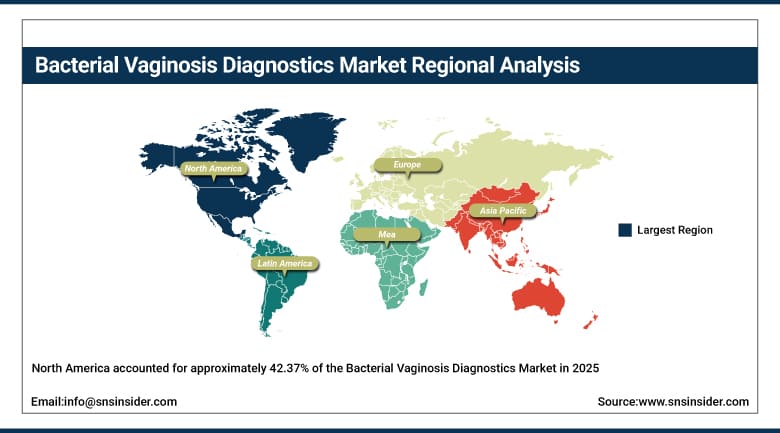
North America accounted for approximately 42.37% of the Bacterial Vaginosis Diagnostics Market in 2025, the largest share among all regions, supported by high BV prevalence, strong awareness of women’s health, and early adoption of molecular vaginitis panels. The United States generates the majority of regional revenue, with leading diagnostics companies such as BD, Hologic, Cepheid, QuidelOrtho, and Thermo Fisher Scientific offering FDA-cleared tests. CDC guidelines recognize molecular testing as an accurate diagnostic option, while broad insurance coverage supports laboratory and point-of-care testing. The growth of women’s health startups and telehealth platforms offering at-home vaginal microbiome testing is also expanding the market.
Canada continues its consistent participation due to its provincial health insurance and increased awareness about BV’s effect on pregnancy. Programs such as Healthy Pregnancy Hub of Pan-Canadian Women’s Health Coalition contribute to the development of patient education about infections in pregnancy, thus encouraging the idea of earlier diagnosis. Mexico offers a more limited but developing market as the network of private hospitals and laboratories provides more opportunities for women’s health tests through molecular methods. Expansion of molecular point-of-care devices used by doctors in clinics and urgent care centers is anticipated to drive regional growth further. At the same time, issues related to the decrease in reimbursement rates and dependence on empiric therapy will still be relevant.
Get Customized Report as Per Your Business Requirement - Enquiry Now
Europe Bacterial Vaginosis Diagnostics Market Insights
Europe continues to be the second-largest regional market, supported by Germany, the UK, France, Italy, and Spain, where public healthcare systems and well-established gynecology services ensure broad access to diagnostic testing. The region is home to major diagnostics companies such as bioMérieux in France, Roche in Switzerland, QIAGEN in Germany and the Netherlands, and Siemens Healthineers in Germany. European guidelines from IUSTI recommend accurate diagnosis of vaginal discharge conditions, supporting wider use of molecular testing. The European In Vitro Diagnostic Regulation has raised evidence requirements, favoring established suppliers with strong clinical data and CE-marked multiplex vaginitis assays across member states.
Germany dominates the local market due to the presence of a big laboratory base, a good number of gynecological practices, and the use of molecular diagnostics. The UK market is growing due to the support from the NHS sexual health clinics, which rely on molecular diagnostics for women suffering from vaginal complaints. In France, the growth of the market is driven by the leading position of bioMérieux in syndromic molecular diagnostics as well as the presence of private laboratories. In Italy and Spain, access to multiplex PCR tests in hospital laboratories and private clinics is expanding. Increasing awareness of pregnancy risks associated with bacterial vaginosis leads to an expansion of prenatal screening in several countries.
Asia-Pacific Bacterial Vaginosis Diagnostics Market Insights
Asia-Pacific is currently witnessing the highest growth rate in the Bacterial Vaginosis Diagnostics Market, anticipated to record a CAGR of around 9.12% during the forecast period from 2026 to 2035, due to its large female population, rising awareness of reproductive health, and expanding diagnostic infrastructure. China is the largest market in the region, driven by growing gynecology and prenatal care services, expanding hospital laboratories, and strong domestic diagnostic manufacturers offering molecular and rapid tests. Government efforts to improve women’s and maternal healthcare, along with rising private healthcare spending, are increasing testing volumes across urban hospitals and regional healthcare centers nationwide.
India is emerging as a key growth driver, supported by a high BV burden, expanding private diagnostic chains, and government programs focused on maternal and reproductive health. Japan remains a significant market owing to its universal health insurance, advanced laboratory infrastructure, and adoption of molecular women’s health testing. South Korea benefits from companies such as Seegene, which offer multiplex PCR assays for vaginitis and sexually transmitted infections. Australia supports demand through strong sexual health services and research on vaginal microbiome health. Improving access to women’s health services across Southeast Asia is expected to further accelerate regional market growth over the forecast period.
MEA & Latin America Bacterial Vaginosis Diagnostics Market Insights
The Middle East & Africa region represents a smaller but growing share of the Bacterial Vaginosis Diagnostics Market, led by Gulf Cooperation Council states such as Saudi Arabia and the UAE, which are investing in modern hospital laboratories and specialized women’s health services. Government healthcare transformation programs and expanding health insurance coverage are increasing access to molecular and rapid testing. Sub-Saharan Africa has one of the highest BV prevalence rates globally, and its link to higher HIV acquisition risk is increasing interest in low-cost screening tools. South Africa anchors regional demand, although limited laboratory infrastructure restricts testing in many African countries.
Latin America is experiencing steady growth, with Brazil leading the region owing to its large female population, broad public healthcare system, and established network of private diagnostic laboratories. Mexico and Argentina contribute significant demand through expanding hospital laboratories and growing gynecology practices. Rising awareness of BV-related complications in pregnancy is supporting wider prenatal screening in several countries. Private laboratory chains are increasingly adding multiplex molecular vaginitis panels to their women’s health menus. However, budget constraints in public health systems, limited reimbursement for molecular tests, and continued reliance on empiric treatment still restrict faster market growth across much of the region.
Market Dynamics:
Growth Drivers: High BV Prevalence and Shift to Molecular Testing
Growth in the Bacterial Vaginosis Diagnostics Market is primarily attributed to the high global prevalence of bacterial vaginosis, the most common cause of abnormal vaginal discharge among women of reproductive age. BV affects roughly a quarter to a third of women in many regions and is frequently recurrent, requiring repeated testing and treatment. Untreated BV is linked to serious complications, including preterm birth, low birth weight, pelvic inflammatory disease, and increased risk of acquiring HIV and other sexually transmitted infections. Growing awareness of these risks among women and healthcare providers is increasing demand for accurate diagnosis, particularly during pregnancy and in sexual health settings.
The shift from subjective traditional methods to objective molecular testing is further reinforcing market growth. Amsel criteria and Nugent scoring depend on clinician skill and microscopy, often resulting in misdiagnosis and inappropriate treatment. Multiplex PCR panels from companies such as BD, Hologic, Cepheid, and Roche provide accurate results for BV, candidiasis, and trichomoniasis from a single swab. CLIA-waived systems now allow molecular testing directly in clinics, while high-throughput platforms serve large laboratories. Clinical studies showing that molecular and rapid testing improve appropriate treatment and reduce repeat visits are strengthening physician confidence and supporting broader insurance coverage for these molecular tests.
Restraints: High Test Costs and Reliance on Empiric Treatment
High prices of the advanced diagnostic techniques are still limiting the development of the market. Molecular vaginitis panels are expensive in comparison with the conventional diagnostic procedures performed in offices, such as pH test, wet mount, and whiff test. Point-of-care molecular devices require a certain investment into the purchase of the equipment and cartridges, and this is an obstacle difficult to overcome for small medical facilities located in poor areas. In many countries, limited and inconsistent reimbursement of the molecular diagnostics procedure is a strong deterrent against using it. Such a problem is especially relevant in developing countries where the prevalence of BV is high and resources of healthcare system are insufficient.
One more limitation is that there is a high degree of empiric prescription of antibiotics without verification of the diagnosis because of the high prevalence of over-the-counter and home remedies. Moreover, in some areas, women are not aware of BV and its possible complications, thus, they have no motivation to go through a test. There is also a significant stigma associated with the issues related to female reproductive system and STDs. Besides, a shortage of professionals who perform the test is another limitation in developing countries.
Opportunities: Point-of-Care, Self-Collection, and At-Home Testing
The expansion of point-of-care molecular testing creates a significant opportunity for manufacturers, as CLIA-waived systems allow clinicians to diagnose and treat patients during a single visit. New platforms that deliver results in 20 to 60 minutes, such as Cepheid’s Xpert Xpress MVP and bioMérieux’s BIOFIRE SPOTFIRE Vaginitis Panel, can reduce empiric treatment and repeat visits. Urgent care centers, retail health clinics, and women’s health practices represent large untapped settings for these tests. Companies that offer compact, easy-to-use systems with broad women’s health menus can capture a growing share of decentralized testing volumes worldwide and build strong, lasting long-term customer loyalty.
At the same time, the growth of self-collection and at-home testing provides a major growth opportunity. Self-collected vaginal swabs have shown accuracy comparable to clinician-collected samples, improving convenience and privacy for women. Telehealth services and women’s health startups are combining virtual consultations with at-home sample kits and vaginal microbiome testing to reach patients who avoid clinic visits. Rising investment in women’s health, including funding for companies such as Heranova Lifesciences, is supporting innovation in diagnostics and treatment. Expanding healthcare infrastructure in Asia-Pacific, Latin America, and Africa also creates new demand for affordable rapid tests suited to resource-limited clinical and community settings.
Recent Developments:
-
2023, BD received FDA 510(k) clearance for the BD Vaginal Panel on its high-throughput BD COR System, detecting BV, vulvovaginal candidiasis, and trichomoniasis from a single swab.
-
2023, Heranova Lifesciences launched with USD 13.5 million in funding to develop advanced diagnostic tests and therapeutics for women’s health conditions, including bacterial vaginosis.
Bacterial Vaginosis Diagnostics Market Key Players:
-
Becton, Dickinson and Company (BD)
-
Hologic, Inc.
-
QIAGEN N.V.
-
Sekisui Diagnostics
-
bioMérieux SA
-
QuidelOrtho Corporation
-
Thermo Fisher Scientific Inc.
-
Cepheid (Danaher Corporation)
-
F. Hoffmann-La Roche Ltd.
-
Abbott Laboratories
-
Siemens Healthineers AG
-
PHASE Scientific International Ltd.
-
Seegene Inc.
-
Labcorp Holdings Inc.
-
Quest Diagnostics Incorporated
-
Bio-Rad Laboratories, Inc.
-
Heranova Lifesciences
-
Evvy
-
Hardy Diagnostics
-
Savyon Diagnostics Ltd.
Bacterial Vaginosis Diagnostics Market Report Scope:
| Report Attributes | Details |
|---|---|
| Market Size in 2025 | USD 1.08 Billion |
| Market Size by 2035 | USD 2.22 Billion |
| CAGR | CAGR of 7.46% From 2026 to 2035 |
| Base Year | 2025 |
| Forecast Period | 2026-2035 |
| Historical Data | 2022-2024 |
| Report Scope & Coverage | Market Size, Segments Analysis, Competitive Landscape, Regional Analysis, DROC & SWOT Analysis, Forecast Outlook |
| Key Segments | • By Diagnostic Method (Molecular Diagnostics, Immunoassays, Rapid Diagnostic Tests, Vaginal pH Tests, Gram Stain & Microscopy, Other Methods) • By Testing Setting (Laboratory-Based Testing, Point-of-Care Testing) • By Sample Collection (Clinician-Collected, Self-Collected) • By End User (Hospitals, Clinics, Diagnostic Laboratories, Other End Users) |
| Regional Analysis/Coverage | North America (US, Canada), Europe (Germany, UK, France, Italy, Spain, Russia, Poland, Rest of Europe), Asia Pacific (China, India, Japan, South Korea, Australia, ASEAN Countries, Rest of Asia Pacific), Middle East & Africa (UAE, Saudi Arabia, Qatar, South Africa, Rest of Middle East & Africa), Latin America (Brazil, Argentina, Mexico, Colombia, Rest of Latin America). |
| Company Profiles | Becton, Dickinson and Company (BD), Hologic, Inc., QIAGEN N.V., Sekisui Diagnostics, bioMérieux SA, QuidelOrtho Corporation, Thermo Fisher Scientific Inc., Cepheid (Danaher Corporation), F. Hoffmann-La Roche Ltd., Abbott Laboratories, Siemens Healthineers AG, PHASE Scientific International Ltd., Seegene Inc., Labcorp Holdings Inc., Quest Diagnostics Incorporated, Bio-Rad Laboratories, Inc., Heranova Lifesciences, Evvy, Hardy Diagnostics, Savyon Diagnostics Ltd. |
Frequently Asked Questions
Key players include Becton, Dickinson and Company, Hologic, Inc., QIAGEN N.V., Sekisui Diagnostics, and bioMérieux SA, among others.
Key opportunities include CLIA-waived point-of-care molecular testing, self-collected and at-home testing, and affordable rapid tests for high-prevalence emerging markets.
The primary growth factor is the high global prevalence of bacterial vaginosis, combined with the shift from subjective traditional methods to accurate molecular testing.
By diagnostic method, the Molecular Diagnostics segment dominates the Bacterial Vaginosis Diagnostics Market with approximately 38.64% share in 2025.
North America dominates the Bacterial Vaginosis Diagnostics Market with approximately 42.37% share in 2025.
