
Banknotes Market Report Scope & Overview:
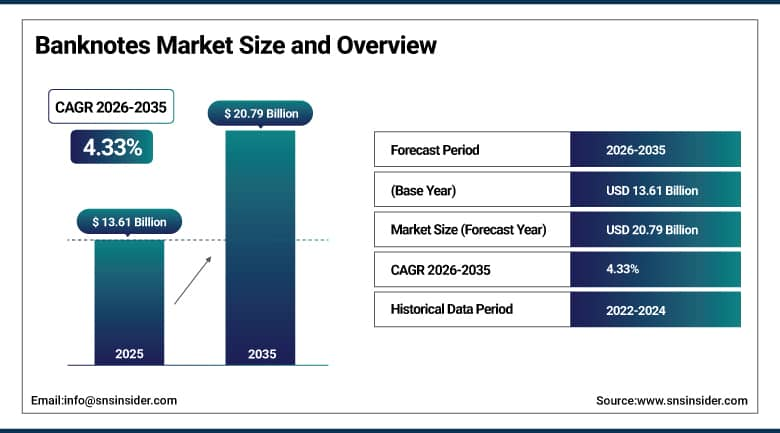
The Banknotes Market was valued at USD 13.61 Billion in 2025 and is expected to reach USD 20.79 Billion by 2035, growing at a CAGR of 4.33% from 2026-2035.
The Banknotes Market is advancing at a steady pace because physical cash remains the dominant means of payment in many economies, and central banks must replace worn notes, issue new series and respond to rising counterfeit sophistication. Demand is supported by population growth, cash hoarding in uncertain periods and scheduled redesigns of national currencies. The producers are allocating funds on polymers and composite substrates, along with optical security features and machine-readable components, which enhance durability of notes and ease verification. The introduction of digital payments and the study of Central Bank Digital Currency is slowing down the growth rate of some nations, but most of the issuers have confirmed that cash will continue to flow in conjunction with the new tools.
⮞In July 2025, the Federal Reserve Board submitted a 2026 currency print order of between 3.78 billion and 5.12 billion notes to the Bureau of Engraving and Printing. The size of the order illustrates the scale of replacement demand in the world's largest cash-issuing economy.
Get Customized Report as Per Your Business Requirement - Enquiry Now
Banknotes Market Trends
-
Central banks are shifting from paper to polymer and hybrid substrates to extend note life.
-
Optically variable and machine-readable security features are being combined within a single design.
-
Complete series redesigns are being scheduled to incorporate new portraits, themes and anti-counterfeiting elements.
-
Issuers are signing multi-year printing contracts with commercial and state printers to secure supply.
-
Central banks are affirming that cash will remain available alongside digital currency projects.
U.S. Banknotes Market Outlook
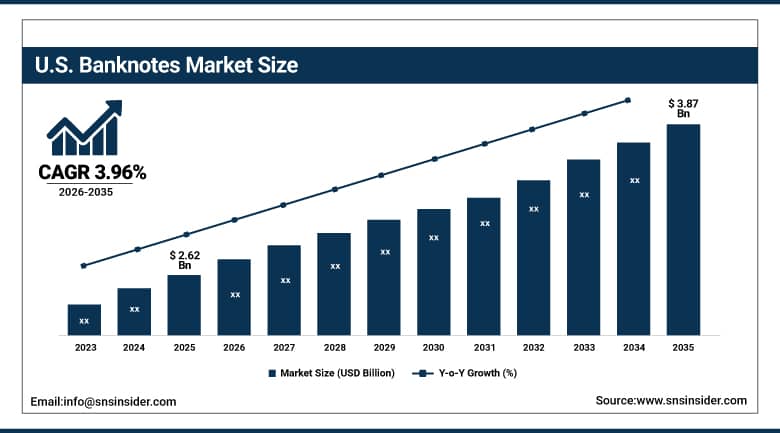
The U.S. Banknotes Market was valued at USD 2.62 Billion in 2025 and is expected to reach USD 3.87 Billion by 2035, growing at a CAGR of 3.96% from 2026-2035.
The U.S. Banknotes Market is characterized by a single national issuer, a centralized printing agency and a long-standing supply chain for cotton-linen paper, inks and security threads. Federal Reserve print orders are set annually in response to forecast demand for currency and the need to replace unfit notes. Overseas holdings of U.S. dollars, estimated to represent a large proportion of notes in circulation, keep demand for high denominations strong. Private suppliers provide substrate and security features under long-term contracts, and the issuer continues to introduce incremental design improvements to deter counterfeiting. Growth is moderate because card and mobile payments handle most small-value consumer spending, while cash demand for storage and cross-border use remains firm.
⮞In September 2025, Crane NXT stated that it expected high-single-digit growth in its U.S. currency business in 2026, with combined volume of $10, $20, $50 and $100 notes projected to rise about 90% at the midpoint compared with 2025. The projection indicates a strong replenishment cycle for higher denominations.
Banknotes Market Segment Analysis
-
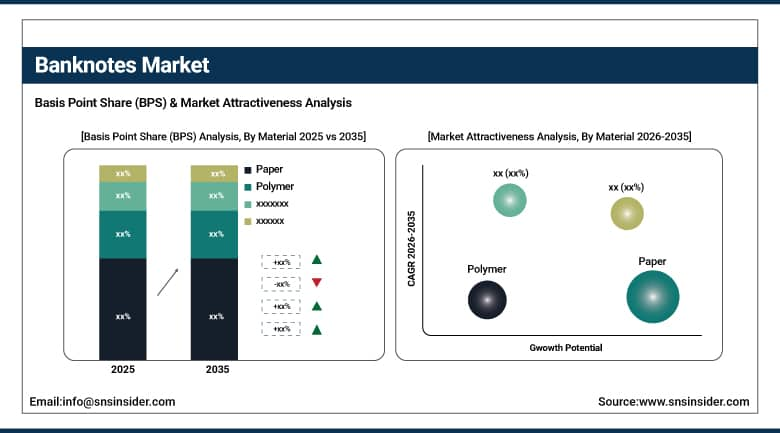
By Material, the Paper segment dominated the Banknotes Market with approximately 61.84% share in 2025, while the Polymer segment is the fastest growing with a CAGR of approximately 12.41%.
-
By Security Feature, the Watermarks segment dominated the Banknotes Market with approximately 22.18% share in 2025, while the Holograms and Foils segment is the fastest growing with a CAGR of approximately 6.37%.
-
By Printing Technology, the Intaglio segment dominated the Banknotes Market with approximately 44.19% share in 2025, while the Digital segment is the fastest growing with a CAGR of approximately 7.08%.
-
By Denomination, the Low Denomination segment dominated the Banknotes Market with approximately 66.52% share in 2025, while the High Denomination segment is the fastest growing with a CAGR of approximately 5.91%.
By Material, Paper Dominates the Banknotes Market and Polymer Grows Fastest
Cotton-based paper remains the principal substrate because most national currencies already use it, printing lines are configured for it and the tactile quality of paper notes is familiar to users and recognized by vending and sorting equipment. Paper supports watermarks, embedded threads and intaglio relief, which are core public-facing authentication elements. Established suppliers hold long contracts for paper with central banks, and the cost per note is lower than polymer for issuers that do not face extreme climates or heavy handling. Cash-intensive economies in Asia and Africa continue to order large paper volumes for routine replacement.
Polymer is advancing fastest as issuers seek notes that last several times longer, resist dirt and moisture and carry transparent windows that are difficult to reproduce. Lower replacement frequency and easier recycling improve the lifetime cost of cash, a point that central banks increasingly cite when approving new series. Countries across the Commonwealth, Latin America and Africa have adopted polymer for some or all denominations, and larger economies are testing it for mid-value notes. Hybrid constructions combine a paper core with polymer coatings to balance durability and familiar feel. Suppliers have expanded film capacity to meet the rising number of orders.
⮞As of October 2026, CCL Secure reported that more than 40 central banks use its GUARDIAN polymer banknote substrate, which was first issued in 1988. The adoption base shows how polymer has become a mainstream choice among issuers.
By Security Feature, Watermarks Dominates the Banknotes Market and Holograms and Foils Grows Fastest
Watermarks continue to be the most widely applied feature because they are produced during paper manufacture, are visible to the public without equipment and are difficult to imitate convincingly. Multitone and electrotype watermarks add portraits or numerals that confirm authenticity by transmitted light. Security threads and microprinting complement them in layered designs, and central banks promote a simple check-by-feel, look and tilt message to educate users. Because watermarked paper is supplied by a small number of specialist mills, the feature also supports supply security and contract continuity for established vendors.
Holograms, foils and other optically variable devices are expanding fastest as issuers add dynamic elements that change appearance when tilted, such as moving stripes and color-shifting patches. These features are valued because they are visible to the public, hard to copy with desktop equipment and can incorporate unique design themes. Machine-readable elements, including UV and infrared responses, are gaining use for automated sorting and acceptance. Counterfeit detection statistics from central banks encourage upgrades, and polymer notes provide a larger surface for transparent windows with embedded optical effects. Specialist foil suppliers are therefore increasing capacity.
⮞In May 2026, Bundesdruckerei presented STELLA, a credit-card-sized concept banknote, as part of its banknote security portfolio, which includes security features and security inks. The concept shows continuing investment in next-generation anti-counterfeiting design.
By Printing Technology, Intaglio Dominates the Banknotes Market and Digital Grows Fastest
Intaglio printing is the defining process for secure banknotes because it produces raised, high-resolution lines and tactile relief that can be recognized by touch, including by visually impaired users, and that are difficult to reproduce with commercial printers. It is combined with offset background printing, numbering and special inks in multi-stage production lines that require specialized presses and trained operators. Large capital investments, long machine lifetimes and certification requirements make the process a barrier to new entrants. State printers and major commercial producers continue to rely on it for most denominations in circulation.
Digital technologies are growing fastest, though from a smaller base, as printers adopt inkjet numbering, laser marking and digital personalization for variable data, small runs and test series. Inline inspection with high-speed cameras and machine learning improves yield by identifying defects early. Digital design workflows also reduce lead time between concept approval and plate production. Screen printing and letterpress remain important for optically variable inks and numbering, while offset supplies fine backgrounds. Press manufacturers continue to develop combined lines to reduce footprint and energy use for issuers building or upgrading their facilities.
⮞As of October 2026, Oberthur Fiduciaire reported production capacity of more than 5 billion notes a year across three European sites. The capacity figure shows the scale at which commercial intaglio and offset production operates.
By Denomination, Low Denomination Dominates the Banknotes Market and High Denomination Grows Fastest
Low denominations account for the largest share of notes produced because they change hands most frequently, wear out quickly and are used for everyday purchases in cash-intensive economies. Replacement cycles are short, which keeps print volumes high even when the share of value is modest. Issuers in emerging markets, where small-ticket transactions still depend on cash, place large orders for the smallest notes, and the shift to polymer for these denominations is intended to reduce reprint frequency. Retail, transport and informal trade sustain demand, and vending and ticketing machines require large supplies of clean, fit notes.
High denominations are growing fastest as inflation in several economies erodes the purchasing power of smaller notes and as households and businesses hold cash for storage. Central banks respond by introducing larger notes, which require stronger security because they carry high counterfeiting incentives. In several mature markets, a small number of high-value notes represent most of the value in circulation, so their security upgrades receive priority. Larger notes also raise the technical content per piece, including more complex optical devices, supporting revenue growth for substrate and feature suppliers even when unit volumes move slowly.
⮞For example, in May 2026, the Reserve Bank of India reported that the 500-rupee note accounted for 41.2% of notes in circulation by volume and 85.5% by value at the end of March 2026. The concentration shows how a single higher denomination can dominate cash value.
Regional Analysis
|
Region |
Major Country |
Share within Region, 2025 (%) |
|---|---|---|
|
Asia Pacific |
China |
60.87% |
|
North America |
United States |
84.63% |
|
Europe |
Germany |
21.48% |
|
Latin America |
Brazil |
39.04% |
|
Middle East and Africa |
Saudi Arabia |
26.57% |
Asia Pacific Banknotes Market Insights
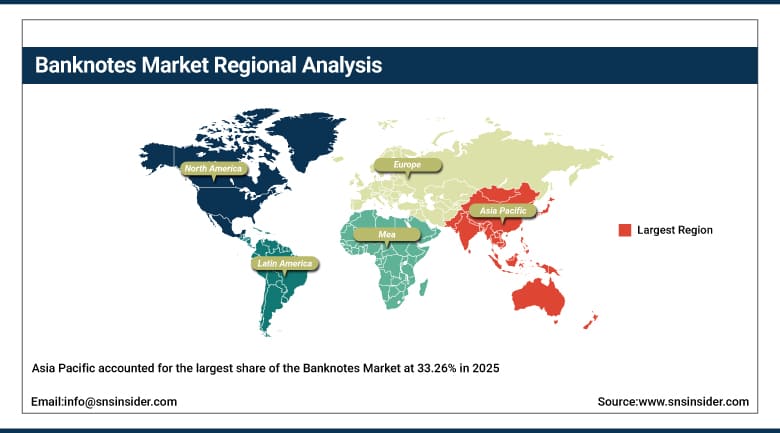
Asia Pacific accounted for the largest share of the Banknotes Market at 33.26% in 2025, reflecting the size of its population, the persistence of cash in retail trade and the presence of the largest state printers. China operates the world's largest note production base through its national printing and minting corporation, while India issues several billion notes each year through public sector presses and a supporting paper industry. Japan, South Korea and Australia maintain advanced polymer and security programs. Regional currency in circulation continues to grow with economic activity, which sustains replacement orders.
Additionally, the market is expected to be the fastest-growing with a forecasted CAGR of 6.21% during 2026-2035 due to growth in income in South and Southeast Asia as well as investments in capacity in paper and substrate production. Some of the issuers have been planning their next issue series with added functionalities, while the governments prefer domestic manufacturing of currency for ensuring the supply. Digital transactions have gained significant momentum through unified payment interfaces but the cash circulating in the market has seen an increase in various nations.
⮞In March 2025, Security Papers Limited of Pakistan said its shareholders had approved an 18-month overhaul of its Paper Machine PM-2 to make banknote paper for the State Bank of Pakistan's new banknote series. The project illustrates the regional push to localize security paper supply.
Get Customized Report as Per Your Business Requirement - Enquiry Now
North America Banknotes Market Insights
North America combines a very large issuer in the United States with a smaller and technologically advanced program in Canada. The U.S. dollar circulates widely abroad, which keeps the region at the center of global cash demand, and the issuer coordinates closely with its paper and ink suppliers to maintain quality. Canada has used polymer notes for more than a decade and continues to introduce new designs that integrate sophisticated optical effects. Both countries invest in public education on authentication and in upgrades to sorting equipment at commercial banks and cash-in-transit firms.
Market growth is modest because noncash payments dominate retail transactions, but replacement of worn notes and periodic series updates provide stable orders. Issuers from both Canada and America are examining digital currency ideas, but maintain that there will still be cash. The local supply chain involves the specialized production of paper, ink and other equipment, and contracts tend to be long-term in nature. Competitive issues revolve around the capability of producing quality that is in accordance with the specifications laid down by the issuers.
⮞In September 2026, the Bank of Canada unveiled the new vertical 20-dollar note, whose purple security stripe contains elements that spin, transform and pulse when the note is moved. The central bank stated that these features have not been used on Canadian currency before.
Europe Banknotes Market Insights
Europe is a mature market with advanced security technology and a strong base of commercial printers, paper mills and equipment makers. The Eurosystem issues euro notes through national central banks that contract with several printers, while the United Kingdom, Switzerland, the Nordic countries and Central Europe run their own series. Germany hosts leading technology suppliers and printing capacity. Issuers prioritize sustainability, accessibility for visually impaired users and durable substrates, and many are moving toward polymer or hybrid designs. Contract competitions among printers are frequent and often multi-year.
Design cycles are active. Several issuers are redesigning their notes, which creates demand for new security features, new artwork and updated verification devices for retailers and machine makers. At the same time, digital currency projects are under review in the euro area and the United Kingdom, although authorities stress that cash will remain legal tender and widely accessible. Cash use for payments is lower in the Nordic countries than in southern and central Europe, creating different demand patterns. Overall growth is steady rather than rapid, supported by replacement and redesign programs and by long-running tender cycles.
⮞In March 2026, the Swiss National Bank announced that the design competition for its tenth banknote series was won by Emphase Ltd of Lausanne with Concept J under the theme Switzerland and its altitudes. The decision starts a long production planning cycle for new Swiss notes.
MEA and Latin America Banknotes Market Insights
The Middle East and Africa combines high cash dependence with growing issuance, and several central banks are modernizing their currencies. Nigeria prints billions of notes each year, using both domestic and foreign printers, Kenya has awarded a new printing contract, and Ghana is preparing an upgraded series. Gulf states are issuing notes with advanced features and polymer substrates, and Egypt has moved some denominations to polymer. Inflation in certain economies increases the need for higher denominations. Security of supply, foreign exchange availability and local production capacity are recurring policy themes in this region.
⮞In August 2026, the Central Bank of Nigeria reported in its 2025 annual report that 3.43 billion naira notes were printed in 2025, of which 1.23 billion came from the domestic security printer and 2.20 billion from foreign printers. The split shows reliance on international capacity.
Latin America is led by Brazil, with Mexico, Argentina, Colombia and Chile as additional markets. Mexico forms part of this regional scope. Inflation has prompted issuers such as Argentina to introduce higher denominations, which created sharp short-term demand for printing capacity, including imports of notes from foreign printers. Brazil and Mexico maintain domestic printing agencies and have adopted polymer for selected denominations. Cash remains widely used in informal trade, while instant payment systems are growing quickly. Producers see currency redesign and polymer migration as the main growth levers.
⮞In May 2024, Banco Central de la Republica Argentina began circulating the 10,000-peso note, with about 19.8 million notes in circulation within days of release. The introduction shows how inflation drives demand for higher denominations.
Growth Drivers: Currency Series Renewal and Local Production Programs Drive Growth in the Banknotes Market
Central banks renew currency series to stay ahead of counterfeiters, to update national imagery and to adopt more durable substrates. Each new series requires design competitions, plate production, new feature development and large initial print runs, which generates sustained work for printers, paper makers and feature suppliers. Series launches are scheduled years in advance and are often accompanied by public education campaigns and updates to machine acceptance equipment. Because transition periods mean old and new notes circulate together, production volumes remain high for extended periods, and printers retain stable order books.
Governments are also investing in local production to protect supply and reduce foreign exchange outflows. New paper machines, ink plants and printing lines are being commissioned in South Asia, Africa and the Middle East, usually with technology partners from Europe. These projects create demand for equipment and technical services as well as for finished notes. Domestic production also supports skills and employment, adding political backing to the programs. As economies grow and the population of cash users expands, issuers plan capacity ahead of expected needs, which supports the long-term outlook.
⮞In September 2026, the Bank of Ghana announced the upgraded Heritage Series cedi notes in eight denominations, to be launched on 3 November 2026. The series shows how scheduled renewals sustain printing and substrate orders.
Restraints: Digital Payment Adoption and Central Bank Digital Currency Programs Restrain Growth in the Banknotes Market
Instant payment systems, card acceptance and mobile wallets are reducing the use of cash for everyday purchases in many countries, particularly in Northern Europe and East Asia. Lower transaction use shortens the list of applications for small denominations and may reduce print volumes over time. Retailers and banks are also trimming cash handling services to cut cost, which places pressure on the cash cycle. Governments promoting formal financial inclusion and tax compliance sometimes introduce incentives for digital payments.
The central banks are developing digital currencies that may complement or replace some of the applications of physical currency. However, despite the authorities assuring that there will still be physical cash, this ambiguity impacts the investment decisions of the producers of such currencies. This is due to the fact that these producers need to make plans several years in advance due to high capital expenditure and durability of the equipment. Price competition among the state-owned printing firms and lengthy bidding periods make the margins small especially when such firms are capable of printing in-house.
⮞In March 2026, the Bank of England said that the design phase of the digital pound ends in 2026 and that a digital pound would complement, not replace, cash. The statement shows both the progress of digital currency work and the central bank commitment to cash.
Opportunities: Polymer Migration and New Note Series Create Opportunities in the Banknotes Market
More issuers are weighing the move from paper to polymer for at least some denominations because longer note life reduces the cost of replacement and the environmental footprint of cash. Suppliers of film, coating and printing services expect rising orders as central banks in Africa, Latin America and Asia complete feasibility studies. Hybrid solutions that retain familiar paper feel with polymer security windows widen the range of choices for conservative issuers. Technical support, staff training and recycling programs provide additional service revenue alongside substrate supply.
Another area that presents opportunities is new series launches. The upgrade in national notes in nations with significant cash economies results in orders for design, security elements, printing machinery, and verification systems. Firms that are able to present an integrated solution from substrate to machine-readable elements are highly positioned. In addition to public-sector demand for security and identity documents, which require similar elements as banknotes, such solutions contribute to capacity utilization in various products for printers. New elements like dynamic optical effects and tactile markings are valuable per note.
⮞In July 2026, the European Central Bank unveiled 10 design proposals for the first complete redesign of euro banknotes since 2002, selected from more than 1,200 applications in an EU-wide contest. The redesign points to new feature and printing demand across the euro area.
Recent Developments:
-
In July 2026, De La Rue won a contract from Danmarks Nationalbank to print Denmark's new banknote series, with a term of at least six years and an extension option. Production will take place at the company's facility outside London, and the new notes are scheduled to debut in 2028, which restores a printing relationship for the company in the Nordic region.
-
In August 2024, Giesecke+Devrient Currency Technology was awarded a five-year contract to print Kenyan banknotes for the Central Bank of Kenya, valued at about USD 109 million according to Business Daily Africa. The award replaced De La Rue as the supplier and expands the German group's presence in East Africa.
Banknotes Market Key Players
-
De La Rue
-
Giesecke+Devrient
-
Oberthur Fiduciaire
-
Canadian Bank Note Company
-
Bundesdruckerei
-
Fabrica Nacional de Moneda y Timbre
-
Orell Fussli
-
Security Printing and Minting Corporation of India
-
China Banknote Printing and Minting Corporation
-
Hong Kong Note Printing Limited
-
CCL Secure
-
Koenig & Bauer Banknote Solutions
-
Security Papers Limited
-
Polska Wytwornia Papierow Wartosciowych
-
Komori
Banknotes Market Report Scope :
| Report Attributes | Details |
|---|---|
| Market Size in 2025 | USD 13.61 Billion |
| Market Size by 2035 | USD 20.79 Billion |
| CAGR | CAGR of 4.33% From 2026 to 2035 |
| Base Year | 2025 |
| Forecast Period | 2026-2035 |
| Historical Data | 2022-2024 |
| Report Scope & Coverage | Market Size, Segments Analysis, Competitive Landscape, Regional Analysis, DROC & SWOT Analysis, Forecast Outlook |
| Key Segments | • By Material (Paper, Polymer, and Hybrid) • By Security Feature (Watermarks, Security Threads, Holograms and Foils, Color-Shifting Ink, Microprinting, UV Features, and Others) • By Printing Technology (Intaglio, Offset, Letterpress, Screen, and Digital) • By Denomination (Low, Medium, and High) |
| Regional Analysis/Coverage | North America (US, Canada), Europe (Germany, UK, France, Italy, Spain, Russia, Poland, Rest of Europe), Asia Pacific (China, India, Japan, South Korea, Australia, ASEAN Countries, Rest of Asia Pacific), Middle East & Africa (UAE, Saudi Arabia, Qatar, South Africa, Rest of Middle East & Africa), Latin America (Brazil, Argentina, Mexico, Colombia, Rest of Latin America). |
| Company Profiles | De La Rue, Giesecke+Devrient, Crane Currency, Oberthur Fiduciaire, Canadian Bank Note Company, Bundesdruckerei, Fabrica Nacional de Moneda y Timbre, Orell Fussli, Security Printing and Minting Corporation of India, China Banknote Printing and Minting Corporation, Note Printing Australia, Hong Kong Note Printing Limited, CCL Secure, Koenig & Bauer Banknote Solutions, Security Papers Limited, Polska Wytwornia Papierow Wartosciowych, Komori |

Frequently Asked Questions
Key opportunities include migration from paper to polymer and hybrid substrates, new note series in cash-intensive economies, and dynamic optical and machine-readable security features. Local production programs in South Asia, Africa and the Middle East also create demand for paper machines, inks and printing technology.
The major growth factor is the regular renewal of national currency series, driven by counterfeit pressure, durability goals and replacement of worn notes. Persistent cash use in large emerging economies and inflation-led demand for higher denominations further support production volumes.
The Paper segment dominated the Banknotes Market in 2025 with approximately 61.84% share. Its lead reflects established printing lines, lower cost per note and the suitability of cotton-based paper for watermarks, security threads and intaglio relief.
Asia Pacific dominated the Banknotes Market in 2025 with approximately 33.26% share. The region combines the largest population, continued cash use in retail trade and the presence of large state printers in China and India.
