
Baseband Processor Market Report Scope & Overview:
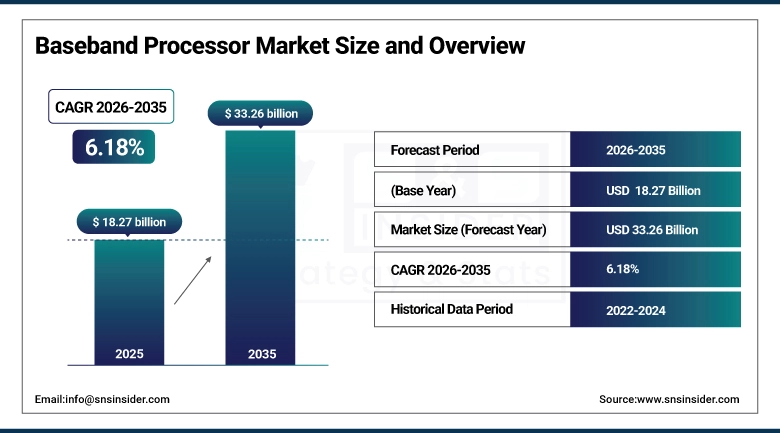
The Baseband Processor Market size was valued at USD 18.27 Billion in 2025 and is projected to reach USD 33.26 Billion by 2035, growing at a CAGR of 6.18% during 2026–2035.
Proliferating demand for 5G-enabled chipsets with high integration in smartphones and connected devices is leveraging strong transformation in the baseband processor market. SoC-based architectures that integrate application processors with modems are getting increasingly efficient in terms of performance and power consumption, offering more reliable connectivity. The adoption of AI-powered communication systems, as well as next-gen wireless standards like 5G-Advanced, is speeding innovation even faster. Investments in domestic semiconductor ecosystems– including significant steps taken by leading firms globally– are fundamentally changing the shape of worldwide competition and pushing integrated strategies up and down supply chains. Together, all of these drivers enable solid growth in the consumer electronics and base station infrastructure markets.
In August 2025, Huawei advanced its semiconductor capabilities by integrating a 5G modem into the Kirin 9020 SoC, marking a major step toward self-reliant chip design amid ongoing U.S. sanctions. The development strengthens China’s domestic semiconductor ecosystem and enhances Huawei’s competitiveness in high-end smartphone connectivity and integrated processor architectures
To Get more information on Baseband Processor Market - Request Free Sample Report
Baseband Processor Market Trends Highlights:
-
Rapid growth driven by increasing adoption of 5G-enabled smartphones and connected devices
-
Strong shift toward highly integrated SoC-based baseband processor architectures
-
Rising demand for low-power, high-performance, and multi-mode connectivity solutions
-
Increasing deployment of advanced wireless standards such as 5G and Wi-Fi 7
-
Growing focus on AI-enabled communication and intelligent signal processing
-
Expanding use of baseband processors in smartphones, IoT, automotive, and industrial applications
-
Intensifying competition among semiconductor companies driving innovation and cost optimization
-
Rising investments in advanced semiconductor fabrication and design technologies
U.S. Baseband Processor Market Size Outlook:
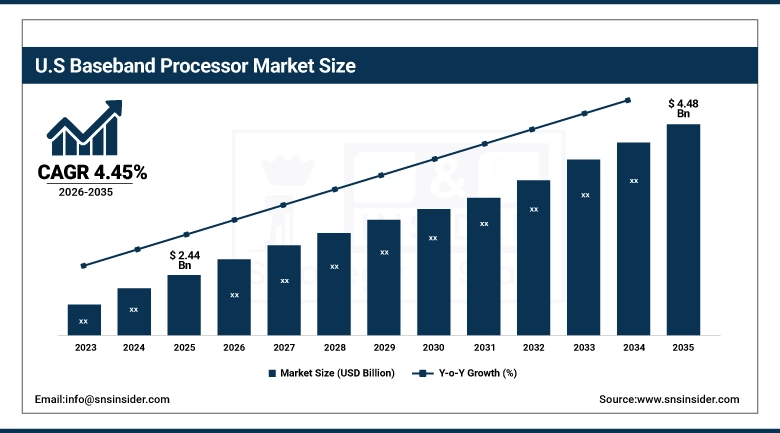
The U.S. Baseband Processor Market was valued at USD 2.44 Billion in 2025 and is projected to reach USD 4.48 Billion by 2035, growing at a CAGR of 4.45% during 2026–2035, as the demand for seamless connectivity in smartphones and other wireless devices increases. The market is benefitting from the growing 5G technology adoption as well as from the transition to highly integrated and low-power SoC-based modem architectures. The demand is further propelled by continuous enhancement of network performance, need for data speed at a high level and device wise integration. Furthermore, increasing investments focused on semiconductor innovation and next-generation communication technologies continue to bolster long-term market development as well as sustain growth momentum.
Market Drivers: Rising Demand for Cost-Effective 5G Devices Driving Integrated Baseband Processor Adoption
Shifting consumer preferences towards cost-effective, high-performance 5G smartphones alongside efficient connectivity solutions through 5G has remained the foremost growth-inducing factor of the Baseband Processor Industry. Increasing acceptance of integrated SoC design style that integrates both application processor and baseband processing for power efficiency, multitasking productivity and lower system cost The increasing consumer inclination towards the feature-rich devices along with the larger memory configurations is further backing the industry growth. Moreover, increasing demand for high-performance integrated RF solutions; as well as anti-interference; and multi-band connectivity to support multiple IoT use cases is making the baseband processor a key element in next-generation mobile device architectures and is pushing manufacturers to create differentiated high performance, integrated baseband processor solutions.
In July 2025, The Xiaomi Redmi Note 14 5G highlights strong competition in the global smartphone market, driven by increasing adoption of integrated MediaTek baseband and applications processors in cost-effective 5G devices.It reflects rising demand for high-performance, affordable Android smartphones with advanced SoC architectures and large memory integration across key regional markets.
Market Restraints: High Design Complexity and Rising Cost Constraints Limiting Baseband Processor Adoption
The Baseband Processor market faces key restraints due to increasing design complexity associated growing design complexity needed for integrating multi-mode connectivity standards such as 4G, 5G, and emerging 6G architectures. Large investments in R&D and long development lead times create barriers to entry for new players by greatly increasing total production costs. Besides, integration hurdles regarding ideal power efficiency, thermal management and capability with heterogeneous network infrastructures inhibit fast deployment on top of all these. Reliance on cutting-edge semiconductor manufacturing technologies further introduces supply chain risks and costs. Combined, they inhibit both accelerated commercialization and adoption of next-generation baseband processor solutions.
Market Opportunities: Rising Demand for High-Speed Connectivity Driving Advanced Baseband Processor Integration
The Baseband Processor Industry has strong growth opportunities and is continuing to expand due to increasing demands for highly integrated, power-efficient SoC-based modem solutions that supports 5G and next-generation wireless connectivity. More focus on performance optimization, multi-mode network support and AI-enabled communication processing can also be seen driving further innovation and growth in advance baseband architectures.
In Sept 2025, Apple officially introduced its self-developed Wi-Fi, Bluetooth, and Thread chip (N1) along with A19 Pro and C1X modem, advancing full in-house wireless and processor integration in iPhones. The new chips improve performance, connectivity, and power efficiency with Wi-Fi 7, Bluetooth 6 support, faster cellular speeds, and reduced power consumption.
Baseband Processor Market Segment Highlights:
-
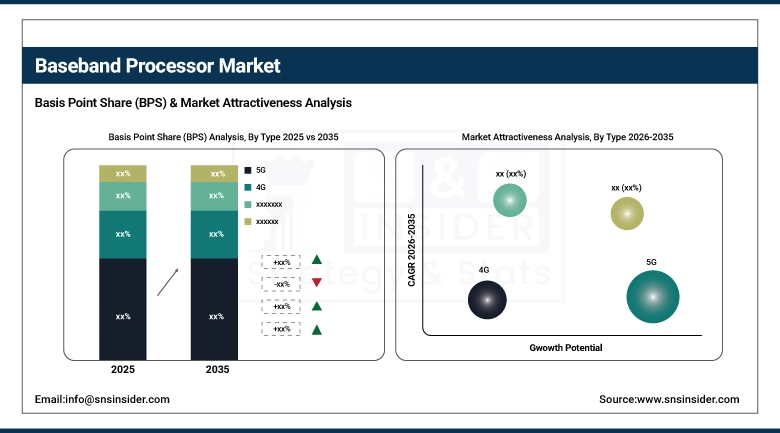
By Type: Dominant – 5G (65.48% → 69.32%, CAGR 6.78%); Fastest-Growing – 5G (highest share expansion and CAGR 6.78%)
-
By Application: Dominant – Smartphone (89.10% → 89.90%, CAGR 6.27%); Fastest-Growing – Smartphone (highest CAGR 6.27%)
-
By Technology: Dominant – CMOS Technology (44.50% → 40.50%, CAGR 5.18%); Fastest-Growing – RF-CMOS / Mixed-Signal Integration (10.10% → 10.90%, CAGR 6.99%)
-
By Processor Type: Dominant – Integrated Baseband (SoC-based) Processors (51.70% → 57.30%, CAGR 7.27%); Fastest-Growing – Integrated Baseband (SoC-based) Processors (highest CAGR 7.27%)
By Type: 5G Dominant and Fastest-Growing
The Baseband Processor market is segmented by technology, with 5G technology estimated to capture the largest share during the anticipated period due to the rapid worldwide deployment of 5G networks and the growing demand for high-speed mobile connectivity, and is projected to be the fastest-growing segment, owing to the rising telecom infrastructure investments, expanding data consumption levels, and advancing capabilities of next-generation wireless communication technologies as whole; along with heavy adoption in smartphone and IoT sector.
By Application: Smartphone Dominant and Fastest-Growing
smartphone is projected to hold the maximum share of the market during the forecast period, owing to its dominant penetration as the primary end-user(s) for baseband processing unit, increasing mobile subscriber base across globe, and consistent demand for highspeed connectivity. It is also anticipated that the segment will experience the highest growth rate due to an increase in 5G smartphone adoption along with increased mobile broadband use and continuing device-level integration and performance efficiency.
By Technology: CMOS Technology Dominant and RF-CMOS / Mixed-Signal Integration Fastest-Growing
CMOS technology is expected to continue to account for most the of the market owing to its general applicability in semiconductor fabrication, lump cost effectiveness and high scalability for baseband processor design. For instance, although the RF-CMOS and Mixed-Signal Integration is forecasted to grow with the highest CAGR due to increasing requirements for high level of integration in chip architectures, results in better power efficiency and in turn, lead to improved performance for 5G and next generation wireless communication systems also propel the need for RF-CMOS and Mixed-Signal Integration.
By Processor Type: Integrated Baseband (SoC-based) Processors Dominant and Fastest-Growing
Integrated Baseband (SoC-based) Processors will continue to hold the largest economical share of the market throughout the forecast period because of their high degree of integration, lower system complexity and greater efficiency performance density that are needed in many modern communication devices. Moreover, the segment is also expected to witness the fastest growth rate due to increasing 5G-enabled device adoption, rising demand for miniaturized & low-power-consuming chipsets, and continuous progress in system-on-chip technologies.
Baseband Processor Market Regional Highlights:
-
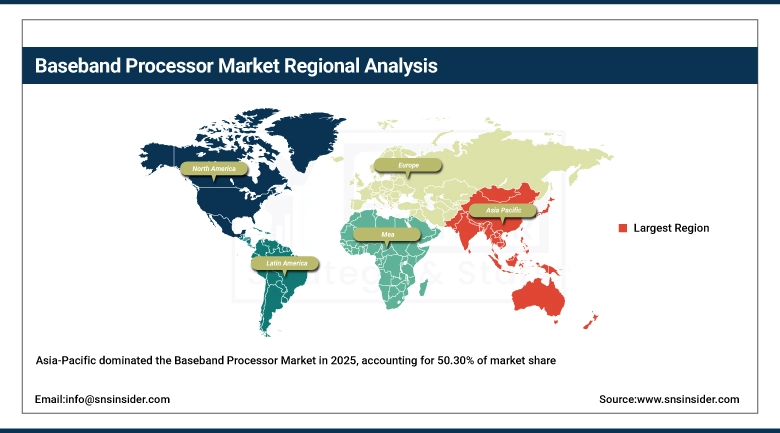
Asia-Pacific: 50.30% (2025) → 52.70% (2035), Dominant and Fastest-Expanding Region driven by large-scale electronics manufacturing, semiconductor fabrication leadership, and rising investments in advanced sensing and industrial technologies (CAGR 6.67%)
-
North America: 20.20% (2025) → 21.80% (2035), Mature Growth Region with strong technology adoption, advanced semiconductor ecosystem, and high penetration of sensing and electronics applications (CAGR 6.99%)
-
Europe: 14.90% (2025) → 14.10% (2035), Stable Mature Region supported by strong industrial automation, automotive innovation, and established R&D infrastructure across precision electronics and manufacturing (CAGR 5.59%)
-
South America: 6.90% (2025) → 6.10% (2035), Emerging Stable Region with gradual adoption supported by industrial modernization, increasing electronics integration, and expanding technology infrastructure (CAGR 4.87%)
-
Middle East & Africa: 7.70% (2025) → 5.30% (2035), Developing Region with moderate expansion driven by diversification initiatives, smart infrastructure projects, and gradual industrial technology adoption (CAGR 2.22%)
Asia-Pacific Baseband Processor Market Insights:
The Baseband Processor market is dominated by the Asia-Pacific region owing to robust semiconductor manufacturing capabilities, rapid deployment of 5G, and high penetration of advanced smartphones and connected devices. This has led to considerable investments in communication infrastructure and chip design by a number of countries including China, South Korea, Japan, and India. This allows the region to maintain its leadership status in the global arena due to a sizeable consumer electronics base, affordable production ecosystem, and presence of top-notch OEMs and foundries.
Get Customized Report as per Your Business Requirement - Enquiry Now
China Baseband Processor Market Insights:
China dominates the Baseband Processor Industry due to its large consumer electronics demand, strong 5G infrastructure rollout, and extensive semiconductor manufacturing and assembly ecosystem supporting global and domestic device production.
North America Baseband Processor Market Insights:
The North America Baseband Processor market is booming on the back of faster adoption of 5G technology, growing need for high-end smartphones, and growing acceptance of connected devices in automotive and IoT applications, etc. It benefits from a high level of R&D investment, advanced semiconductor design capabilities, and a strong technology industry base. Simultaneously, growing adoption of edge computing, cloud connectivity, and next-gen communication infrastructure also bolster market growth; innovation in chip architecture facilitates process efficiency and network functioning.
United States Baseband Processor Market Insights:
The United States Baseband Processor market is growing steadily, driven by strong 5G adoption, increasing smartphone demand, and advanced semiconductor R&D supported by leading technology companies and continuous innovation.
Europe Baseband Processor Market Insights:
Europe Baseband Processor market is due to its increases in 5G network deployment, strengthening demand for connected automotive and growing use of IoT devices in different sectors of industry and consumers. Regulatory support for digital transformation and improvements in semiconductor design are expected to further drive market growth. Investment in communication infrastructure and chip innovation in Germany, France, and the UK, and collaboration among telecom operators and technology firms will continue to drive regional competitiveness and adoption of advanced baseband processor solutions.
Germany Baseband Processor Market Insights:
The Germany Baseband Processor Industry is growing at a steady pace owing to resilient automotive connectivity demand, 5G infrastructure proliferation, industrial IoT deployment, and rising investments in advanced semiconductor and communication technologies across the region..
Latin America Baseband Processor Market Insights:
Latin America Baseband Processor market owing to the increasing smartphone penetration, expanding 4G and 5G network deployment and demand for inexpensive connected devices. Regional adoption is being spearheaded in countries like Brazil and Mexico, where telecom infrastructure is improving and digital transformation initiatives are taking hold. Inelastic demand is further fueled by investments in mobile connectivity, e-commerce expansion, and growing consumer inclination towards high-speed data services in urban and semi-urban zones providing opportunities for growth to this market segment.
Brazil Baseband Processor Market Insights:
Latin America Baseband Processor Industry is led by Brazil, owing to its robust smartphone adoption coupled with the expanding 4G and 5G infrastructure, rising demand for digital services, and upsurging telecom and connectivity technologies investments.
Middle East & Africa (MEA) Baseband Processor Market Insights:
The Middle East & Africa Baseband Processor market is gradually driven by increasing smartphone penetration, rising demand for high-speed mobile connectivity, and ongoing 4G and 5G network deployments across key countries. Government-led digital transformation initiatives, growing investments in telecom infrastructure, and the expansion of data centers are further supporting market growth. Additionally, the increasing adoption of IoT-enabled devices and affordable mobile devices is accelerating demand for efficient baseband processing solutions across the region.
United Arab Emirates Baseband Processor Market Insights:
The United Arab Emirates Baseband Processor Industry is growing steadily, driven by rapid 5G deployment, high smartphone penetration, smart city initiatives, and increasing demand for advanced connectivity and digital services.
Baseband Processor Market Competitive Landscape:
Qualcomm Incorporated is one of the biggest semiconductor companies in the United States and specializes in baseband processors, 5G modems, wireless communication technology, etc. Established in 1985 and with its global headquarters in San Diego, it commands the global smartphone modem market with its molecular Snapchat platforms and high IP licensing. It has expanded into chips for AI, automotive, and PC.
-
In March 2025, Qualcomm and MediaTek introduced next-generation 5G modems focused on advancing speed, AI capabilities, satellite connectivity, and energy efficiency for 5G-Advanced and future 6G networks.MediaTek’s M90 delivers up to 12 Gbps peak throughput with improved carrier aggregation and enhanced uplink performance, strengthening high-speed mobile connectivity and power efficiency
Apple Inc. is a California-based, U.S. tech giant founded in 1976. It also includes manufacturing integration, designing devices such as smart devices, computers and silicone products such as A-series chips and a C1 modems among other in-house chips. Apple is also vertically integrating more by lowering reliance on third-party suppliers and gaining more hardware-software ecosystem control.
-
In February 2025, Apple introduced its first custom C1 modem chip, marking a strategic shift away from reliance on Qualcomm and strengthening its in-house wireless connectivity ecosystem. The new modem enhances battery life and tight integration with Apple processors, while enabling improved network efficiency and future product differentiation across iPhone devices
Baseband Processor Companies are:
-
Qualcomm Incorporated
-
Apple Inc.
-
Samsung Electronics Co., Ltd.
-
Huawei Technologies Co., Ltd.
-
HiSilicon (Huawei)
-
UNISOC (Spreadtrum Communications)
-
Intel Corporation
-
Marvell Technology Group
-
Texas Instruments Incorporated
-
STMicroelectronics N.V.
-
NXP Semiconductors N.V.
-
Renesas Electronics Corporation
-
Sony Semiconductor Solutions Corporation
-
Analog Devices, Inc.
-
Infineon Technologies AG
-
Skyworks Solutions, Inc.
-
Qorvo, Inc.
-
Silicon Labs
| Report Attributes | Details |
|---|---|
| Market Size in 2025 | USD 18.27 Billion |
| Market Size by 2035 | USD 33.26 Billion |
| CAGR | CAGR of 6.18% From 2026 to 2035 |
| Base Year | 2025 |
| Forecast Period | 2026-2035 |
| Historical Data | 2022-2024 |
| Report Scope & Coverage | Market Size, Segments Analysis, Competitive Landscape, Regional Analysis, DROC & SWOT Analysis, Forecast Outlook |
| Key Segments | • By Type(4G, 5G and Others) • By Application(Smartphone and Tablets) • By Technology(CMOS Technology, FinFET Technology, FD-SOI Technology and RF-CMOS / Mixed-Signal Integration) • By Processor Type(Standalone Baseband Processors, Integrated Baseband (SoC-based) Processors and Multi-mode Baseband Processors) |
| Regional Analysis/Coverage | North America (US, Canada), Europe (Germany, UK, France, Italy, Spain, Russia, Poland, Rest of Europe), Asia Pacific (China, India, Japan, South Korea, Australia, ASEAN Countries, Rest of Asia Pacific), Middle East & Africa (UAE, Saudi Arabia, Qatar, South Africa, Rest of Middle East & Africa), Latin America (Brazil, Argentina, Mexico, Colombia, Rest of Latin America). |
| Company Profiles | Qualcomm Incorporated, MediaTek Inc., Apple Inc., Samsung Electronics Co., Ltd., Huawei Technologies Co., Ltd., HiSilicon (Huawei), UNISOC (Spreadtrum Communications), Intel Corporation, Broadcom Inc., Marvell Technology Group, Texas Instruments Incorporated, STMicroelectronics N.V., NXP Semiconductors N.V., Renesas Electronics Corporation, Sony Semiconductor Solutions Corporation, Analog Devices, Inc., Infineon Technologies AG, Skyworks Solutions, Inc., Qorvo, Inc., Silicon Labs. |

Frequently Asked Questions
Asia-Pacific dominated the Baseband Processor Market in 2025.
The “5G” segment dominated during the projected period.
Rapid growth in 5G adoption, increasing smartphone penetration, rising demand for high-speed low-latency connectivity, expansion of IoT and connected devices, and advancements in integrated and energy-efficient semiconductor technologies.
The Baseband Processor Market size was USD 18.27 Billion in 2025 and is expected to reach USD 33.26 Billion by 2035.
The Baseband Processor Market is expected to grow at a CAGR of 6.18%from 2026-2035
