
Bi Metal Band Saw Blade Market Report Scope & Overview:
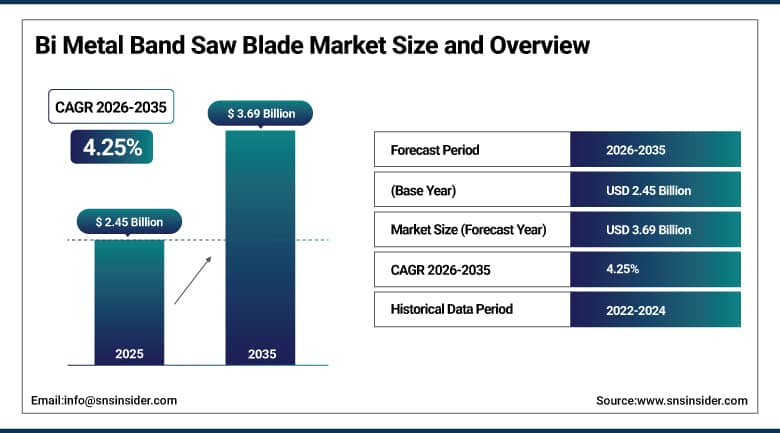
The Bi Metal Band Saw Blade Market was valued at USD 2.45 billion in 2025 and is expected to reach USD 3.69 billion by 2035, growing at a CAGR of 4.25% from 2026–2035.
The Bi Metal Band Saw Blade Market is experiencing fast growth across the globe owing to the increasing need for precise cutting products that can be used in the steel, aluminium, cast iron, mold steel, and bearing steel industries. Bi-metal blades have also gained popularity among the users operating in the industrial manufacturing industry, constructions sector, automobile sector, aerospace sector, and metal fabrications shop. Blade development and innovations like carbide tips, laser-hardening technologies, and variable pitch blades contribute to the development of the industry. Increasing fabrication centers, increased investment in infrastructure projects, and lightweight materials used in the automotive and aerospace sectors are driving the growth of the industry.
Orbit-based engineering and industry solutions provider is a North American company, driving increased demand for highly sophisticated manufacturing processes, aerospace machining capabilities, and industrial automation technology in the Bi Metal Band Saw Blade industry. Engineering operations and defense operations for Orbit have received multi-million dollar orders from aircraft companies in the United States and the US Air Force.
To Get More Information On Bi Metal Band Saw Blade Market - Request Free Sample Report
Bi Metal Band Saw Blade Market Trends
-
Fast uptake of carbide-tipped blades ensures precise cutting of sophisticated metals and light alloys, thus improving efficiency and prolonging blade life.
-
The high growth rate in manufacturing in the automotive, aerospace, and construction sectors worldwide boosts the need for durable and adaptable cutting options.
-
Growth in laser-treated and coated blades guarantees long-term service and cuts down downtime in manufacturing facilities.
-
Temperature variations that lead to vibrations in blade performance are minimized by the use of varying tooth pitches.
-
The growing need for light metals like aluminium and mold steels is driving adoption in the aerospace and electric vehicles industries.
U.S. Bi Metal Band Saw Blade Market Size Outlook.
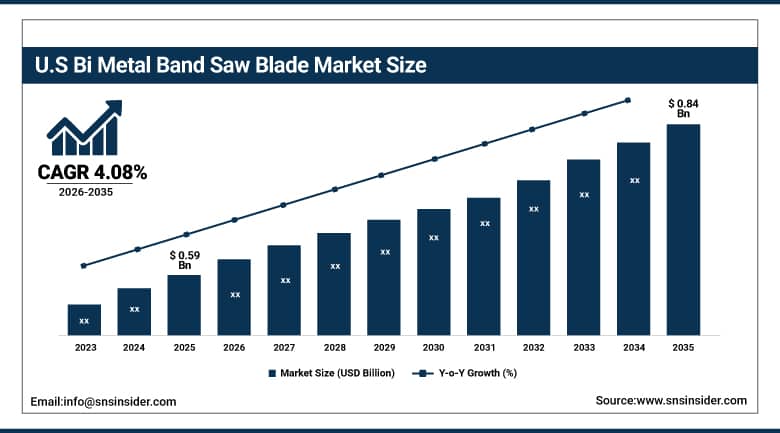
The U.S. Bi Metal Band Saw Blade Market was valued at USD 0.59 billion in 2025 and is expected to reach around USD 0.84 billion by 2035, growing at a CAGR of 4.08% from 2026–2035.
The U.S. market demand for bi metal band saw blades is rising consistently owing to increasing demand in aerospace industry, automotive industry, metal fabrication industry, and industrial manufacturing industry. Growing use of CNC machinery, automated cutting machinery, and precision metal processing technology in high-capacity manufacturing units is boosting market growth. Moreover, manufacturers have started using carbide tipped bi metal blades and variable pitch bi metal band saw blades due to their ability to cut metals accurately, improve efficiency, enhance durability, and minimize material waste. Demand for high performing blades used in hard steel and titanium metal cutting has further strengthened market growth.
U.S. government efforts aimed at promoting domestic manufacturing growth, infrastructure improvement, and resuming the relocation of manufacturing activities are fuelling higher demand for advanced cutting solutions and machine tools. Major suppliers are improving their CNC machining facilities, robotic sawing technology, and carbide blade production lines to meet higher demands from aircraft, vehicle, military, and heavy construction sectors. Besides, increased usage of Industry 4.0 technologies in U.S. factories is creating demand for robust bi-metal band saw blades.
Bi Metal Band Saw Blade Market Segment Analysis
-
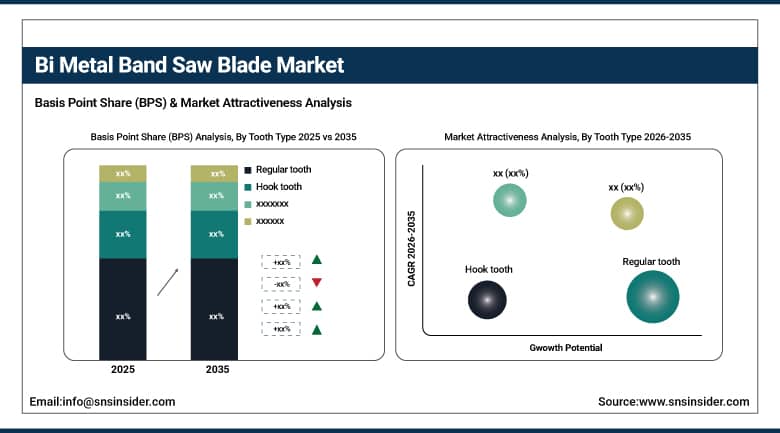
By Tooth Type, regular tooth segment dominated the bi metal band saw blade market with 28.61% share in 2025, while the variable pitch tooth segment is the fastest growing tooth type with CAGR of 5.14% during 2026 to 2035.
-
By Product Type, high-speed steel (HSS) bi-metal blades segment dominated the bi metal band saw blade market with 40.21% share in 2025, while the carbide-tipped bi-metal blades segment is the fastest growing product type with CAGR of 5.01% during 2026 to 2035.
-
By Application, steel segment dominated the bi metal band saw blade market with 36.81% share in 2025, while the aluminium segment is the fastest growing application with CAGR of 5.28% during 2026 to 2035.
-
By End-use Industry, industrial manufacturing segment dominated the bi metal band saw blade market with 31.81% share in 2025, while the aerospace & defense segment is the fastest growing end-use industry with CAGR of 5.28% during 2026 to 2035.
By Tooth Type, regular tooth segment dominated, while variable pitch tooth emerged as the fastest-growing segment
Regular tooth Bi-metal Band Saw Blades were the most popular products with a market share of 28.6% in 2025 owing to their ability to cut wide varieties of thin wall tubing and structural metals along with other general metal cutting purposes. The blades have tooth designs that provide better cutting action, reduced vibrations, and improved surface finishing, thereby making them more appropriate for industrial manufacturing and fabricating processes.
Variable Pitch Tooth blades have recorded the fastest growth rate because of their excellent cutting action and efficient chip removal capacity during heavy-duty metal cutting operations. Cutting of thick metal pieces, bars, and alloyed metals in the automotive, aerospace, and steel processing sectors have contributed substantially to the popularity of Hook Tooth Blades.
By Product Type, high-speed steel (HSS) bi-metal blades segment dominated, while carbide-tipped bi-metal blades emerged as the fastest-growing segment
High-speed steel (HSS) bi-metal blades retained their position as the market leader, with their market share accounting for 40.21% due to their better combination of durability, flexibility, and affordability in various industrial applications. High-speed steel bi-metal blades have proven to be very popular for use in fabrication and machining workshops for cutting various types of structural steel, carbon steel, and alloyed metals.
Carbide-tipped bi-metal blades are growing at a fast pace as they offer excellent properties such as higher cutting speed and improved performance when cutting hard metals and steel such as those used in aircrafts, vehicles, and heavy machinery. Their ability to withstand cutting at extremely high temperatures is one of the reasons that make them more preferable in many industrial applications.
By Application, steel segment dominated, while aluminium emerged as the fastest-growing segment
Steel was one of the most dominant product segments within the global bi-metal band saw blades market with 36.81% share in 2025. The extensive use of bi-metal band saw blades in construction and infrastructure activities, as well as in heavy machinery and industrial fabrication activities, led to their preference over other blades for steel cutting applications.
Aluminium emerged as the most rapidly growing application segment, owing to growing demand from the automotive industry for light-weighting, aerospace and EV components, and various others. Growing demand for aluminium in transportation and industrial equipment manufacturing activities is resulting in increased demand for cutting tools such as bi-metal band saw blades for smooth surface finish without any deformations of materials.
By End-use Industry, industrial manufacturing segment dominated, while aerospace & defense emerged as the fastest-growing segment
The industrial manufacturing sector held the major share of 31.81% in the bi-metal band saw blade market, as a result of growing demand from metal processing industries, machine shops, fabricators, and heavy machinery manufacturing facilities. The extensive usage of automation in cutting applications along with the availability of cutting machines and advanced metal processing equipment ensures high utilization of bi-metal band saw blades.
Aerospace and defense are anticipated to emerge as the most promising end-use segments in terms of growth on account of rising demand for precision cut titanium alloys, nickel alloys, and other aerospace metals. With the increased production of aircrafts and defense modernization, demand from this segment is expected to rise at a high rate.
Regional Analysis:
|
Region |
Major Country |
Share within Region, 2025(%) |
|---|---|---|
|
North America |
United States |
81.62% |
|
Europe |
Germany |
35.61% |
|
Asia Pacific |
China |
40.27% |
|
Middle East & Africa |
UAE |
11.80% |
|
Latin America |
Brazil |
9.68% |
Asia Pacific Bi Metal Band Saw Blade Market Insights.
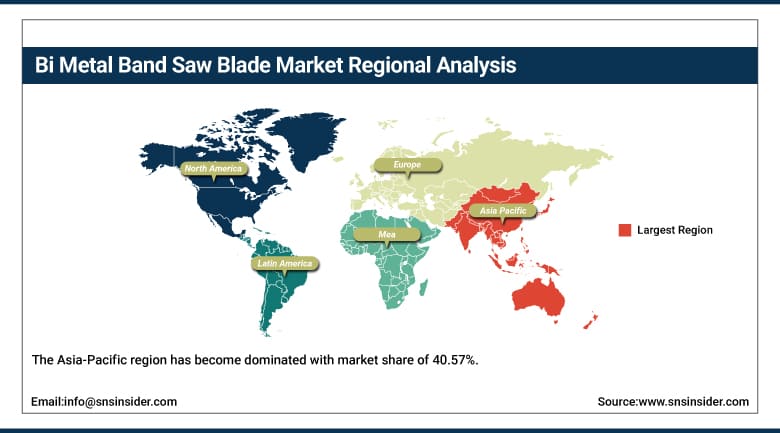
The Asia-Pacific region has become dominated with market share of 40.57% and also emerged as fastest-growing CAGR with 5.09% for the global bi metal band saw blade market for 2025 and will witness rapid growth from 2026 through 2035 due to increased industrialization, increased manufacturing capacity, and higher adoption rates of machining techniques in China, India, Japan, and South Korea. Factors driving the market include investments made towards producing automotive products, infrastructural developments, ship-building industry, and manufacturing of heavy machines. There has been considerable deployment of CNC machining, automated metal cutting equipment, and fabrication processes in various industries.
Multicut Machine Tools improved the bi-metal compatibility of their blades used in CNC band saw machines, which facilitated cutting efficiency improvements of about 10.15% along with an increase in blade longevity of 12.18%. On the other hand, Bipico Industries further extended its product range of bi-metal and carbon steel blades, featuring innovative geometrical and alloy compositions that contributed to efficiency improvement of 9.68%, as well as reduced operational downtimes of 11.20%.
Get Customized Report as Per Your Business Requirement - Enquiry Now
North America Bi Metal Band Saw Blade Market Insights.
The North American region in the bi metal band saw blade market with the share for approximately 29.49% in 2025. The North American region had a high level of demand in the industries of aerospace, automotive, industrial manufacturing, and metal fabrication. The region had a well-developed manufacturing environment, and the presence of major industrial tools and machinery manufacturers such as Sandvik, AMADA, and LENOX contributed significantly to the development of innovative cutting technology products.
L.S. Starrett Company improved its range of M42 bi-metal blades as well as its cutting tools and achieved an increase in cutting efficiency up to 10.15% and an extension of blade lifetime up to 11.8% during continuous production in the industrial sector. The company DoALL Sawing Products stated that it has gained improvements in cutting productivity up to 12.30% and downtime reduced from 10% to 12%.
Europe Bi Metal Band Saw Blade Market Insights.
Europe was estimated to be worth about 18.20% of the global revenue generated from bi metal band saw blade sales in 2025, due to the significant growth in demand from sophisticated manufacturing sectors, auto engineering, aerospace manufacturing, and metal working. The European market features an advanced manufacturing base with very high standards for quality, thus driving the uptake of high quality and durable cutting tools. Germany is leading the region in terms of demand for the products owing to the robust manufacturing base in the country. Other major players include the UK, France, Italy, and the Nordic nations.
The Honsberg Company has added to their range of highly engineered bi-metallic blades through improved versions of the company’s “Spectra” and “Delta M42” products, which feature the ability to perform well in cutting operations involving alloys, stainless steel, and structural metals within the auto, machinery, and heavy manufacturing sectors. Further improvements were made in the company’s M42 blades that contain high cobalt content for increased wear resistance and stable performance at high loads during CNC machining processes.
Middle East & Africa and Latin America Bi Metal Band Saw Blade Market Insights.
Middle East & Africa and Latin America held a small yet growing share of the bi metal band saw blade market globally in 2025, due to increased industrialization, development of infrastructure, and growth in manufacturing processes and metal cutting operations. Nations like the United Arab Emirates, Saudi Arabia, South Africa, Brazil, and Mexico are seeing higher investments made in automotive assembly lines, construction machinery manufacturing, oil & gas fabrication operations, and general machining services. Government policies and programs centered around economic diversification like Saudi Vision 2030 and industrial modernization plans in Brazil are bolstering these economies' manufacturing capabilities.
Serrametal, Starrett Brazil, and Truper are working to upgrade their products with regard to bi-metal blades due to increased demand for these types of products from the local manufacturing industries. Reports indicate that there have been increased productivity levels by 12.62 percent owing to better designs of these blades.
Market Dynamics:
Growth Drivers: Rapid expansion of industrial automation and increasing demand for precision metal-cutting across global manufacturing ecosystems
Increased use of CNC machining machines, automation of band saw machines, and other factory automation technologies is leading to higher demands for high-quality and long-lasting cutting tools among industries. The development of automotive, aerospace, construction, and heavy engineering industries is creating a need for metal processing techniques that can process hardened steels and titanium alloys and other advanced metals. Increasing focus on improving production, minimizing downtime, and achieving accurate cuts is compelling producers to use more advanced bi-metal band saw blades.
Besides, there are growing reshoring activities in North America and Europe, which are expected to contribute to an increase in the domestic industrial tooling industry by 8.47%. On the other hand, rising emerging economies in the Asia-Pacific region are contributing to an installation base of CNC machines at a growth rate of 7.42% per annum.
Restraints: High dependency on skilled machinists and limited technical expertise in advanced metal-cutting and CNC machining operations
Effective usage of the bi-metal band saw blade needs knowledgeable people who have adequate experience regarding cutting conditions, calibration of equipment, hardness of materials, and choosing the right blades. In many cases, there is usually a scarcity of well-trained machinists and technical personnel who can make use of the blades effectively within the automated and precise working environments. Mismanagement of the equipment leads to low efficiency of the blade and wastage of resources due to increased cost. Lack of continuous training and absence of technical knowledge in newly developed industrial areas makes efficient usage difficult.
Opportunities: Integration of advanced machining automation and smart manufacturing technologies in next-generation metal cutting systems
Increasing applications for automation technologies, robotics, and CNC machining systems will result in many business opportunities for bi-metal band saw blade companies. Installation of intelligent sensor technologies will ensure timely monitoring of blade wear rates and efficiency levels of blade performance, thereby helping boost output. Cutting-edge manufacturing methods will also help enhance tool life through advanced blade wear rate prediction and setting optimal blade operation parameters. Given the rise of Industry 4.0 trends and the proliferation of smart factory technologies.
Applications of IoT-enabled CNC machines, robotic metal cutting technologies, and digital band saws will help improve cutting efficiency rates by 12.60%, and also decrease blade wear variations by 14%.
Recent Developments
-
2025: LENOX expanded its industrial saw blade innovation portfolio by strengthening its focus on high-performance bi-metal band saw blades designed for high-speed cutting and extended tool life in aerospace, automotive, and heavy fabrication applications.
-
2025: AMADA advanced its global sawing solutions business by integrating next-generation automated band saw systems with digital monitoring and predictive maintenance capabilities, enabling manufacturers to optimize blade performance and reduce downtime in smart factory environments.
-
2026: WIKUS strengthened its premium band saw blade portfolio by launching upgraded bi-metal and carbide-tipped blade solutions engineered for high-precision cutting of stainless steel, titanium, and hardened alloys.
-
2025: BAHCO (SNA Europe) enhanced its professional sawing tools segment by expanding its bi-metal blade offerings with improved wear resistance and optimized cutting performance for industrial metalworking applications.
Bi Metal Band Saw Blade Market Key Players are:
-
LENOX
-
AMADA
-
WIKUS
-
BAHCO (SNA Europe)
-
Simonds International
-
The L.S. Starrett Company
-
DoALL Sawing Products
-
Eberle
-
NACHI-FUJIKOSHI
-
Bichamp Cutting Technology
-
ITL Industries
-
Indotech Industries
-
Bipico Industries
-
Multicut Machine Tools
-
Honsberg
-
Cosen Saw
-
Everising Machine Co.
-
M. K. Morse Company
-
Röntgen
-
Kinkelder
Bi Metal Band Saw Blade Market Report Scope:
| Report Attributes | Details |
|---|---|
| Market Size in 2025 | USD 2.45 Billion |
| Market Size by 2035 | USD 3.69 Billion |
| CAGR | CAGR of 4.25% From 2026 to 2035 |
| Base Year | 2025 |
| Forecast Period | 2026-2035 |
| Historical Data | 2022-2024 |
| Report Scope & Coverage | Market Size, Segments Analysis, Competitive Landscape, Regional Analysis, DROC & SWOT Analysis, Forecast Outlook |
| Key Segments | • By Product Type (High-Speed Steel (HSS) bi-metal blades, Carbide-tipped bi-metal blades, Laser-hardened / coated blades, Custom engineered blades, Others), • By Tooth Type (Regular tooth, Hook tooth, Skip tooth, Variable pitch tooth, Others), • By Application (Steel, Aluminum, Cast Iron, Mold Steels, Bearing Steels, Others), • By End-use Industry (Industrial manufacturing, Construction & infrastructure, Automotive & transport, Aerospace & defense, Metal fabrication workshops, Others) |
| Regional Analysis/Coverage | North America (US, Canada), Europe (Germany, UK, France, Italy, Spain, Russia, Poland, Rest of Europe), Asia Pacific (China, India, Japan, South Korea, Australia, ASEAN Countries, Rest of Asia Pacific), Middle East & Africa (UAE, Saudi Arabia, Qatar, South Africa, Rest of Middle East & Africa), Latin America (Brazil, Argentina, Mexico, Colombia, Rest of Latin America). |
| Company Profiles | LENOX, AMADA, WIKUS, BAHCO (SNA Europe), Simonds International, The L.S. Starrett Company, DoALL Sawing Products, Eberle, NACHI-FUJIKOSHI, Bichamp Cutting Technology, ITL Industries, Indotech Industries, Bipico Industries, Multicut Machine Tools, Honsberg, Cosen Saw, Everising Machine Co., M. K. Morse Company, Röntgen, Kinkelder |

Frequently Asked Questions
The bi metal band saw blade market is expected to grow at a CAGR of 4.25% from 2026 to 2035.
The bi metal band saw blade market was valued at USD 2.45 billion in 2025.
Rising demand for precision cutting in industrial manufacturing, automotive, aerospace, and construction sectors, coupled with the shift toward lightweight materials and the need for durable, cost-efficient blades.
high-speed steel (HSS) bi-metal blades segment dominated the bi metal band saw blade market in 2025.
Asia Pacific dominated the market in 2025 due to strong advancement in manufacturing and R&Ds in bi metal band saw blade market.
