
Blood Clot Retrieval Devices Market Report Scope & Overview:
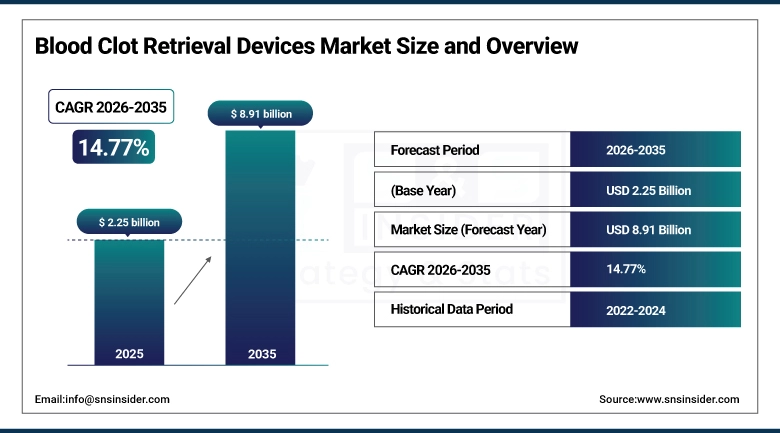
The Blood Clot Retrieval Devices Market was valued at USD 2.25 billion in 2025 and is expected to reach USD 8.91 billion by 2035, growing at a CAGR of 14.77% from 2026–2035.
The Blood Clot Retrieval Devices Market is growing rapidly worldwide owing to factors like high incidences of ischemic stroke, increasing number of elderly patients, and increasing use of minimally invasive neurovascular procedures. In addition, the development of new infrastructure for treating strokes, increasing awareness about the importance of thrombectomy treatments, and improvements in emergency care facilities are also contributing towards the growth of this market in both developed and developing countries. Technological developments in stent retrievers, aspiration catheters, and hybrid systems for removing clots are also boosting the demand for this market.
Utilization of sophisticated imaging technologies such as real-time angiography, artificial intelligence-driven stroke diagnosis technology, and robotic neuro-interventions is expected to grow globally until 2026.
Some of the underlying factors driving the above forecast include the rising need for rapid, accurate, and minimally invasive solutions to stroke cases, together with innovations in healthcare equipment, biocompatible materials, and modern neurovascular guidance technologies to improve the rate of success during the process.
To Get more information on Blood Clot Retrieval Devices Market - Request Free Sample Report
Blood Clot Retrieval Devices Market Trends
-
-
Rising global burden of ischemic stroke and growing geriatric population is significantly increasing demand for mechanical thrombectomy procedures and advanced clot retrieval devices across hospitals and stroke centers.
-
Increasing adoption of minimally invasive neurovascular interventions is reshaping stroke treatment protocols, with preference shifting from traditional drug therapy toward stent retrievers and aspiration-based systems.
-
Technological innovation in stents and other clot removal tools such as next-gen stents, large-bore aspiration catheters, and hybrid thrombectomy devices is helping increase the rate of success in the first pass and decrease procedure time.
-
Growing integration of AI-based imaging and real-time stroke detection systems is enhancing treatment speed and accuracy, enabling faster decision-making in acute ischemic stroke management.
-
Expanding establishment of comprehensive stroke centers and improved emergency response infrastructure is accelerating timely access to thrombectomy procedures, especially in urban and tier-2 regions.
-
Increasing clinical evidence supporting early mechanical thrombectomy intervention is strengthening guideline-based adoption, encouraging wider reimbursement coverage and hospital investment in neurointerventional capabilities.
-
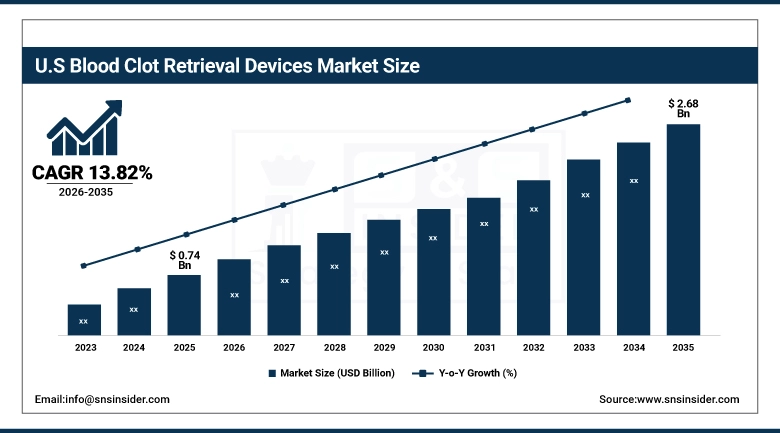
U.S. Blood Clot Retrieval Devices Market was valued at USD 0.74 billion in 2025 and is expected to reach around USD 2.68 billion by 2035, growing at a CAGR of 13.82% from 2026–2035.
The U.S. Blood Clot Retrieval Devices Market is considered the most technologically advanced and leading regional market on a global scale due to the presence of highly sophisticated neurovascular care facilities and comprehensive stroke centers, along with a high prevalence of minimally invasive thrombectomy techniques. Major players like Medtronic, Stryker Corporation, Penumbra Inc., and Johnson & Johnson (Cerenovus) have been actively involved in innovation, stent retrievers, and aspiration technology advancements.
Regulation by the U.S. Food and Drug Administration (FDA) in terms of ensuring the safety, efficacy, and monitoring of neurovascular thrombectomy devices enhances physicians' trust and adoption of innovative clot retrieval techniques.
As per data from the U.S. Centers for Disease Control and Prevention (CDC), increased incidences of ischemic stroke due to an aging population and health risk factors among patients are contributing to increased adoption of mechanical thrombectomy techniques. Consequently, there is a rising demand for advanced AI-based imaging equipment and clot retrieval devices in the market.
Blood Clot Retrieval Devices Market Segment Analysis
-
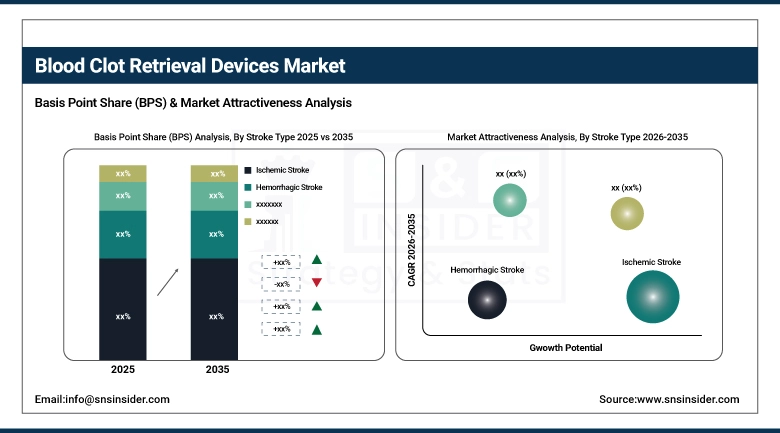
By Stroke Type, Ischemic Stroke dominated the Blood Clot Retrieval Devices Market with 42.35% share in 2025; Transient Ischemic Attack (TIA) fastest growing (CAGR).
-
By Device Type, Penumbra-Type Retrieval Systems dominated the Athletic Footwear Market with 27.10% share in 2025 and it is also fastest growing (CAGR).
-
By Application, Cerebral (Neurovascular) Interventions dominated the Athletic Footwear Market with 42.05% share in 2025 and it is also fastest growing (CAGR).
Blood Clot Retrieval Devices Market Segment Analysis
By Stroke Type, Ischemic Stroke dominates the Blood Clot Retrieval Devices Market, while Transient Ischemic Attack (TIA) is the fastest-growing segment.
Ischemic Stroke segment dominated the Blood Clot Retrieval Devices Market with the highest revenue share in 2025 due to its high global prevalence and strong clinical requirement for rapid intervention. Increasing incidence of large-vessel occlusions and widespread adoption of mechanical thrombectomy as standard treatment further strengthen its dominance.
Transient Ischemic Attack (TIA) section is projected to experience the highest CAGR between 2026 and 2035 owing to increased awareness about early warning signs of stroke along with improvements in diagnostic ability. Early interventions driven by preventive health care programs and hospital admission are contributing to the increasing demand for clot retrieval technology.
By Device Type, Penumbra-Type Retrieval Systems segment dominates the Blood Clot Retrieval Devices Market and is also expected to grow fastest.
Penumbra-Type Retrieval Systems occupied the largest share in the Blood Clot Retrieval Devices Market in terms of revenue owing to their highly efficient performance in retrieving clots that have a large volume. The preference of clinicians towards aspiration-based thrombectomy procedure also favors the increased usage of Penumbra-type retrieval devices.
Penumbra-Type Retrieval Systems segment is expected to grow at the fastest CAGR from 2026–2035 due to continuous technological advancements, improved catheter designs, and increasing use in minimally invasive stroke interventions globally, along with rising demand for faster and more effective recanalization outcomes.
By Application, Cerebral (Neurovascular) Interventions segment dominates the Blood Clot Retrieval Devices Market and is also expected to grow fastest.
Cerebral (Neurovascular) Interventions dominated the Blood Clot Retrieval Devices Market with the highest revenue share in 2025 due to the high burden of acute ischemic stroke cases requiring immediate mechanical thrombectomy. Increasing availability of advanced stroke centers and strong clinical preference for minimally invasive neurovascular procedures further support its dominance.
Cerebral (Neurovascular) Interventions is expected to grow at the fastest CAGR from 2026–2035 due to rising adoption of stent retrievers, AI-assisted imaging, and expanding stroke care infrastructure globally. Growing emphasis on rapid diagnosis and improved patient outcomes is further accelerating the shift toward advanced cerebral intervention techniques.
Blood Clot Retrieval Devices Market Regional Analysis
|
Region |
Major Country |
Share (%) |
|---|---|---|
|
North America |
United States |
84.60% |
|
Europe |
Germany |
26.75% |
|
Asia Pacific |
China |
31.20% |
|
Middle East & Africa |
UAE |
18.60% |
|
Latin America |
Brazil |
22.45% |
North America Blood Clot Retrieval Devices Market Insights
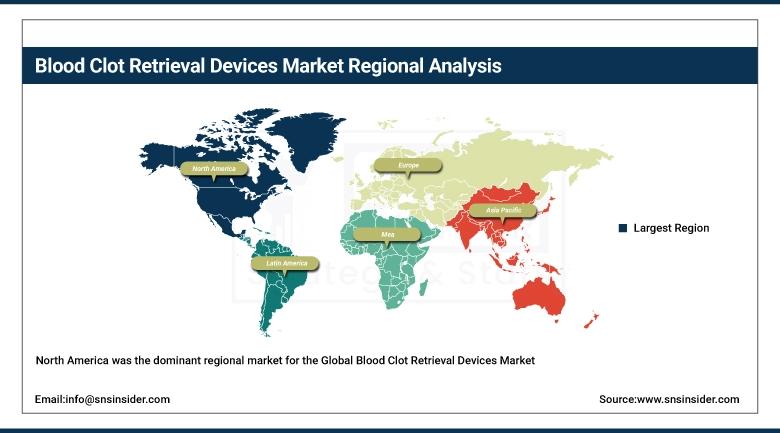
North America was the dominant regional market for the Global Blood Clot Retrieval Devices Market owing to the highly advanced healthcare system in neurovascular care, presence of stroke centers, and faster uptake of mechanical thrombectomy procedures. North America enjoys high awareness regarding ischemic stroke treatments, efficient emergency systems, and advanced minimally invasive neurointerventional devices. The U.S. is the leading country within the region, accounting for the largest market share owing to high clinical acceptance, stroke cases, and technological innovations in device-based treatment.
Supporting this dominance, the U.S. FDA ensures strict regulatory approvals, safety monitoring, and clinical validation for neurovascular devices, strengthening physician confidence and accelerating market adoption. Major companies such as Medtronic, Stryker Corporation, Penumbra Inc., and Johnson & Johnson (Cerenovus) are continuously advancing product portfolios with next-generation stent retrievers and aspiration systems tailored for improved first-pass success rates and better patient outcomes.
Get Customized Report as per Your Business Requirement - Enquiry Now
Asia Pacific Blood Clot Retrieval Devices Market Insights
Asia-Pacific region anticipated to register the highest growth rate in the Blood Clot Retrieval Devices Market in terms of revenue, owing to rising prevalence of strokes, development of healthcare infrastructure, and heightened awareness regarding early detection and treatment of strokes. The growing trend towards urbanization and aging population, along with increasing incidences of lifestyle disorders, will contribute to the market's growth.
China holds a significant position within Asia Pacific due to large investments in hospital infrastructure, expanding stroke care centers, and rising adoption of minimally invasive neurovascular procedures. Countries such as Japan, India, and South Korea are also supporting regional growth through improving healthcare access and increasing demand for advanced thrombectomy devices. Government initiatives focused on strengthening emergency stroke care systems are further driving market expansion.
Europe Blood Clot Retrieval Devices Market Insights
The Blood Clot Retrieval Devices Market is very significant in Europe because of several reasons, including highly advanced healthcare facilities, adoption of technologically advanced devices, and a strong clinical guideline for the management of strokes. Some major nations include Germany, UK, France, and Italy. The geriatric population and minimally invasive neurovascular techniques are some of the reasons for their significance.
The European Medicines Agency (EMA) and regional regulatory authorities ensure strict safety and performance standards for neurovascular devices, supporting high-quality clinical adoption across the region. Europe is also witnessing increasing use of stent retrievers and aspiration devices in stroke treatment, driven by rising investments in stroke units, advanced imaging technologies, and hospital-based neurointerventional care facilities.
Middle East & Africa and Latin America Blood Clot Retrieval Devices Market Insights
The Middle East and Africa region is witnessing strong growth in terms of the Blood Clot Retrieval Devices Market owing to the presence of advanced healthcare infrastructure, increasing knowledge regarding stroke treatments, and the development of specialized hospital setups. In particular, countries like UAE, Saudi Arabia, and South Africa have become pioneers in their implementation, courtesy of increased numbers of specialized hospitals and neurointerventional practices.
In Latin America, countries such as Brazil and Mexico are contributing significantly to market growth due to rising stroke prevalence, improving access to advanced medical technologies, and expansion of private healthcare systems. Increasing adoption of minimally invasive procedures and gradual improvement in stroke care pathways are further supporting the demand for clot retrieval devices across the region.
Blood Clot Retrieval Devices Market Growth Drivers:
-
Advancements in Minimally Invasive Thrombectomy Technologies and Device Innovation
Fast-paced developments in stent retriever technology, aspiration catheters, and hybrid clot retrieval tools have greatly benefited patient results and procedure efficiency. Increased device maneuverability, better navigation along complicated neurovascular routes, and greater first-pass revascularization effectiveness are contributing to physicians’ growing favor toward thrombectomy equipment. The inclusion of artificial intelligence-enabled image processing and navigation assistance systems is adding another dimension of precision in the process of deciding on stroke treatments. Persistent research and development efforts from major companies will produce even safer and more efficient devices that can be easily adopted in clinical settings around the world.
In 2026, it is observed that healthcare professionals have become more dependent on the use of modern stent retrievers, aspiration catheters, as well as thrombectomy devices that use artificial intelligence for improving stroke outcomes.
Blood Clot Retrieval Devices Market Restraints:
-
Stringent Regulatory Approval Processes and Clinical Risk Concerns
Regulatory standards required for the clearance of neurovascular products result in a longer time to bring newer blood clot removal technologies to market. The numerous clinical trials, safety evaluations, and post-market surveillance conducted by regulatory agencies like FDA and EMA contribute to delayed launches. In addition, issues related to the procedural risks like puncture of the blood vessel, excessive bleeding, and inadequate removal of blood clots also affect physician choices in adopting newer blood clot removal devices. Differences in results due to differences in operator skills further contribute to reluctance toward adoption.
Blood Clot Retrieval Devices Market Opportunities:
-
Rising Adoption of AI, Robotics, and Next-Generation Neurointerventional Technologies
With rising integration of AI, robotics, and advanced imaging technology in neurovascular interventions, there are ample opportunities in the blood clot retrieval devices market. Stroke diagnosis with the help of AI is helping doctors in making quick diagnoses and decisions, thereby resulting in better patient outcomes. The use of robotic assistance in neurointerventions helps in ensuring precise procedures, lowering procedural risks, and providing better access to difficult-to-reach areas. With continuous innovations in smart catheters, navigational techniques, and image-guided thrombectomy devices, the clinical possibilities are growing. The above developments are anticipated to revolutionize stroke care pathways and operations, leading to the adoption of advanced clot retrieval solutions.
In 2026, the blood clot retrieval devices market is experiencing rapid expansion because of their integration with AI-enabled imaging tools, robotic neuro interventions, and advanced thrombectomy solutions to enhance the efficiency of stroke detection and procedures worldwide.
Recent Developments
-
2026: Medtronic augmented its portfolio in thrombectomy by introducing innovative aspiration systems for clot retrieval in combination with AI-powered systems for treating strokes, emphasizing fast recanalization and minimally invasive neurovascular interventions.
-
2025: Penumbra Inc. introduced new-age Lightning Bolt thrombectomy systems to enhance efficiency and precision in clot aspiration for patients undergoing stroke treatment procedures.
-
2024: Stryker Corporation made substantial investments in state-of-the-art stent retrievers and thrombectomy technologies in conjunction with imaging techniques.
Blood Clot Retrieval Devices Market Key Players
Some of the Blood Clot Retrieval Devices Market Companies
-
Medtronic
-
Stryker Corporation
-
Penumbra Inc.
-
Johnson & Johnson (Cerenovus)
-
Boston Scientific Corporation
-
Terumo Corporation
-
Abbott Laboratories
-
Becton Dickinson (BD)
-
Teleflex Incorporated
-
AngioDynamics Inc.
-
Argon Medical Devices
-
Merit Medical Systems Inc.
-
Cook Medical LLC
-
Rapid Medical Ltd.
-
Phenox GmbH
-
Acandis GmbH
-
Inari Medical Inc.
-
MicroVention Inc. (Terumo Group)
-
Philips Healthcare
-
B. Braun Melsungen AG
Blood Clot Retrieval Devices Market Report Scope:
| Report Attributes | Details |
|---|---|
| Market Size in 2025 | USD 2.25 Billion |
| Market Size by 2035 | USD 8.91 Billion |
| CAGR | CAGR of 14.77% From 2026 to 2035 |
| Base Year | 2025 |
| Forecast Period | 2026-2035 |
| Historical Data | 2022-2024 |
| Report Scope & Coverage | Market Size, Segments Analysis, Competitive Landscape, Regional Analysis, DROC & SWOT Analysis, Forecast Outlook |
| Key Segments | • By Stroke Type (Ischemic Stroke, Hemorrhagic Stroke, Transient Ischemic Attack) • By Device Type (Mechanical Embolus Removal Devices, Penumbra-Type Blood Clot Retrieval Systems, Stent Retrievers, Aspiration Thrombectomy Devices, Ultrasound-Assisted Thrombectomy Devices) • By Application (Coronary Artery Interventions, Peripheral Artery Interventions, Cerebral (Neurovascular) Interventions) |
| Regional Analysis/Coverage | North America (US, Canada), Europe (Germany, UK, France, Italy, Spain, Russia, Poland, Rest of Europe), Asia Pacific (China, India, Japan, South Korea, Australia, ASEAN Countries, Rest of Asia Pacific), Middle East & Africa (UAE, Saudi Arabia, Qatar, South Africa, Rest of Middle East & Africa), Latin America (Brazil, Argentina, Mexico, Colombia, Rest of Latin America). |
| Company Profiles | Medtronic, Stryker Corporation, Penumbra Inc., Johnson & Johnson (Cerenovus), Boston Scientific Corporation, Terumo Corporation, Abbott Laboratories, Becton Dickinson (BD), Teleflex Incorporated, AngioDynamics Inc., Argon Medical Devices, Merit Medical Systems Inc., Cook Medical LLC, Rapid Medical Ltd., Phenox GmbH, Acandis GmbH, Inari Medical Inc., MicroVention Inc. (Terumo Group), Philips Healthcare, B. Braun Melsungen AG |
Frequently Asked Questions
North America dominated the Blood Clot Retrieval Devices Market in 2025.
The Ischemic Stroke segment dominated the Blood Clot Retrieval Devices Market in 2025.
Rising prevalence of ischemic stroke, increasing adoption of minimally invasive thrombectomy procedures, advancements in clot retrieval technologies, and growing investments in stroke care infrastructure are the major growth drivers.
The Blood Clot Retrieval Devices Market was valued at USD 2.25 billion in 2025.
The Blood Clot Retrieval Devices Market is expected to grow at a CAGR of 14.77% from 2026 to 2035.
