
Bloodstream Infection Testing Market Report Scope & Overview:
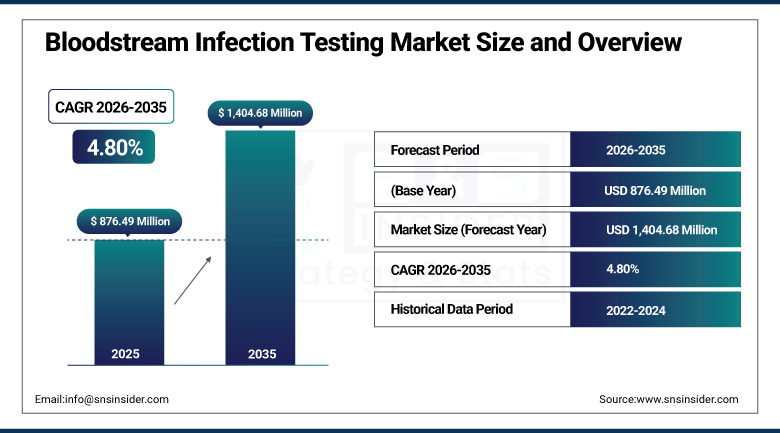
The Bloodstream Infection Testing Market was valued at USD 876.49 Million in 2025 and is expected to reach USD 1,404.68 Million by 2035, growing at a CAGR of 4.80% from 2026 to 2035.
Growth in the global bloodstream infection testing market is being seen due to the rising incidence of bloodstream infections. Bacteremia, fungaemia, and septicemia are some of the forms of bloodstream infections that are considered to be one of the worst and most dangerous infectious diseases. Growth in the global bloodstream infection testing market is being seen due to the rising demand for automated and rapid testing solutions, increasing usage of molecular diagnostics and rising need for effective antimicrobial stewardship programs, which require fast and accurate detection of pathogens and their susceptibility to guide de-escalation from broad-spectrum empirical antibiotic treatment.
In 2024, bioMerieux expanded its BIOFIRE FILMARRAY Bacteremia Panel capabilities with additional pathogen and resistance marker targets, enabling simultaneous detection of more than 26 bacterial and fungal pathogens plus 10 antimicrobial resistance genes directly from positive blood culture bottles within approximately one hour. The expanded panel addresses the clinical need for comprehensive rapid identification that guides transition from broad-spectrum empirical antibiotic coverage to pathogen-directed targeted therapy, directly reducing the duration of inappropriate antibiotic exposure and improving antimicrobial stewardship compliance metrics.
To Get more information On Bloodstream Infection Testing Market - Request Free Sample Report
Bloodstream Infection Testing Market Trends
-
Rapid molecular diagnostics enable faster pathogen identification, significantly reducing time to treatment in sepsis management.
-
Expanding antimicrobial stewardship programs are increasing demand for rapid bloodstream infection testing and targeted therapy decisions.
-
MALDI-TOF mass spectrometry improves pathogen identification speed and accuracy within clinical microbiology laboratories.
-
Direct whole-blood molecular testing is advancing earlier pathogen detection without requiring prior blood culture positivity.
-
AI-powered blood culture monitoring systems enhance early positivity detection and accelerate clinical decision-making processes.
The U.S. Bloodstream Infection Testing Market Outlook
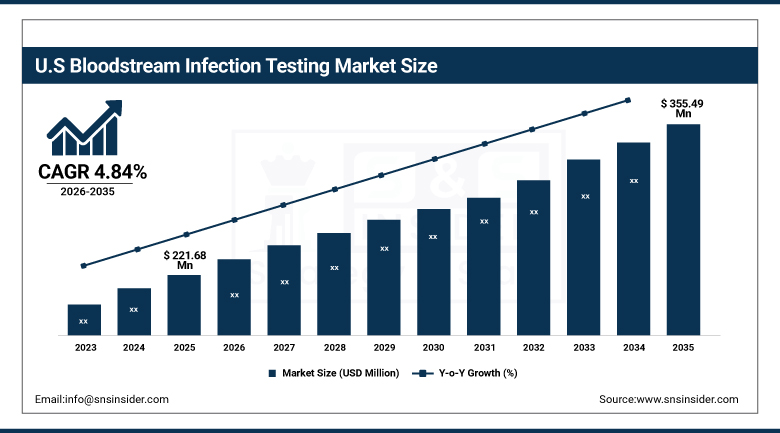
The U.S. Bloodstream Infection Testing Market was valued at approximately USD 221.68 Million in 2025 and is expected to reach approximately USD 355.49 Million by 2035, growing at a CAGR of approximately 4.84%.
The U.S. is the most commercially significant bloodstream infection testing market within North America's dominant regional position, driven by the high incidence of hospital-acquired bloodstream infections affecting approximately 250,000 to 500,000 patients annually, the extraordinary adoption of automated blood culture systems and molecular diagnostic platforms, and the strong antimicrobial stewardship mandate from the Centers for Medicare and Medicaid Services that links reimbursement to infection control performance. BD Diagnostics’ BACTEC blood culture system, bioMerieux's BacT/ALERT and BIOFIRE systems, Becton Dickinson’s molecular platforms, and Thermo Fisher Scientific's blood culture media collectively define the domestic commercial landscape.
Becton Dickinson obtained FDA clearance in 2023 for BD MAX Enteric Bacterial Panel to run on the BD MAX molecular diagnostic system. This is an example of the regulatory process that drives the adoption of rapid multiplex molecular assays to develop new infection diagnostics for BSI-related indications. The approval is an example of the growth of the multiplex PCR platform, which can expand testing capability into new applications using the same laboratory equipment.
Bloodstream Infection Testing Market Segment Analysis
-
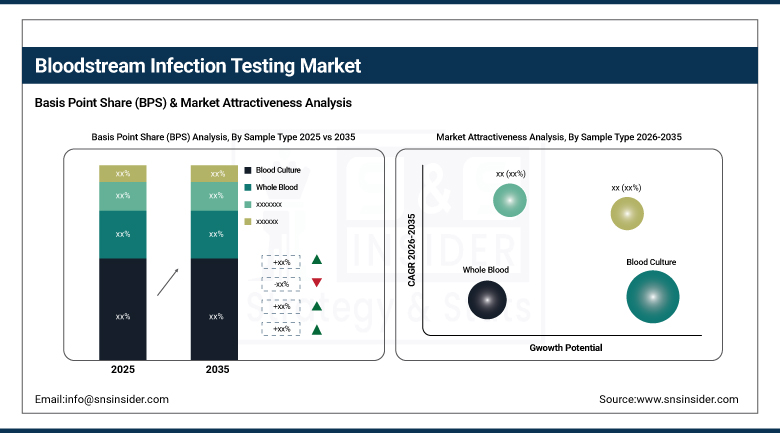
By Sample Type, the blood culture segment dominated the market with approximately 78.8% share in 2025, while the whole blood segment is the fastest growing.
-
By Product, the consumables and reagents segment dominated the market with the largest revenue share in 2025, while the instruments segment is the fastest growing.
-
By Technology, the microbiological testing segment dominated the market with approximately 55% share in 2025, while the molecular diagnostics segment is the fastest growing.
-
By Test Type, the conventional blood culture tests segment dominated the market with the largest volume share in 2025, while the PCR method segment is the fastest growing.
-
By End User, the hospitals segment dominated the market with approximately 46% share in, while the diagnostic laboratories segment is the fastest growing.
By Sample Type, blood culture dominates, whole blood grows fastest
Blood culture retained the dominant sample type position with approximately 78.8% of the bloodstream infection testing market in 2025. The blood culture bottle's clinical status as the standard specimen for bacteraemia and fungaemia detection reflects decades of validation, clinical guideline integration, and antibiotic susceptibility testing compatibility that no alternative sample type yet matches comprehensively. Automated blood culture systems from BD Diagnostics, bioMerieux, and Thermo Fisher Scientific whose continuous fluorescence-based detection algorithms identify positive bottles within the shortest biologically feasible incubation period have transformed blood culture from a technically demanding multi-day process to an efficient automated workflow.
Whole blood molecular testing is the fastest growing sample type because the ability to detect pathogen DNA directly from unprocessed blood without the one to five-day blood culture incubation delay creates a clinically transformative capability for early sepsis management. Each whole blood molecular testing system that delivers pathogen identification within two to six hours of blood collection rather than after culture positivity creates a therapeutic window improvement whose clinical value in reducing inappropriate broad-spectrum antibiotic exposure and improving patient outcomes justifies premium platform pricing.
By Technology, microbiological testing dominates, molecular diagnostics grow fastest
Microbiological testing retained the dominant technology position with approximately 55% of the bloodstream infection testing market in 2025. The established clinical integration of blood culture-based microbiological testing, whose culture-positive bottle identification triggers MALDI-TOF species identification and antibiotic susceptibility testing, creates a proven diagnostic pathway that hospital microbiology laboratories have optimised over decades of operational experience. Automated blood culture incubation systems create efficient workflows for large daily blood culture volumes sustain microbiological testing's commercial dominance. Each hospital microbiology laboratory that operates a BD BACTEC, bioMerieux BacT/ALERT, or Thermo Fisher Blood Culture system creates blood culture media procurement whose annual volume reflects the institution's patient admission rate and clinician ordering patterns.
Molecular diagnostics are the fastest growing technology because multiplex PCR panels that provide comprehensive pathogen and resistance gene identification from positive blood culture bottles within one to two hours are being adopted systematically in hospital microbiology laboratories as the standard second-step identification method following culture positivity detection. The BIOFIRE FILMARRAY Bacteremia Panel, Verigene Gram-positive and Gram-negative Blood Culture assays, and Luminex VERIGENE panels collectively demonstrate the commercial scale of post-culture molecular identification adoption whose premium pricing relative to conventional biochemical identification is justified by the antimicrobial stewardship value of same-day targeted therapy guidance.
Regional Analysis
|
Region |
Major Country |
Share within Region, 2025 (%) |
|---|---|---|
|
North America |
United States |
87.4% |
|
Europe |
Germany |
22.3% |
|
Asia Pacific |
China |
44.8% |
|
Middle East & Africa |
South Africa |
31.2% |
|
Latin America |
Brazil |
44.2% |
North America Bloodstream Infection Testing Market Insights
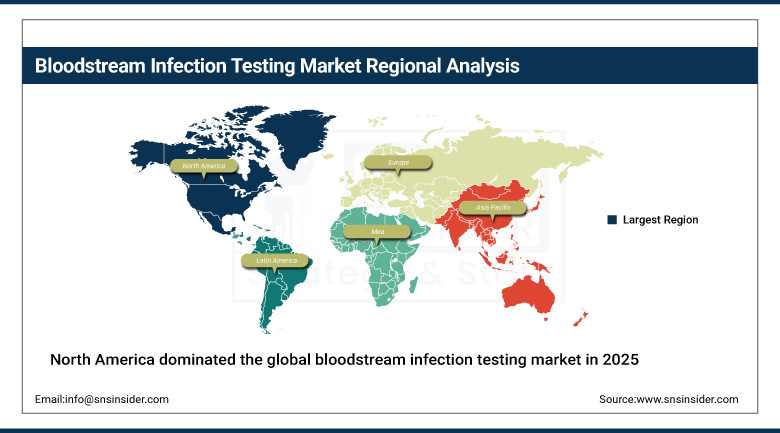
North America dominated the global bloodstream infection testing market in 2025, driven by advanced healthcare infrastructure, high hospital-acquired infection awareness, antimicrobial stewardship regulatory requirements, and the commercial concentration of BD Diagnostics, bioMerieux, Thermo Fisher Scientific, and Becton Dickinson. The United States accounts for approximately 87.4% of North American revenues through its hospital-acquired infection prevention mandate and the extraordinary adoption of automated blood culture systems across acute care facilities.
Canada contributes approximately 12.6% of North American revenues through its publicly funded hospital system's bloodstream infection testing procurement, the provincial public health laboratory network's surveillance role, and the adoption of molecular diagnostic platforms in academic medical centre microbiology laboratories.
Get Customized Report as per Your Business Requirement - Enquiry Now
Europe Bloodstream Infection Testing Market Insights
Europe is a technically sophisticated bloodstream infection testing market where ECDC antimicrobial resistance surveillance requirements, EUCAST clinical breakpoint standards for susceptibility testing, and national antimicrobial stewardship programme mandates create structured institutional investment in rapid bloodstream infection diagnostics. Germany accounts for approximately 22.3% of European revenues through its dense hospital microbiology laboratory network, Siemens Healthineers’ domestic commercial presence, and the academic medical center sector's molecular diagnostic adoption.
The United Kingdom, France, and Spain are significant secondary markets where NICE antimicrobial prescribing guidance, NHS antimicrobial stewardship programme requirements, and Institut Pasteur's reference microbiology function create consistent bloodstream infection testing procurement. bioMerieux's French headquarters and BD Diagnostics’ European operations sustain regional supply.
Asia Pacific Bloodstream Infection Testing Market Insights
Asia Pacific is the fastest growing regional bloodstream infection testing market, driven by China's hospital infection control investment, India's growing antimicrobial resistance awareness, Japan's advanced clinical microbiology adoption, South Korea's hospital-acquired infection prevention programme, and the ASEAN region's expanding healthcare infrastructure whose increasing ICU capacity creates growing bloodstream infection testing demand. China accounts for approximately 44.8% of Asia Pacific revenues through its hospital laboratory modernization programme, the government's antimicrobial resistance national action plan, and the growing adoption of automated blood culture systems in major urban hospitals.
India represents the most commercially dynamic emerging market within Asia Pacific where the extraordinarily high antimicrobial resistance burden, the growing private hospital sector's laboratory investment, and the government's national antimicrobial stewardship programme create above-average bloodstream infection testing market growth from both clinical demand and compliance-driven procurement sources.
MEA & Latin America Bloodstream Infection Testing Market Insights
South Africa leads MEA revenues at approximately 31.2% through its established hospital microbiology infrastructure, the National Health Laboratory Service's bloodstream infection surveillance, and the high HIV-associated fungal bloodstream infection burden creating structured cryptococcaemia and candidaemia testing demand. Saudi Arabia's advanced hospital sector adds substantial Gulf demand.
Brazil leads Latin American revenues at approximately 44.2% through its large hospital sector, the growing private diagnostic laboratory network, and the ANVISA antimicrobial stewardship regulation creating structured BSI testing procurement. Mexico's hospital sector and Colombia's diagnostic infrastructure collectively sustain regional market growth through 2035.
Market Dynamics
Growth Drivers: Rising hospital-acquired bloodstream infection incidence and antimicrobial stewardship mandate creating non-discretionary rapid testing procurement
The rising incidence of hospital-acquired bloodstream infections is the bloodstream infection testing market's most commercially direct structural growth driver. Each patient who acquires a central line-associated bloodstream infection, a ventilator-associated pneumonia with bacteraemia, or a catheter-associated urinary tract infection with bacteraemic spread creates a testing procurement event whose diagnostic investigation requires blood culture, pathogen identification, and antibiotic susceptibility testing. The growing population of immunocompromised patients including solid organ transplant recipients, haematological malignancy patients receiving myeloablative chemotherapy, and HIV patients with advanced immunosuppression creates a persistently high-risk patient cohort whose bloodstream infection incidence sustains testing volume independent of overall hospital admission growth.
Antimicrobial stewardship programme mandates from CMS, The Joint Commission, and national regulatory bodies create non-discretionary investment in rapid bloodstream infection testing whose result speed directly determines the clinical effectiveness of stewardship protocols aimed at de-escalating broad-spectrum empirical antibiotic therapy.
Restraints: High cost of rapid molecular diagnostic systems and blood culture volume requirements for adequate sensitivity
The high capital and reagent cost of rapid molecular diagnostic systems, whose multiplexed PCR panel pricing of USD 100 to USD 300 per test substantially exceeds conventional blood culture costs of USD 20 to USD 50 per episode, creates adoption barriers in cost-constrained healthcare settings where diagnostic budget limitations prioritize higher-volume conventional testing over premium rapid molecular alternatives. Each hospital whose diagnostic budget allocation creates a per-test cost threshold below molecular panel pricing creates a market segment where conventional blood culture remains the sole procurement option despite inferior identification speed.
Blood culture's volume requirements for adequate diagnostic sensitivity, typically two sets of two to three bottles drawn from separate venepuncture sites, create both procedural burden and consumable cost per episode that moderates testing frequency in settings where nursing workload or patient compliance limits optimal collection protocol adherence.
Opportunities: Direct-from-blood molecular testing and AI-integrated blood culture monitoring systems
Direct-from-blood molecular testing represents the most commercially transformative emerging opportunity whose same-day pathogen identification independent of blood culture positivity creates therapeutic decision support at the earliest clinically actionable timepoint in sepsis management. Each direct-from-blood molecular testing system validated for clinical use in sepsis creates procurement whose clinical value in reducing time to targeted therapy from one to five days to two to six hours creates patient outcome improvement whose health economic justification sustains premium pricing above conventional culture-based alternatives.
AI-integrated blood culture monitoring represents the most commercially accessible near-term technology enhancement opportunity whose predictive positivity detection algorithms, optical density trend analysis, and clinical alert integration create earlier pathogen identification and automated communication to clinical teams.
Recent Developments:
-
2026: QIAGEN launched the CE-IVDR-certified QIAstat-Dx BCID GPF Plus AMR Panel, enabling identification of bloodstream infection pathogens and antimicrobial resistance markers in approximately one hour.
-
2025: bioMerieux obtained CE marking for the BIOFIRE® Blood Culture Identification 2 (BCID2) test, supporting rapid detection of bloodstream infection pathogens and resistance genes directly from positive blood cultures.
-
2025: T2 Biosystems expanded its FDA-cleared T2Bacteria® Panel and reported record sales of sepsis testing products, strengthening its direct-from-blood pathogen detection portfolio.
-
2025: bioMerieux advanced its sepsis diagnostics portfolio by promoting VITEK® REVEAL rapid antimicrobial susceptibility testing, designed to accelerate targeted treatment decisions for bloodstream infections.
Bloodstream Infection Testing Market Key Players are:
-
bioMerieux SA
-
Becton Dickinson and Company
-
Thermo Fisher Scientific Inc.
-
Siemens Healthineers AG
-
F. Hoffmann-La Roche Ltd.
-
Abbott Laboratories
-
DiaSorin S.p.A.
-
Bruker Corporation
-
QIAGEN N.V.
-
Accelerate Diagnostics, Inc.
-
T2 Biosystems, Inc.
-
Molzym GmbH & Co. KG
-
Shenzhen Mindray Bio-Medical Electronics Co., Ltd.
-
Sysmex Corporation
-
Danaher Corporation
-
QuidelOrtho Corporation
-
Meridian Bioscience, Inc.
-
Seegene Inc.
-
Revvity, Inc.
-
bioMason Inc.
Bloodstream Infection Testing Market Report Scope:
| Report Attributes | Details |
|---|---|
| Market Size in 2025 | USD 876.49 Million |
| Market Size by 2035 | USD 1,404.68 Million |
| CAGR | CAGR of 4.80% From 2026 to 2035 |
| Base Year | 2025 |
| Forecast Period | 2026-2035 |
| Historical Data | 2022-2024 |
| Report Scope & Coverage | Market Size, Segments Analysis, Competitive Landscape, Regional Analysis, DROC & SWOT Analysis, Forecast Outlook |
| Key Segments | • By Product (Instruments, Consumables and Reagents) • By Sample Type (Blood Culture, Whole Blood, Plasma, Serum, Other Body Fluids) • By Technology (Microbiological Testing/Culture-Based, Molecular Diagnostics, Immunoassays, Mass Spectrometry) • By Test Type (Conventional Blood Culture Tests, PCR Method, Nucleic Acid Testing, Mass Spectrometry Testing, Point-of-Care Testing) • By End User (Hospitals, Diagnostic Laboratories, Ambulatory Care Centers, Others) |
| Regional Analysis/Coverage | North America (US, Canada), Europe (Germany, UK, France, Italy, Spain, Russia, Poland, Rest of Europe), Asia Pacific (China, India, Japan, South Korea, Australia, ASEAN Countries, Rest of Asia Pacific), Middle East & Africa (UAE, Saudi Arabia, Qatar, South Africa, Rest of Middle East & Africa), Latin America (Brazil, Argentina, Mexico, Colombia, Rest of Latin America). |
| Company Profiles | bioMerieux SA, Becton Dickinson and Company, Thermo Fisher Scientific Inc., Siemens Healthineers AG, F. Hoffmann-La Roche Ltd., Abbott Laboratories, DiaSorin S.p.A., Bruker Corporation, QIAGEN N.V., Accelerate Diagnostics, Inc., T2 Biosystems, Inc., Molzym GmbH & Co. KG, Shenzhen Mindray Bio-Medical Electronics Co., Ltd., Sysmex Corporation, Danaher Corporation, QuidelOrtho Corporation, Meridian Bioscience, Inc., Seegene Inc., Revvity, Inc., bioMason Inc. |
Frequently Asked Questions
Rising hospital-acquired bloodstream infection incidence creating consistent diagnostic testing procurement.
The Bloodstream Infection Testing Market is expected to grow at a CAGR of 4.80% from 2026 to 2035.
The Bloodstream Infection Testing Market was valued at USD 876.49 Million in 2025.
North America dominated the Bloodstream Infection Testing Market in 2025.
Blood Culture dominated the Bloodstream Infection Testing Market with approximately 78.8% share in 2025.
