
Carob Chocolate Market Report Scope & Overview:
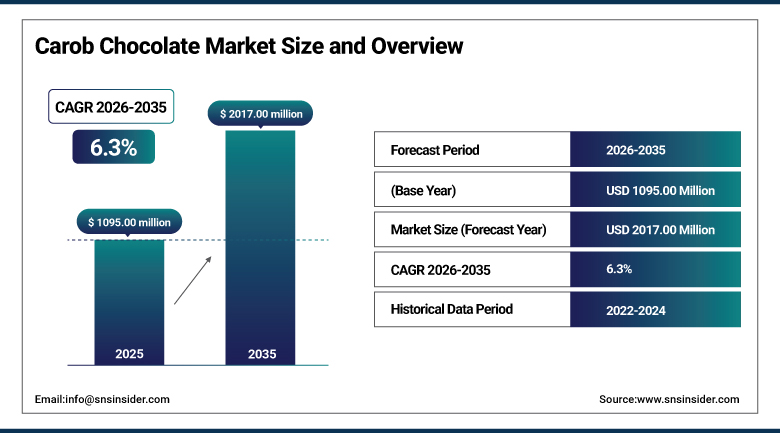
The Carob Chocolate Market was valued at USD 1,095.00 Million in 2025 and is expected to reach USD 2,017.00 Million by 2035, growing at a CAGR of 6.3% from 2026 to 2035.
The expansion of the Carob Chocolate Market is due to increasing consumer preference for natural products that are healthy alternatives to traditional chocolates. Consumer awareness regarding the health advantages of carob including its naturally occurring sweetness, low-fat nature, and the absence of caffeine and theobromine is stimulating the use of carob among health-oriented consumers. The growing demand for clean label, organic, no-sugar, and plant-based chocolate is aiding market growth. Apart from this, manufacturers are coming up with novel chocolate products based on carob such as bars, chips, powder, and others in response to changing dietary trends. Besides this, expanding uses of carob chocolate in bakery products, snacks, confectionary, and foodservice are opening up new avenues for growth.
Win-Win announced an exclusive UK distribution partnership with ingredients supplier Keylink in February 2026, launching a new bake-stable chocolate chip range designed specifically for the bakery and foodservice sectors and becoming the first and only cocoa-free chocolate in Keylink's portfolio, reflecting the accelerating industry shift toward carob-based chocolate alternatives amid climate-driven cocoa supply volatility affecting the broader global chocolate industry.
To Get more information Carob Chocolate Market - Request Free Sample Report
Carob Chocolate Market Trends
-
Growing global chocolate sector disruption, with cocoa trees threatened and a third potentially dying out by 2050, continues accelerating carob adoption.
-
Rising manufacturer investment in advanced fermentation and processing techniques is improving carob-based products' texture, snap, and melt characteristics.
-
Expanding e-commerce and direct-to-consumer models are enabling niche carob brands to reach targeted health-conscious segments quickly and efficiently.
-
Increasing partnerships between carob chocolate innovators and established bakery and confectionery suppliers continue to broaden mainstream distribution access.
-
Growing sugar-free and low-sugar carob formulations continue gaining popularity in retail, specialty shops, and online marketplaces among health-conscious consumers.
U.S. Carob Chocolate Market Outlook
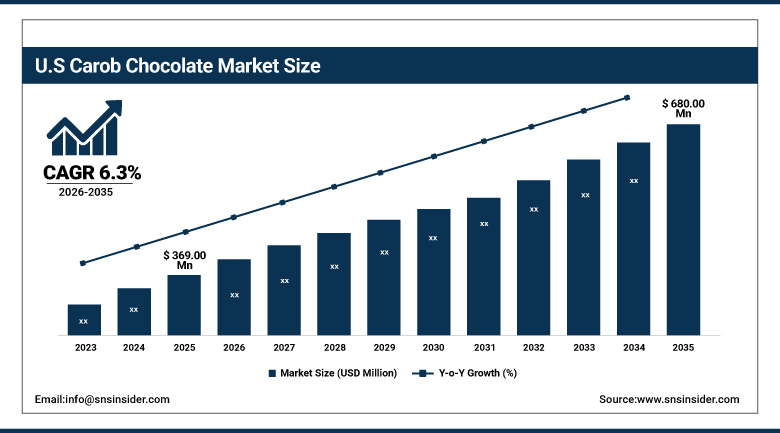
The U.S. Carob Chocolate Market was valued at USD 369.00 Million in 2025 and is projected to reach USD 680.00 Million by 2035, growing at a CAGR of 6.3% during 2026-2035.
The growth of the U.S. Carob Chocolate Market is attributed to the growing consumer preference for more healthy and natural confectionery options. With the increase in consumer awareness about the naturally occurring sweetness of carob, its absence of caffeine, and the lower fat levels, it is becoming more popular among health-conscious consumers. The growing demand for organic, clean label, sugar-free, and plant-based foods is adding to the growth prospects of the market. Companies are coming up with various products such as carob chocolate bars, chips, powder, and others to cater to changing dietary needs. Besides, there is an increasing use of carob chocolate in bakery, confectionery, snacking, and foodservice applications.
Barry Callebaut joined forces with German food technology company Planet A Foods in November 2025 to scale up production of cocoa-free products using ChoViva, a chocolate alternative made with sunflower seeds, reflecting how seriously major global chocolate manufacturers are taking the structural shift toward cocoa-free alternatives amid persistent cocoa supply chain volatility and climate-related crop yield concerns affecting the broader confectionery industry.
Carob Chocolate Market Segment Analysis
-
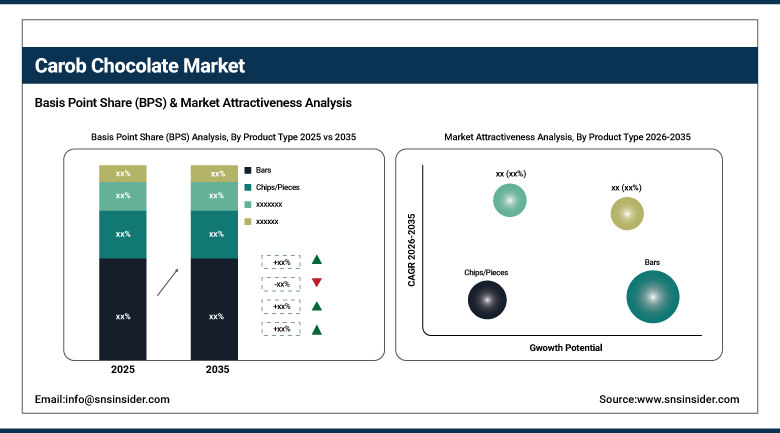
By Product Type, Bars segment dominated the Carob Chocolate Market in 2025 with approximately 43.35% share; Chips segment is the fastest growing segment.
-
By Formulation, Conventional/Standard segment dominated the Carob Chocolate Market in 2025 with approximately 60% share; Organic segment is the fastest growing segment.
-
By Distribution Channel, Supermarkets/Hypermarkets segment dominated the Carob Chocolate Market in 2025 with approximately 35% share; Convenience Stores & Drug Stores segment is the fastest growing segment.
-
By End-User, Retail Consumers segment dominated the Carob Chocolate Market in 2025 with approximately 43% share; Food Manufacturers & Bakeries segment is the fastest growing segment.
By Product Type, Bars dominated the market, while Chips is the fastest-growing segment
Bars dominated the Carob Chocolate Market in 2025 because they offer convenient, ready-to-eat formats that align with consumers’ demand for portable and portion-controlled snacks. Their familiarity with mainstream chocolate products also supports broader consumer acceptance of carob-based alternatives. Extensive shelf presence, diverse flavors, and availability across supermarkets and specialty retailers further strengthen sales. Additionally, bars provide manufacturers with flexibility to combine carob with nuts, fruits, and functional ingredients, enhancing product differentiation and supporting sustained consumer interest.
Chips are projected to be the fastest-growing product type in the Carob Chocolate Market as demand increases for versatile carob ingredients suitable for baking, desserts, snacking, and food preparation. Their convenient format enables consumers and foodservice users to incorporate carob into cookies, muffins, granola, and other applications. Growing experimentation with plant-based and naturally sweetened ingredients further supports adoption. In addition, carob chips can provide chocolate-like functionality while appealing to consumers seeking caffeine-free and alternative confectionery options.
By Formulation, Conventional/Standard dominated the market, while Organic is the fastest-growing segment
Conventional/Standard formulations dominated the Carob Chocolate Market in 2025 because they generally offer broader availability, established consumer familiarity, and competitive pricing compared with specialized formulations. Mainstream manufacturers and retailers can produce and distribute conventional products at scale, supporting widespread accessibility. These formulations also appeal to consumers who prioritize familiar taste, texture, and product characteristics when trying carob chocolate. Established supply chains and extensive retail placement further reinforce the segment’s strong position across major consumer markets.
Organic formulations are expected to be the fastest-growing segment as consumers increasingly prioritize clean-label, naturally sourced, and environmentally responsible food products. Rising awareness of organic certification and ingredient transparency is encouraging shoppers to seek carob products produced without conventional agricultural inputs. Premium positioning also enables manufacturers to target health-conscious and sustainability-focused consumers willing to pay higher prices. Organic food distribution, product innovation, and demand for minimally processed confectionery are supporting growth in organic carob chocolate offerings.
By Distribution Channel, Supermarkets/Hypermarkets dominated the market, while Convenience Stores & Drug Stores is the fastest-growing segment
Supermarkets and hypermarkets dominated the Carob Chocolate Market in 2025 because they provide extensive product visibility, broad assortment, and convenient one-stop shopping. These outlets allow consumers to compare multiple carob chocolate brands, formats, and price points while benefiting from promotions and private-label offerings. Their customer base and widespread physical presence also support frequent impulse purchases and repeat buying. Retailers’ increasing emphasis on healthier and alternative confectionery categories further improves shelf space and accessibility for carob products.
Convenience Stores and Drug Stores are expected to be the fastest-growing distribution channel as consumers increasingly seek quick, accessible options for snacks and confectionery products. Urban lifestyles and on-the-go consumption patterns encourage purchases through nearby outlets rather than planned supermarket trips. Greater availability of healthier, sugar-conscious, and specialty snack products in these stores is also supporting category expansion. Better product placement, compact packaging, and growing consumer awareness of carob-based alternatives can further accelerate sales through this channel.
By End-User, Retail Consumers dominated the market, while Food Manufacturers & Bakeries is the fastest-growing segment
Retail Consumers dominated the Carob Chocolate Market in 2025 because household shoppers represent the largest consumer base for ready-to-eat carob products, particularly bars, confectionery, and snack formats. Growing interest in alternative chocolate ingredients, naturally sweetened foods, and caffeine-free options supports consumer purchases. Product availability through supermarkets, specialty stores, and online channels further strengthens accessibility. In addition, packaging, flavor variety, and convenient portion sizes encourage repeat purchases and help sustain strong demand within the retail consumer segment.
Food Manufacturers and Bakeries are projected to be the fastest-growing end-user segment as commercial users incorporate carob into baked goods, confectionery, desserts, snacks, and specialty formulations. Carob’s functional versatility, naturally sweet flavor profile, and suitability for chocolate-style applications make it attractive for product reformulation and innovation. Growing demand for plant-based, caffeine-free, and naturally sourced ingredients further encourages industrial adoption. Bakery and packaged-food production and new carob-based product launches are expected to accelerate procurement from manufacturers and bakeries.
Regional Insights
|
Region |
Country |
Share (2025) |
|---|---|---|
|
North America |
United States |
84.60% |
|
Europe |
United Kingdom |
22.80% |
|
Asia Pacific |
China |
32.60% |
|
Middle East & Africa |
UAE |
20.60% |
|
Latin America |
Brazil |
24.60% |
North America Carob Chocolate Market Insights
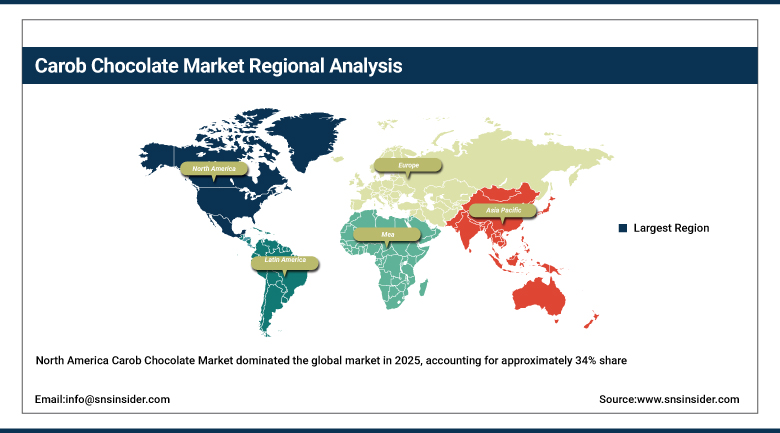
The North America Carob Chocolate Market dominated the global market in 2025, accounting for approximately 34% share, supported by strong consumer demand for healthier and plant-based confectionery alternatives. The region’s preference for clean-label, organic, sugar-free, and naturally sweetened products is driving carob chocolate adoption. The U.S. represents the largest market within North America, supported by increasing health awareness and product availability. Rising applications of carob in bakery, snacks, and confectionery products, along with expanding specialty and online retail channels, are further contributing to regional market growth.
The United States accounted for approximately 84.60% of the North American market in 2025, reflecting its concentration of leading carob chocolate brands and robust direct-to-consumer sales infrastructure. Canada is contributing to regional growth through steady health-conscious consumer adoption and growing consumer interest in functional, caffeine-free confectionery alternatives.
Get Customized Report as per Your Business Requirement - Enquiry Now
Europe Carob Chocolate Market Insights
Europe represented a meaningful share of the global Carob Chocolate Market in 2025, supported by growing food company embrace of climate-friendly chocolate alternatives amid rising cocoa prices and supply chain uncertainty affecting the broader confectionery industry. Growing partnerships between carob chocolate innovators and established European bakery suppliers continue to reinforce steady regional demand.
The United Kingdom led the European market with a 22.80% regional share in 2025, supported by leading carob chocolate innovators headquartered across the region including Win-Win. Germany, France, and Italy are also contributing meaningfully to regional growth, supported by expanding bakery and foodservice distribution partnerships across major European markets.
Asia Pacific Carob Chocolate Market Insights
Asia Pacific is expected to register the fastest CAGR in the Carob Chocolate Market during 2026–2035, driven by rising health consciousness and increasing disposable incomes among the expanding middle-class population. Growing consumer interest in caffeine-free, low-sugar, and naturally derived confectionery alternatives is strengthening demand across China, Japan, India, and Southeast Asia. Additionally, increasing awareness of healthier snack options and clean-label products is supporting market adoption. The rapid expansion of modern supermarkets, specialty health-food stores, and e-commerce platforms is improving product availability and accessibility.
China accounted for approximately 32.60% of the Asia Pacific market in 2025, supported by its rapidly expanding health-conscious consumer base and growing domestic confectionery manufacturing capacity. Japan, India, and South Korea are also contributing meaningfully to regional growth, with growing consumer interest in functional, allergy-friendly confectionery alternatives.
Middle East & Africa and Latin America Carob Chocolate Market Insights
The Middle East & Africa region is exhibiting steady growth as health and wellness awareness expands across the Gulf states, supported by growing modern retail infrastructure. Latin America is similarly benefiting from rising disposable income and growing consumer interest in caffeine-free, low-sugar confectionery alternatives across major regional urban centers.
The UAE led the Middle East & Africa market with a 20.60% regional share in 2025, supported by growing health-conscious consumer demand and expanding modern retail penetration. Brazil represented 24.60% of the Latin American market in 2025, driven by expanding functional confectionery consumption, with Mexico also contributing to regional growth through rising interest in carob-based products.
Growth Drivers: Cocoa Supply Volatility and Health-Conscious Confectionery Demand Driving Market Growth
The Carob Chocolate Market is being driven primarily by growing consumer demand for low-sugar, allergy-friendly, and caffeine-free candy substitutes, coupled with fluctuating cocoa prices encouraging manufacturers to explore carob-based formulations. Scientists have warned that cocoa trees are threatened, with a third potentially dying out by 2050, which could lead to a global chocolate shortage, while dark chocolate remains a highly emissive product generating more greenhouse gases than nearly all other foods except beef.
Growing global chocolate sector disruption continues accelerating carob adoption as manufacturers seek sustainable, climate-resilient alternatives. Rising manufacturer investment in advanced fermentation and processing techniques is improving carob-based products' texture, snap, and melt characteristics. Expanding e-commerce and direct-to-consumer models are further enabling niche carob brands to reach targeted health-conscious segments quickly, reinforcing sustained category momentum.
Restraints: Taste Perception Challenges and Limited Brand Awareness Limiting Market Expansion
Despite favorable underlying demand, the market faces meaningful restraints related to persistent taste perception challenges, as carob's naturally sweet, earthy flavor profile continues to differ meaningfully from cocoa, requiring careful formulation to achieve mainstream consumer acceptance. Limited brand awareness relative to established chocolate categories continues to constrain broader market penetration beyond health-conscious early adopters.
Advances in food processing and formulation techniques are helping manufacturers achieve improved texture and shelf life without relying on heavy masking agents, though this remains an ongoing technical challenge. Growing competitive intensity among an expanding roster of carob and broader cocoa-free chocolate alternative manufacturers also continues to fragment the competitive landscape, requiring sustained differentiation investment.
Opportunities: B2B Bakery Partnerships and Functional Formulation Innovation Creating New Growth Avenues
Substantial opportunity exists in continued expansion of B2B partnerships with bakery and food service suppliers, as carob chocolate innovators increasingly position their products as viable ingredients for professional bakers, chocolatiers, and chefs. Companies that successfully commercialize bake-stable, workable carob formulations stand to capture significant share of category growth as mainstream food manufacturers seek cocoa supply chain diversification.
Growing functional and fortified formulation innovation presents a further significant growth avenue, as manufacturers increasingly combine carob with complementary ingredients to enhance nutritional positioning and differentiate from conventional chocolate. Expanding distribution into mainstream supermarket and club store channels beyond specialty health food stores also represents meaningful untapped opportunity for carob chocolate manufacturers.
Recent Developments:
-
2025: Win-Win raised GBP 3 million (USD 4 million) in Series A funding and partnered with Germany's Martin Braun-Gruppe for coating products.
-
2026: Nestlé Germany launched Nestlé Choco Crossies Snack Vibes, a cocoa-free chocolatey snack made with ChoViva, in three flavors.
-
2026: Italian food technology company Foreverland introduced Choruba, a cocoa-free chocolate analog made from carob, pumpkin seeds, and chickpeas.
-
2025-2026: Win-Win expanded its European growth strategy following its Series A funding, targeting expansion into Germany, France, the Nordics, Benelux, and Switzerland.
Carob Chocolate Companies are:
-
The Carob Kitchen
-
The Australian Carob Co.
-
Missy J’s
-
Carob World
-
D&D Chocolates / Carob House
-
Uncommon Carob
-
CarobMe
-
Caroboo
-
Supertreats UK
-
Foundation Foods
-
Iswari
-
Carobou LLC
-
Carobana Pty Ltd.
-
AEP Colloids
-
TerraSana
-
Eurocarob
-
Alpine Herb Company
-
The Hain Celestial Group
Carob Chocolate Market Report Scope:
| Report Attributes | Details |
|---|---|
| Market Size in 2025 | USD 1,095.00 Million |
| Market Size by 2035 | USD 2,017.00 Million |
| CAGR | CAGR of 6.3% From 2026 to 2035 |
| Base Year | 2025 |
| Forecast Period | 2026-2035 |
| Historical Data | 2022-2024 |
| Report Scope & Coverage | Market Size, Segments Analysis, Competitive Landscape, Regional Analysis, DROC & SWOT Analysis, Forecast Outlook |
| Key Segments | • By Product Type (Bars, Chips/Pieces, Tablets, Powder, Others) • By Formulation (Conventional/Standard, Organic, Sugar-Free/Low-Sugar, Functional/Fortified) • By Distribution Channel (Supermarkets/Hypermarkets, Convenience Stores & Drug Stores, Online Retail, Specialty/Health Food Stores, Others) • By End-User (Retail Consumers, Food Manufacturers & Bakeries, Confectionery & Snack Producers, Foodservice/Hospitality, Others) |
| Regional Analysis/Coverage | North America (US, Canada), Europe (Germany, UK, France, Italy, Spain, Russia, Poland, Rest of Europe), Asia Pacific (China, India, Japan, South Korea, Australia, ASEAN Countries, Rest of Asia Pacific), Middle East & Africa (UAE, Saudi Arabia, Qatar, South Africa, Rest of Middle East & Africa), Latin America (Brazil, Argentina, Mexico, Colombia, Rest of Latin America). |
| Company Profiles | The Carob Kitchen, The Australian Carob Co., Missy J’s, Carob World, D&D Chocolates / Carob House, PANOS Brands, Uncommon Carob, CarobMe, Caroboo, Supertreats UK, Foundation Foods, Iswari, Carobou LLC, Carobana Pty Ltd., AEP Colloids, NOW Foods, TerraSana, Eurocarob, Alpine Herb Company, The Hain Celestial Group. |
Frequently Asked Questions
The Carob Chocolate Market is expected to grow at a CAGR of 6.3% from 2026 to 2035.
The Carob Chocolate Market was valued at USD 1,095.00 Million in 2025.
The market is driven by growing consumer demand for low-sugar, allergy-friendly, and caffeine-free candy substitutes, coupled with fluctuating cocoa prices.
The Bars segment dominated the Carob Chocolate Market in 2025.
The North America region dominated the Carob Chocolate Market in 2025.
