
Clean Beauty Market Report Scope & Overview:
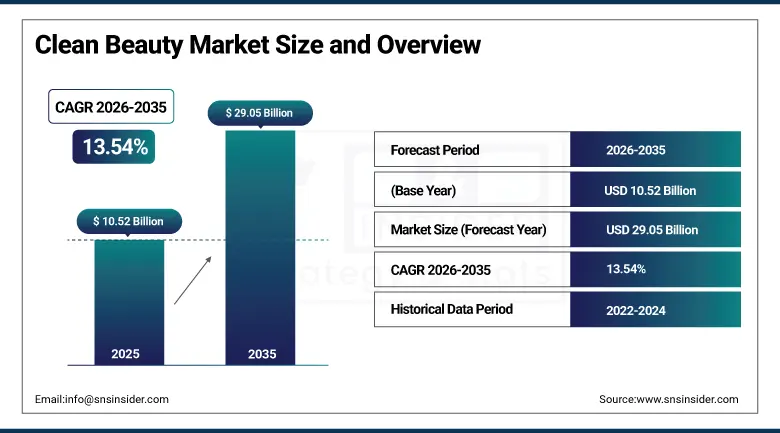
The Clean Beauty Market size was valued at USD 10.52 Billion in 2025 and is expected to reach USD 29.05 Billion by 2035, growing at a CAGR of 13.54% from 2026 to 2035.
Clean beauty is the commercial expression of a fundamental shift in consumer values toward personal care products formulated without harmful or controversial ingredients. Over 65% of beauty consumers now actively check ingredient labels before purchasing personal care products according to independent consumer survey data, a behavior pattern that did not characterize the majority of beauty buyers a decade ago and whose commercial consequences are being felt across established conventional brands and emerging clean-positioned challengers alike. Brands that establish credible, evidence-based, and consumer-legible clean standards build strong loyalty and premium pricing authority among informed consumers whose trust is difficult to transfer to competing products once established. Third-party certification organizations including EWG Verified, COSMOS Organic, NATRUE, and Leaping Bunny provide standardization that reduces the consumer interpretation burden, and retailer-defined clean standards at Sephora, Ulta, Target, and Whole Foods create high-traffic distribution channel access for brands that qualify, giving clean certification significant commercial value beyond consumer trust.
Ilia Beauty, a leading clean beauty brand, surpassed USD 150 million in annual revenue in 2024 and continued its retail expansion in 2025 through extended Sephora and international retailer placement. The brand's Super Serum Skin Tint SPF 40, which combines skincare and color cosmetic functional benefits in a clean-certified formulation, became one of the fastest-selling tinted SPF products in the clean beauty category.
To Get more information On Clean Beauty Market - Request Free Sample Report
Clean Beauty Market Trends
-
Biotech-derived ingredients are gaining adoption as effective clean alternatives to controversial conventional cosmetic formulation components.
-
Refillable and packaging-free beauty formats are becoming major sustainability-focused competitive differentiators in clean beauty retail markets.
-
Men’s clean beauty products represent the fastest-growing segment driven by increasing global grooming and skincare awareness.
-
TikTok Shop and social commerce platforms are accelerating Gen Z clean beauty product discovery and purchasing behavior.
-
Major beauty conglomerate acquisitions are accelerating clean beauty premiumization while expanding global brand distribution capabilities.
U.S. Clean Beauty Market Size Outlook
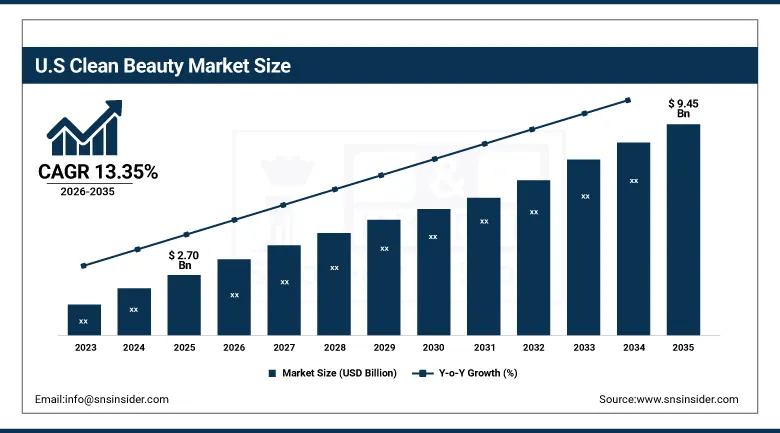
The U.S. clean beauty market was valued at USD 2.70 Billion in 2025 and is expected to reach USD 9.45 Billion by 2035, growing at a CAGR of 13.35% from 2026 to 2035.
The United States is the world's largest clean beauty market by revenue and is characterized by a mature retailer clean beauty standard ecosystem that sets category quality standards, and the highest consumer awareness of cosmetic ingredient safety concerns. Sephora's Clean at Sephora programme, Ulta's Conscious Beauty at Ulta Beauty, and Target's Clean at Target each define curated clean beauty retail environments whose shelf placement represents validated commercial access to millions of consumers. California's Cosmetic Fragrance and Flavor Ingredient Right to Know Act and proposed federal cosmetic ingredient regulation are creating regulatory tailwinds that support clean beauty positioning across the broader U.S. personal care market.
Beekman 1802, which is a clean beauty brand focused on the formulation of goat’s milk products, became the leading brand in terms of sales volume at QVC in the U.S. in 2024 and was also growing its retail footprint in 2025 through partnerships with Target and DTC subscriptions. This business success was an indicator of the popularity of clean beauty as a category, one that had to be credible and tied to specific ingredients.
Clean Beauty Market Segment Analysis
-
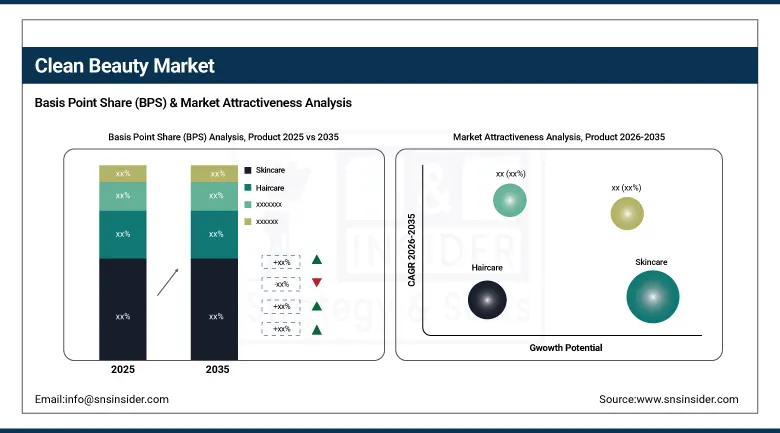
By Product, the skincare segment dominated the market with 39.26% share in 2025, while the haircare segment is the fastest growing product with a CAGR of 15.12% during 2026 to 2035.
-
By Ingredient Type, the natural ingredients segment dominated the market with 44.18% share in 2025, while the organic ingredients segment is the fastest growing with a CAGR of 14.74%.
-
By Distribution Channel, the specialty stores segment dominated the market with 41.84% share in 2025, while the online segment is the fastest growing channel with a CAGR of 16.05%.
-
By End User, the women segment dominated the market with 68.92% share in 2025, while the men segment is the fastest growing end user with a CAGR of 15.38%.
By Product, skincare dominates, haircare grows fastest
Skincare retained the dominant product position with 39.26% of clean beauty market revenue in 2025. Consumer concern about the long-term dermal exposure to potentially harmful cosmetic ingredients is most acute in the skincare category whose daily-use, leave-on formulations involve sustained skin contact that amplifies the perceived risk of any ingredient whose safety profile is contested. Facial serums, moisturizers, SPF products, and cleansers are the categories in which ingredient transparency most directly influences purchase decisions and where premium pricing for clean-certified products is most consistently supported by documented consumer willingness-to-pay.
Haircare is growing fastest with a CAGR of 15.12%, driven by rising consumer awareness of scalp health, chemical-free shampoo demand, and sustainable haircare routine adoption that positions clean haircare as both a health and lifestyle choice whose emotional resonance with consumers translates into above-market-average brand loyalty and repeat purchase frequency.
By Distribution Channel, specialty stores dominate, online grows fastest
Specialty stores generated 41.84% of clean beauty market revenue in 2025, reflecting the commercial importance of Sephora, Ulta Beauty, and independent clean beauty retail curators whose expert merchandising, product editing, and consumer consultation create a high-trust purchasing environment that clean beauty brands particularly value for initial trial conversion. The specialist retail channel's ability to explain ingredient stories, demonstrate product performance, and communicate brand values through trained beauty advisors creates conversion rates and basket values that mass retail channels whose self-service format cannot match for higher-priced clean beauty products.
Online is growing fastest with a CAGR of 16.05% as direct-to-consumer brand webstores, clean beauty e-commerce platforms including Credo Beauty and Detox Market, and social commerce integration on TikTok Shop and Instagram Shopping create purchasing pathways whose convenience, content integration, and subscription capability sustain repeat purchase frequency above physical retail channel norms.
By End User, women dominate, men grow fastest
In 2025, women made up 68.92% of the clean beauty revenue market, owing to the tradition whereby women have been the major buyers of cosmetics and personal care items throughout history. This is because women are adopting clean beauty due to a number of reasons such as awareness of ingredients used in clean beauty items and also due to the lifestyle attached to clean beauty brands, which are communicated to them through social media content.
Men are the fastest-growing end user segment with a CAGR of 15.38%, driven by rapidly rising grooming awareness among younger male consumers, the expanding distribution of men's clean grooming products through mainstream retail channels including Target and Walgreens, and the increasing normalization of skincare routines among men who previously were not regular personal care product buyers beyond basic hygiene.
Regional Analysis
|
Region |
Major Country |
Share within Region, 2025 (%) |
|---|---|---|
|
North America |
United States |
84.73% |
|
Europe |
Germany |
26.84% |
|
Asia Pacific |
China |
38.47% |
|
Middle East & Africa |
UAE |
22.84% |
|
Latin America |
Brazil |
43.84% |
North America Clean Beauty Market Insights
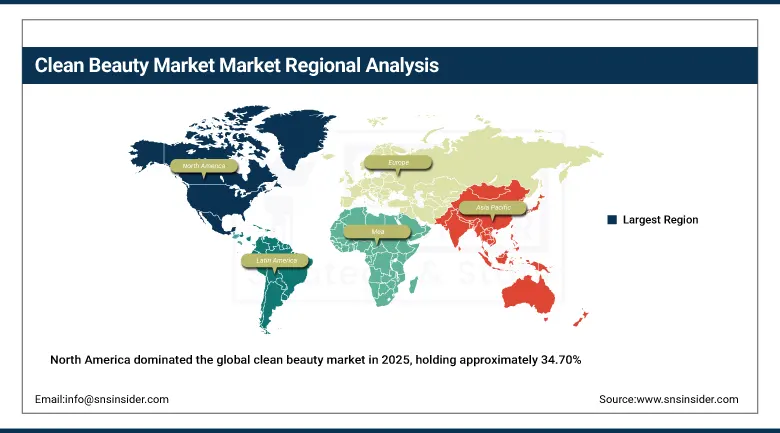
North America dominated the global clean beauty market in 2025, holding approximately 34.70% of global revenues. The United States accounts for approximately 84.73% of regional revenue through the highest consumer awareness of cosmetic ingredient safety concerns, the most commercially developed retailer clean beauty standard ecosystem, and the concentration of pioneering clean beauty brand founders whose product innovation and direct-to-consumer marketing have defined global category standards. Canada contributes supplementary demand through its progressive cosmetic ingredient regulation under Health Canada's Cosmetic Ingredient Hotlist and strong consumer alignment with natural and sustainable personal care values.
Get Customized Report as per Your Business Requirement - Enquiry Now
Europe Clean Beauty Market Insights
Europe held approximately 26.84% of global Clean Beauty revenues in 2025. The European Union's restrictive cosmetic ingredients regulation, which bans over 1,300 substances for use in cosmetics compared to fewer than 30 banned by FDA in the United States, has historically produced a European cosmetic market whose average formulation safety standard is above global norms. This regulatory baseline means that European consumers interpret clean beauty as a premium beyond regulatory minimum rather than a substitute for inadequate regulation, creating commercial demand concentrated in organic certification, biodynamic sourcing, and zero-waste packaging that goes further than regulatory compliance. Germany, France, the United Kingdom, and Scandinavia are the leading national markets, each hosting distinctive clean beauty brand cultures and strong natural cosmetics retail infrastructure.
Asia Pacific Clean Beauty Market Insights
Asia Pacific is the fastest-growing regional clean beauty market with a CAGR of approximately 16.50% through 2035. China accounts for approximately 38.47% of Asia Pacific revenues through its rapidly expanding urban middle class whose beauty spending is growing rapidly and whose younger consumer demographic is demonstrating strong alignment with ingredient transparency and K-Beauty-influenced skin health values. South Korea, Japan, India, and Southeast Asian markets contribute substantial and growing demand as social media-driven beauty culture, growing disposable incomes, and expanding natural and organic personal care brand development across the region builds the commercial infrastructure for clean beauty adoption at mass market and premium tiers simultaneously.
MEA & Latin America Clean Beauty Market Insights
Middle East and Latin America are growing clean beauty markets where expanding affluent consumer segments, growing awareness of cosmetic ingredient safety through social media, and increasing market entry by international clean beauty brands are progressively building commercial adoption. The UAE leads MEA revenues at approximately 22.84% of the regional total through its cosmopolitan consumer base with high per-capita beauty spending, premium retail infrastructure, and growing halal cosmetics market that shares formulation philosophy with clean beauty through its emphasis on ingredient purity and transparency. Brazil leads Latin American revenues at approximately 43.84% of the regional total through its world's third-largest beauty market status, strong naturals beauty culture, and the commercial success of Brazilian clean beauty brands including Natura whose biodiversity-sourced ingredient positioning resonates globally.
Market Dynamics
Growth Drivers: Rising consumer ingredient safety awareness and the commercial mainstream adoption of clean beauty standards are creating market expansion.
The clean beauty market's structural growth is powered by a consumer awareness cycle whose commercial momentum accelerates with each new media report about potentially harmful cosmetic ingredients, each celebrity or influencer who publicly advocates for clean product choices, and each major retailer that introduces a clean beauty curation programme that makes clean product identification effortless for mainstream consumers. The transition of clean beauty from niche natural health store category to mainstream Sephora and Target retail fixture has been the most commercially consequential structural development in the category, as it brought clean beauty products into the purchase consideration set of tens of millions of consumers who previously did not encounter them in their primary shopping environments. Major beauty company acquisitions of clean beauty brands, including Unilever's acquisition of multiple clean beauty brands and L'Oreal's investment in clean beauty platform development, signal that the largest players in the global beauty industry have validated clean beauty's long-term commercial trajectory.
Restraints: Lack of universal clean beauty definition and the premium pricing of certified clean products create consumer confusion and accessibility barriers.
Without global harmonization of the clean beauty certification process, there is a potential risk for greenwashing through the use of brand-based claims that cannot stand up against ingredient verification. When consumers become informed about ingredients and their levels of safety, they will begin to question the reliability of such vague clean claims that have unique exclusions among each other. Due to the premium cost of organic clean beauty products, which can be twice or even four times more expensive than non-certified versions, accessibility remains an issue.
Opportunities: Biotech-derived clean ingredients and the men's grooming expansion represent commercial innovation frontiers that can expand the clean beauty market's consumer base.
Technologies of precision fermentation and synthetic biology have been making it possible to produce cosmetics active ingredients like squalane, collagen peptides, hyaluronic acid, and even complex botanical extracts via biotech methods rather than traditional agriculture or petrochemical routes. Such biotechnologically produced ingredients share the ingredient efficacy of their traditionally produced counterparts, and in addition to offering transparency regarding their origin, consistent quality, and smaller agricultural footprint, they qualify as truly revolutionary ingredients for clean beauty products. In clean beauty, men's grooming is the biggest unserved market segment, where there is a fast-growing demand among men for effective skin care products and transparent ingredients but which remains unserved by product range and shopping environment catering predominantly to women.
Recent Developments:
-
2025: Ilia Beauty continued its Sephora retail expansion and international market development, with its Super Serum Skin Tint SPF 40 becoming one of the fastest-selling tinted SPF products in the clean beauty category and validating consumer willingness-to-pay for multi-functional clean beauty formulations at premium price points.
-
2025: Beekman 1802 extended its retail partnership with Target across additional product categories and maintained its position as a top-selling clean beauty brand on QVC, demonstrating the commercial viability of clean beauty with distinctive, transparently communicated natural ingredient stories at mass accessible retail price points.
-
2024: Credo Beauty, the leading clean beauty specialty retailer in the United States, expanded its store network and updated its Credo Clean Standard ingredient restriction list, maintaining its position as the most stringent retailer clean beauty standard and providing a commercially influential benchmark that brand formulation teams reference in product development decisions.
Clean Beauty Companies are:
-
L'Oreal SA (Garnier, La Roche-Posay)
-
Unilever PLC (Love Beauty and Planet)
-
Estee Lauder Companies Inc.
-
Procter & Gamble Co.
-
Shiseido Company Ltd.
-
The Honest Company Inc.
-
Beautycounter LLC
-
Beekman 1802
-
Credo Beauty
-
Drunk Elephant (Shiseido)
-
Tata Harper Skincare
-
Versed Skin
-
Biossance (Amyris Inc.)
-
Tower 28 Beauty LLC
-
Kjaer Weis GmbH
-
Aether Beauty LLC
-
Follain Inc.
-
Alima Pure Inc.
-
Cocokind LLC
Clean Beauty Market Report Scope:
| Report Attributes | Details |
|---|---|
| Market Size in 2025 | USD 10.52 Billion |
| Market Size by 2035 | USD 29.05 Billion |
| CAGR | CAGR of 13.54% From 2026 to 2035 |
| Base Year | 2025 |
| Forecast Period | 2026-2035 |
| Historical Data | 2022-2024 |
| Report Scope & Coverage | Market Size, Segments Analysis, Competitive Landscape, Regional Analysis, DROC & SWOT Analysis, Forecast Outlook |
| Key Segments | • By Product (Skincare, Haircare, Color Cosmetics, Oral Care, Fragrances, Others) • By Ingredient Type (Natural Ingredients, Organic Ingredients, Vegan Ingredients, Non-Toxic Synthetic) • By Distribution Channel (Specialty Stores, Hypermarkets & Supermarkets, Online, Convenience Stores, Others) • By End User (Women, Men, Children) |
| Regional Analysis/Coverage | North America (US, Canada), Europe (Germany, UK, France, Italy, Spain, Russia, Poland, Rest of Europe), Asia Pacific (China, India, Japan, South Korea, Australia, ASEAN Countries, Rest of Asia Pacific), Middle East & Africa (UAE, Saudi Arabia, Qatar, South Africa, Rest of Middle East & Africa), Latin America (Brazil, Argentina, Mexico, Colombia, Rest of Latin America). |
| Company Profiles | L'Oreal SA (Garnier, La Roche-Posay), Unilever PLC (Love Beauty and Planet), Estee Lauder Companies Inc., Procter & Gamble Co., Shiseido Company Ltd., The Honest Company Inc., Ilia Beauty LLC, Beautycounter LLC, Beekman 1802, Credo Beauty, Drunk Elephant (Shiseido), Tata Harper Skincare, Versed Skin, Biossance (Amyris Inc.), Tower 28 Beauty LLC, Kjaer Weis GmbH, Aether Beauty LLC, Follain Inc., Alima Pure Inc., Cocokind LLC |
Frequently Asked Questions
The market is expected to grow at a CAGR of 13.54% from 2026 to 2035.
The market was valued at USD 10.52 Billion in 2025.
Ingredient safety awareness, clean retail expansion, influencer-driven discovery, and growing men’s grooming demand are accelerating clean beauty market growth.
The skincare segment dominated the market with 39.26% share in 2025.
North America dominated the market in 2025, holding approximately 34.70% of global revenues.
