
Cloud Billing Market Report Scope & Overview:
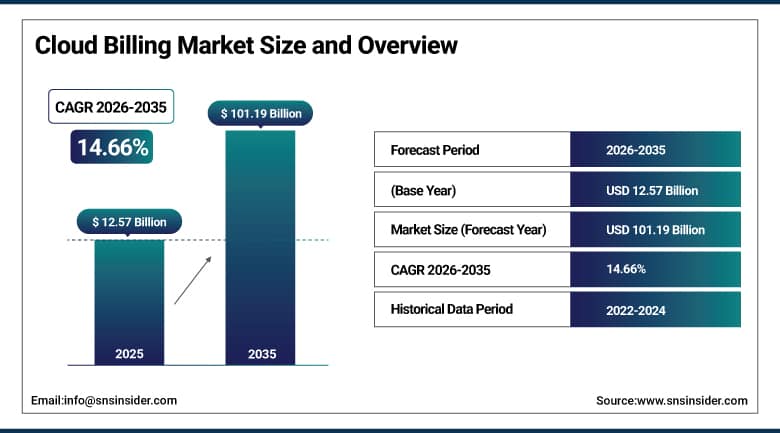
The Cloud Billing Market was valued at USD 12.57 billion in 2025 and is expected to reach USD 101.19 billion by 2035, growing at a CAGR of 14.66% from 2026-2035.
The Cloud Billing Market is witnessing growth because of the increasing adoption of the subscription-based business model, cloud migration of enterprises, and rising need for automatic revenue management systems. Companies in various industries like telecommunication, IT, media, and SaaS are adopting the cloud billing system in order to handle complicated pricing mechanisms, recurring billing, and billing in real time. Moreover, the growth in digital transformation efforts, the incorporation of AI and analytics in the billing process, and the increasing need for scalable and cost-efficient billing systems are boosting the market growth.
To Get More Information On Cloud Billing Market - Request Free Sample Report
Cloud Billing Market Trends:
-
AI-powered billing automation improving invoice accuracy and reducing manual operational workloads.
-
Multi-cloud billing platforms enabling unified cost management across diverse cloud environments.
-
Real-time usage-based pricing models gaining popularity among cloud service providers globally.
-
Integration of FinOps practices enhancing cloud cost optimization and financial accountability.
-
Increasing adoption of subscription-based billing systems supporting recurring revenue management.
U.S. Cloud Billing Market Outlook:
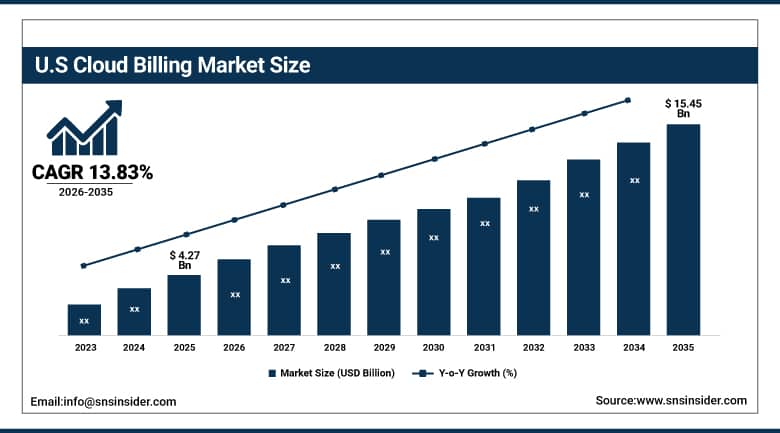
The U.S. Cloud Billing Market was valued at USD 4.27 billion in 2025 and is expected to reach USD 15.45 billion by 2035, growing at a CAGR of 13.83% from 2026-2035.
The U.S. Cloud Billing Market has been propelled by the robust presence of major cloud service providers and SaaS providers, as well as the rising adoption of multi-cloud and hybrid cloud approach by enterprises. Enterprises need advanced cloud billing software to manage their subscription plans, track cloud resource utilization and optimize expenditure in their multiple environment. Increased spending on digital transformation and automated finance management tools is also adding fuel to the U.S. cloud billing market.
Amazon's plan to invest USD 25 billion in AI and cloud infrastructures will also boost the demand for automated billing, usage tracking and cloud cost management services.
Cloud Billing Market Segment Analysis:
-
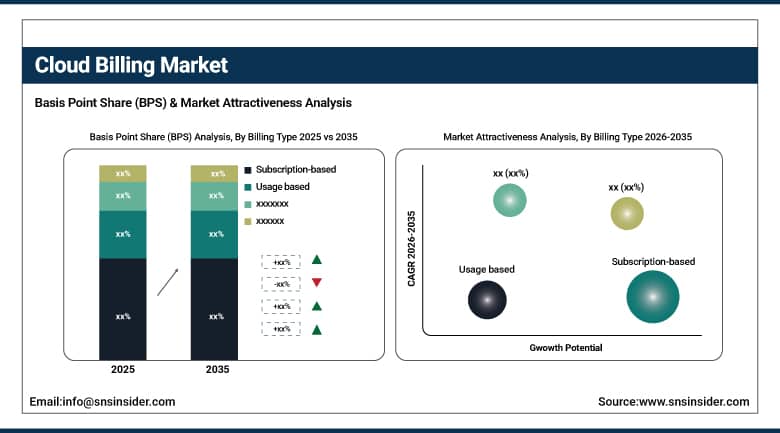
By billing type, subscription-based dominated the cloud billing market in 2025 with 48.12% share; hybrid (subscription + usage) is the fastest-growing segment with a 17.10% CAGR.
-
By deployment model, public dominated the market in 2025 with 57.32% share; hybrid cloud is the fastest-growing segment with a 16.71% CAGR.
-
By organization size, large enterprises dominated the market in 2025 with 68.44% share; SMEs are the fastest-growing segment with a 15.74% CAGR.
-
By cloud service model, SaaS billing dominated the cloud billing market in 2025 with 51.70% share; PaaS billing is the fastest-growing segment with a 16.21% CAGR.
-
By end-user industry, BFSI dominated the cloud billing market in 2025 with 23.80% share; healthcare and life sciences is the fastest-growing segment with a 17.31% CAGR.
By billing type, subscription-based segment dominates the cloud billing market, hybrid (subscription + usage) segment expected to grow fastest
The Subscription-based segment was the dominant player within the Cloud Billing Market in 2025 with a share of 48.12%. The high rate of subscription-based billing is because most of the players have adopted revenue models for their software as a service (SaaS), media, telecommunications, and digital service. In today’s world, businesses prefer predictable revenue models with long-term customers' engagement. The growing number of enterprises and consumers using subscription models has played an important role in increasing the market dominance of this segment.
Hybrid (subscription + usage) segment is anticipated to have the highest CAGR of 17.10%, as many enterprises are adopting flexible pricing model, which is combination of subscription and usage models. Cloud provider, software vendor and telecom players are customizing their pricing models in order to retain their customers and earn from premium services. Growing requirement of flexible billing solutions which support the dynamic pricing models is boosting the market growth.
By deployment model, public segment dominates the cloud billing market, hybrid segment expected to grow fastest
Public Cloud led the market during the forecast period 2025 with 57.32% market share due to its cost-effectiveness, scalability, and easier implementation. Companies have been moving their workloads to public clouds in order to save on infrastructure costs and take advantage of high-end computing power. Public cloud platforms also integrate seamlessly with the billing and revenue management system to make automation easy and efficient.
Hybrid Cloud is expected to show the highest growth rate or CAGR of 16.71%. Enterprises are trying to maintain flexibility and security at the same time, hence deploying some workloads in private cloud infrastructures and others in the public clouds. The need to integrate the two infrastructures needs efficient and sophisticated billing systems, thus creating a huge demand for hybrid cloud billing solution in various industries.
By organization size, large enterprises dominates the cloud billing market; SMEs show faster growth
The Large Enterprises Segment was estimated to represent 68.44% of the market in 2025 as they had significant cloud presence, complex billing needs, and heavy investments in digital transformation strategies. Such organizations had high numbers of customers and different cloud instances which needed advanced billing solutions that could handle recurring billing, usage and revenue analytics. Large organizations already have higher IT budgets and were early adopters of cloud technologies, which helps them hold a dominant share of the market.
The Small and Medium Enterprises Segment is expected to grow at a CAGR of 15.74% due to rising cloud deployment and the availability of cost-effective cloud billing platforms. Companies from this category are fast adopting cloud technologies to streamline their processes. The need for automatic invoicing and efficient revenue management is making organizations from this segment adapt quickly to cloud billing solutions.
By cloud service model, SaaS billing dominated the cloud billing market; PaaS billing shows fastest growth
SaaS Billing held the leading position in the Cloud Billing Market with a 51.70% share in 2025 because of the fast adoption of software-as-a-service applications by companies in different industries. Subscription-based software for customer relationship management, collaboration, cybersecurity, and enterprise resource planning have become widely used by businesses today. As a result, the necessity for effective solutions that help to handle regular billing, renewals, and customer lifecycles has led to high growth of the revenue share generated by this segment.
The PaaS Billing segment is expected to show the fastest CAGR of 16.21%, driven by the increasing demand for cloud-native applications development and platform services for software deployment among companies. The growth of the usage of analytics, artificial intelligence, and application modernization projects has led to the increasing popularity of the platform services that have the pay-per-use pricing model. Therefore, businesses require powerful billing solutions for such services.
By end-user industry, BFSI dominated the cloud billing market, while healthcare and life sciences is the fastest-growing segment
The BFSI segment led the Cloud Billing Market in 2025 with 23.80% market share due to the wide adoption of digital banking, payment, and finance services by the industry. Highly secure and automated billing systems have been adopted by the financial organizations due to huge volumes of transactions, subscription services, and compliance requirements. Continuous investments in digital transformations and customer-oriented financial products by BFSI companies have helped drive growth in the adoption of cloud billing solutions.
Healthcare & Life Sciences is expected to witness the highest CAGR of 17.31% during the forecast period due to growing digitalization in the healthcare industry. The organizations operating in the space need flexible billing systems to facilitate subscription services, usage-based healthcare platforms, and intensive data applications. High investments in healthcare IT infrastructure and digital health have greatly driven the demand for cloud billing solutions.
Regional Insights:
|
Region |
Major Country |
Share within Region, 2025 (%) |
|---|---|---|
|
North America |
United States |
85.36% |
|
Europe |
Germany |
24.30% |
|
Asia Pacific |
China |
38.60% |
|
Middle East & Africa |
UAE |
22.10% |
|
Latin America |
Brazil |
41.50% |
North America Cloud Billing Market Insights
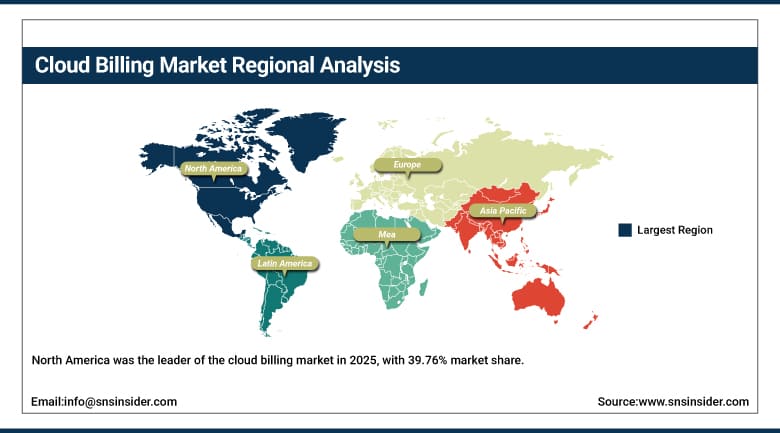
North America was the leader of the cloud billing market in 2025, with 39.76% market share, owing to the high adoption of digital transformation trends in industries such as telecommunications, BFSI, healthcare, and retail. Companies are adopting cloud technology for their activities to scale up operations, automate billing processes, and increase efficiency. With an increasing demand for flexible and usage-based billing systems, there has been significant adoption of cloud-based billing solutions across the North American region.
Increasing popularity of recurring revenue models is adding to the advantages of the market. Firms are increasingly resorting to recurring revenue strategies and customized packages and services, necessitating a more advanced billing solution for managing complex pricing plans. Cloud-based billing solutions are essential for organizations due to their ability to automate invoicing, facilitate payments in multiple ways, and generate real-time customer insights.
Get Customized Report as Per Your Business Requirement - Enquiry Now
Europe Cloud Billing Market Insights
The European cloud billing market is highly influenced by the rise in the implementation of digital transformation programs and cloud migration strategies by firms. Enterprises from different sectors are upgrading their IT operations to streamline processes, cut down costs, and deliver better service. This trend has generated significant demand for cloud billing solutions capable of automating invoices, managing recurring billing models, and facilitating complex billing procedures.
The market is also experiencing positive impacts of the growing trend of subscription-based business models and the increased requirement for regulatory compliant billing solutions. Firms are providing services via digital channels through a subscription-based model, which needs an effective and efficient billing system. In addition to this, there are tight financial regulations and data security norms prevalent across Europe that have encouraged firms to use cloud-based billing solutions.
Asia Pacific Cloud Billing Market Insights
The Asia Pacific cloud billing market is expected to grow at fastest rate of 16.71%, driven by the process of digitalization and increasing cloud adoption in developing economies like China, India, Indonesia, and southeast Asia. With an increase in migration to cloud-based platforms, companies are able to operate more efficiently while reducing their infrastructure costs and ensuring scalability. This shift has resulted in a large need for an automated billing system that would help to facilitate efficient management of recurring revenue streams.
Another key driver of the market includes the quick growth of subscription services and the development of the digital economy of the region. Companies working in the sectors of telecommunication, media, e-commerce, and software are adopting recurring payment models to engage customers better and have stable income sources. With increasing digital services and growing internet penetration, organizations are turning to cloud-based billing systems.
Middle East & Africa and Latin America Cloud Billing Market Insights
In the Middle East, Africa, and Latin American cloud billing markets, the key drivers behind growth include increasing investments in digital transformation and cloud infrastructure development. Many governments and businesses in these regions have decided to adopt cloud technologies to modernize their operations and improve efficiency and decrease IT expenditures. The increase in the adoption of cloud technology applications has led to the development of the market for automated billing, which is able to provide scalability and efficient management of revenue models.
Another driver for the growth of cloud billing markets in these regions includes the fast-growing popularity of subscription models and increasing digital service providers. Telecommunication, media, financial technology, and e-commerce companies have developed subscriptions and offer them to consumers through their apps. In addition, the rise in internet penetration and digital payments is driving the adoption of cloud billing solutions.
Growth Drivers: Rising Adoption of Subscription-Based Business Models and Cloud Transformation
There is considerable growth in the cloud billing space because of fast proliferation of subscription business models and cloud transformation efforts across different sectors. Businesses are now gradually moving away from their conventional one-off sales model to subscription models that need powerful billing solutions to handle subscriptions, usage-based pricing, and invoices. At the same time, organizations are moving to the cloud to enhance scalability, efficiency, and customer experience. Cloud billing software helps businesses manage revenue better, avoid any billing mistakes, and provides them with insights into their financial standing at all times. The increased demand for Software as a Service, digital services, and consumption-based models has further fueled the need for scalable billing solutions, making cloud billing systems indispensable for digital businesses.
Restraints: Data Security Concerns and Complex Integration with Legacy Systems
Although the cloud billing industry exhibits impressive growth potential, there are issues that arise when one considers the concerns for data security and the difficulty in integration with existing systems. Companies dealing with sensitive personal and financial data tend to be wary of moving their critical billing services into cloud computing because of issues relating to data breach, cyber-attacks, and compliance issues. Further, many companies use legacy systems that are complicated and expensive to be integrated with cloud billing services. This process of integration involves substantial costs in terms of system upgrades, personnel training, and business processes adjustment. This can result in extended implementation period and make it harder for small businesses to adopt cloud billing services.
Opportunity: Artificial Intelligence Integration Enhancing Automated Revenue and Billing Management
The incorporation of technologies related to artificial intelligence and advanced analytics is a great chance for the cloud billing market. More and more companies want to implement intelligent billing systems that can automate invoice creation, recognize possible abnormalities in billing processes, predict customers' behavior regarding payments, and optimize pricing strategies. Such cloud billing systems based on artificial intelligence can increase the efficiency of operations through the minimization of mistakes and human intervention while providing a company with real-time information about customer behavior and performance in terms of revenue. Moreover, the rising need for personalizing subscription models and implementing pricing strategies based on the usage of machine learning will push vendors to use AI technologies in their billing solutions.
Recent Developments:
-
2025: Google Cloud introduced AI-powered forecasting capabilities within its Cloud Billing platform, enabling enterprises to predict cloud spending more accurately and optimize cost management strategies.
-
2025: Open-source billing startup Flexprice raised USD 500,000 in seed funding to expand its usage-based billing and metering platform for AI and cloud-native applications.
-
2025: Silver Lake and GIC completed the USD 1.7 billion acquisition of Zuora, strengthening investment in subscription and cloud billing technologies worldwide.
-
2024: IBM announced its acquisition of HashiCorp to enhance hybrid cloud automation and infrastructure management capabilities, supporting the growing demand for advanced cloud billing and cost optimization solutions.
-
2023: Zuora expanded its cloud billing ecosystem through strategic platform enhancements and partnerships, improving subscription management, recurring billing, and monetization capabilities for enterprise customers.
Cloud Billing Market Key Players:
-
Amazon Web Services (AWS) Inc.
-
Microsoft Corporation (Azure)
-
Google Cloud Platform
-
Oracle Corporation
-
SAP SE
-
Salesforce Inc. (Revenue Cloud)
-
Zuora Inc.
-
BillingPlatform LLC
-
FinancialForce LLC
-
IBM Corporation
-
Comarch SA
-
Tencent Cloud
-
Huawei Cloud
-
CloudBlue (An Ingram Micro Co.)
-
CloudHealth (VMware)
-
Chargebee Inc.
-
Recurly Inc.
-
Stripe Billing
Cloud Billing Market Report Scope:
| Report Attributes | Details |
|---|---|
| Market Size in 2025 | USD 12.57 Billion |
| Market Size by 2035 | USD 101.19 Billion |
| CAGR | CAGR of 14.66% From 2026 to 2035 |
| Base Year | 2025 |
| Forecast Period | 2026-2035 |
| Historical Data | 2022-2024 |
| Report Scope & Coverage | Market Size, Segments Analysis, Competitive Landscape, Regional Analysis, DROC & SWOT Analysis, Forecast Outlook |
| Key Segments | • By Billing Type (Subscription-based, Usage-based, Hybrid (Subscription + Usage), Others) • By Deployment Model (Public Cloud, Private Cloud, Hybrid Cloud) • By Organization Size (Large Enterprises, Small and Medium Enterprises (SMEs)) • By Cloud Service Model (SaaS Billing, PaaS Billing, IaaS Billing) • By End-user Industry (Retail and E-commerce, BFSI, Telecommunications, Healthcare and Life Sciences, Energy and Utilities, Government and Public Sector, Media and Entertainment, Other End-user Industries) |
| Regional Analysis/Coverage | North America (US, Canada), Europe (Germany, UK, France, Italy, Spain, Russia, Poland, Rest of Europe), Asia Pacific (China, India, Japan, South Korea, Australia, ASEAN Countries, Rest of Asia Pacific), Middle East & Africa (UAE, Saudi Arabia, Qatar, South Africa, Rest of Middle East & Africa), Latin America (Brazil, Argentina, Mexico, Colombia, Rest of Latin America). |
| Company Profiles | Amazon Web Services (AWS) Inc., Microsoft Corporation (Azure), Google Cloud Platform, Oracle Corporation, SAP SE, Salesforce Inc. (Revenue Cloud), Zuora Inc., Aria Systems Inc., BillingPlatform LLC, FinancialForce LLC, IBM Corporation, Comarch SA, Tencent Cloud, Huawei Cloud, Alibaba Cloud, CloudBlue (An Ingram Micro Co.), CloudHealth (VMware), Chargebee Inc., Recurly Inc., Stripe Billing. |

Frequently Asked Questions
The Cloud Billing Market is expected to grow at a CAGR of 14.66% from 2026 to 2035.
The Cloud Billing Market was valued at USD 12.57 billion in 2025.
The major growth factor driving the cloud billing market is the increasing adoption of subscription-based and usage-based business models, requiring automated, scalable, and real-time billing solutions.
The subscription based segment dominated the Cloud Billing Market in 2025.
North America dominated the Cloud Billing Market in 2025.
