
Cloud Robotics Market Report Scope & Overview:
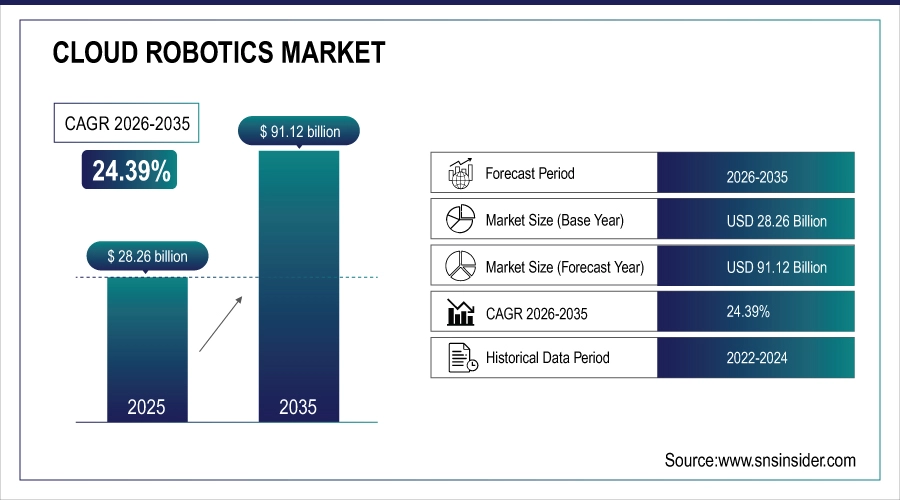
The Cloud Robotics Market was valued at USD 8.26 Billion in 2025 and is expected to reach USD 91.12 Billion by 2035, growing at a CAGR of 24.39% from 2026-2035.
Cloud Robotics Market is expanding at a rapid pace with the increasing combination of cloud architecture and robot systems, which facilitates in real-time processing of data along with increased scope for automation and remote operation. The usage of robots has been expanding across segments such as manufacturing, healthcare, logistics and defence thereby driving the demand for scalable connected solutions. Robotics are becoming more intelligent as AI, IoT and machine learning advancements make robots smarter and a better use of resources. What’s more, companies are using cloud robotics to keep costs down, enhance operational flexibility, and drive new innovations in every sector.
In 2024, over 65% of industrial robotics deployments incorporated cloud connectivity for data analytics and remote control; by 2025, more than 40% of healthcare and logistics robots are expected to leverage cloud-based AI for real-time decision-making and operational efficiency.
To Get more information on Cloud Robotics Market - Request Free Sample Report
Cloud Robotics Market Trends
-
Rapid adoption of cloud-connected robots for real-time data processing and enhanced operational efficiency globally
-
Integration of AI and machine learning in cloud robotics enables smarter decision-making and autonomous functionality
-
Growing demand in manufacturing and logistics sectors drives development of scalable, cloud-based robotic solutions
-
Expansion of edge-cloud computing reduces latency, improving performance and responsiveness of robotic systems in real-time
-
Rising investments in collaborative cloud robots for healthcare, agriculture, and service industries enhance productivity and safety
-
Increased focus on cybersecurity and data privacy in cloud robotics to protect sensitive operational information
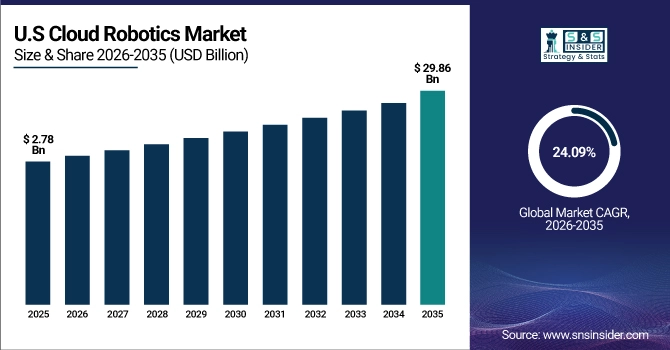
U.S. Cloud Robotics Market was valued at USD 2.78 Billion in 2025 and is expected to reach USD 29.86 Billion by 2035, growing at a CAGR of 24.09% from 2026-2035.
Growth in the U.S. Cloud Robotics Market is driven by increasing adoption of cloud-connected robots for manufacturing, healthcare, and logistics applications. Progresses in artificial intelligence, Internet of Things (IoT), and real-time data analytics is a key driver for market growth along with growing demand for low cost, scalable, flexible automation solutions.
Cloud Robotics Market Growth Drivers:
-
Increasing adoption of collaborative robots (cobots) in manufacturing and healthcare is boosting demand for cloud robotics platforms and services
Increasing adoption of cobots in manufacturing, healthcare, and logistics industry is fueling the demand for cloud robotics solution. Cobots need sophisticated data processing, real-time monitoring and easy integration with enterprises systems something cloud platforms can do well. The use of cloud robotics allows for centralized control, analysis and coordination of different robots in many locations. With the rising adoption of humans working alongside robots to improve efficiency, safety and accuracy within manufacturing, cloud-based robotic services such as software, storage capacity and AI integration are in high demand.
As of 2024, more than 55% of new cobot installations in logistics and healthcare utilized cloud-connected systems for analytics and coordination; global cloud robotics adoption in cobot operations is expected to exceed 70% by 2025, fueled by needs for remote monitoring, AI integration, and cross-facility scalability.
-
Scalability and flexibility offered by cloud robotics solutions enable businesses to expand robotic capabilities without significant capital investment or infrastructure constraints
Cloud robotics allows companies to scale robotic operations efficiently by leveraging remote computing, storage, and software-as-a-service platforms. Companies can implement new robots or update ones that already exist without spending a lot on local infrastructure or IT. This agility lowers initial investment, speeds deployment and allows quick adjustment to changing operational requirements. Manufacturing, logistics and healthcare are just a few of the ready-made beneficiaries from scalable cloud-based solutions to enable real-time analytics, remote monitoring and coordinated multi-robot activities making cloud robotics an efficient, flexible solution for automation as well as future-proofing.
In 2024, 70% of healthcare and logistics robotics adopters reported faster deployment times using cloud platforms, while 60% cut operational costs by integrating SaaS-based robotics solutions accelerating scalability and real-time coordination across fleets.
Cloud Robotics Market Restraints:
-
High initial investment and implementation costs for cloud robotics solutions limit adoption, particularly among small and medium-sized enterprises globally
Cloud robotics systems cannot be deployed without significant investment in hardware, software, and cloud infrastructure. The budget requirements of robotic systems generally cause small and medium-sized enterprises (SMEs) to shy from deploying sophisticated robots. High cost of maintenance, subscription fees charged for cloud services and scarcity of skilled personnel are additional economic burdens. These cost challenges slow adoption rates, particularly in developing regions, and create barriers for businesses seeking to leverage robotics for automation, efficiency, and scalability in manufacturing, logistics, healthcare, and other sectors.
Over 65% of SMEs cite upfront costs exceeding USD 50,000 as a key barrier to cloud robotics adoption; 58% report recurring cloud and maintenance expenses as unsustainable, and 70% in developing regions lack access to skilled personnel collectively limiting deployment despite strong interest in automation benefits.
-
Data security and privacy concerns in cloud-based robotics systems create risks, restricting deployment in sensitive industrial and healthcare applications
Cloud-connected robots transmit and store large volumes of sensitive data, including operational metrics and personal information. Vulnerabilities in data encryption, access controls, or cloud networks can expose organizations to cyberattacks, data breaches, and intellectual property theft. Healthcare, defense, and pharmaceutical sectors in particular are wary because of stringent regulations and possible legal liabilities. Such motivations hinder the deployment of cloud robotics in security-sensitive applications and compel firms to spend considerable time, cost and effort on cybersecurity, thereby hampering the overall rate of market adoption despite the inherent technological benefits associated with cloud-based robotic systems.
In 2024, 68% of cloud robotics deployments in healthcare and defense reported cybersecurity as a top barrier; 43% of organizations delayed adoption due to data privacy concerns, while global cloud robotics breach incidents rose by 27% year-over-year.
Cloud Robotics Market Opportunities:
-
Integration of AI and machine learning with cloud robotics enables smarter, adaptive, and autonomous robotic systems across industries
The intersection of AI and ML with cloud robotics helps robots learn from data, adapt to the dynamic environment and accomplish complicated tasks without human intervention. Applications of such systems in manufacturing, health care, logistics, or agriculture can benefit from intelligent robots that optimize efficiency and reduce errors in order to increase productivity. Being connected to the cloud allows for real-time data sharing, centralized control, and collaborative operations between multiple robots. Combining these technologies provides major benefits to bring robotic solutions to a new level, always-learning and self-optimization systems that fulfil increasing needs for innovation across sectors.
In 2024, 65% of new robotic deployments in logistics and manufacturing leveraged AI-driven cloud platforms, reducing downtime by 22% and improving task accuracy by up to 30% through continuous learning and real-time data sharing.
-
Growing adoption of Industry 4.0 and smart factories provides opportunities for cloud robotics in manufacturing automation and predictive maintenance
Industry 4.0 initiatives and smart factory implementations are accelerating demand for cloud-connected robotics in manufacturing environments. Cloud robotics enables automation of repetitive tasks, real-time monitoring of production lines, and predictive maintenance of machinery, reducing downtime and operational costs. By using data analytics and remote robot management, manufacturers can streamline operations and enhance supply chain efficiency. Taken together with IoT sensors and AI-powered insights, cloud robotics can scale up to provide manufacturers with enhanced flexibility, productivity, and competitiveness in the context of automation-heavy industrial environments.
In 2024, 68% of manufacturers deployed cloud-connected robotics; by 2025, over 75% leveraged cloud robotics for real-time monitoring and predictive maintenance, cutting downtime by 30% and operational costs by 22%.
Cloud Robotics Market Segment Highlights
-
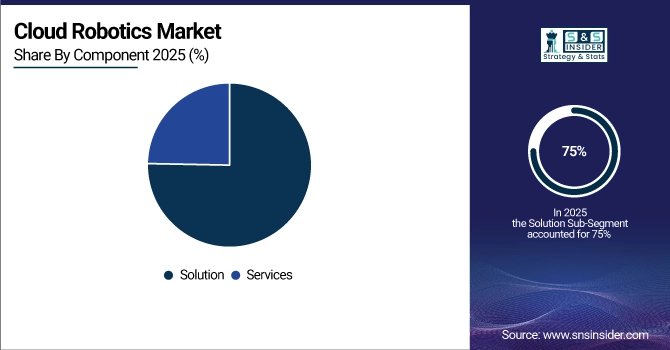
By Component: In 2025, Solution led the market with 75% share due to high demand for integrated robotics platforms, while Services is the fastest-growing segment (2026–2035)
-
By Service Model: In 2025, SaaS led the market with 50% share owing to ease of deployment and scalability, while IaaS is the fastest-growing segment (2026–2035)
-
By Robot Type: In 2025, Industrial Robots led the market with 60% share driven by manufacturing automation demand, while Service Robots is the fastest-growing segment (2026–2035)
-
By Industry Vertical: In 2025, Manufacturing led the market with 32% share due to widespread robotics adoption, while Retail & E-commerce is the fastest-growing segment (2026–2035)
Cloud Robotics Market Segment Analysis
By Component, Solution segment led in 2025; Services segment expected fastest growth
Solution segment dominated the Cloud Robotics Market with the highest revenue share of about 75% in 2025 due to increasing deployment of integrated robotics solutions, rising adoption across industries, and demand for automation that improves operational efficiency.
Services segment is expected to grow at the fastest CAGR from 2026-2035 due to increase in demand for cloud-based maintenance, consulting & support services as well as managed services that help enterprises achieve optimal levels of robot performance and scalability while mitigating upfront costs and operational complexities.
By Service Model, SaaS segment led in 2025; IaaS segment expected fastest growth
SaaS segment dominated the Cloud Robotics Market with the highest revenue share of about 50% in 2025 due to its easy accessibility, lower upfront costs, and widespread adoption for deploying robotic applications on cloud platforms.
IaaS segment is expected to grow at the fastest CAGR from 2026-2035 driven by increasing demand for scalable computing resources, storage, and infrastructure to support complex robotic operations and AI-driven workloads.
By Robot Type, Industrial Robots segment led in 2025; Service Robots segment expected fastest growth
Industrial Robots segment dominated the Cloud Robotics Market with the highest revenue share of about 60% due to product use in manufacturing, automotive and electronics industries for repetitive and accurate tasks automation.
Service Robots segment is likely to register the fastest CAGR from 2026-2035, aided by increasing interest in healthcare, hospitality, logistics and retail type applications such as delivery, cleaning and customer service.
By Industry Vertical, Manufacturing segment led in 2025; Retail & E-commerce segment expected fastest growth
The Manufacturing segment led the Cloud Robotics Market in 2025 with a revenue of around 32% because of increasing penetration of robotic automation for on-assembly, material handling, and production efficiency.
Retail & E-commerce segment is expected to grow at the fastest CAGR from 2026-2035 driven by rising adoption of cloud robotics for inventory management, order fulfillment, and last-mile delivery solutions.
Cloud Robotics Market Regional Analysis
North America Cloud Robotics Market Insights
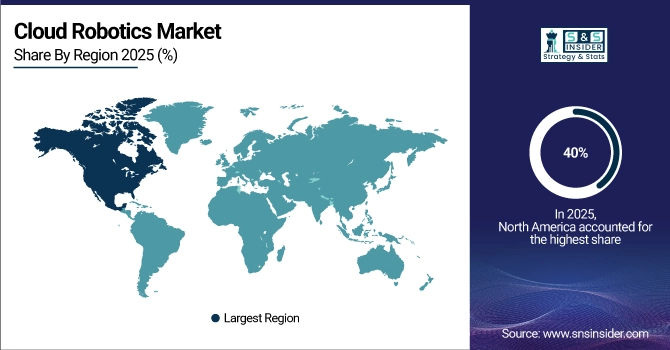
North America dominated the Cloud Robotics Market with a 40% share in 2025 due to the presence of advanced industrial automation infrastructure, strong R&D capabilities, and high adoption of robotics across manufacturing, healthcare, and logistics sectors. Supportive government initiatives, extensive enterprise investment, and early technology adoption further reinforced the region’s leadership.
Get Customized Report as per Your Business Requirement - Enquiry Now
Asia Pacific Cloud Robotics Market Insights
Asia Pacific is expected to grow at the fastest CAGR of about 27.18% from 2026–2035, driven by rapid industrialization, climbing levels of manufacturing automation and surging preference for cloud-based robotics solutions. Increasing smart factory set ups, growing demand for service robots and increasing government support in its 4.0 implementation are propelling the market development in the region.
Europe Cloud Robotics Market Insights
Europe held a significant share in the Cloud Robotics Market in 2025, supported by its advanced manufacturing ecosystem, strong adoption of automation technologies, and presence of leading robotics solution providers. Growing industrial digitization, increasing investment in smart factories, and focus on Industry 4.0 initiatives further strengthened Europe’s position in the cloud robotics market.
Middle East & Africa and Latin America Cloud Robotics Market Insights
The Middle East & Africa and Latin America together showed steady growth in the Cloud Robotics Market in 2025, driven by increasing industrial automation, growing adoption of smart manufacturing technologies, and rising investments in logistics and service robotics. Expanding infrastructure, supportive government initiatives, and gradual technological modernization further strengthened the regions’ market presence.
Cloud Robotics Market Competitive Landscape:
Amazon Web Services (AWS)
Amazon Web Services (AWS) is a subsidiary of Amazon and a global leader in cloud computing services. It provides a wide range of infrastructure services including computing power, storage, and databases, enabling companies to scale applications efficiently. AWS supports cloud robotics solutions by offering AI, machine learning, and IoT services that allow robots to process data, make decisions, and collaborate remotely. Its robust, secure, and scalable platform makes it a key player in cloud robotics and industrial automation.
-
September 2025, AWS decided to retire its RoboMaker service, its cloud‑robotics simulation platform, recommending customers migrate to AWS Batch instead.
Microsoft Corporation
Microsoft Corporation is a multinational technology company headquartered in Redmond, Washington, known for software, hardware, and cloud solutions. Its Azure Cloud platform enables cloud robotics by providing computing, AI, and IoT services that allow robots to operate collaboratively and process real-time data. Microsoft focuses on integrating cloud, AI, and edge computing to support intelligent automation across industries. Its strong developer ecosystem, enterprise solutions, and innovation in cloud-based services make it a leader in the cloud robotics market.
-
April 2024, Microsoft announced new industrial‑AI cloud solutions at Hannover Messe, including an edge + cloud system to monitor and control robots via Azure IoT Operations.
IBM Corporation
IBM Corporation, headquartered in Armonk, New York, is a global technology and consulting company specializing in AI, cloud computing, and enterprise solutions. IBM supports cloud robotics through its IBM Cloud platform, Watson AI, and IoT technologies, enabling robots to process large data sets, perform predictive maintenance, and collaborate in real-time. IBM combines advanced analytics, hybrid cloud infrastructure, and cognitive computing to provide intelligent automation solutions, making it a major player in cloud robotics for manufacturing, healthcare, and logistics sectors.
-
May 2025, IBM unveiled new hybrid-AI technologies enabling enterprises to build AI agents with their own data, boosting AI scalability via IBM Cloud and its watsonx platform.
Google LLC (Alphabet)
Google LLC, part of Alphabet Inc., is a multinational technology company known for search, advertising, cloud computing, and AI. Through Google Cloud, it provides cloud infrastructure, AI, and machine learning services that support cloud robotics applications. Google Cloud allows robots to process large-scale data, learn from experiences, and communicate efficiently across networks. Its investments in AI, robotics, and IoT technologies make it a significant innovator in cloud robotics, enabling smart, autonomous, and collaborative robotic systems globally.
-
March 2025, Google DeepMind introduced Gemini Robotics and Gemini Robotics‑ER, two AI models designed to control robots with vision, language, and action capabilities.
Cloud Robotics Market Key Players
Some of the Cloud Robotics Market Companies
-
Amazon Web Services (AWS)
-
Microsoft Corporation
-
IBM Corporation
-
Google LLC (Alphabet)
-
Rockwell Automation Inc.
-
Huawei Technologies Co., Ltd.
-
ABB Ltd.
-
FANUC Corporation
-
KUKA AG
-
Hit Robot Group Co. Ltd
-
CloudMinds Technologies Co. Ltd
-
C2RO Cloud Robotics Inc.
-
Rapyuta Robotics Co. Ltd
-
Ortelio Ltd
-
V3 Smart Technologies PTE Ltd
-
Formant
-
OTTO Motors (Clearpath Robotics)
-
Locus Robotics
-
Zebra Technologies
-
Universal Robots (Teradyne)
| Report Attributes | Details |
|---|---|
| Market Size in 2025 | USD 8.26 Billion |
| Market Size by 2035 | USD 91.12 Billion |
| CAGR | CAGR of 24.39% From 2026 to 2035 |
| Base Year | 2025 |
| Forecast Period | 2026-2035 |
| Historical Data | 2022-2024 |
| Report Scope & Coverage | Market Size, Segments Analysis, Competitive Landscape, Regional Analysis, DROC & SWOT Analysis, Forecast Outlook |
| Key Segments | • By Component (Solution, Services) • By Service Model (SaaS, IaaS, PaaS) • By Robot Type (Industrial Robot, Service Robot) • By Industry Vertical (Manufacturing, Military and Defense, Retail and E-commerce, Healthcare, Others) |
| Regional Analysis/Coverage | North America (US, Canada), Europe (Germany, UK, France, Italy, Spain, Russia, Poland, Rest of Europe), Asia Pacific (China, India, Japan, South Korea, Australia, ASEAN Countries, Rest of Asia Pacific), Middle East & Africa (UAE, Saudi Arabia, Qatar, South Africa, Rest of Middle East & Africa), Latin America (Brazil, Argentina, Mexico, Colombia, Rest of Latin America). |
| Company Profiles | Amazon Web Services (AWS), Microsoft Corporation, IBM Corporation, Google LLC (Alphabet), Rockwell Automation Inc., Huawei Technologies Co., Ltd., ABB Ltd., FANUC Corporation, KUKA AG, Hit Robot Group Co. Ltd, CloudMinds Technologies Co. Ltd, C2RO Cloud Robotics Inc., Rapyuta Robotics Co. Ltd, Ortelio Ltd, V3 Smart Technologies PTE Ltd, Formant, OTTO Motors (Clearpath Robotics), Locus Robotics, Zebra Technologies, Universal Robots (Teradyne) |
Frequently Asked Questions
North America dominated with a 40% share due to advanced automation infrastructure, strong R&D, high robotics adoption, and government support.
Solution segment dominated the Cloud Robotics Market in 2025.
Integration of cloud computing with robotics, enabling real-time data processing, automation, remote operations, and AI-enhanced efficiency drives market growth.
The global Cloud Robotics Market was valued at USD 8.26 billion in 2025, supported by growing cloud-connected robot deployments across industries.
The Cloud Robotics Market is expected to grow at a CAGR of 24.39% from 2026 to 2035, driven by automation adoption.
