
Collagen Supplements Market Report Scope & Overview:
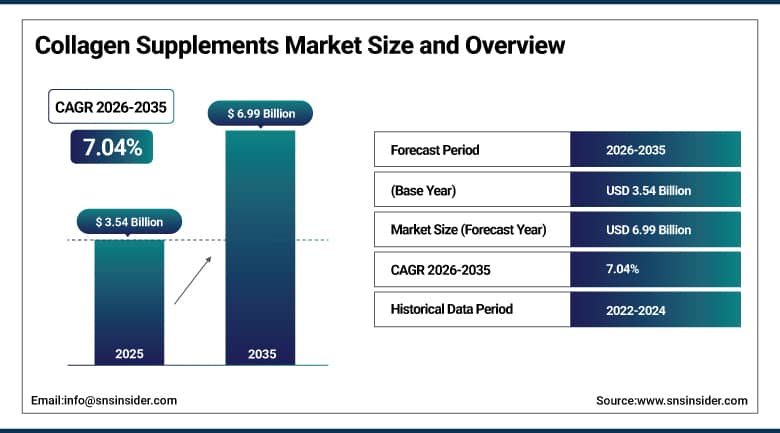
The Collagen Supplements Market was valued at USD 3.54 Billion in 2025 and is expected to reach USD 6.99 Billion by 2035, growing at a CAGR of 7.04% from 2026 to 2035.
The Collagen Supplements Market is witnessing strong growth due to the emergence of the global trend of "beauty from within" and healthy aging practices making collagen supplements a preventive health care ingredient rather than just a reactive health care solution. More knowledge among customers on benefits of joint flexibility, elasticity of the skin, and hydrating effects is leading to higher popularity of the ingredient with the wider population, not only with beauty product enthusiasts. More accessible e-commerce purchases and changing trends towards personalized nutrition and plant-based solutions are influencing innovations in the market. Furthermore, increased use of collagen in sports nutrition and protein supplements, as well as the increasing attention of customers to product purity, is driving this trend.
In January 2025, GNC unveiled its Premier Collagen line, featuring bovine and marine peptides combined with vitamin C to improve absorption and support skin health, reflecting continued mainstream supplement brand investment in scientifically formulated, multi-source collagen products.
To Get More Information On Collagen Supplements Market - Request Free Sample Report
Collagen Supplements Market Trends
- Growing consumer demand for bioengineered, precision-fermented collagen is emerging as brands seek animal-free alternatives free from ethical and allergy concerns.
- Rising scrutiny of collagen supplement purity is compelling manufacturers to invest in third-party testing and transparent, traceable sourcing following reports of lead contamination in certain products.
- Expanding shift toward personalized nutrition is enabling brands to develop collagen formulations tailored to individual wellness goals and health profiles.
- Increasing incorporation of collagen into functional beverages and ready-to-drink formats is broadening the category’s reach beyond traditional powder and capsule formats.
- Growing plant-based and marine-derived collagen alternatives are gaining traction among vegan, pescatarian, and allergen-conscious consumer segments.
U.S. Collagen Supplements Market Outlook
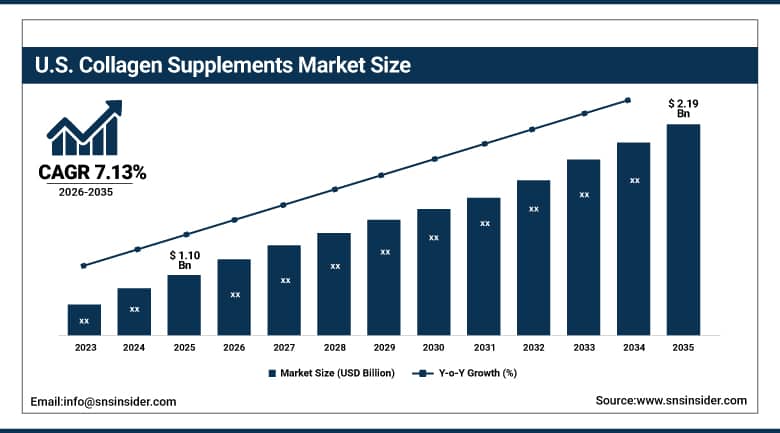
The U.S. Collagen Supplements Market was valued at USD 1.10 Billion in 2025 and is projected to reach USD 2.19 Billion by 2035, growing at a CAGR of 7.13% during 2026-2035.
The U.S. Collagen Supplements Market is registering healthy growth due to high awareness levels of health and wellness especially pertaining to anti-aging properties of collagen and skin health benefits from collagen supplementation. With the advent of e-commerce, collagen supplements have become widely available to health-conscious customers due to their direct reach to existing and newer brands. Higher utilization of collagen in sports nutrition and protein supplements is also helping attract fitness-focused customers to the segment in addition to its beauty applications. New developments like bio-engineered, precision-fermented collagen peptides are creating customer choices due to high demand for alternatives to animal products.
In December 2026, Nestlé Health Science’s Vital Proteins launched Collagen Sparkling Water in the U.S., combining VERISOL collagen peptides with vitamin C in a zero-sugar, ready-to-drink format. The product began nationwide retail rollout in March 2026, including Walmart, with expansion to Amazon and other channels later in the year.
Collagen Supplements Market Segment Analysis
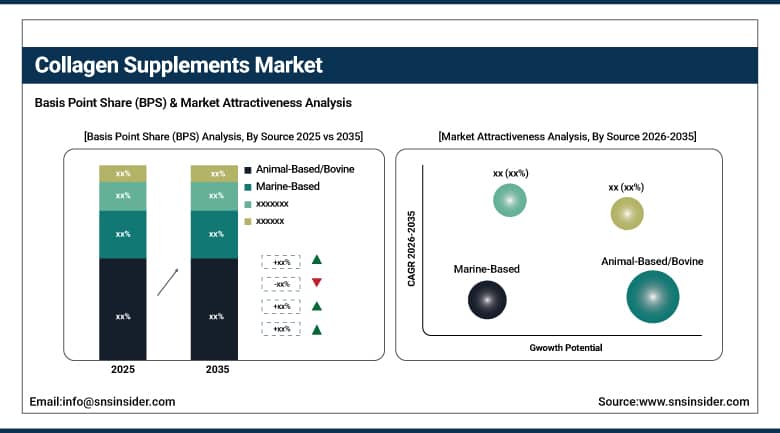
- By Source, animal-based/bovine segment dominated the collagen supplements market in 2025 with around 78.90% share; marine-based segment is the fastest-growing segment.
- By Form, powder segment dominated the market in 2025 with around 45.80% share; gummies segment is the fastest-growing segment.
- By Type, hydrolyzed segment dominated the market in 2025 with around 65% share; native segment is the fastest-growing segment.
- By Distribution Channel, online retailers segment dominated the market in 2025; specialty & health stores segment is the fastest-growing segment.
By Source, Animal-Based/Bovine Dominates the Collagen Supplements Market While Marine-Based Registers the Fastest Growth
Animal-based/bovine leads the Collagen Supplements Market share in 2025 at 78.90%, due to high bioavailability, consumer confidence in it, and efficient extraction process from readily available bovine hides. This collagen has been benefiting due to well-developed manufacturing facilities and expertise in manufacturing it for decades among experienced gelatin and collagen peptide manufacturers. The widespread presence, established supply chain, and consumer confidence in bovine collagen have made this segment a dominant player.
Marine-Based is growing fast, driven by increased consumer preference for fish scale and fish skin collagen, which is considered more bioavailable and preferred by consumers looking to avoid bovine and porcine-based collagen for religious, ethical, and allergen purposes. Increased consumer demand for sustainably sourced, waste product-derived marine collagen is forcing companies to look for partnership opportunities within seafood processing industry. Consumer preference for fish-based and halal compliant collagen is providing many commercial opportunities in this segment.
By Form, Powder Dominates the Collagen Supplements Market While Gummies Emerge as the Fastest-Growing Form
The powder form holds a leading position in the Collagen Supplements Market, with a share of 45.80% in 2025, owing to the ease of dosing, wide application of beverages, smoothies, and foods in which it can be used. Collagen powders enjoy a better shelf-life and well-established manufacturing and distribution chain from specialty supplement stores to regular grocery chains. Collagen powder enjoys a leadership position due to its wide availability and brand recognition as well as versatile applications.
The gummies segment is witnessing fast-paced growth due to the growing preference of customers for more palatable and easy-to-take supplement types, which do not require the mixing of powders or taking of capsules. This segment is growing at an above average pace owing to the rising trend of gummies consumption among young generation consumers. Innovative sugar-free and functional gummies, combined with vitamins, create various prospects of commercial use of this segment.
By Type, Hydrolyzed Dominates the Collagen Supplements Market While Native Registers the Fastest Growth
Hydrolyzed dominates the Collagen Supplements Market, accounting for approximately 65% of revenue in 2025, as hydrolyzed collagen peptides offer superior solubility and bioavailability compared to unprocessed forms, making them the preferred choice for powder, capsule, and beverage applications. Hydrolyzed collagen’s ease of incorporation into diverse formulations without altering taste or texture has driven its widespread adoption among supplement manufacturers. The established production infrastructure and strong clinical research base supporting hydrolyzed collagen’s absorption benefits are reinforcing this segment’s continued market leadership.
Native is experiencing the fastest growth as premium supplement brands position undenatured, native collagen as a differentiated, minimally processed alternative appealing to consumers seeking closer-to-source formulations. Growing consumer interest in specific native collagen types associated with joint and cartilage health benefits is compelling manufacturers to expand specialized product lines. Advances in extraction technology preserving native collagen’s molecular structure are opening up several opportunities for commercial utilization in this segment.
Regional Analysis
|
Region |
Country |
Share (2025) |
|
Asia Pacific |
China |
43.40% |
|
North America |
United States |
84.90% |
|
Europe |
Germany |
22.50% |
|
Middle East & Africa |
UAE |
17.70% |
|
Latin America |
Brazil |
24.30% |
Asia Pacific Collagen Supplements Market Insights
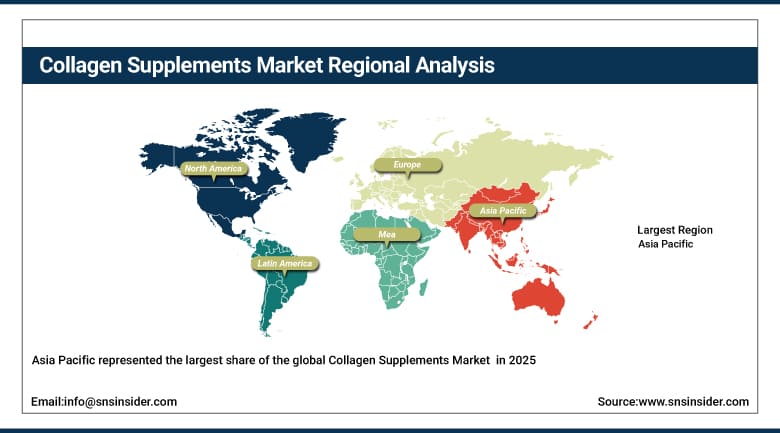
Asia Pacific represented the largest share of the global Collagen Supplements Market in 2025, accounting for approximately 35.33% of global revenue, supported by deep-rooted beauty and wellness culture across China, Japan, and South Korea that has long embraced collagen as a core skincare and anti-aging ingredient. Rising disposable incomes and growing middle-class populations across the region continue driving increased spending on premium beauty-from-within supplement products. Leading regional supplement brands are expanding collagen product lines to meet sustained domestic demand and growing export interest. Well-established nutraceutical manufacturing infrastructure across China, Japan, and South Korea is also improving product accessibility and sustaining regional market development.
China accounted for approximately 43.40% of the Asia Pacific market in 2025, supported by its expanding nutraceutical manufacturing base and rising domestic demand for beauty and wellness supplements, with revenues estimated at around USD 0.69 Billion, representing roughly 15.29% of global sales. Japan and South Korea are also contributing meaningfully to regional growth, with Japan’s market valued at around USD 0.32 Billion in 2025, reflecting its long-standing consumer familiarity with collagen-based beauty products.
Get Customized Report as Per Your Business Requirement - Enquiry Now
North America Collagen Supplements Market Insights
North America is expected to register the fastest CAGR in the Collagen Supplements Market during 2026–2035, growing at approximately 8.60%, driven by the accelerating “beauty-from-within” movement, growing incorporation of collagen into sports nutrition, and rising e-commerce accessibility facilitating broader consumer reach. The United States and Canada are witnessing increased mainstream adoption of collagen supplementation beyond traditional beauty-focused consumers into general wellness and fitness use cases. Rising product innovation, including bioengineered and precision-fermented collagen alternatives, is further supporting market expansion. Growing consumer interest in personalized nutrition and clean-label, traceable products is also reinforcing North America’s above-average growth trajectory compared with more mature applications.
The United States accounted for approximately 84.90% of the North American market in 2025, reflecting its large health-conscious consumer base and extensive dietary supplement distribution infrastructure. Canada is contributing to regional growth through steady demand for beauty and wellness-focused supplement products.
Europe Collagen Supplements Market Insights
The Collagen Supplements Market in Europe was significant in 2025, due to the high consumer demand for clean label, sustainability sourced materials along with established supplement manufacturing infrastructure in the region. Growing consumer demand for transparently sourced collagen supplements in countries like Germany, France, and UK is driving innovations in the products. Growing regulatory guidance on novel food health claims and also growing clean label foods in the region are helping to establish a strong market in Europe.
Germany was leading the European market with 22.50% of regional market share in 2025, owing to the strong health-conscious consumer base and established supplement manufacturing infrastructure in the country. France and UK are also significantly contributing to the regional growth, supported by top collagen ingredient manufacturers in the region.
Middle East & Africa and Latin America Collagen Supplements Market Insights
The Middle East & Africa region is exhibiting steady growth as beauty and wellness awareness expands across the Gulf states, supported by growing modern retail and pharmacy infrastructure. Latin America is similarly benefiting from expanding urban health-conscious consumption and growing consumer interest in beauty-from-within and anti-aging supplement products across major regional urban centers.
The UAE led the Middle East & Africa market with a 17.70% regional share in 2025, supported by growing health-conscious consumer demand and expanding modern retail penetration. Brazil represented 24.30% of the Latin American market in 2025, driven by expanding beauty and wellness supplement consumption, with Mexico also contributing to regional growth through rising interest in anti-aging products.
Market Dynamics
Growth Drivers: Beauty-From-Within Movement and Healthy Aging Trends Driving Market Growth
The major drivers of growth for the Collagen Supplements Market are the increasing prevalence of the global "beauty from within" trend and trends related to healthy aging that promote collagen as an ingredient that helps to preserve skin, joint, and overall vitality in a preventive way. With consumers becoming more aware of the fact that collagen helps to replace the lost collagen due to aging process, manufacturers see potential for expansion into beauty products, sports nutrition products, and wellness in general, which stimulates growth in the global market for such ingredients.
Continued availability of e-commerce provides more possibilities for the existing and emerging collagen brands to get in touch with their customers. Innovation in personalized nutrition and plant-based formulas plays its part in influencing the product development trends.
Restraints: Purity Concerns and Raw Material Sourcing Challenges Limiting Market Expansion
Even with the positive consumer demand for the products, there are challenges related to increasing concerns about purity of the products after reports that measurable amounts of lead were found in roughly 64% of collagen supplements tested and thus, demands have increased to ensure greater transparency in the testing processes. Challenges related to the sources of raw materials due to the availability of bovine, porcine, and marine byproducts will pose a challenge in pricing and production.
The differences in regulations from different regions on the use of novel ingredients and health claims in the labeling and certification of products are still relevant factors affecting the market entrance strategies. Costs incurred in the process of testing the purity of the ingredients and clinically validating the products make it costly for production, thus reducing competitive pricing of the products. In addition, there are competitive pressures from both the branded products and biologically engineered collagen products.
Opportunities: Bioengineered Collagen and Personalized Nutrition Creating New Growth Avenues
There are many opportunities within the domain of bioengineered, precision-fermented collagen technology, expanding personalized nutrition platforms, and increasing application within sports nutrition. Creating human-identical collagen peptides using precision fermentation techniques without using any animal-derived ingredients can cater to the consumer demand for ethical and hypoallergenic products while overcoming the supply chain limitations associated with conventional raw material sources. The manufacturers have a great scope to tap into the growing trend towards personalized formulations of collagen to suit consumer needs. Including collagen within sports nutrition and protein supplement formulations is another opportunity.
The innovations in relation to transparent sourcing and rigorous testing by third parties can enable companies to leverage product differentiation based on quality assurance to attract purity-conscious consumers. Another possible business opportunity for companies is industry consolidation through strategic alliances and mergers such as joint ventures between collagen peptide manufacturers. Moreover, creating more functional beverages and ready-to-drink beverages can be a means to drive differentiation.
Recent Developments:
- 2025: GNC unveiled its Premier Collagen line, featuring bovine and marine peptides combined with vitamin C to improve absorption and support skin health.
- 2025: Rousselot and PB Leiner, both subsidiaries of Darling Ingredients, signed a definitive agreement to form the Nextida joint venture, anticipated to close in 2026.
- 2025: Geltor, Inc. and Jellatech, Inc. continued advancing precision-fermentation technology to produce human-identical, animal-free collagen peptides.
Collagen Supplements Market key players are:
- Nestlé S.A. (Vital Proteins)
- GNC Holdings, LLC
- Shiseido Company, Limited
- Gelita AG
- Rousselot (Darling Ingredients Inc.)
- PB Leiner (Darling Ingredients Inc.)
- Amway Corporation
- Herbalife Nutrition Ltd.
- NeoCell (Nestlé Health Science)
- Sports Research Corporation
- Ancient Nutrition
- Great Lakes Wellness
- Youtheory (NutraWise Health & Beauty)
- Geltor, Inc.
- Jellatech, Inc.
- Doctor’s Best, Inc.
- NOW Health Group, Inc.
- Reserveage Nutrition
- Codeage LLC
- Further Food
Collagen Supplements Market Report Scope :
| Report Attributes | Details |
|---|---|
| Market Size in 2025 | USD 3.54 Billion |
| Market Size by 2035 | USD 6.99 Billion |
| CAGR | CAGR of 7.04% From 2026 to 2035 |
| Base Year | 2025 |
| Forecast Period | 2026-2035 |
| Historical Data | 2022-2024 |
| Report Scope & Coverage | Market Size, Segments Analysis, Competitive Landscape, Regional Analysis, DROC & SWOT Analysis, Forecast Outlook |
| Key Segments | • By Source (Animal-Based/Bovine, Marine-Based, and Plant-Based) • By Form (Powder, Capsules, Gummies, and Liquid) • By Type (Hydrolyzed, Native, and Gelatin) • By Distribution Channel (Online Retailers, Specialty & Health Stores, and Supermarkets/Hypermarkets) |
| Regional Analysis/Coverage | North America (US, Canada), Europe (Germany, UK, France, Italy, Spain, Russia, Poland, Rest of Europe), Asia Pacific (China, India, Japan, South Korea, Australia, ASEAN Countries, Rest of Asia Pacific), Middle East & Africa (UAE, Saudi Arabia, Qatar, South Africa, Rest of Middle East & Africa), Latin America (Brazil, Argentina, Mexico, Colombia, Rest of Latin America). |
| Company Profiles | Nestlé S.A. (Vital Proteins); GNC Holdings, LLC; Shiseido Company, Limited; Gelita AG; Rousselot (Darling Ingredients Inc.); PB Leiner (Darling Ingredients Inc.); Amway Corporation; Herbalife Nutrition Ltd.; NeoCell (Nestlé Health Science); Sports Research Corporation; Ancient Nutrition; Great Lakes Wellness; Youtheory (NutraWise Health & Beauty); Geltor, Inc.; Jellatech, Inc.; Doctor’s Best, Inc.; NOW Health Group, Inc.; Reserveage Nutrition; Codeage LLC; Further Food |

Frequently Asked Questions
The Animal-Based/Bovine segment dominated the Collagen Supplements Market in 2025, accounting for 78.90% of revenue share.
Key players include Nestlé S.A. (Vital Proteins), GNC Holdings, LLC, Shiseido Company, Limited, Gelita AG, and Amway Corporation, among others.
Key opportunities include bioengineered, precision-fermented collagen technology, expanding personalized nutrition platforms, growing sports nutrition applications, transparent and traceable sourcing initiatives, and expanding functional beverage and ready-to-drink formats.
The market is driven by the global “beauty-from-within” movement and healthy aging trends that position collagen as a preventive wellness ingredient.
The Asia Pacific region dominated the Collagen Supplements Market in 2025, accounting for approximately 35.33% of global market share, driven by deep-rooted beauty and wellness culture across China, Japan, and South Korea.
