
Combined Heat and Power (CHP) Market Report Scope & Overview:
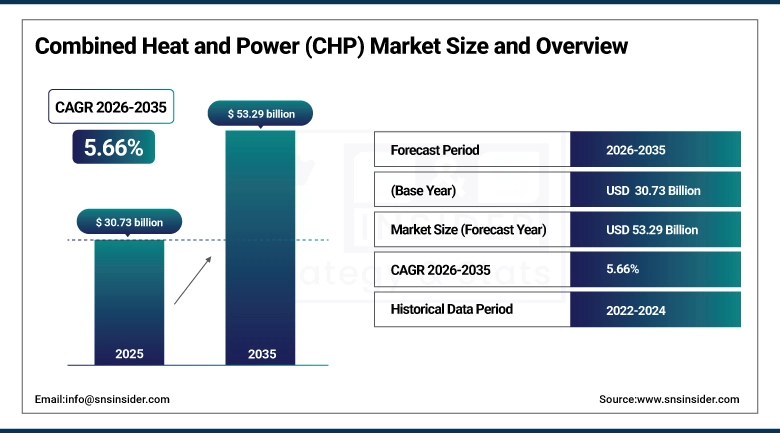
The Combined Heat and Power (CHP) Market Size is valued at USD 30.73 Billion in 2025 and is projected to reach USD 53.29 Billion by 2035, growing at a CAGR of 5.66% during the forecast period 2026–2035.
The Combined Heat and Power (CHP) Market analysis report provides in-depth insights into technology adoption, capacity trends, and end-use applications. Growing focus on energy efficiency, decarbonization, grid resilience, and cost optimization across industrial and commercial sectors is driving market growth during 2026–2035.
CHP demand surpassed 8.5 GW in 2025, driven by industrial efficiency, renewable integration, and rising commercial and district energy adoption through 2035.
Market Size and Forecast:
-
Market Size in 2025: USD 30.73 Billion
-
Market Size by 2035: USD 53.29 Billion
-
CAGR: 5.66% from 2026 to 2035
-
Base Year: 2025
-
Forecast Period: 2026–2035
-
Historical Data: 2022–2024
To Get more information On Combined Heat and Power (CHP) Market - Request Free Sample Report
Combined Heat and Power (CHP) Market Trends:
-
Growing emphasis on energy efficiency and carbon reduction is driving CHP adoption across industrial and commercial sectors.
-
Integration with renewable energy sources, such as biomass and waste heat recovery, is enhancing system sustainability.
-
Rising demand for decentralized and district energy solutions is boosting CHP installations in urban and residential areas.
-
Technological advancements in microturbines, fuel cells, and high-efficiency engines are improving performance and reliability.
-
Smart grid compatibility and digital monitoring are enabling optimized energy management and reduced operational costs.
-
Collaborations between energy providers, technology developers, and government initiatives are expanding CHP market reach and application diversity.
U.S. Combined Heat and Power (CHP) Market Size Outlook:
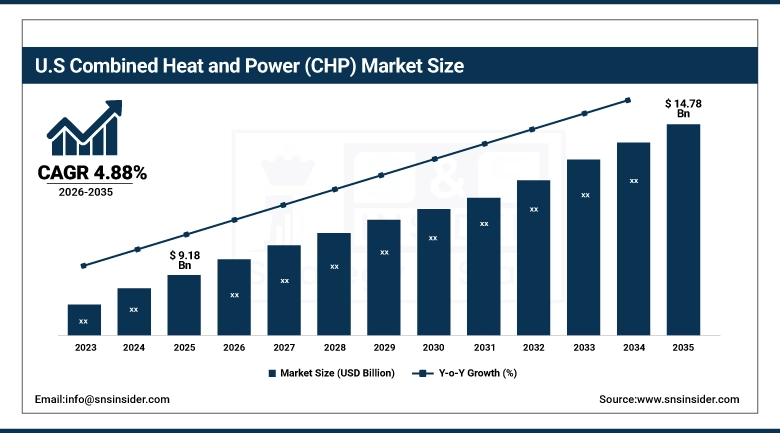
The U.S. Combined Heat and Power (CHP) Market is projected to grow from USD 9.18 Billion in 2025 to USD 14.78 Billion by 2035, at a CAGR of 4.88%. Growth is driven by rising industrial energy efficiency initiatives, carbon reduction mandates, adoption of natural gas and renewable-based CHP systems, and expanding commercial and district energy applications.
Market Growth Drivers: Increasing industrial energy efficiency mandates and renewable integration accelerating CHP system adoption.
Increasing industrial energy efficiency mandates and the integration of renewable energy sources are driving the growth of the Combined Heat and Power (CHP) Market Growth. Industries and commercial facilities are adopting CHP systems to optimize energy use, reduce operational costs, and meet stringent environmental regulations. The growing emphasis on sustainability and carbon footprint reduction is encouraging investments in high-efficiency engines, microturbines, and fuel cells. Technological advancements and smart energy management solutions further enhance performance, reliability, and overall market expansion.
Over 40% of industrial and commercial facilities implemented CHP systems in 2025 to enhance energy efficiency and reduce carbon emissions.
Market Restraints: High upfront installation costs and regulatory complexities are restraining widespread adoption of CHP systems.
High upfront installation costs and regulatory complexities pose significant restraints for the Combined Heat and Power (CHP) Market. Small and medium-sized industrial and commercial facilities often face budgetary limitations, restricting investment in advanced CHP systems. Compliance with diverse local and international energy regulations can be time-consuming and challenging, while permitting processes add further delays. Additionally, integrating CHP systems with existing energy infrastructure requires technical expertise and planning. These financial and regulatory hurdles collectively slow widespread adoption, limiting overall market growth.
Market Opportunities: Growing demand for sustainable and decentralized energy solutions presents opportunities for advanced and flexible CHP deployments.
Rising demand for sustainable and decentralized energy solutions offers significant growth opportunities for the Combined Heat and Power (CHP) Market. Industries, commercial facilities, and urban planners are increasingly investing in CHP systems to enhance energy efficiency, reduce emissions, and optimize operational costs. Companies providing advanced, flexible, and renewable-integrated CHP technologies can capitalize on this trend. Innovations in smart energy management, microturbines, and fuel cells enable scalable, reliable deployments, expanding adoption across industrial, commercial, residential, and district energy applications.
Advanced CHP systems accounted for 28% of industrial and commercial energy projects in 2025, driven by efficiency and sustainability goals.
Combined Heat and Power (CHP) Market Segmentation Analysis:
-
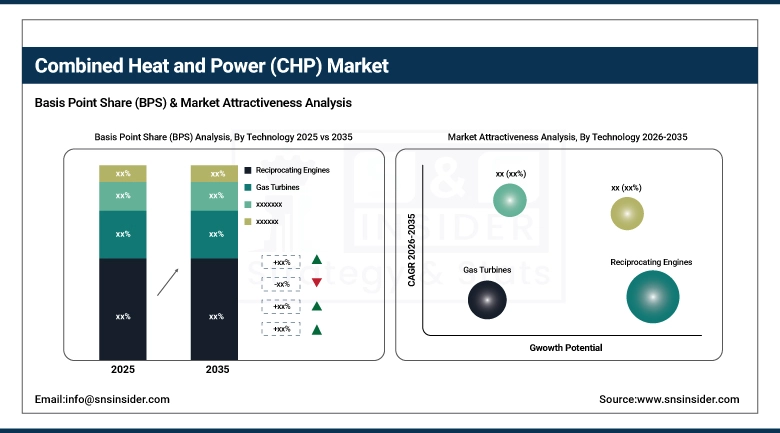
By Technology, Reciprocating Engines held the largest market share of 36.47% in 2025, while Fuel Cells are expected to grow at the fastest CAGR of 7.14% during 2026–2035.
-
By Fuel Type, Natural Gas accounted for the highest market share of 45.32% in 2025, while Biomass is anticipated to record the fastest CAGR of 6.89% through 2026–2035.
-
By Capacity, Up to 10 MW dominated with a 41.26% share in 2025, while 10–50 MW is projected to expand at the fastest CAGR of 6.23% during the forecast period.
-
By End-Use Industry, Industrial held the largest share of 49.57% in 2025, while District Energy is expected to grow at the fastest CAGR of 6.98% through 2026–2035.
By Technology, Reciprocating Engines Dominate While Fuel Cells Expand Rapidly:
Reciprocating Engines segment dominated the market due to their proven reliability, cost-effectiveness, and versatility across industrial, commercial, and residential applications. They are widely used for distributed energy generation, combined heat and electricity production, and district energy systems. In 2025, over 3,200 MW of capacity was installed using reciprocating engines, reflecting their widespread adoption.
Fuel Cells are the fastest-growing segment, driven by rising demand for zero-emission, high-efficiency energy solutions, especially in commercial and high-tech facilities. In 2025, fuel cell-based CHP installations exceeded 450 MW, with rapid adoption in high-tech industries, commercial complexes, and innovative pilot projects.
By Fuel Type, Natural Gas Dominates While Biomass Expands Rapidly:
Natural Gas segment dominated the market due to abundant availability, lower emissions compared to coal and oil, and compatibility with modern engines and turbines. In 2025, natural gas-fueled CHP projects exceeded 4,100 MW, spanning industrial plants, hospitals, and commercial buildings.
Biomass is the fastest-growing segment, fueled by increasing environmental regulations, sustainability initiatives, and renewable energy integration. In 2025, biomass-based CHP capacity surpassed 650 MW, driven by adoption in agro-industrial sectors, district energy networks, and small-scale renewable energy projects.
By Capacity, Up to 10 MW Dominates While 10–50 MW Expands Rapidly:
10 MW segment dominated the market due to their adaptability, lower installation costs, and suitability for commercial, institutional, and small industrial facilities. In 2025, over 2,800 MW of capacity was installed in this range, supporting decentralized energy needs and efficient heat recovery.
10–50 MW is the fastest-growing segment, driven by rising energy demands in medium-sized industrial and district energy projects. In 2025, installations reached 1,150 MW, reflecting rapid expansion in urban energy networks and industrial parks.
By End-Use Industry, Industrial Dominates While District Energy Expands Rapidly:
Industrial segment dominated the market, benefiting from high and consistent energy demand, process heat requirements, and cost-saving incentives. In 2025, industrial CHP installations exceeded 4,600 MW, powering manufacturing plants, refineries, and food processing facilities.
District Energy is the fastest-growing segment, supported by urbanization, smart city initiatives, and centralized energy efficiency projects. In 2025, district energy CHP capacity surpassed 850 MW, with new installations in residential complexes, hospitals, and municipal energy networks driving accelerated growth.
Combined Heat and Power (CHP) Market Regional Analysis:
North America Combined Heat and Power (CHP) Market Insights:
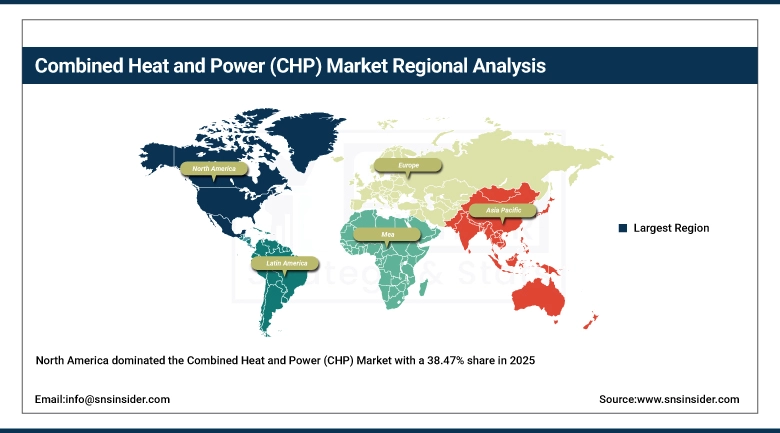
North America dominated the Combined Heat and Power (CHP) Market with a 38.47% share in 2025, led by extensive adoption across the U.S. and Canada. Strong demand from industrial, commercial, and district energy projects is driving growth. Rising emphasis on energy efficiency, carbon reduction initiatives, and integration with natural gas and renewable fuels, combined with technological advancements in reciprocating engines, microturbines, and fuel cells, is enhancing operational efficiency. These factors reinforce North America’s position as a leading and highly attractive CHP market.
Get Customized Report as per Your Business Requirement - Enquiry Now
U.S. Combined Heat and Power (CHP) Market Insights:
The U.S. Combined Heat and Power (CHP) Market is strongly driven by industrial modernization, energy efficiency mandates, and renewable integration initiatives. Widespread adoption of natural gas, microturbines, and fuel cell-based systems, alongside expanding district energy and commercial applications, is enhancing operational efficiency and sustainability, reinforcing the U.S. as the North American CHP market leader.
Asia-Pacific Combined Heat and Power (CHP) Market Insights:
The Asia-Pacific Combined Heat and Power (CHP) Market is the fastest-growing region, projected to expand at a CAGR of 6.72% during 2026–2035. Growth is driven by rapid industrialization, urbanization, and increasing energy demand in China, India, Japan, and Australia. Rising adoption of biomass, natural gas, and waste heat recovery-based CHP systems, alongside technological advancements in microturbines, fuel cells, and reciprocating engines, is fueling market uptake. Expanding district energy projects, commercial applications, and government sustainability initiatives are supporting APAC’s dynamic market growth.
China Combined Heat and Power (CHP) Market Insights:
The China Combined Heat and Power (CHP) Market is driven by rapid industrialization, urban energy demand, and government efficiency initiatives. Expanding adoption of natural gas, biomass, and waste heat recovery-based CHP systems is boosting installations across industrial, commercial, and district energy sectors. China remains a key growth hub in the Asia-Pacific CHP market.
Europe Combined Heat and Power (CHP) Market Insights:
The Europe Combined Heat and Power (CHP) Market is driven by increasing investments in energy efficiency, decarbonization initiatives, and industrial modernization. Countries such as Germany, France, and the UK are shaping regional demand through widespread adoption of natural gas, biomass, and waste heat recovery-based CHP systems. Expansion of district energy networks, advanced microturbines and fuel cell technologies, and government-led sustainability programs are boosting installations. Rising technological innovations and regulatory support are reinforcing Europe’s significance in the CHP market.
Germany Combined Heat and Power (CHP) Market Insights:
Germany is a key market in the European Combined Heat and Power (CHP) landscape, driven by strong industrial energy efficiency mandates and renewable integration initiatives. Growth is fueled by widespread adoption of natural gas and biomass-based CHP systems, expanding district energy projects, and rising demand for sustainable, high-efficiency energy solutions, reinforcing Germany’s market significance.
Latin America Combined Heat and Power (CHP) Market Insights:
The Latin America Combined Heat and Power (CHP) Market is growing due to rising industrialization and energy efficiency initiatives. Demand is supported by expanding commercial, industrial, and district energy projects across Brazil, Mexico, and Argentina. Technological adoption, renewable integration, and government sustainability programs are driving regional market growth and CHP system installations.
Middle East and Africa Combined Heat and Power (CHP) Market Insights:
The Middle East & Africa Combined Heat and Power (CHP) Market is expanding with rising industrialization, energy efficiency initiatives, and renewable integration projects. Technological adoption, natural gas and biomass-based CHP systems, and government-led sustainability programs are driving demand. Key markets include Saudi Arabia, UAE, and South Africa, supporting regional energy modernization and CHP deployment.
Combined Heat and Power (CHP) Market Competitive Landscape:
Siemens Energy, headquartered in Germany, is a leader in CHP solutions, offering high-efficiency gas turbines, steam turbines, and hybrid systems for industrial, commercial, and district energy applications. The company dominates the market through technological innovation, reliability, and integration with renewable energy sources. Strategic partnerships with governments and industrial clients, along with substantial R&D investments, enable scalable and sustainable energy solutions. Siemens Energy’s focus on digital monitoring, operational efficiency, and low-emission systems reinforces its position as a market leader.
-
In April 2025, Siemens Energy launched a hybrid CHP system in Germany integrating green hydrogen and thermal storage for industrial microgrids, reducing emissions while enhancing flexible, efficient heat and power generation for industrial and district energy applications.
General Electric (GE), headquartered in the U.S., provides advanced CHP systems including gas turbines, steam turbines, and microturbines for industrial, commercial, and district energy sectors. GE dominates the market through engineering expertise, a service network, and technology-driven solutions. Its focus on sustainability, renewable integration, and digital optimization platforms ensures high efficiency and reliability. Strategic collaborations with utilities and industrial clients, combined with continuous innovation and R&D investment, have strengthened GE’s position as a leading force in the CHP market.
-
In March 2025, GE Vernova introduced upgraded high-efficiency 9HA.01 gas turbines for CHP applications, improving performance, reliability, and flexibility for industrial and utility cogeneration projects, supporting sustainable energy transition and low-carbon power generation.
Wärtsilä Corporation, headquartered in Finland, is a prominent provider of CHP systems, specializing in flexible power plants, bioenergy, and hybrid solutions for industrial, commercial, and district heating applications. The company dominates the market through modular system design, technological innovation, and renewable fuel integration. Strategic partnerships with governments, utilities, and industrial clients, combined with significant R&D investments, enable Wärtsilä to deliver scalable, low-emission, and reliable solutions. Its focus on operational efficiency, digital optimization, and sustainability strengthens its market leadership.
-
In February 2025, Wärtsilä launched its next-generation 46TS engine for CHP and hybrid power plants, enabling efficient baseload energy, renewable integration, and sustainable fuel operation, strengthening flexible, low-emission heat and power solutions in industrial and utility sectors.
Combined Heat and Power (CHP) Companies are:
-
General Electric (GE)
-
Wärtsilä Corporation
-
Mitsubishi Heavy Industries
-
Caterpillar Inc.
-
ABB Ltd.
-
Veolia Environnement
-
Robert Bosch GmbH
-
Capstone Green Energy Corporation
-
Clarke Energy
-
2G Energy AG
-
Tecogen Inc.
-
E.ON SE
-
Centrica Business Solutions
-
FuelCell Energy, Inc.
-
BDR Thermea Group
-
Yanmar Co., Ltd.
-
MAN Energy Solutions
-
Kawasaki Heavy Industries Ltd.
| Report Attributes | Details |
|---|---|
| Market Size in 2025 | USD 30.73 Billion |
| Market Size by 2035 | USD 53.29 Billion |
| CAGR | CAGR of 5.66% From 2026 to 2035 |
| Base Year | 2025 |
| Forecast Period | 2026-2035 |
| Historical Data | 2022-2024 |
| Report Scope & Coverage | Market Size, Segments Analysis, Competitive Landscape, Regional Analysis, DROC & SWOT Analysis, Forecast Outlook |
| Key Segments | • By Technology (Reciprocating Engines, Gas Turbines, Steam Turbines, Microturbines, Fuel Cells, Others) • By Fuel Type (Natural Gas, Biomass, Coal, Oil, Waste Heat Recovery, Others) • By Capacity (Up to 10 MW, 10–50 MW, Above 50 MW) • By End-Use Industry (Industrial, Commercial, Residential, District Energy, Others) |
| Regional Analysis/Coverage | North America (US, Canada), Europe (Germany, UK, France, Italy, Spain, Russia, Poland, Rest of Europe), Asia Pacific (China, India, Japan, South Korea, Australia, ASEAN Countries, Rest of Asia Pacific), Middle East & Africa (UAE, Saudi Arabia, Qatar, South Africa, Rest of Middle East & Africa), Latin America (Brazil, Argentina, Mexico, Colombia, Rest of Latin America). |
| Company Profiles | Siemens Energy, General Electric (GE), Wärtsilä Corporation, Mitsubishi Heavy Industries, Cummins Inc., Caterpillar Inc., ABB Ltd., Veolia Environnement, Robert Bosch GmbH, Capstone Green Energy Corporation, Clarke Energy, 2G Energy AG, Tecogen Inc., E.ON SE, Centrica Business Solutions, FuelCell Energy, Inc., BDR Thermea Group, Yanmar Co., Ltd., MAN Energy Solutions, Kawasaki Heavy Industries Ltd. |
Frequently Asked Questions
North America dominated with a 38.47% share in 2025, while Asia-Pacific is the fastest-growing region, expected to expand at a CAGR of 6.72% during 2026–2035.
Reciprocating Engines dominated with a 36.47% share in 2025, while Fuel Cells are projected to grow at the fastest CAGR of 7.14% during 2026–2035.
Growth is driven by energy efficiency mandates, renewable integration, carbon reduction, and rising commercial and district CHP adoption.
The market is valued at USD 30.73 Billion in 2025 and is projected to reach USD 53.29 Billion by 2035.
The Combined Heat and Power (CHP) Market is expected to grow at a CAGR of 5.66% during 2026–2035.
