
Convenience Stores Market Report Scope & Overview:
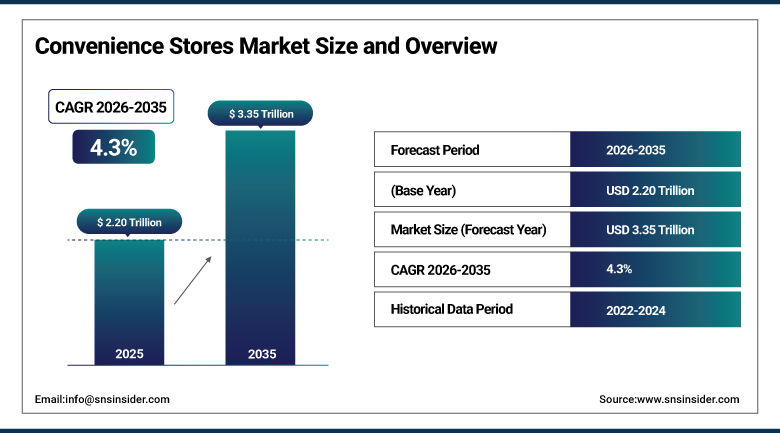
The Convenience Stores Market was valued at USD 2.20 Trillion in 2025 and is expected to reach USD 3.35 Trillion by 2035, growing at a CAGR of 4.3% from 2026–2035.
The Convenience Stores Market is growing at a consistent pace due to several factors including changes in consumer lifestyle, urbanization, and increased preference for convenience in terms of fast shopping experience. The increase in 24x7 shopping experience, increase in product assortments along with easy availability of ready-to-eat meals and beverages is resulting in an influx of customers in such stores. Technology is providing an additional boost to the market through the use of mobile payments, self-checkouts, loyalty applications and personalized promotions. Further, the inclusion of fresh products, private label products and healthy products is meeting the changing preferences of consumers. There are various other revenue channels available through fueling services, delivery platforms and online orders.
To Get more information Convenience Stores Market - Request Free Sample Report
Convenience Stores Market Trends
-
Prepared and ready-to-eat food is becoming a bigger part of convenience store revenue and identity, as chains invest in kitchens, hot food cases, and proprietary restaurant concepts to compete with quick-service restaurants rather than just other gas stations.
-
Industry consolidation continues at a rapid pace, with large chains acquiring regional operators to gain scale, supply chain leverage, and negotiating power with fuel and product suppliers.
-
Digital payment and mobile app adoption keep climbing, letting stores speed up checkout, run loyalty programs, and gather purchase data that shapes inventory and promotional decisions.
-
Electric vehicle charging infrastructure is starting to appear at forecourt locations, a long-term bet by fuel-linked chains that their real estate along commuter routes remains valuable even as the vehicles stopping there eventually shift away from gasoline.
-
Private label product lines are expanding as chains look to improve margins on everyday staples, competing more directly with national brands on both price and, increasingly, quality.
U.S. Convenience Stores Market Outlook
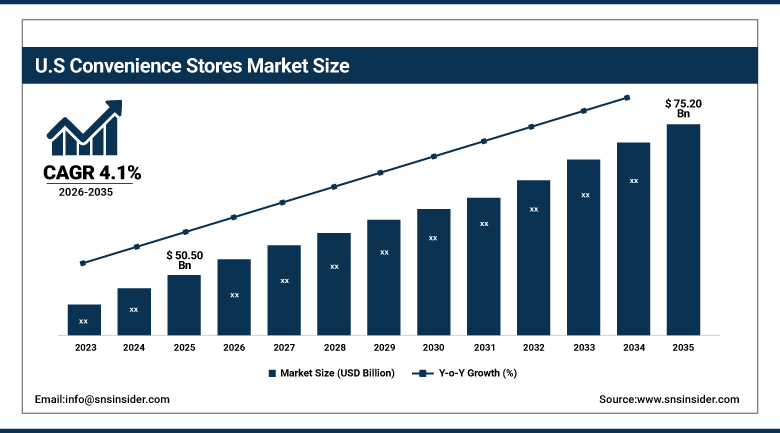
The U.S. Convenience Stores Market was valued at approximately USD 50.50 Billion in 2025 and is expected to reach approximately USD 75.20 Billion by 2035, growing at a CAGR of approximately 4.1%.
The United States remains the world's most consolidated and competitively intense convenience store market, anchored by a small number of massive national chains alongside thousands of independent operators. Fuel sales still make up a meaningful share of revenue at most U.S. locations, though foodservice has become the primary battleground for differentiation as major chains invest heavily in kitchens, proprietary restaurant brands, and app-based ordering and delivery. Industry consolidation has accelerated in recent years as the largest players acquire regional chains to expand their footprint and strengthen supply chain leverage.
Following the failed Couche-Tard takeover attempt, Seven & i Holdings launched what it calls the “Transformation of 7-Eleven,” a plan to open approximately 1,300 new large-format, food-focused U.S. convenience stores by 2030, expand its 7NOW delivery platform to more than 200 additional stores per year, and add roughly 1,100 proprietary restaurant concepts to existing locations.
Convenience Stores Market Segment Analysis
-
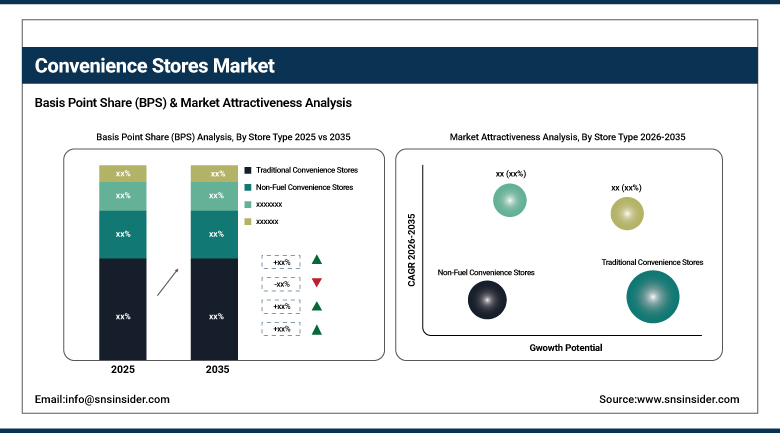
By Store Type, the Traditional Convenience Stores segment dominated the Convenience Stores Market with approximately 34.3% share in 2025, while the Non-Fuel Convenience Stores segment is the fastest growing with a CAGR of approximately 6.4%.
-
By Ownership Model, the Independent Stores segment dominated the Convenience Stores Market with approximately 49.7% share in 2025, while the Chain & Franchise Stores segment is the fastest growing with a CAGR of approximately 5.8%.
-
By Product Type, the Food & Beverages segment dominated the Convenience Stores Market with approximately 34.6% share in 2025, while the Personal Care & Health Products segment is the fastest growing with a CAGR of approximately 6.8%.
-
By Location, the Urban segment dominated the Convenience Stores Market with approximately 48.2% share in 2025, while the Suburban segment is the fastest growing with a CAGR of approximately 6.1%.
-
By Payment Mode, the Cash segment dominated the Convenience Stores Market with approximately 46.8% share in 2025, while the Mobile & Digital Wallet segment is the fastest growing with a CAGR of approximately 11.4%.
By Store Type, traditional convenience stores dominate, non-fuel grows fastest
Traditional convenience stores held the largest share of the store-type segment in 2025, covering the broad category of standalone corner-style and neighborhood stores that don't fit neatly into a fuel-linked or purely non-fuel format. Their sheer number and geographic spread, present in nearly every urban and suburban neighborhood, keeps this the largest single store-type category even as newer formats gain ground.
Non-fuel convenience stores are growing fastest as chains expand standalone urban and transit-adjacent locations that don't depend on gasoline sales for foot traffic or profitability. That shift reflects both changing urban development patterns, where dense city blocks favor a small-format grocery store over a gas station, and a long-term hedge against a slow but real decline in gasoline demand as vehicle electrification progresses.
By Ownership Model, independent stores dominate, chain & franchise grows fastest
Independent stores accounted for the largest share of the ownership-model segment in 2025, reflecting how fragmented the convenience retail industry remains globally despite the visibility of a handful of massive national chains. Local and regional operators continue to serve a meaningful share of neighborhoods, particularly in markets where large chains haven't yet achieved full geographic coverage.
Chain and franchise stores are growing fastest as industry consolidation continues, with large operators acquiring independent and regional chains to gain scale, negotiating leverage with suppliers, and access to more sophisticated technology and foodservice programs than smaller operators can typically afford. That consolidation trend shows few signs of slowing, given the clear operational and purchasing advantages scale provides in a thin-margin retail category.
By Product Type, food & beverages dominates, personal care & health grows fastest
Food and beverages accounted for the largest product-type share in 2025, spanning everything from packaged snacks and soft drinks to the growing category of prepared, ready-to-eat meals that chains increasingly treat as a core part of their identity rather than an afterthought. This category's blend of high purchase frequency and improving margins on fresh and prepared items makes it the most strategically important product category for most operators.
Personal care and health products are the fastest-growing product category as convenience stores expand beyond their traditional snack-and-cigarette assortment to capture more of a shopper's daily essentials basket. Rising consumer expectations around one-stop convenience, combined with chains actively working to diversify revenue away from declining tobacco sales, are both pushing operators to expand this category faster than the broader store.
By Location, urban dominates, suburban grows fastest
Urban locations held the largest location-based share in 2025, benefiting from the population density and foot traffic that make a small-format, quick-transaction store viable without requiring a car to reach it. Dense city blocks with limited space for large-format grocery stores are natural territory for convenience retail.
Suburban locations are growing fastest as chains expand into newer residential developments and commuter corridors where population growth is outpacing that of established urban cores. Suburban expansion also tends to favor larger-format stores with more parking and often fuel service, giving chains a way to capture both daily convenience trips and higher-margin fuel and foodservice sales in a single location.
By Payment Mode, cash dominates, mobile & digital wallet grows fastest
Cash remained the largest single payment mode in 2025, particularly across price-sensitive and less digitally banked consumer segments in emerging markets where convenience stores serve as a primary retail channel. Even in more developed markets, the small transaction sizes typical of convenience store purchases keep cash a persistent and meaningfully used payment option.
Mobile and digital wallet payments are growing fastest by a wide margin as chains roll out branded apps, loyalty programs, and contactless checkout options that speed up transactions and generate valuable purchase data. Younger, more digitally native shoppers are driving much of this shift, and operators have strong incentive to encourage it given how directly digital payment adoption ties into loyalty program engagement and repeat visit frequency.
Regional Analysis
|
Region |
Major Country |
Share within Region, 2025 (%) |
|
North America |
United States |
83.0% |
|
Europe |
Germany |
22.0% |
|
Asia Pacific |
Japan |
31.0% |
|
Latin America |
Mexico |
42.0% |
|
Middle East & Africa |
South Africa |
29.0% |
North America Convenience Stores Market Insights
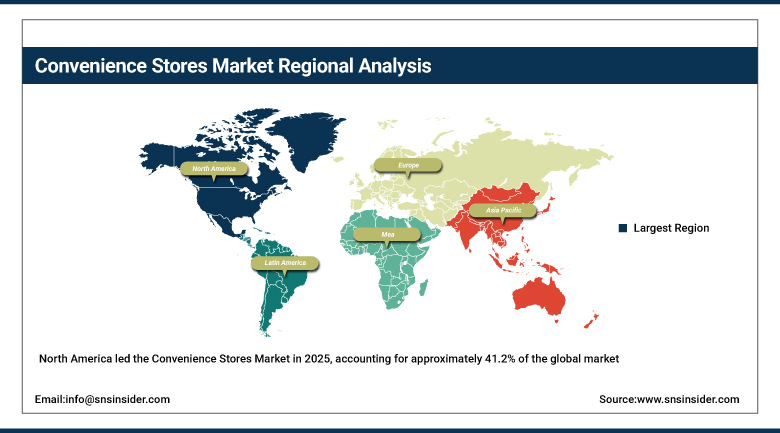
North America led the Convenience Stores Market in 2025, accounting for approximately 41.2% of the global market. The region’s dominance is anchored by the United States’ deep concentration of national chains, independent operators, and a commuter culture built heavily around car travel and fuel-linked retail. High consumer demand for quick purchases, ready-to-eat food, beverages, and tobacco products further supports market scale. Strong store networks, extended operating hours, digital payment adoption, and established fuel-retail infrastructure reinforce North America’s position as the largest convenience retail market globally.
Canada contributes a meaningful share through its own well-developed chain and independent store base, while Mexico's market continues expanding rapidly, led by domestic giant OXXO's aggressive store growth across the country. Cross-border investment activity, including U.S. and Canadian chains acquiring or partnering with Mexican operators, ties much of North American demand together.
Get Customized Report as per Your Business Requirement - Enquiry Now
Asia Pacific Convenience Stores Market Insights
Asia Pacific is expected to register the fastest regional growth through 2035, driven by rapid urbanization and rising disposable incomes across China, India, and Southeast Asia that are pulling more shoppers toward the quick, small-format retail convenience stores offer. Japan's deeply developed convenience store culture, dense with chains like 7-Eleven, Lawson, and FamilyMart, offers something of a preview of where other regional markets may be headed as urban density increases.
China's sheer population scale gives the region enormous long-term growth potential as convenience store penetration continues rising in its expanding cities, while South Korea's convenience store density is already among the highest in the world relative to population. Southeast Asian markets, including Vietnam, Thailand, and the Philippines, are seeing rapid chain expansion as both domestic and international operators race to establish early market position.
Europe Convenience Stores Market Insights
Europe represents a mature, more fragmented convenience store market than North America or Asia Pacific, shaped by a longer tradition of small independent grocers and stricter regulation around store hours and fuel retailing in several countries. Germany anchors regional demand, home to a large base of both fuel-linked and standalone convenience formats.
The United Kingdom, France, and the Netherlands contribute meaningful volume as well, each with established convenience retail sectors adapting to rising e-commerce competition and changing urban shopping habits. Regulatory attention to plastic packaging and single-use item restrictions is shaping product assortment and store operations across the region more directly than in most other markets.
MEA & Latin America Convenience Stores Market Insights
The Middle East and Africa represent a smaller but steadily developing convenience stores market, with South Africa anchoring regional demand through its more established retail infrastructure relative to much of the rest of the continent. Growing urbanization and a rising middle class across several African economies are expected to support continued convenience retail expansion over the forecast period.
Latin America is a significant and rapidly growing market led by Mexico, where OXXO's massive store network has made convenience retail a genuinely mainstream part of daily shopping across both urban and rural areas. Brazil and Colombia contribute meaningful secondary demand, with regional and international chains continuing to expand store counts across major metropolitan areas.
Market Dynamics
Growth Drivers: Foodservice expansion and urbanization fueling store growth
The convenience store industry's expanding investment in prepared food and foodservice is one of the clearest forces behind rising sector revenue, as chains reposition themselves as quick-service dining destinations rather than just fuel stops with snacks. That shift is pulling in a broader customer base and higher per-transaction spending than traditional convenience purchases alone would generate.
Continued urbanization and rising disposable incomes across emerging markets add a second major driver, as more consumers gain the income and urban density needed to support the small-format, high-frequency shopping trips convenience stores are built around. That demographic tailwind is expected to keep supporting store count growth for years, particularly across Asia Pacific and Latin America.
Restraints: Declining tobacco and fuel margins limiting profitability
Declining tobacco sales, driven by falling smoking rates and tightening regulation in many developed markets, remove a historically important and high-margin product category from convenience store revenue, forcing operators to find replacement categories that don't always carry comparable margins.
Fuel margins face their own long-term pressure as vehicle electrification gradually reduces gasoline demand in markets with aggressive EV adoption, threatening a revenue stream that has anchored profitability at many forecourt locations for decades. Operators are responding by investing in foodservice and EV charging infrastructure, but that transition requires real capital investment during a period when core fuel margins are already under pressure.
Opportunities: Digital engagement and premium foodservice opening new growth avenues
Expanding digital engagement through branded apps, loyalty programs, and delivery partnerships gives convenience store chains a way to build the kind of repeat-visit relationship with customers that used to depend entirely on physical location and habit. Operators that build genuine digital engagement are positioned to capture a growing share of consumer spending even as e-commerce continues pulling some traditional convenience purchases online.
Premium and proprietary foodservice concepts offer a second significant opportunity, letting chains capture higher-margin dining occasions that would otherwise go to quick-service restaurants entirely outside the convenience channel. Chains that successfully build genuine food credibility, rather than treating foodservice as an afterthought, are positioned to capture a meaningfully larger share of daily food spending than convenience retail has traditionally captured.
Recent Developments:
-
2024: Casey's General Stores acquired Fikes Wholesale and its 198-location CEFCO Convenience Stores network for approximately USD 1.145 billion, expanding its presence in Texas.
-
June 2025: Alimentation Couche-Tard completed its USD 1.57 billion acquisition of GetGo Cafe + Market, a 270-store chain, from Giant Eagle, divesting 35 stores to gain FTC approval.
-
2024: FEMSA, parent company of the OXXO chain, acquired 249 stores from Delek US Holdings, continuing its expansion into the U.S. convenience retail market.
-
2024-2025: 7-Eleven acquired more than 200 stores from Sunoco LP and Cal's Convenience, continuing its organic and acquisition-driven growth strategy in the U.S. market.
Convenience Stores Market Key Players
-
7-Eleven, Inc. (Seven & i Holdings)
-
Alimentation Couche-Tard Inc. (Circle K)
-
FamilyMart Co., Ltd.
-
Lawson, Inc.
-
GS Retail Co., Ltd. (GS25)
-
Casey’s General Stores, Inc.
-
OXXO (FEMSA)
-
Wawa, Inc.
-
QuikTrip Corporation
-
Speedway LLC
-
Sheetz, Inc.
-
Murphy USA Inc.
-
EG Group Ltd.
-
SPAR International
-
Indomaret (PT Indomarco Prismatama)
-
Alfamart (PT Sumber Alfaria Trijaya Tbk)
-
CP ALL Public Company Limited
-
Parkland Corporation
-
RaceTrac, Inc.
-
Pilot Company
Convenience Stores Market Report Scope:
| Report Attributes | Details |
|---|---|
| Market Size in 2025 | USD 2.20 Trillion |
| Market Size by 2035 | USD 3.35 Trillion |
| CAGR | CAGR of 4.3% From 2026 to 2035 |
| Base Year | 2025 |
| Forecast Period | 2026-2035 |
| Historical Data | 2022-2024 |
| Report Scope & Coverage | Market Size, Segments Analysis, Competitive Landscape, Regional Analysis, DROC & SWOT Analysis, Forecast Outlook |
| Key Segments | • By Store Type (Traditional Convenience Stores, Forecourt & Fuel Convenience Stores, Non-Fuel Convenience Stores) • By Ownership Model (Independent Stores, Chain & Franchise Stores) • By Product Type (Food & Beverages, Tobacco Products, Grocery & Staples, Personal Care & Health Products, Fuel & Automotive, Others) • By Location (Urban, Suburban, Rural & Highway) • By Payment Mode (Cash, Card, Mobile & Digital Wallet) |
| Regional Analysis/Coverage | North America (US, Canada), Europe (Germany, UK, France, Italy, Spain, Russia, Poland, Rest of Europe), Asia Pacific (China, India, Japan, South Korea, Australia, ASEAN Countries, Rest of Asia Pacific), Middle East & Africa (UAE, Saudi Arabia, Qatar, South Africa, Rest of Middle East & Africa), Latin America (Brazil, Argentina, Mexico, Colombia, Rest of Latin America). |
| Company Profiles | 7-Eleven, Inc. (Seven & i Holdings), Alimentation Couche-Tard Inc. (Circle K), FamilyMart Co., Ltd., Lawson, Inc., GS Retail Co., Ltd. (GS25), Casey’s General Stores, Inc., OXXO (FEMSA), Wawa, Inc., QuikTrip Corporation, Speedway LLC, Sheetz, Inc., Murphy USA Inc., EG Group Ltd., SPAR International, Indomaret (PT Indomarco Prismatama), Alfamart (PT Sumber Alfaria Trijaya Tbk), CP ALL Public Company Limited, Parkland Corporation, RaceTrac, Inc., Pilot Company. |
Frequently Asked Questions
Key players include 7-Eleven, Alimentation Couche-Tard (Circle K), FamilyMart, Lawson, and GS Retail (GS25), leading convenience retail worldwide.
Key opportunities include digital payments, loyalty platforms, ready-to-eat food, private labels, delivery services, EV charging, and smart-store technologies.
Expanding investment in prepared food and foodservice, alongside continued urbanization and rising disposable incomes across emerging markets.
Food & Beverages dominated with approximately 34.6% share in 2025, while Personal Care & Health Products is the fastest growing segment with a CAGR of approximately 6.8%.
North America dominated the Convenience Stores Market in 2025, while Asia Pacific is the fastest-growing region.
