
Data Warehouse Automation Market Report Scope & Overview:
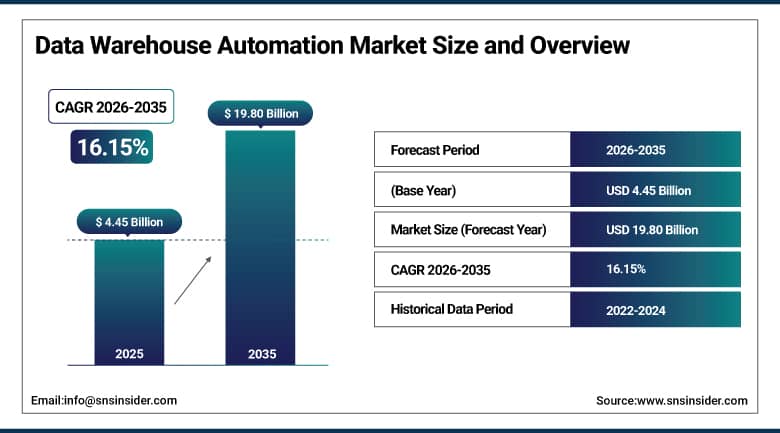
The Data Warehouse Automation Market was valued at USD 4.45 billion in 2025 and is expected to reach USD 19.80 billion by 2035, growing at a CAGR of 16.15% from 2026-2035.
Growth in the Data Warehouse Automation Market can be attributed to increasing volume of data and the growing requirement of real-time analytics within organizations. Automation has become increasingly popular among businesses due to the reduced effort involved in manual processes as well as improved decision making abilities. The growing usage of cloud services, artificial intelligence, and machine learning along with the rising demand for scalable data solutions have led to significant growth within this market.
According to Microsoft Azure documentation, organizations generate more than 2.5 quintillion bytes of data every day, driving strong demand for automated data pipelines and analytics systems.
Additionally, data-driven organizations leveraging cloud analytics have been observed to achieve up to 30–40% faster decision-making cycles through automated data processing and real-time analytics tools.
To Get More Information On Data Warehouse Automation Market - Request Free Sample Report
Data Warehouse Automation Market Trends:
-
Rising demand for faster data integration and analytics is driving the data warehouse automation market.
-
Growing adoption of cloud-based data platforms and modern data architectures is boosting market growth.
-
Expansion of big data, AI, and business intelligence applications is fueling deployment.
-
Increasing focus on reducing manual coding, improving data accuracy, and accelerating time-to-insight is shaping adoption trends.
-
Advancements in metadata-driven automation, ETL/ELT optimization, and real-time data processing are enhancing efficiency.
-
Rising need for scalable, cost-effective, and agile data management solutions is supporting market expansion.
-
Collaborations between data platform providers, enterprises, and analytics vendors are accelerating innovation and global adoption.
U.S. Data Warehouse Automation Market Outlook:
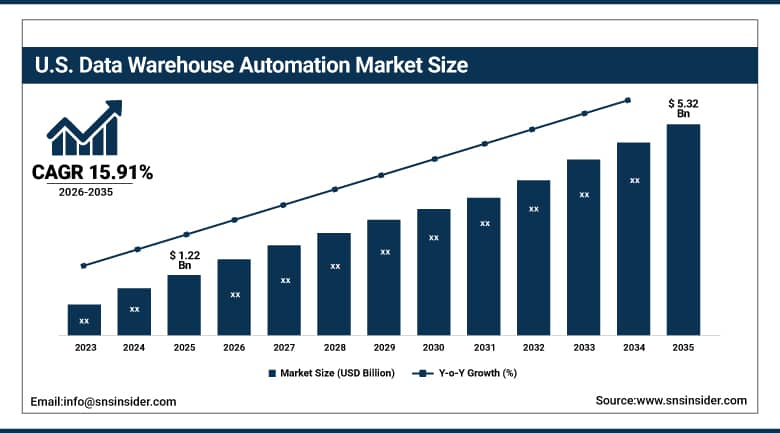
The U.S. Data Warehouse Automation Market was valued at USD 1.22 billion in 2025 and is expected to reach USD 5.32 billion by 2035, growing at a CAGR of 15.91% from 2026-2035.
U.S. Data Warehouse Automation Market Growth is being fuelled by high acceptance of cloud technologies, the rising need for real-time analytics, and improved data management techniques. Increased spending on AI-based automation technologies and digital transformation is helping to speed up the market growth rate.
According to research, cloud migration and digital transformation have become major U.S. enterprise priorities, with cloud spending increasing by more than 20% annually, driven by the modernization of data infrastructure.
Data Warehouse Automation Market Growth Drivers:
-
Rising demand for faster data processing and real-time analytics is accelerating adoption of automated data warehouse solutions globally
The rise in data volume and the necessity of obtaining real-time analytics have led companies to use automated data warehouses. Companies have been trying to minimize their reliance on manual intervention while integrating, transforming, and loading data. This makes automation software a popular choice among businesses, given the benefits they offer in improving workflows, decreasing development time, and eliminating human errors. Furthermore, the rising focus on data-based decision-making has further augmented the demand. Enterprises are increasingly considering scalability and agility in their data management solutions to accommodate varying data demands, thus fueling the growth of the data warehouse automation market.
According to research, organizations using modern cloud analytics achieve near real-time data processing capabilities, enabling faster insights and decision-making compared to traditional batch-based systems.
Modern data integration tools such as Azure Data Factory can reduce data pipeline development time from weeks to hours, significantly lowering manual effort in ETL/ELT workflows. Reports further indicate that organizations leveraging advanced analytics platforms experience up to 2x faster decision-making cycles compared to traditional data systems.
Data Warehouse Automation Market Restraints:
-
High initial implementation costs and complexity in integrating legacy systems are limiting adoption among small and resource-constrained organizations
The integration of data warehousing automation requires a huge amount of money in terms of the software itself, the necessary infrastructure, and even highly skilled manpower. For small and mid-sized organizations, allocating the necessary funding is a challenge. Besides, it would take a lot of effort and time to integrate the new system with the legacy system currently being used by companies. There may even be compatibility problems that have to be overcome during the process. This results in delayed installation and ROI, discouraging organizations from adopting the technology.
According to research, organizations spend 50%–80% of their IT budgets maintaining legacy systems, leaving limited funds for modernization and automation initiatives. Integration projects frequently face delays and cost overruns, with studies showing up to 70% of enterprise integration initiatives experiencing significant implementation challenges.
A global enterprise study further indicates that organizations lose around $370 million annually due to outdated legacy systems and failed modernization projects.
Data Warehouse Automation Market Opportunities:
-
Integration of artificial intelligence and machine learning technologies is creating advanced automation capabilities and enhancing data processing efficiency significantly
The incorporation of artificial intelligence and machine learning in data warehouse automation products is creating opportunities for growth. The use of artificial intelligence and machine learning ensures that intelligent data processing, analytics, and decision making are done, hence increasing efficiency. Artificial intelligence allows automatic detection of trends and anomalies in data processes, hence increasing accuracy and minimizing the cost incurred by organizations. With the high demand for business intelligence and analytics, businesses will seek automated solutions incorporating artificial intelligence. There are many opportunities that innovators can take advantage of in order to drive growth in the industry.
Integration of AI and Machine Learning in Data Warehouse Automation Platforms:
|
Platform / Solution |
AI/ML Capabilities in Data Warehouse Automation |
|---|---|
|
Microsoft Azure Synapse + Microsoft Fabric |
AI-driven warehouse automation: auto-optimize query performance, detect data anomalies, generate automated insights, reduce manual ETL tasks |
|
AWS Redshift + SageMaker Integration |
ML embedded in data warehouse environment: run ML models inside warehouse, automated forecasting, anomaly detection in datasets |
|
Google BigQuery ML |
ML integrated directly into SQL-based data warehouse: run ML models using SQL, automate predictive analytics, build models directly inside warehouse queries |
Data Warehouse Automation Market Segment Highlights:
-
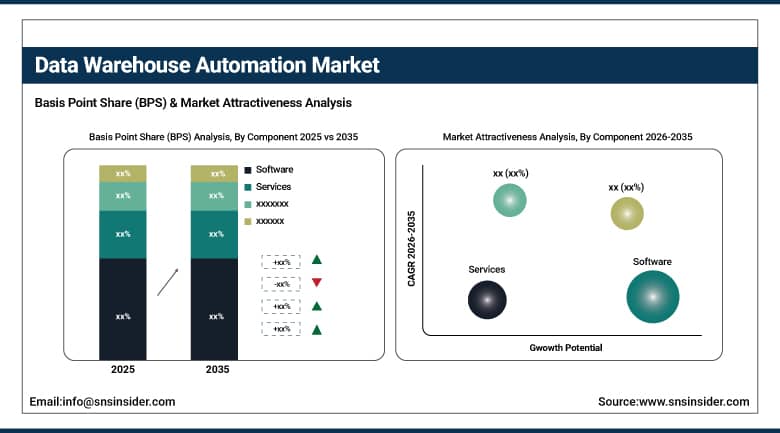
By Component, Software dominated the Data Warehouse Automation Market with ~63% share in 2025; Services fastest growing (CAGR).
-
By Organization Size, Large Enterprises dominated the Data Warehouse Automation Market with ~66% share in 2025; Small and Medium Enterprises fastest growing (CAGR).
-
By Application, Data Integration dominated the Data Warehouse Automation Market with ~31% share in 2025; Data Governance fastest growing (CAGR).
-
By End-User, BFSI dominated the Data Warehouse Automation Market with ~24% share in 2025; IT & Telecommunications fastest growing (CAGR).
-
By Deployment Mode, Cloud dominated the Data Warehouse Automation Market with ~67% share in 2025; Cloud fastest growing (CAGR).
Data Warehouse Automation Market Segment Analysis:
By Component, Software segment dominates the Market, Services segment expected to grow fastest
The Software Segment held the leading position in the Data Warehouse Automation Market in 2025 owing to the significant contribution made by it towards automation of the process of integrating, transforming, and managing the flow of data within a complex business environment. Companies have been extensively investing in software platforms that are capable of scaling and operating on cloud infrastructure, resulting in improved operational efficiencies, reduced human intervention, and faster analytical abilities.
The Services Segment is forecasted to register the highest CAGR between 2026 and 2035 owing to the increasing need for consulting, integration, and maintenance services as companies leverage automation solutions. The complexities involved in deploying automation systems along with ongoing upgrades have been fueling the demand for managed services across various industry verticals globally.
By Organization Size, Large Enterprises segment dominates the Market, Small and Medium Enterprises segment expected to grow fastest.
Large Enterprises segment has the largest market share in the Data Warehouse Automation Market in 2025 owing to high volume data, sophisticated IT architecture, and higher financial strength. Such enterprises rely more on advanced automation systems that can optimize operations and help them maintain an edge over others. Their inclination towards digital transformation and analysis-based strategy formation has ensured that they will continue using data warehousing automation tools in large numbers in operations.
SME segment is anticipated to witness the fastest growth in terms of CAGR between 2026 and 2035 due to growing awareness about decision-making through data and low-cost automation options. Cloud computing and low-code platforms are making it easy for SMEs to implement advanced data solutions without incurring hefty costs. With greater digitalization and growing understanding, SMEs are rapidly adopting such automation tools within their operations.
By Application, Data Integration segment dominates the Market, Data Governance segment expected to grow fastest.
The Data Integration segment accounted for largest share of the market in 2025 because of the increasing need for consolidating data collected from various sources into integrated platforms. With proper integration of data, organizations get precise analytics, quick insight generation, and better decision-making abilities. Automated processes not only help to streamline data integration, but also minimize the chances of errors and inconsistency in information. Hence, this segment becomes highly important for enterprises operating with voluminous data.
The Data Governance segment is predicted to witness the highest CAGR during 2026–2035 owing to the rising concern over data security, compliance, and quality management. In order to achieve accuracy and privacy of data, enterprises have started adopting data governance framework. Increasing data volume along with stringent compliance requirements is likely to drive the adoption of automated data governance solutions worldwide.
By End-User, BFSI segment dominates the Market, IT & Telecommunications segment expected to grow fastest.
The BFSI segment accounted the largest market share of the Data Warehouse Automation Market in 2025 due to its requirement for real-time processing of data, managing risks, and complying with regulations. The BFSI industry creates huge amounts of sensitive data and needs an automated system to ensure precision, prevent fraud, and gain insights into customers. Ongoing digital transformations have also increased the need for automated data warehouses.
The IT & Telecommunications segment is forecasted to witness the highest growth rate during the forecast period owing to the high amount of data that needs to be processed due to the expansion of digital networks and devices. Enterprises in this industry need automated software to process huge amounts of data and facilitate advanced analytics. Rising use of cloud computing and enhanced customer experience are contributing to the growing demand for automation software.
By Deployment Mode, Cloud segment dominates the Market and is expected to grow fastest.
In 2025, the Cloud segment led the Data Warehouse Automation Market owing to its scalability, adaptability, and economical benefits, allowing enterprises to efficiently handle vast and intricate data environments. Additionally, cloud technology facilitates quick implementation, real-time capabilities, and smooth integration with sophisticated analytical applications. The Cloud segment is anticipated to register the highest CAGR between 2026 and 2035, owing to growing reliance on cloud technology, high demand for remote accessibility, and innovations in AI-powered data automation solutions.
Data Warehouse Automation Market Regional Analysis:
North America Data Warehouse Automation Market Insights
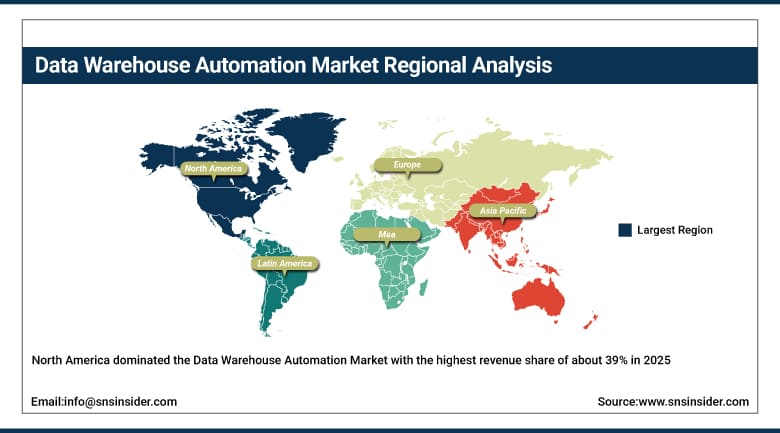
North America dominated the Data Warehouse Automation Market with the highest revenue share of about 39% in 2025 due to the active participation of leading technology vendors and rapid adoption of data solutions. Businesses from various verticals actively adopt data-oriented approaches backed by professional human resources and sophisticated IT infrastructures. The constant development and integration of automation technologies add more strength to the dominance of the market in the region.
Get Customized Report as Per Your Business Requirement - Enquiry Now
Asia Pacific Data Warehouse Automation Market Insights
Asia Pacific Region will witness the highest growth rate at a CAGR of nearly 17.69%, from 2026 to 2035, owing to its quick digital transformation, increased cloud deployments, and heavy investments in data infrastructure. The growing presence of businesses, thriving startup culture, and government efforts promoting digitization have boosted the need for automation in the data sector. Moreover, an increase in data production and analytics-based decision making is adding more impetus to market growth.
Europe Data Warehouse Automation Market Insights
The European region within the global data warehouse automation market is experiencing continuous growth, mainly owing to the growing use of cloud-based data solutions and the emphasis on regulatory compliance, including data protection regulations. There is a rising investment by businesses in automation, and the presence of mature organizations along with digitalization programs further fuels the deployment of data warehouse automation systems in Europe.
Middle East & Africa and Latin America Data Warehouse Automation Market Insights
The Middle East and Africa Data Warehouse Automation Market is currently exhibiting steady growth owing to digital transformation efforts, use of cloud computing, and increased data infrastructure investment. Firms are increasingly investing in improving their efficiency and analytics capabilities. The Latin American region is also exhibiting steady growth due to growth in enterprises, improved understanding of decision making using data, and increased use of affordable cloud automation systems.
Data Warehouse Automation Market Competitive Landscape:
Fivetran
Established in 2012, Fivetran is an automated data integration company that provides cloud-based data pipeline services to transfer data from multiple sources to data warehouses. It delivers its services via a fully-managed connector solution that ensures seamless data ingestion without any scaling issues. Fivetran holds immense significance for the automation of data warehouses as it automates ETL operations and provides real-time data access capabilities.
-
2026: dbt Labs and Fivetran announced a merger to unify automated data ingestion and transformation, creating an integrated platform simplifying data warehouse automation workflows and supporting AI-ready analytics infrastructure for enterprises.
Informatica
Informatica, founded in 1993, is a global leader in providing enterprise cloud data management solutions. The company offers solutions such as data integration, data governance, data quality, and master data management services. It has an Intelligent Data Management Cloud (IDMC) that uses intelligent automation driven by artificial intelligence to manage complex data flows. The company can help companies automate their data warehouses using metadata-driven integration and scalable cloud-based solutions.
-
2025: Informatica announced Fall 2025 updates to its Intelligent Data Management Cloud, adding AI-driven automation, governance, and integration features to accelerate enterprise data warehouse automation and support scalable, trusted analytics and AI workloads.
Snowflake Inc.
Snowflake was established in the year 2012, which serves as a provider of cloud data platform services including data warehousing, data lakes, and data sharing via the scalable infrastructure it offers. The compute-storage separation offered in Snowflake makes it suitable for performing high-speed analytics. With Snowflake's data warehouse automation, one can achieve integration of the functionalities related to data engineering and transformation in addition to pipeline management.
-
2024: Snowflake expanded its cloud data platform capabilities with integrated data engineering, transformation, and pipeline automation features, strengthening automated data warehouse operations and enabling enterprises to reduce manual ETL workloads across unified analytics environments.
Databricks
Databricks, which was established in 2013, is a reputable data and AI company. The company develops and offers a Lakehouse Platform that integrates data engineering, analytics, and machine learning in one. Databricks Lakehouse Platform uses Apache Spark, an open-source computing system, to achieve high efficiency. It can also automate the work of data warehouses using advanced features such as automation of pipelines, governance, and integration.
-
2024: Databricks – Databricks enhanced its Lakehouse platform with automated pipeline orchestration and data engineering features, enabling organizations to streamline data warehouse automation and unify analytics, governance, and AI workflows within a single platform environment.
Key Players:
Some of the Data Warehouse Automation Market Companies
-
WhereScape
-
TimeXtender
-
Datavault Builder
-
VaultSpeed
-
AutomateDV
-
Anatella
-
Snowflake Inc.
-
Databricks
-
Google Cloud
-
Amazon Web Services
-
Microsoft
-
Fivetran
-
Matillion
-
SnapLogic
-
Informatica
-
Talend
-
Tamr
-
Rocket Software
-
Coalesce.io
-
dbt Labs
| Report Attributes | Details |
|---|---|
| Market Size in 2025 | USD 4.45 Billion |
| Market Size by 2035 | USD 19.80 Billion |
| CAGR | CAGR of 16.15% From 2026 to 2035 |
| Base Year | 2025 |
| Forecast Period | 2026-2035 |
| Historical Data | 2022-2024 |
| Report Scope & Coverage | Market Size, Segments Analysis, Competitive Landscape, Regional Analysis, DROC & SWOT Analysis, Forecast Outlook |
| Key Segments | • By Component (Software, Services) • By Deployment Mode (On-Premises, Cloud) • By Organization Size (Small and Medium Enterprises, Large Enterprises) • By Application (Data Integration, Data Quality, Metadata Management, Data Governance, Others) • By End-User (BFSI, Healthcare, Retail and E-commerce, IT and Telecommunications, Manufacturing, Government, Others) |
| Regional Analysis/Coverage | North America (US, Canada), Europe (Germany, UK, France, Italy, Spain, Russia, Poland, Rest of Europe), Asia Pacific (China, India, Japan, South Korea, Australia, ASEAN Countries, Rest of Asia Pacific), Middle East & Africa (UAE, Saudi Arabia, Qatar, South Africa, Rest of Middle East & Africa), Latin America (Brazil, Argentina, Mexico, Colombia, Rest of Latin America). |
| Company Profiles | WhereScape, TimeXtender, Datavault Builder, VaultSpeed, AutomateDV, Anatella, Snowflake Inc., Databricks, Google Cloud, Amazon Web Services, Microsoft, Fivetran, Matillion, SnapLogic, Informatica, Talend, Tamr, Rocket Software, Coalesce.io, dbt Labs |

Frequently Asked Questions
North America dominated the Data Warehouse Automation Market in 2025.
The Large Enterprises segment dominated the Data Warehouse Automation Market in 2025.
Rising demand for faster data processing and real-time analytics is accelerating adoption of automated data warehouse solutions globally.
The Data Warehouse Automation Market was valued at USD 4.45 billion in 2025.
The Data Warehouse Automation Market is expected to grow at a CAGR of 16.15% from 2026 to 2035.
