
Day Care Market Report Scope & Overview:
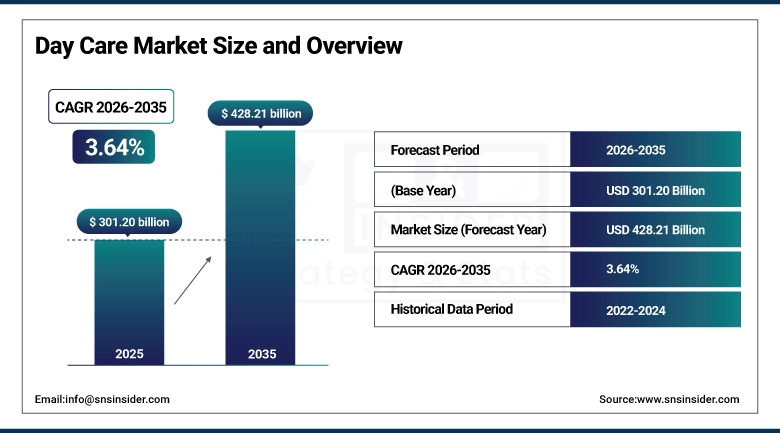
The Day Care Market size is valued at USD 301.20 Billion in 2025 and is projected to reach USD 428.21 Billion by 2035, growing at a CAGR of 3.64% during the forecast period 2026–2035.
The Day Care Market analysis report offers an insightful evaluation of the market dynamics, services innovations, and applicability to the various age groups. Dual-income families, urbanization, high demand for systematic education among young children, and franchising trends are responsible for strong growth in the market from 2026 to 2035.
Daycare service utilization was over 250 million enrollments around the world in 2025 due to high demand for care services to infants and pre-schoolers, advanced digital surveillance systems and government backing programs.
Market Size and Forecast:
-
Market Size in 2025: USD 301.20 Billion
-
Market Size by 2035: USD 428.21 Billion
-
CAGR: 3.64% from 2026 to 2035
-
Base Year: 2025
-
Forecast Period: 2026–2035
-
Historical Data: 2022–2024
To Get more information on Day Care Market - Request Free Sample Report
Day Care Market Trends:
-
Greater need for center-based childcare due to the preference of parents for organized and professional environments.
-
Significant growth of franchised childcare centers based on quality standards and brand identity.
-
Increased usage of digital applications that provide remote observation of children at the center and facilitate parental communication.
-
The development of specialized childcare programs such as STEM and language immersion initiatives.
-
Emergence of green childcare centers that utilize environmentally-friendly furniture, toys, and other materials.
-
Greater demand for corporate childcare centers due to employers offering such services as an employee benefit package.
-
Extended opening hours and flexible scheduling of childcare centers to accommodate dual-income families.
-
An increased focus on educational outcomes and innovations in the curriculum and training of childcare center employees.
-
An increased number of publicly supported childcare centers in areas such as Canada and Europe.
U.S. Day Care Market Insights:
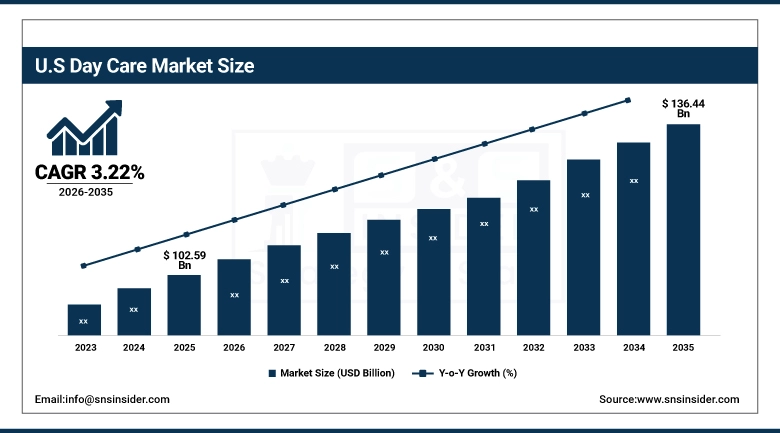
The U.S. Day Care Market is estimated to increase from USD 102.59 billion in 2025 to USD 136.44 billion in 2035 at a CAGR of 3.22%. This growth will be fueled by the growth of dual-income families, urbanization trends, the popularity of formal programs of early childhood education, and innovations in delivery channels such as center-based, home-based, corporate-sponsored, and franchised day care centers.
Day Care Market Growth Drivers:
-
Rising dual‑income households and increasing urbanization are key drivers of U.S. Day Care Market growth.
The need for more organized daycare programs with an emphasis on safety, developmental benefits, and flexibility is gaining prominence among families. The adoption of sophisticated daycare programs such as center-based, home-based, and chain franchises by hospitals, specialized medical clinics, and corporations is on the rise as a means to help working parents and enhance children’s development. Improvements such as digital surveillance technology, personalized curriculum, and environmentally sustainable daycare facilities are also fueling adoption.
Over 63% of daycare centers across the United States implemented digital engagement platforms by 2025.
Day Care Market Restraints:
-
High operational costs, staffing shortages, and regulatory compliance burdens are key restraints on U.S. Day Care Market growth.
The problem of recruiting and retaining skilled employees is faced by many centers owing to wages and difficult working conditions, along with increasing tuition costs hindering access for middle- and lower-income households. Stringent licensing and safety policies make it costly to scale up operations, thereby hindering the growth of small enterprises. The threat posed by informal child care and public schemes adds to declining enrollments at private daycare centers.
More than 42% of daycare facilities in America have experienced problems with hiring and compliance issues in 2025.
Day Care Market Opportunities:
-
Expanding corporate‑sponsored childcare programs, rising demand for specialized early education, and integration of digital technologies present significant opportunities for the U.S. Day Care Market.
Many companies are increasingly making use of daycare options that are either on-site or subsidized for the sake of attracting or retaining employees. On the other hand, parents are increasingly looking for daycare centers that provide enrichment courses in areas such as STEM subjects, language immersion, and special needs. The use of technology to monitor, facilitate communication, and provide individualized education is adding value to the service.
Around 46 percent of daycare centers within the U.S. had specialized or technology-based services by the year 2025.
Day Care Market Segmentation Analysis:
-
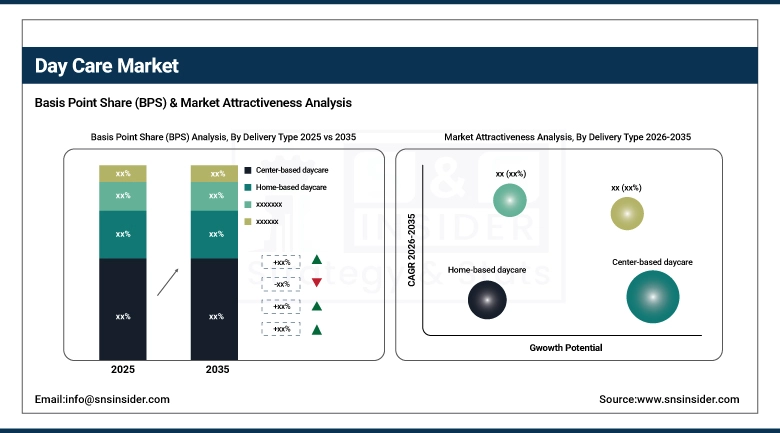
By Delivery Type, Center-based daycare held the largest market share of 31.52% in 2025, while they are also expected to grow at the fastest CAGR of 4.63% during 2026–2035.
-
By Service Type, Full-time care dominated with 39.82% market share in 2025, whereas Specialized daycare is projected to record the fastest CAGR of 5.97% through 2026–2035.
-
By Age Group, Infants (0–2 years) accounted for the highest market share of 31.59% in 2025, while Preschoolers (4–6 years) are expected to grow at the fastest CAGR of 4.99% during the forecast period.
-
By Ownership Type, Private daycare centers dominated with a 59.86% share in 2025, while Franchise daycare chains are anticipated to expand at the fastest CAGR of 5.71% through 2026–2035.
By Delivery Type, Center‑based daycare dominates while also growing rapidly:
The Center‑based Childcare segment is the dominant segment in the U.S. Day Care Market, owing to its well‑structured setup, professional staff, and safety‑focused approach that resonates strongly with parents. These facilities provide organized learning environments, standardized curricula, and reliable supervision, making them the preferred choice for families across both urban and suburban regions.
The Center-based Childcare segment can be considered the most rapidly developing one due to it’s associated with dual income families and corporations offering childcare options and curricula improvements resulting in better developmental results. These facilities provide structured learning, professional staff, and a safe environment, making them the preferred choice for parents nationwide.
By Service Type, Full‑time care dominates while Specialized daycare grows rapidly:
The Full-time Child Care system has emerged as the predominant choice due to the parents' preference for regular routines, structured learning environments, and dependable developmental support for working families. For 2025, the enrollment numbers for full-time childcare were highest throughout the country, demonstrating its accessibility and reputation.
Specialty Day Care has become the most fastest expanding type, owing to the increasing need for unique child care programs such as STEM, language immersion, and special education services. The uptake rate increased as parents started looking for specialized child care programs that would benefit their children.
By Age Group, Infants (0–2 years) dominate while Preschoolers (4–6 years) grow rapidly:
Infants still form the dominant group as parents opt for professional childcare at the beginning stage of development, ensuring that children are safe, cared for, and provided with educational activities. In 2025, infant care was enrolled by the most children across the United States, which can be attributed to their dependence on professional care.
The Preschools category showed fast growth due to parents focus more on preparing their children for education by offering new curriculum programs and various enrichment programs such as STEM and language immersion. The increased enrollment rates can be attributed to their quest for high-quality education.
By Ownership Type, Private daycare centers dominate while Franchise daycare chains grow rapidly:
Private Daycare Centers have dominated the market due to their versatility, extensive range of services, and broad geographical spread in both urban and suburban areas. In 2025, enrollments at private centers were the highest in the country, indicating parents' confidence in individualized learning programs and community-based approaches.
Franchise Daycare centers are the most fastest expanding business segment, owing to their consistent quality, recognizable brands, and scalability through various branches. The adoption of franchises is on the rise since parents are becoming more interested in dependable, innovative, and credible day care options.
Day Care Market Regional Analysis:
North America Day Care Market Insights:
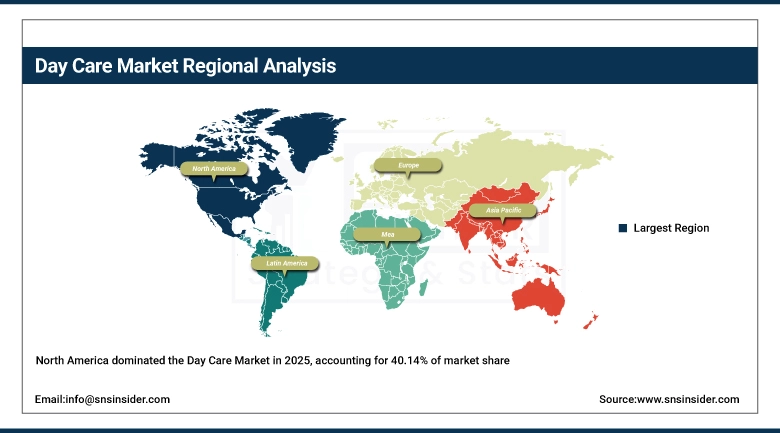
North America leads in the market with 40.14% share, on account of high demand for structured child care, dual income earners, and an existing developed infrastructure base in both Canada and the United States. The center-based daycare system continues to be dominant due to the backing it receives from corporation-funded programs and government initiatives. Digital monitoring systems, curriculum development, and environmentally friendly child-care centers boost growth. Increasing importance accorded to early childhood education and program specialization promotes better development of children. Consistent investments and awareness among parents consolidate the region's dominance and makes North America the most mature market.
Get Customized Report as per Your Business Requirement - Enquiry Now
U.S. Day Care Market Insights:
The United States is at the forefront among North American nations due to increased demand for child care facilities, adoption of center-based day care services, and corporate support for such ventures. The growing trend of working dual-income families, alongside urbanization, contributes to high enrollment rates, while advances in personalized curriculum and interactive digital platforms increase visibility and satisfy parents' needs.
Asia Pacific Day Care Market Insights:
Asia Pacific has emerged as one of the high growth regions with CAGR of 4.67%, owing to factors including fast-paced urbanization, increase in number of middle-class individuals, and increasing participation of women in the labor force. In countries such as India, Japan, and Australia, the acceptance of center-based daycare programs has been observed and is being boosted by government programs that aim to increase the quality of early childhood development programs. With an increased awareness about childcare services and higher disposable income levels, there exists a growing demand for professional childcare services.
China Day Care Market Insights:
China is among the fast-growing markets within the Asia-Pacific region due to the focus by the government towards early childhood education. In addition, there has been loosening of family planning regulations leading to the need for childcare services. The most common type of childcare in China is center based daycare which benefits from heavy investments in both physical structures and innovative curricula. Children today require specialized preparation in order to thrive in schools.
Europe Day Care Market Insights:
Europe remains one of the leading players in the world market due to the existing childcare system, governmental support, and heightened parental awareness. The Nordic countries, the UK, and France emphasize the importance of early childhood education, which boosts interest in center-based daycare services. Innovative approaches to child development, such as immersion programs and creative learning, are gaining popularity. Technology solutions enable better parent-child communication and promote sustainable practices in line with modern consumers' preferences. Increased female employment and favorable policies are likely to stimulate future growth.
Germany Day Care Market Insights:
Germany is among the prominent markets in Europe, mainly owing to its substantial government assistance, high levels of subsidies, and importance attached to early childhood development. It mainly comprises of center-based day care systems, which is an indication that parents have more trust in the well-established systems, with professionals handling all their children’s needs. There are specialized systems that target various areas such as language and creative development and preparing for school.
Latin America Day Care Market Insights:
Latin America is witnessing stable growth due to factors including increasing urbanization, women participation in the labor force, and increasing knowledge about structured childcare. Examples of nations making progress on this front include Brazil and Mexico where daycare services are increasingly used in urban centers. Cost remains an issue but efforts are underway to increase access through government-led schemes and private funding.
Middle East & Africa Day Care Market Insights:
Middle East & Africa Day region is relatively new in terms of its development, although its potential is immense due to increased urbanization, increased presence of women in the workforce, and increasing importance of early childhood care. UAE and South Africa are among the countries that have adopted childcare practices, with center-based daycare becoming increasingly popular among employed parents. Slow improvements are being seen in this regard due to efforts made by governments and private investors alike.
Day Care Market Competitive Landscape:
Learning Care Group
The Learning Care Group is one of the largest child care organizations in the United States, offering multiple brands such as La Petite Academy, ChildTime, Tutor Time, and Montessori Unlimited. The organization boasts many child care centers throughout the country that focus on structuring learning programs for young children, ensuring safety and involving families. Through its extensive size and diversity of brands, the company serves all age ranges of children, from babies up to older kids.
- In May 2025, Learning Care Group expanded its digital monitoring platform across all brands, enhancing parent engagement and operational efficiency.
ChildTime
ChildTime is one of the largest daycare providers and early childhood education providers in America. Renowned for providing a loving atmosphere, the ChildTime brand is focused on creating personalized learning programs for children that help enhance their creativity, socialization and academic readiness. ChildTime has many centers operating in various regions of America for infants, toddlers, preschoolers, and even older kids. This brand makes use of technological innovations to facilitate parent communication and ensure that children’s growth is accurately monitored.
- In April 2025, ChildTime introduced a nationwide enrichment program focused on STEM and creative arts, broadening its service portfolio for preschoolers and school-aged children.
Bright Horizons Family Solutions
Bright Horizons is an international player in child care and early education, with centers located across North America, Europe, and even further afield. This organization focuses mainly on providing employer-based care options, on-site centers, and back up services, positioning it as an excellent partner to companies that offer their employees more family-friendly programs. One of the key aspects of this company lies in delivering a high-quality curriculum, inclusion, and results-driven services.
- In June 2025, Bright Horizons launched new employer-sponsored childcare partnerships with Fortune 500 companies, expanding its corporate client base.
Day Care Market Key Players:
Some of the Day Care Market Companies are:
-
Learning Care Group
-
ChildTime
-
Bright Horizons Family Solutions
-
KinderCare
-
La Petite Academy
-
Primrose Schools
-
Goddard Systems
-
Kids R Kids
-
Tutor Time
-
Montessori Unlimited
-
Creative Kids Learning Centers
-
Cadence Education
-
Knowledge Universe
-
Busy Bees
-
BrightPath
-
YMCA Childcare
-
Kinderland
-
Safari Kid
-
Child Development Centers Inc.
-
KinderCare Education at Work
| Report Attributes | Details |
|---|---|
| Market Size in 2025 | USD 301.20 Billion |
| Market Size by 2035 | USD 428.21 Billion |
| CAGR | CAGR of 3.64% From 2026 to 2035 |
| Base Year | 2025 |
| Forecast Period | 2026-2035 |
| Historical Data | 2022-2024 |
| Report Scope & Coverage | Market Size, Segments Analysis, Competitive Landscape, Regional Analysis, DROC & SWOT Analysis, Forecast Outlook |
| Key Segments | • By Delivery Type (Center-based Daycare, Home-based Daycare, Corporate-sponsored Daycare, Franchise Daycare Chains, Others), • By Service Type (Full-time Care, Part-time Care, Drop-in Care, After-school Programs, Specialized Daycare, Others), • By Age Group (Infants [0–2 years], Toddlers [2–4 years], Preschoolers [4–6 years], School-aged [6+ years], Others), • By Ownership Type (Private Daycare Centers, Public Daycare Centers, Corporate-sponsored Daycare, Franchise Daycare Chains, Others) |
| Regional Analysis/Coverage | North America (US, Canada), Europe (Germany, UK, France, Italy, Spain, Russia, Poland, Rest of Europe), Asia Pacific (China, India, Japan, South Korea, Australia, ASEAN Countries, Rest of Asia Pacific), Middle East & Africa (UAE, Saudi Arabia, Qatar, South Africa, Rest of Middle East & Africa), Latin America (Brazil, Argentina, Mexico, Colombia, Rest of Latin America). |
| Company Profiles | Learning Care Group, ChildTime, Bright Horizons Family Solutions, KinderCare, La Petite Academy, Primrose Schools, Goddard Systems, Kids R Kids, Tutor Time, Montessori Unlimited, Creative Kids Learning Centers, Cadence Education, Knowledge Universe, Busy Bees, BrightPath, YMCA Childcare, Kinderland, Safari Kid, Child Development Centers Inc., KinderCare Education at Work |

Frequently Asked Questions
Center-based chains are expanding fastest at CAGR of 4.63%, offering standardized quality, brand recognition, and scalability across urban centers.
Infants (0–2 years) and preschoolers (4–6 years) together account for 59.04% of demand, as working parents prioritize structured care during early developmental stages.
Specialized daycare services (e.g., for children with special needs or language immersion) are the fastest-growing, with 5.97% CAGR, reflecting demand for tailored educational and developmental support.
North America dominates in revenue share of 40.14% with 3.19% CAGR, largely due to high penetration of organized daycare centers and strong government and employer support programs.
Asia-Pacific is the fastest-growing region, with a CAGR of 4.67% through 2035, driven by urbanization, dual-income households, and rising awareness of early childhood education.
