
Digital Content Creation Market Report Scope & Overview:
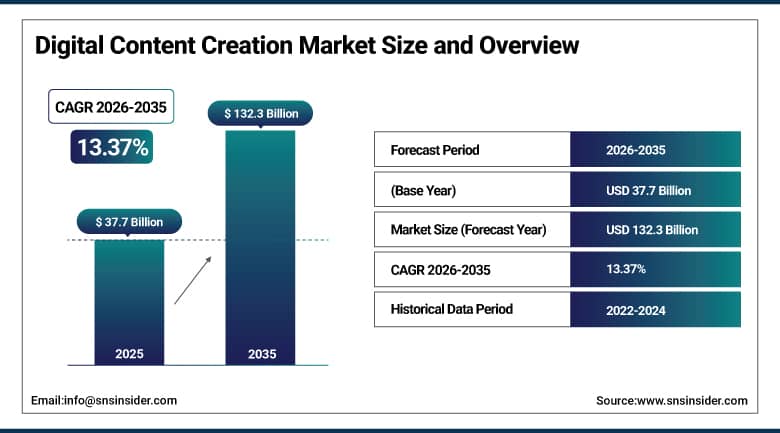
The Digital Content Creation Market was valued at USD 37.7 Billion in 2025 and is expected to reach USD 132.3 Billion by 2035, growing at a CAGR of 13.37% from 2026–2035.
The global digital content creation market is developing at a fast pace due to the streamlining of textual, graphical, video, and audio asset creation within businesses using AI-based design applications, cloud computing, and social media advertising. The use of generative AI within standard software programs has significantly reduced time taken to create videos, graphic designs, and animations and created scope for personalized content creation in multiple languages. With affordable production based on automation, machine learning, and AR applications, along with SaaS subscription, the production process has become increasingly democratized for both companies and individuals.
In 2023, Adobe Systems introduced Firefly AI, a generative artificial intelligence tool embedded within Photoshop and Illustrator that enables real-time content creation from text prompts, image generation, and style transfer. The launch represented Adobe’s strategy of embedding generative AI directly within its Creative Cloud ecosystem, allowing designers and marketers to accelerate ideation and production while maintaining brand-consistent visual quality across the company’s dominant creative software suite.
Market Size and Forecast:
-
Market Size in 2026E: USD 42.76 Billion
-
Market Size by 2035: USD 132.3 Billion
-
CAGR: 13.37% from 2026 to 2035
-
Fastest Growing Region: Asia Pacific
-
Largest Region: North America
To Get More Information On Digital Content Creation Market - Request Free Sample Report
Digital Content Creation Market Trends:
-
Generative AI tools embedded in design and video software are compressing content production timelines across enterprise marketing teams.
-
Cloud-based collaborative content platforms are enabling real-time multi-user editing and remote production workflows across distributed teams.
-
Short-form video demand from TikTok, Instagram Reels, and YouTube Shorts is driving mobile-friendly editing tool adoption.
-
Multilingual and localised content production is expanding as brands target Tier II and III markets across Asia.
-
Verticalised content solutions for healthcare, manufacturing, and finance are creating industry-specific digital asset demand.
U.S. Digital Content Creation Market Outlook:
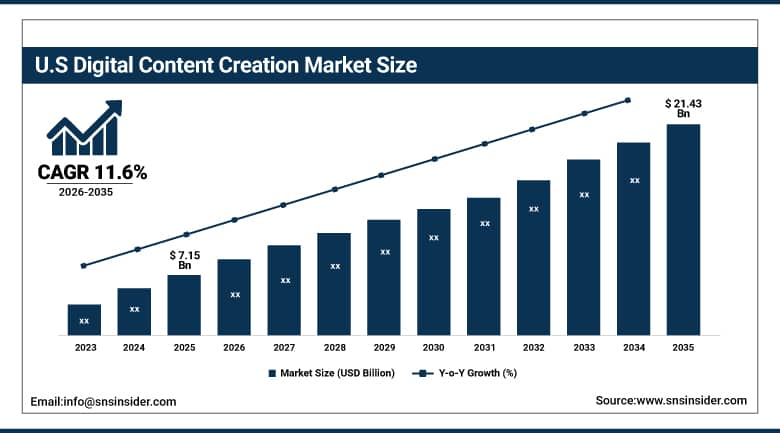
The U.S. Digital Content Creation Market was valued at approximately USD 7.15 Billion in 2025 and is expected to reach approximately USD 21.43 Billion by 2035, growing at a CAGR of approximately 11.6%.
The US is the top North American digital content creation revenues generator owing to its strong presence of Adobe, Microsoft, Apple, and Google firms, whose software solutions have set standards of content creation worldwide. Social networking sites, online videos, and online ads have largely contributed towards the growth of content creation, where firms and individual content producers spend on sophisticated technologies for editing videos and graphics, among other processes. Content generation via artificial intelligence within enterprises involved in marketing, e-learning, and e-commerce has remained above average.
In 2024, Microsoft introduced AI-powered content generation tools within Microsoft 365, enabling enterprise teams to automate document drafting, presentation design, and meeting summarisation directly within their existing productivity workflow. The integration addressed enterprises’ increasing need for automation in digital content workflows, allowing non-specialist business users to produce professional-quality marketing collateral, internal communications, and training materials without requiring dedicated design or video production resources.
Digital Content Creation Market Segment Analysis:
-
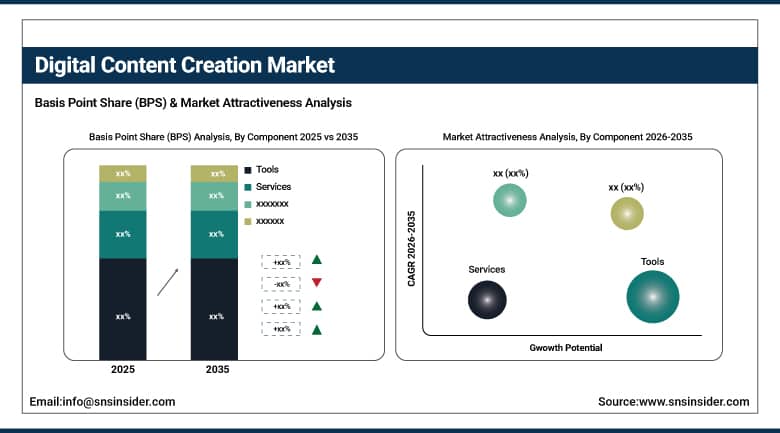
By Component, tools segment dominated the digital content creation market with approximately 75% share in 2025, while the services segment is the fastest growing with a CAGR of approximately 14.9% driven by demand for tailored content consulting.
-
By Content Format, video segment dominated the digital content creation market with approximately 32% share in 2025, while the graphical segment is the fastest growing with a CAGR of approximately 12.6% driven by AI-oriented design software adoption.
-
By Deployment, the cloud segment dominated the digital content creation market with the largest share in 2025 and is also fastest growing, driven by scalability and real-time collaboration that on-premise alternatives cannot match.
-
By Enterprise Size, large enterprises dominated the digital content creation market with approximately 58.9% share in 2025, while the SMEs segment is the fastest growing with a CAGR of approximately 13.6%.
-
By End User, retail & e-commerce segment dominated the digital content creation market with the largest share in 2025, while the Healthcare & Pharmaceutical segment is the fastest growing end user.
By Component, tools dominate, services grow fastest
Tools retained the dominant component position with approximately 75% of the digital content creation market in 2025. Its commercial primacy reflects the rising demand for content creation platforms and software whose AI-powered design capabilities, video editing functionality, and cloud-based content management create the foundational infrastructure that every content production workflow requires. Adobe, Corel Corporation, and Microsoft’s continuous product innovation and software upgrades sustain enterprise and individual creator dependence on licensed tool subscriptions whose recurring revenue model creates predictable platform provider income. The segment continues to intensify with the rise of interactive content, immersive AR/VR experiences, and real-time collaboration capabilities whose integration into mainstream creative software suites is progressively redefining baseline tool functionality expectations across the creative software market.
Services is growing fastest at approximately 14.9% CAGR because the rising demand for tailor-made content solutions, consulting, and professional digital services is creating outsourcing relationships between content-intensive industries and specialist providers. Companies in media, entertainment, and e-learning are increasingly outsourcing content creation and management to third-party service providers for improved brand storytelling and audience engagement. Growing reliance on content subscriptions, influencer marketing, and digital advertisement campaigns is driving demand for content strategy consulting and managed services whose scalable, cost-effective delivery model creates above-average growth relative to the broader tools-dominated market.
By Content Format, video dominates, graphical grows fastest
The format type of video remained the most prevalent format type used for digital content creation with about 32% of the total share for the same year due to increased consumption of videos in social media, streaming sites, and business marketing efforts. Video editing tools powered by AI technology, live broadcasting software, and video content that is interactive have forced both businesses and creators to focus more on engaging audiences; this is seen through Adobe Premiere Pro’s AI-assisted automated editing capabilities, the real-time collaboration capabilities in Apple Final Cut Pro, and the video editing tools offered in the cloud by Avid. Video format has been established as the key format type due to increased usage in mobile devices via TikTok, Instagram Reels, and YouTube Shorts.
Graphical is the fastest-growing format at approximately 12.6% CAGR, powered by AI-oriented design software, cloud-based illustration, and 3D design rendering tools. Canva’s AI-based design automation, CorelDRAW’s AI-based vector illustration, and Adobe Firefly’s on-demand generative content capability are each accelerating adoption among small businesses and independent creators who previously lacked professional design skills. The increasing use of AR graphics, NFT-based digital art, and immersive brand visuals is further propelling growth, with aesthetic-driven marketing and interactive media emerging as key drivers sustaining this segment’s above-average expansion.
Regional Analysis:
|
Region |
Major Country |
Share within Region, 2025 (%) |
|---|---|---|
|
North America |
United States |
82.5% |
|
Europe |
Germany |
22.4% |
|
Asia Pacific |
China |
44.8% |
|
Middle East & Africa |
UAE |
22.8% |
|
Latin America |
Brazil |
43.8% |
North America Digital Content Creation Market Insights
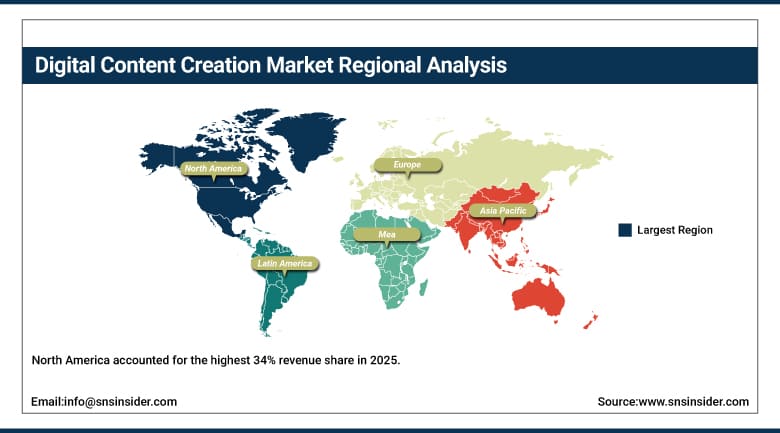
North America accounted for the highest 34% revenue share in 2025, fuelled by the rapid adoption of AI-powered content tools, cloud-based platforms, and digital marketing investment. Adobe, Microsoft, Apple, and Google’s continuous software innovation drives rapid change across the content creation software and services sector, with Adobe’s Firefly AI integration into Photoshop and Illustrator and Microsoft’s AI-powered Microsoft 365 content tools addressing enterprises’ growing automation needs.
The United States accounts for approximately 82.5% of North American revenues through its concentration of leading software developers and the world’s most mature digital marketing and e-commerce ecosystem. Canada contributes supplementary revenues through its growing media production sector and the expanding adoption of cloud-based content tools among Canadian enterprises and independent creators.
Get Customized Report as Per Your Business Requirement - Enquiry Now
Europe Digital Content Creation Market Insights
Europe is a significant digital content creation market where stringent GDPR data protection requirements shape platform design and the region’s strong publishing, media, and advertising industries sustain consistent tool and service procurement. Germany accounts for approximately 22.4% of European revenues through its large enterprise marketing sector and growing e-learning content production investment.
The United Kingdom’s advertising and media sector, France’s growing digital marketing investment, and the Netherlands’ creative technology start-up ecosystem collectively sustain European market development. European multilingual content requirements across the EU’s diverse linguistic markets create above-baseline demand for localization and translation-integrated content tools.
Asia Pacific Digital Content Creation Market Insights
Asia Pacific is the fastest-growing regional digital content creation market at a CAGR of approximately 15.36%, fuelled by digital transformation, internet penetration, and an expanding social media landscape. AI-based content creation tools are in high demand as Alibaba, Tencent, Baidu, and Canva invest heavily in regional platform development.
China accounts for approximately 44.8% of Asia Pacific revenues through Tencent’s AI-powered content personalization tools for gaming and entertainment and growing domestic cloud-based content management investment. India’s expanding broadband and smartphone penetration and Canva’s localised AI-powered design solutions are accelerating small business and creator adoption across the region.
MEA & Latin America Digital Content Creation Market Insights
The UAE leads MEA revenues through its advanced digital media and advertising sector, government-backed digital transformation initiatives, and growing e-commerce content investment. Saudi Arabia’s Vision 2030 media sector development creates growing institutional content production demand.
Brazil leads Latin American revenues through its large social media user base, growing digital marketing sector, and expanding e-commerce content production investment. Mexico and Colombia contribute growing secondary demand through their retail and media sector digitalization programmes.
Market Dynamics:
Growth Drivers: AI integration enhancing content production efficiency and rising internet penetration expanding global content demand
Increasing AI and automation usage are improving productivity, quality, and personalization within the digital content creation market. Real-time transcription, automatic video editing, and content optimization powered by AI are making the content creation process easier, efficient, and cost-effective, reducing time spent manually. Machine learning algorithms will enhance the effectiveness of content by increasing audience retention through personalization and automate content curation, image generation, and voice synthesis to make digital content creation affordable for enterprises and individuals. AI-powered translation tools and real-time analytics enable multilingual content creation and marketing strategies that benefit social media marketing, e-learning, and digital advertisement applications.
Increasing internet penetration is driving the addressable content creation market size worldwide. India had 810 million broadband connections and 750 million smartphone users from 60 million and 150 million connections, respectively, in eight years according to PIB data, while the World Bank recorded an internet penetration rate of 63% in 2021. Increasing connectivity drives the structural demand growth in emerging markets that lack affordable content creation platforms, but have increasing smartphone penetration that consumes and creates digital content.
Restraints: Copyright infringement concerns and content ownership disputes restricting market growth
The market keeps growing at the same time becoming more and more concerned about copyright infringements and violations of intellectual property rights and content ownership issues. With the increasing availability of digital content, it is hard for the authors of content to avoid plagiarism, copyright violation, and even content theft. The tendency to release content again and again became quite common for the video, audio, and drawing segments; thus, it has become difficult for the authors to protect their copyright. In connection with the fast adoption of AI in the content creation, there have appeared a number of copyright infringements involving images, videos, and written texts of unknown ownership.
The potential risks associated with digital piracy, content copying, and deepfake pose a threat to content integrity. Due to the development of the digital environment, it has become more and more complicated for content creators to apply copyright provisions developed in times when the internet did not exist. This, in turn, poses a challenge to the decision-making processes on enterprise content investments because of possible legal restrictions connected with ownership status of AI-produced content.
Opportunities: Cloud-based platform expansion and emerging market AI innovation labs creating new content creation frontiers
The rising acceptance of cloud-based platforms for producing documents, videos, and entire websites is creating substantial new market opportunity. Cloud-based solutions are scalable, collaborative in real time, accessible remotely, and cost-efficient, appealing to a wide range of businesses and individual content creators. Adobe Creative Cloud, Canva, and Picsart’s software-as-a-service platforms have transformed content creation by offering access to powerful editing tools without the hardware expense traditionally required to run them, while cloud-integrated AI tools automate editing and provide real-time engagement analytics.
Government-backed AI innovation labs in South Korea and Singapore are progressively generating new generative tools for real-time content production, creating emerging market opportunity beyond established Western and Chinese platform leadership. Verticalised content solutions for industries including healthcare, manufacturing, and finance are creating ultra-specific content demand, exemplified by Siemens’ digital twin platform for factory operations and healthcare start-ups’ HIPAA-compliant video libraries built using content automation tools like Vyond.
Recent Developments:
-
2024: Microsoft introduced AI-powered content generation tools within Microsoft 365, enabling enterprise teams to automate document drafting, presentation design, and meeting summarization, reducing reliance on dedicated content production resources for routine business communications.
-
2023: Adobe Systems introduced Firefly AI, a generative artificial intelligence tool embedded within Photoshop and Illustrator enabling real-time content creation from text prompts, image generation, and style transfer across its Creative Cloud ecosystem.
-
2023: Google launched an AI-powered automatic dubbing and translation tool, enabling content creators and businesses to make video and audio content accessible across multiple languages and global markets without manual translation production.
Digital Content Creation Market Key Players are:
-
Adobe Systems Incorporated
-
Microsoft Corporation
-
Corel Corporation
-
Apple Inc.
-
Avid Technology Inc.
-
Quark Software Inc.
-
Trivantis Corporation
-
Acrolinx GmbH
-
MarketMuse Inc.
-
Magic GmbH
-
Aptara Inc.
-
Amazon.com Inc. (AWS Media Services)
-
Canva Pty Ltd.
-
Autodesk Inc.
-
Wondershare Technology Co. Ltd.
-
Synthesia Ltd.
-
Vyond Inc.
-
InVideo Technologies Inc.
-
Lumen5 Inc.
-
Blackmagic Design Pty Ltd.
Digital Content Creation Market Report Scope:
| Report Attributes | Details |
|---|---|
| Market Size in 2025 | USD 37.7 Billion |
| Market Size by 2035 | USD 132.3 Billion |
| CAGR | CAGR of 13.37% From 2026 to 2035 |
| Base Year | 2025 |
| Forecast Period | 2026-2035 |
| Historical Data | 2022-2024 |
| Report Scope & Coverage | Market Size, Segments Analysis, Competitive Landscape, Regional Analysis, DROC & SWOT Analysis, Forecast Outlook |
| Key Segments | • By Component (Tools, Services) • By Content Format (Textual, Graphical, Video, Audio) • By Deployment (On-Premise, Cloud) • By Enterprise Size (Large Enterprises, SMEs) • By End User (Retail & E-Commerce, Automotive, Healthcare & Pharmaceutical, Media & Entertainment, Travel & Tourism, Others) |
| Regional Analysis/Coverage | North America (US, Canada), Europe (Germany, UK, France, Italy, Spain, Russia, Poland, Rest of Europe), Asia Pacific (China, India, Japan, South Korea, Australia, ASEAN Countries, Rest of Asia Pacific), Middle East & Africa (UAE, Saudi Arabia, Qatar, South Africa, Rest of Middle East & Africa), Latin America (Brazil, Argentina, Mexico, Colombia, Rest of Latin America). |
| Company Profiles | Adobe Systems Incorporated, Microsoft Corporation, Corel Corporation, Apple Inc., Avid Technology Inc., Quark Software Inc., Trivantis Corporation, Acrolinx GmbH, MarketMuse Inc., Magic GmbH, Aptara Inc., Amazon.com Inc. (AWS Media Services), Canva Pty Ltd., Autodesk Inc., Wondershare Technology Co. Ltd., Synthesia Ltd., Vyond Inc., InVideo Technologies Inc., Lumen5 Inc., and Blackmagic Design Pty Ltd. |
Frequently Asked Questions
The Digital Content Creation Market is expected to grow at a CAGR of 13.37% from 2026 to 2035.
The Digital Content Creation Market was valued at USD 37.7 Billion in 2025.
Growing integration of AI and automation enhancing content production efficiency, rising internet and smartphone penetration in emerging markets, and expanding cloud-based collaborative platform adoption are the primary growth factors.
The Tools segment dominated the Digital Content Creation Market with approximately 75% share in 2025.
North America dominated the Digital Content Creation Market with approximately 34% revenue share in 2025.
