
Electronic Health Record (EHR) Apps Market Report Scope & Overview:
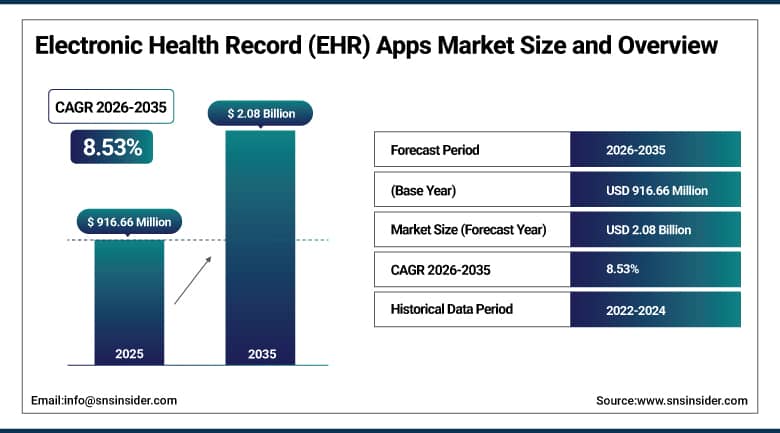
The Electronic Health Record (EHR) Apps Market was valued at USD 916.66 Million in 2025 and is expected to reach USD 2.08 Billion by 2035, growing at a CAGR of 8.53% from 2026-2035.
The market for Electronic Health Record (EHR) Apps is expanding due to the transition of common clinical and patient activities to smart phones and tablets. With the use of apps, doctors can view charts, process orders and make notes from wherever they are. Patients can use apps to view their results, schedule appointments and send messages to the care providers. Interoperability laws and open data standards have enabled third party developers to develop applications on top of the EHR. The use of ambient artificial intelligence has reduced documentation time. There continues to be investment in mobile access by hospitals and ambulatory centers. Cloud delivery of apps reduces update cycles. Android leads in the market while iOS is gaining ground.
⮞In March 2026, the American Medical Association reported that 81% of physicians use AI professionally, more than double the share in 2023. Rising clinician comfort with AI supports demand for apps that embed documentation and decision tools.
To Get More Information On Electronic Health Record (EHR) Apps Market - Request Free Sample Report
Electronic Health Record (EHR) Apps Market Trends:
-
Ambient AI documentation embedded in mobile and web EHR workflows
-
Patient facing apps built on open application programming interfaces
-
Cloud native EHR apps replacing on premise clinician tools
-
Voice assistants and generative AI inside mobile charting
-
National health data exchanges widening app access to patient records
U.S. Electronic Health Record (EHR) Apps Market Outlook:
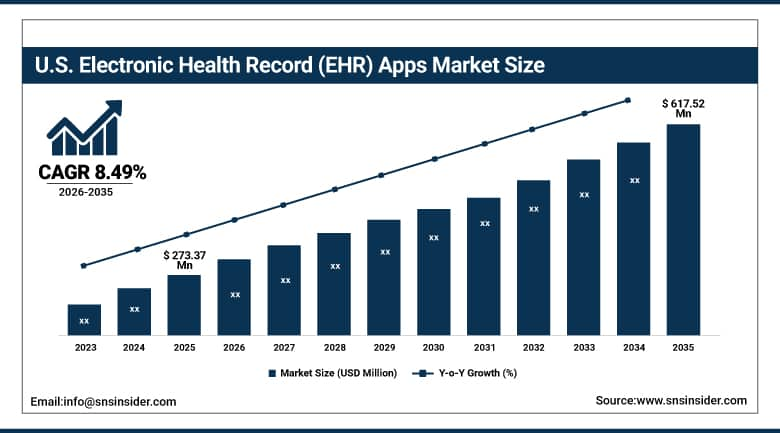
The U.S. Electronic Health Record (EHR) Apps Market was valued at USD 273.37 Million in 2025 and is expected to reach USD 617.52 Million by 2035, growing at a CAGR of 8.49% from 2026-2035.
The U.S. Market for Electronic Health Record Apps is greatly supported by the universal adoption of certified electronic health record (EHR) systems at hospitals and doctors' offices. The requirements of interoperability from the federal government demand standard application programming interfaces. This allows the apps to be linked with patient information. Health systems use clinician mobile apps to increase the speed of rounding and documentation process. Offices opt for scribe and patient engagement apps to reduce paperwork. Competition happens on marketplaces, partner programs, and artificial intelligence. Security and privacy responsibilities define procurement and vendor selection. Increasing the number of apps required due to telemedicine and remote monitoring programs is a trend too.
⮞In July 2025, the Centers for Medicare & Medicaid Services announced that more than 60 companies had pledged to a Health Tech Ecosystem that includes EHR vendors. The pledge signals federal backing for patient facing apps built on shared data standards.
Electronic Health Record (EHR) Apps Market Segment Analysis:
-
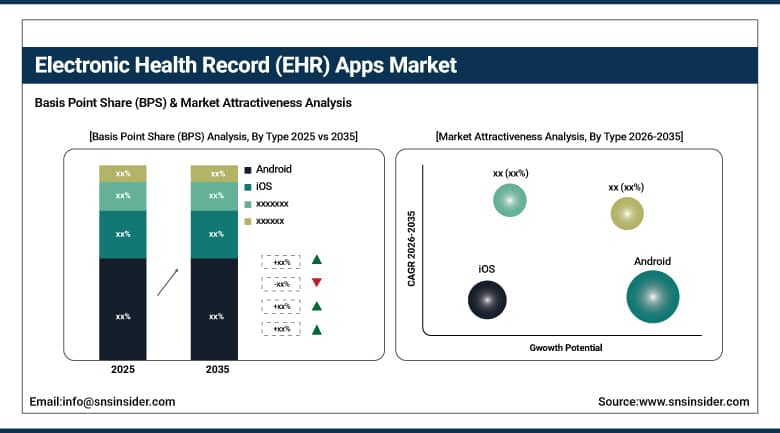
By Type, the Android segment dominated the Electronic Health Record (EHR) Apps Market with approximately 84.85% share in 2025, and is also the fastest growing with a CAGR of approximately 8.63%.
-
By Application, the Administrative segment dominated the Electronic Health Record (EHR) Apps Market with approximately 32.75% share in 2025, while the Clinical segment is the fastest growing with a CAGR of approximately 9.37%.
-
By End Use, the Hospitals segment dominated the Electronic Health Record (EHR) Apps Market with approximately 53.50% share in 2025, while the Ambulatory Care Centers segment is the fastest growing with a CAGR of approximately 10.33%.
-
By Product Type, the Cloud-Based EHR Apps segment dominated the Electronic Health Record (EHR) Apps Market with approximately 61.42% share in 2025, while the Mobile EHR Apps segment is the fastest growing with a CAGR of approximately 9.90%.
By Type, Android Dominates the Electronic Health Record (EHR) Apps Market and Also Grows Fastest
Android dominates the market as it fuels most of the mobile devices used by doctors and patients around the world. Health systems with a BYOD program find Android compelling due to its diversity of hardware options and reduced cost of devices. Manufacturers focus on Android platform while releasing patient applications in cost-sensitive regions such as APAC and Latin America. Hospital devices that use managed fleets depend on durable Android tablets and hand-held devices for nursing processes and barcode scanning. The development environment and open platforms facilitate faster release of feature updates among a large number of devices.
The platform is also expanding fastest because new markets adopt digital records through mobile first services. Public health programs in India, Southeast Asia, and Africa distribute apps that run on low cost phones. Clinicians in community practices use Android devices for voice dictation and image capture. Better security controls, such as device encryption and managed work profiles, are reducing past concerns. Meanwhile iOS remains strong in North America and among physicians in large academic centers, which keeps competition for clinician mindshare active. Vendors that support both platforms with consistent features capture the widest audience.
⮞In February 2026, Epic reported that MyChart Central was live in all 50 U.S. states. Reach of this scale gives patient facing mobile apps a national footprint.
By Application, Administrative Dominates the Electronic Health Record (EHR) Apps Market and Clinical Grows Fastest
Scheduling, registration, billing, messaging, and referrals head the list as these are used on an everyday basis by all practices. Mobile applications that make these processes easier help staff save time and prevent mistakes in claim submissions and insurance eligibility verification. Patients utilize administrative tools to check-in, pay bills, and schedule appointments using their mobile devices. Quick ROI is observed with the use of these solutions as the processes are highly repetitive and defined. Administrative software is often sold alongside other essential modules in EHRs by vendors. Thus, adoption and high usage rates are guaranteed for both hospitals and clinics.
Clinical apps are growing faster as artificial intelligence moves into the exam room. Ambient scribes, chart summaries, and order entry on mobile devices let clinicians document care while staying focused on patients. Decision support alerts and imaging viewers on tablets support rounding and bedside decisions. Medication tools that link to e-prescribing reduce errors and improve adherence. Hospitals value these features because they address clinician burnout and documentation backlogs. Interoperability with laboratory and imaging systems gives clinicians a fuller picture of the patient from a single app. Voice commands let clinicians update records without touching shared devices.
⮞In August 2026, Oracle Health reported that note generation in its Clinical AI Agent has saved physicians more than 400,000 hours in nearly two years. Time savings of this size explain the shift of investment toward clinical documentation apps.
By End Use, Hospitals Dominates the Electronic Health Record (EHR) Apps Market and Ambulatory Care Centers Grows Fastest
Hospitals lead adoption because they employ large clinical teams that move between units and need mobile access to records at the point of care. Nurses use handheld devices for medication administration and bedside documentation. Physicians review results and sign orders between procedures. Large IT budgets and enterprise agreements with EHR vendors support broad rollouts of mobile and patient apps. Integrated delivery networks also push patient portals to reduce call volumes and no shows, which increases the number of active users on each platform. Command center and rounding apps are also entering routine use.
Outpatient settings are growing faster as care shifts away from hospitals. Independent practices adopt cloud based EHR apps that need no on premise servers and can be run from a tablet. Specialty groups value configurable templates, mobile charting, and integrated billing. Smaller practices benefit from subscription pricing and rapid onboarding. Telehealth visits and remote monitoring link home patients to practice records through mobile apps. Private equity backed groups also standardize on a single platform across sites, which accelerates app adoption in outpatient networks. Staffing shortages in clinics increase interest in tools that reduce documentation time.
⮞In February 2026, MEDITECH reported that thousands of healthcare organizations in 29 countries and territories use its Expanse platform. A base of this breadth gives hospital app developers a large audience.
By Product Type, Cloud-Based EHR Apps Dominates the Electronic Health Record (EHR) Apps Market and Mobile EHR Apps Grows Fastest
The cloud based apps are the most dominant since vendors have shifted the EHR platforms to cloud based platforms that are always updated. Hospital and practices will not need server management but will enjoy easy access from anywhere. The cloud delivery system allows integration of other applications through application programming interfaces and market place. Regional hosting and certification allow addressing of the regulatory requirements. Subscriptions enable distribution of costs over time, which is beneficial to smaller providers. The vendors also use cloud based analytics to enhance the performance of the application and roll out the feature at the same time to the users.
The handheld apps are growing faster as there is the expectation from both clinicians and patients of the complete function when using phones and tablets. The offline mode, biometric logins, and push notifications make it easier for the clinicians to be able to use them in corridors and home visits. The apps allow the use of camera and microphone for taking photos, voice notes, and ambient sound recordings. The patients are also expected to use the mobile applications for viewing and messaging the care team, which increases engagement.
⮞In March 2026, Microsoft reported that Dragon Copilot is used by more than 100,000 clinicians. Cloud delivered ambient tools of this kind are becoming a standard layer on top of EHR platforms.
Regional Analysis:
|
Region |
Major Country |
Share within Region, 2025 (%) |
|---|---|---|
|
North America |
United States |
79.00% |
|
Europe |
Germany |
24.31% |
|
Asia Pacific |
China |
41.26% |
|
Latin America |
Brazil |
46.37% |
|
Middle East & Africa |
Saudi Arabia |
29.52% |
North America Electronic Health Record (EHR) Apps Market Insights
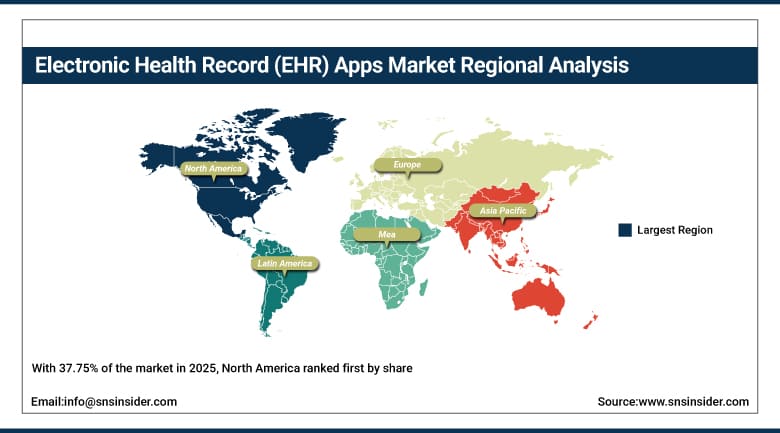
With 37.75% of the market in 2025, North America ranked first by share, supported by near universal EHR adoption, active developer ecosystems, and strong digital health investment. The United States drives most regional demand, and Canada adds activity through provincial digital health programs. Health systems run marketplaces where third party apps connect to clinical data. Vendors compete on artificial intelligence features, usability, and integration depth. Reimbursement for telehealth and remote monitoring supports app adoption in outpatient care. Patient access rules push providers to offer mobile access to records. Large academic centers often pilot new apps before network wide rollout.
Policy efforts are making an expansion in the app ecosystem. National exchange models link together vendors and payers, while federal initiatives promote patient oriented applications and interoperable standards. Software developers adopt standardized data formats to develop apps that will operate on multiple EHR systems. Security requirements are becoming higher, and vendors develop identity and audit services. Vendor consolidation and the involvement of major IT companies change partnership strategies. Specialty software vendors specialize in workflows like behavioral health, oncology and pediatrics and use special features to make their users loyal. Procurement groups request evidence of workflow improvements before purchasing.
⮞In February 2026, the U.S. Department of Health and Human Services reported that TEFCA had reached nearly 500 million health records exchanged. National exchange at this scale gives app developers a growing pool of connected data.
Get Customized Report as Per Your Business Requirement - Enquiry Now
Europe Electronic Health Record (EHR) Apps Market Insights
Europe led by Germany, the United Kingdom, France, and the Nordic countries, which have mature digital health programs. National patient portals and health apps give citizens access to records, prescriptions, and vaccination data. Hospital groups are replacing older systems with modern platforms that support mobile access. Public procurement frameworks favor interoperable and standards based solutions. Strict data protection law shapes design, and vendors host data in regional clouds to meet requirements. Language support and local clinical coding are decisive selection factors. Regional health authorities often run joint tenders, which favor vendors with proven references.
Cross border exchange is a growing priority, and EU wide plans aim to let citizens share records across member states and to support research use. Vendors are preparing for these requirements through new interfaces and certification efforts. Health technology startups focus on clinical documentation and triage tools adapted to local languages. National programs in the United Kingdom are working toward single patient records, which would increase demand for connected apps. Budget constraints in some countries slow rollouts, but staffing pressure keeps interest in efficiency tools high. Hospitals value tools that reduce administrative load. Clinician training programs are being funded alongside these technical upgrades.
⮞In March 2025, the European Commission confirmed that the European Health Data Space regulation entered into force, with priority data categories for primary use applying from 2029 and 2031. The timetable gives vendors a fixed horizon for interoperability work.
Asia Pacific Electronic Health Record (EHR) Apps Market Insights
Asia Pacific is the fastest growing region with an expected CAGR of 10.02% from 2026 to 2035, led by China, India, Japan, Australia, and South Korea. Government digital health programs are linking millions of records and encouraging apps built on national standards. Smartphone penetration is high, so mobile is the main way many patients and clinicians reach digital records. Hospital expansion in China and India creates demand for mobile clinician tools. Local vendors develop apps adapted to language, coding, and workflow needs, while global vendors partner with regional providers. Telemedicine growth after the pandemic keeps app usage elevated.
Public health insurance programs and digital identities become very useful in this situation. Identifiers of patients and consent management become critical in connecting apps with proper medical records. Private hospital chains in Southeast Asia and India use apps to provide services such as appointment booking, receiving test results, and billing services. Japan and South Korea have emphasized interoperability standards and adoption of cloud technology in their hospitals. Australia has created a national record from which connected apps receive a solid foundation. The buyers of cost sensitive nature prefer Android based solutions because they can serve large volumes of customers in the region.
⮞In July 2026, India's government fact sheet on the Ayushman Bharat Digital Mission reported about 1.04 billion health records linked. A linked base of this size gives app developers access to a very large patient population.
MEA & Latin America Electronic Health Record (EHR) Apps Market Insights
Latin America is advancing through national health data networks and growing private hospital groups in Brazil and Mexico. Mexico belongs to this region in market estimates, and its social security institutes are working on record interoperability agreements. Mobile first populations in the region favor apps for appointments, vaccination records, and teleconsultation. Currency volatility and budget limits slow enterprise purchases, yet public programs support steady growth. Local developers focus on affordable apps for clinics and pharmacies, and global vendors partner with regional distributors to reach new accounts. Argentina, Chile, and Colombia contribute through hospital modernization.
⮞In July 2025, a federal decree made Brazil's National Health Data Network the official digital platform of the public health system. The decree gives app developers a national interoperability reference.
The development of the Middle East and Africa region occurs due to government-led digital health initiatives in such countries as Saudi Arabia, United Arab Emirates, and Qatar. The exchange of health information at the national level connects various hospitals and clinics providing standardized data to developers of health apps. The development of virtual hospitals and patients' applications extends services to distant territories. The private hospital chains are implementing their records in the cloud system. In Africa, the initiatives of mobile health systems are implemented in order to provide assistance in clinics with poor connectivity.
⮞In August 2025, M42 reported that Abu Dhabi's Malaffi health information exchange had reached 3.5 billion clinical records. Exchange data at this scale supports app developers building tools for the emirate's providers.
Market Dynamics:
Growth Drivers: Ambient AI Documentation and Smartphone Adoption Among Clinicians Drive Growth in the Electronic Health Record (EHR) Apps Market
Documentation burden is a leading source of clinician burnout, and ambient artificial intelligence tools address it directly. Apps that listen to visits and draft notes reduce after hours charting and allow clinicians to focus on patients. Vendors are embedding these features in mobile and web workflows, and large health systems are rolling them out across specialties. Investment in AI scribes has grown quickly, which shows strong commercial interest. Adoption by more physicians creates a larger base for further app development. Positive early results are encouraging wider deployment. Pilot programs that report shorter charting time help justify budgets for broader rollouts.
Smartphone and tablet use among clinicians and patients provides the user base that apps need. Most office based physicians and nearly all hospitals use certified EHR systems, so the data foundation is in place. Interoperability rules require open interfaces, which lets developers build apps without custom integration for each customer. Patients expect mobile access to results and scheduling. Telehealth and remote monitoring programs add use cases that rely on connected apps. Cloud delivery allows vendors to ship improvements quickly and keeps apps current. Together these forces support steady growth through 2035. Software updates reach every user at once, which keeps feature sets consistent across sites.
⮞In December 2025, athenahealth announced that its Ambient Notes offering is available to more than 170,000 clinicians. Reach of this scale shows how quickly AI documentation apps are spreading through ambulatory care.
Restraints: Implementation Costs, Security Risks, and Regulatory Uncertainty Restrain Growth in the Electronic Health Record (EHR) Apps Market
Costs of implementation are still very high for smaller practices. Costs related to license of EHRs, installation of applications, support services and integration can sum up to a lot, and many practices are not willing to add additional payment for application to the cost of main software. For large hospitals procurement takes a lot of time and customization is quite complicated. Lock-in to one vendor is limited by the fact that application functions properly only with one software platform. Disruption of workflow during implementation process decreases productivity, and thus managers are hesitant about implementation. Integration problems between applications and legacy systems delay the process and make practices not want to invest more money.
There are substantial issues of security and privacy. Mobile devices multiply the access points to confidential information, and data breaches lead to millions of records compromised annually. There is an additional expense due to the need for providers to spend on encryption and other aspects. Regulatory uncertainties exist due to the evolving nature of certification and interoperability in some of the regions. Products have to be adapted to changing regulations, which slows down the roadmaps. Conflicting privacy regulations across various nations make the launch process difficult and expensive. Small vendors find it challenging to cope with the additional expense. Cyber insurance rates increased dramatically.
⮞In December 2025, the Assistant Secretary for Technology Policy and its Office of the National Coordinator for Health IT announced a proposed rule that would remove 34 of 60 health IT certification criteria. Such changes force vendors to revisit product roadmaps and compliance plans.
Opportunities: National Health Record Programs and Patient Facing App Ecosystems Create Opportunities in the Electronic Health Record (EHR) Apps Market
National health record schemes in Australia, India, Saudi Arabia, and many other countries are building large interconnected pools of data that can be leveraged by apps. Uniform identifiers and consent structures reduce integration effort for developers. Government-backed app marketplaces and ecosystems provide approved apps with visibility and credibility. Vendors who develop products according to national standards can access several markets using common technical components. Publicly-funded digital literacy and education programs for clinicians contribute to higher adoption. Early involvement allows for better positioning in national app stores. Interoperability projects with neighboring nations would multiply these advantages.
Patient facing app ecosystems offer another opportunity. Patients increasingly expect to manage appointments, medications, and records from their phones. Apps that connect to multiple providers and wearables give a complete view of health, which supports chronic disease management. Payers and employers sponsor engagement tools that improve adherence and reduce costs. Developers that offer secure data sharing, personalized guidance, and easy onboarding can build large user bases. Partnerships with health systems and pharmacies expand reach and create recurring revenue. Generative AI features such as plain language summaries add value for patients. Pharmacies and retail clinics are emerging as new partners for connected record apps.
⮞In February 2026, the Australian Digital Health Agency reported more than 24.8 million My Health Records. A national record of this scale offers a stable base for connected consumer and clinician apps.
Recent Developments:
-
In March 2026, ModMed reported that its Scribe 2.0 ambient documentation tool reached 240,000 patient visits and more than 1,600 providers within three months of release.
-
In June 2026, Elation Health acquired Aster, a voice AI start-up, to add voice automation to its EHR platform. The acquisition brings tools for calls and administrative tasks into the clinical workflow of independent primary care practices.
-
In June 2026, AdvancedMD released its 2026 Summer Release, which includes an AI Clinical Assistant for Mobile.
-
In January 2026, Tebra reported that its AI Note Assist generated more than 500,000 notes in the second half of 2025.
Electronic Health Record (EHR) Apps Market Key Players are:
-
Epic
-
Oracle Health
-
athenahealth
-
MEDITECH
-
eClinicalWorks
-
NextGen Healthcare
-
Veradigm
-
ModMed
-
Tebra
-
Elation Health
-
DrChrono
-
AdvancedMD
-
TruBridge
-
Netsmart
-
Microsoft (Dragon Copilot)
-
Abridge
-
Ambience Healthcare
Electronic Health Record (EHR) Apps Market Report Scope:
| Report Attributes | Details |
|---|---|
| Market Size in 2025 | USD 916.66 Million |
| Market Size by 2035 | USD 2.08 Billion |
| CAGR | CAGR of 8.53% From 2026 to 2035 |
| Base Year | 2025 |
| Forecast Period | 2026-2035 |
| Historical Data | 2022-2024 |
| Report Scope & Coverage | Market Size, Segments Analysis, Competitive Landscape, Regional Analysis, DROC & SWOT Analysis, Forecast Outlook |
| Key Segments | • By Type (Android and iOS) • By Application (Administrative, Clinical, e-Prescribing, and Others) • By End Use (Hospitals, Ambulatory Care Centers, and Others) • By Product Type (Cloud-Based EHR Apps and Mobile EHR Apps) |
| Regional Analysis/Coverage | North America (US, Canada), Europe (Germany, UK, France, Italy, Spain, Russia, Poland, Rest of Europe), Asia Pacific (China, India, Japan, South Korea, Australia, ASEAN Countries, Rest of Asia Pacific), Middle East & Africa (UAE, Saudi Arabia, Qatar, South Africa, Rest of Middle East & Africa), Latin America (Brazil, Argentina, Mexico, Colombia, Rest of Latin America). |
| Company Profiles | Epic, Oracle Health, athenahealth, MEDITECH, eClinicalWorks, NextGen Healthcare, Veradigm, ModMed, Tebra, Elation Health, DrChrono, AdvancedMD, TruBridge, Netsmart, Microsoft (Dragon Copilot), Abridge, Ambience Healthcare |

Frequently Asked Questions
Key players in the market include Epic, Oracle Health, athenahealth, MEDITECH, eClinicalWorks, and NextGen Healthcare, among others.
Key opportunities include national health record programs that create large connected data pools and patient facing app ecosystems that connect providers, payers, and wearables.
Ambient AI documentation and rising smartphone adoption among clinicians are the major growth factors, as apps reduce documentation burden and extend EHR access to mobile devices.
The Android segment dominated the market in 2025 with approximately 84.85% share, as the platform powers most smartphones and tablets used by clinicians and patients worldwide.
North America dominated the market in 2025 with approximately 37.75% share, supported by near universal EHR adoption, active developer ecosystems, and strong digital health investment.
