
Electronic Trial Master File (eTMF) Systems Market Report Scope & Overview:
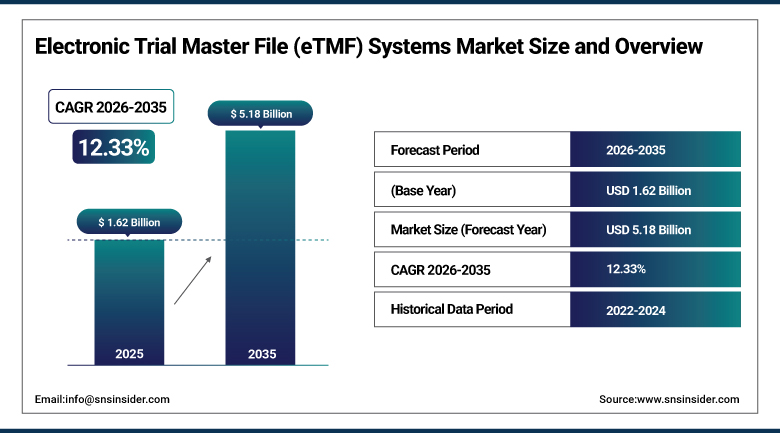
The Electronic Trial Master File (eTMF) Systems Market was valued at USD 1.62 Billion in 2025 and is expected to reach USD 5.18 Billion by 2035, growing at a CAGR of 12.33% from 2026-2035.
The Electronic Trial Master File (eTMF) Systems Market serves the increasing number and complexity of the documents associated with clinical trials. The documents consist of protocols, consent forms, regulatory communications, visit reports, and others. Previously, filing cabinets and binders used to be used by sponsors and clinical research organizations for managing documents. However, it created problems as trials were conducted in different countries and at several sites. eTMF systems have made it possible to store, retrieve, and track clinical trial documents in a single, auditable system. In a recent 2023 survey conducted by Veeva Systems, approximately 80% of sponsors of clinical trials using eTMF indicated increased productivity, whereas the process of document filing took 50% less time than previously used methods.
In April 2025, Veeva Systems announced Veeva SiteVault CTMS, a clinical trial management system purpose-built for research sites that integrates directly with SiteVault eISF and eConsent, giving sites bidirectional data flow with sponsors that use Veeva's broader Clinical Platform. That kind of seamless site-to-sponsor connectivity matters enormously in practice, since a huge amount of friction in clinical trial oversight has historically come from documents and data getting stuck in translation between what a site tracks locally and what a sponsor's systems expect to see, and closing that gap is exactly what's driving the next wave of eTMF platform investment.
To Get more information Electronic Trial Master File (eTMF) Systems Market - Request Free Sample Report
Electronic Trial Master File (eTMF) Systems Market Trends
-
Rising integration of generative AI for document classification, redaction, and automated compliance checking.
-
Growing use of blockchain technology to create immutable, tamper-proof audit trails for regulatory documentation.
-
Expanding demand for centralized, cloud-based eTMF platforms supporting decentralized and hybrid trial designs.
-
Increasing predictive analytics capability helping sponsors flag trial delays and inspection readiness gaps in advance.
-
Rising strategic partnerships between eTMF vendors and broader clinical trial platform providers for deeper integration.
U.S. Electronic Trial Master File (eTMF) Systems Market Outlook
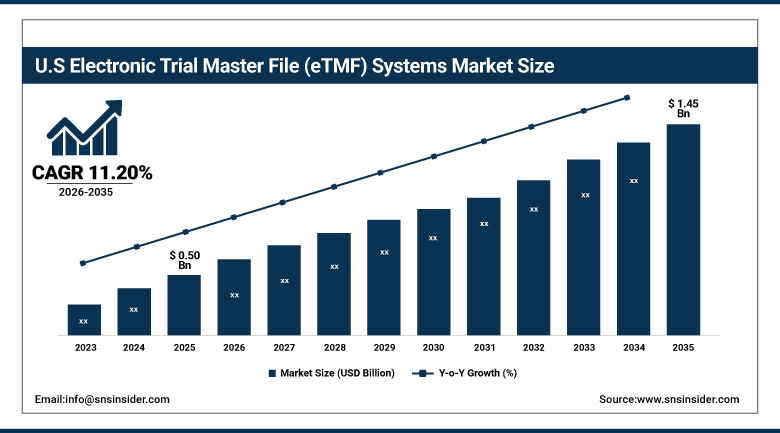
The U.S. Electronic Trial Master File (eTMF) Systems Market was valued at USD 0.50 Billion in 2025 and is expected to reach USD 1.45 Billion by 2035, growing at a CAGR of 11.20% from 2026-2035.
The United States anchors this market by a wide margin, home to the majority of leading eTMF vendors and a pharmaceutical and biotech industry that runs an enormous share of the world's clinical trial activity. That concentration of both supply and demand keeps the domestic market at the technical forefront of the category, with vendors here typically first to market with AI-powered document classification, predictive inspection-readiness tools, and other capabilities that later get adopted more broadly. The continued shift toward decentralized and hybrid trial designs, which became especially pronounced during the pandemic years and never fully receded, keeps reinforcing demand for centralized, cloud-based platforms capable of coordinating study teams and documentation across geographically dispersed sites.
In 2025, MasterControl, based in Salt Lake City, entered a strategic partnership with Oracle Health to integrate its eTMF solution with Oracle's broader health data ecosystem, a move explicitly aimed at streamlining regulatory submissions. Pairing eTMF documentation with a major electronic health record and health data platform is a genuinely useful combination, since it starts to close the gap between clinical trial documentation and the broader healthcare data infrastructure that increasingly informs how trials are designed and monitored, illustrating how domestic vendors continue looking beyond eTMF as a standalone category toward deeper integration with the broader clinical technology stack.
Electronic Trial Master File (eTMF) Systems Market Segment Analysis
-
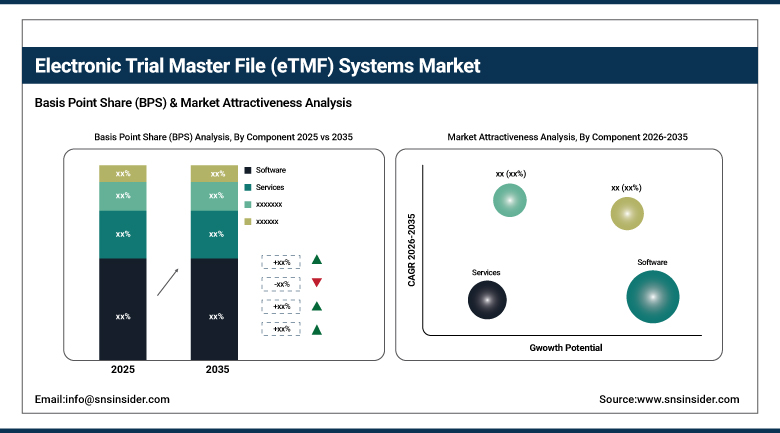
By Component, the Software segment dominated the eTMF Systems Market with approximately 58.60% share in 2025, while the Services segment is the fastest growing with a CAGR of approximately 13.60%.
-
By Deployment Mode, the Cloud-Based segment dominated the eTMF Systems Market with approximately 58.60% share in 2025, and is also the fastest growing with a CAGR of approximately 14.20%.
-
By Functionality, the Document Management segment dominated the eTMF Systems Market with approximately 39.60% share in 2025, while the Regulatory Compliance segment is the fastest growing with a CAGR of approximately 15.20%.
-
By System Type, the Integrated eTMF Systems segment dominated the eTMF Systems Market with approximately 64.20% share in 2025, while the Standalone eTMF Systems segment is the fastest growing with a CAGR of approximately 13.80%.
-
By End-User, the Pharmaceutical & Biotech Companies segment dominated the eTMF Systems Market with approximately 47.60% share in 2025, while the Contract Research Organizations segment is the fastest growing with a CAGR of approximately 14.60%.
By Component, Software Dominates the eTMF Systems Market and Services Grows Fastest
Software makes up the largest share of this market simply because the platform itself, the actual document repository, workflow engine, and compliance tracking tools, is what sponsors and CROs are fundamentally purchasing. Modern eTMF software has evolved well beyond basic file storage into genuinely sophisticated systems capable of enterprise content management, automated document classification through tools like TMF Bot, and real-time co-authoring, and that expanding functionality keeps software firmly at the center of what buyers value most.
Services are growing faster, though, which reflects how much expertise it now takes to properly configure and maintain an increasingly sophisticated eTMF deployment. As platforms add AI-driven classification, predictive analytics, and deeper integrations with CTMS and EDC systems, sponsors and CROs increasingly need specialized implementation, migration, and ongoing consulting support to actually realize that functionality's full value, pushing services demand to outpace software growth.
By Deployment Mode, Cloud-Based Dominates the eTMF Systems Market and Also Grows Fastest
Cloud-based deployment dominates this market because it directly solves one of clinical research's most persistent operational headaches: coordinating document access and collaboration across sponsors, CROs, and sites scattered across dozens of countries. A centralized cloud platform gives every stakeholder real-time access to the same up-to-date documentation regardless of where they're physically located, which matters enormously for trials that increasingly span multiple continents and involve constantly shifting rosters of external partners.
Cloud-based deployment is also the fastest-growing mode, as the continued rise of decentralized and hybrid trial designs makes centralized, remotely accessible documentation less of a nice-to-have and more of an operational requirement. Vendors are responding by continuing to invest heavily in cloud infrastructure, including new regional data centers that address data residency and security requirements, reinforcing cloud's already-dominant position as the default deployment choice for new eTMF implementations.
By Functionality, Document Management Dominates the eTMF Systems Market and Regulatory Compliance Grows Fastest
Document management remains the core functionality most buyers are purchasing an eTMF system for in the first place, covering the fundamental work of uploading, classifying, version-controlling, and organizing the enormous volume of documentation a clinical trial generates. This foundational capability, upload, quality control, approval workflows, and matching content against Expected Document Lists, continues to represent the largest share of functionality-driven demand across the market.
Regulatory compliance functionality is growing fastest, as sponsors and CROs increasingly look to their eTMF platform to do more than just store documents, they want active support in staying ahead of inspection readiness and shifting regulatory expectations. Features like automated quality checks for missing or overdue documents, risk-based document QC, and predictive analytics flagging potential compliance gaps before an inspector ever asks about them are becoming central selling points, and demand for this capability is outpacing growth in more basic document storage functionality.
By System Type, Integrated eTMF Systems Dominates the eTMF Systems Market and Standalone eTMF Systems Grows Fastest
The Integrated eTMF Systems segment held the highest market share in the eTMF Systems Market in 2025 due to rising needs for clinical trial documentation and its integration into other clinical research systems. Integrated eTMF systems allow companies to link the process of eTMF with the process of clinical trials management, electronic data capture, regulatory, and quality process. The capability of integrated eTMF systems to enhance document visibility, workflow standardization, compliance, and decrease administrative burdens contributes to their adoption by pharmaceutical, biotechnology, and contract research organizations conducting clinical trials.
The standalone eTMF systems are projected to witness the fastest growth in the eTMF Systems Market on account of the rising demand for stand-alone systems from companies requiring specific functions of electronic document management without having to integrate an entire clinical platform. The advantages of such systems include easy implementation and deployment with specific functionalities such as document management, document indexing, versioning, and audit-readiness. Growth in the adoption of such systems by small pharmaceuticals, biotechnology firms, and new clinical research organizations is expected to drive segment growth over the forecast period.
By End-User, Pharmaceutical & Biotech Companies Dominates the eTMF Systems Market and Contract Research Organizations Grows Fastest
Pharmaceutical and biotech companies represent the largest end-user category, and that makes sense given the intense regulatory scrutiny these organizations face in demonstrating the safety and efficacy of new products to public health authorities. As trial sponsors, these companies bear ultimate responsibility for the completeness and integrity of the trial master file, making comprehensive eTMF investment a business-critical rather than optional purchase for any organization running global trials.
Contract research organizations are growing fastest as end-users, reflecting the broader trend of sponsors increasingly outsourcing trial execution to specialized CROs that need eTMF capability suited to managing multiple concurrent client studies rather than a single sponsor's portfolio. CROs need features like federated access and multi-client TMF management that differ somewhat from what a typical sponsor requires, and vendors serving this segment well are capturing a growing share of demand as outsourced trial execution continues to expand.
Regional Analysis
|
Region |
Major Country |
Share within Region, 2025 (%) |
|---|---|---|
|
North America |
United States |
84.60% |
|
Europe |
Germany |
29.60% |
|
Asia Pacific |
China |
39.60% |
|
Latin America |
Brazil |
27.60% |
|
Middle East & Africa |
United Arab Emirates |
24.60% |
North America eTMF Systems Market Insights
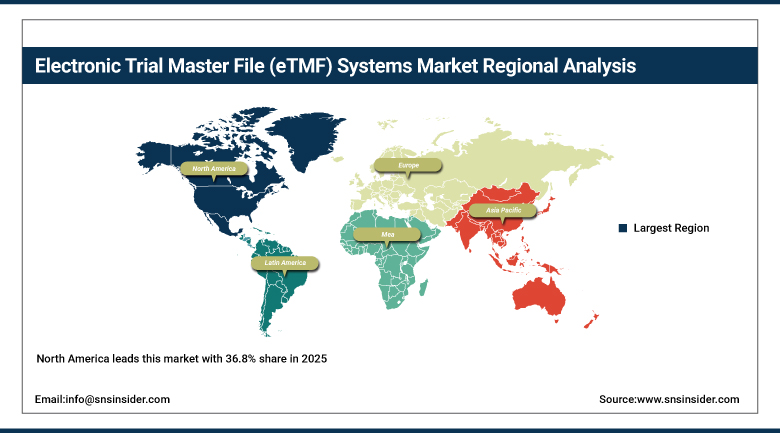
North America leads this market with 36.8% share in 2025, anchored by the United States' substantial concentration of pharmaceutical, biotech, and CRO sponsors running an outsized share of global clinical trial activity. The region's regulatory environment, with the FDA's well-established expectations around trial documentation and inspection readiness, has long pushed sponsors here toward sophisticated, audit-ready eTMF capability well ahead of many other markets.
Canada contributes steadily to regional demand as its own clinical research sector continues expanding. Continued domestic vendor investment in AI-driven compliance tools and deeper platform integration is expected to sustain North America's leading position through the forecast period, even as growth rates elsewhere start to close the gap.
Get Customized Report as per Your Business Requirement - Enquiry Now
Asia Pacific eTMF Systems Market Insights
Asia Pacific is the fastest-growing region in the Electronic Trial Master File (eTMF) Systems Market, with a CAGR of approximately 14.80% from 2026 to 2035. This is fueled by increasing investment in clinical trials and a growing embrace of decentralized trial approaches across the region. China's rapidly maturing pharmaceutical industry and expanding clinical trial infrastructure continue to drive substantial new demand for eTMF platforms as domestic sponsors increasingly run trials meeting international regulatory standards.
India is contributing meaningful growth as its contract research organization sector continues to scale, drawing increasing international sponsor outsourcing activity. Japan and South Korea add further weight through established pharmaceutical industries adopting increasingly sophisticated trial documentation technology, keeping Asia Pacific firmly on track as the fastest-growing region through 2035.
Europe eTMF Systems Market Insights
Europe represents a substantial share of this market, anchored by Germany's large pharmaceutical industry and a well-established clinical research infrastructure. European Medicines Agency guidance around risk-proportionate trial oversight continues to reinforce regional adoption of sophisticated eTMF capability as sponsors align documentation practices with evolving regulatory expectations.
The United Kingdom, France, and Switzerland contribute steady demand as regional pharmaceutical and CRO sponsors continue extending eTMF adoption across their trial portfolios. Vendors serving the region continue investing in local data center capacity to address data residency requirements that matter increasingly to European sponsors and regulators alike.
MEA & Latin America eTMF Systems Market Insights
The Middle East & Africa market remains comparatively modest, though growing clinical trial activity across the United Arab Emirates and Saudi Arabia is starting to create real interest in eTMF adoption. Regional pharmaceutical and healthcare investment continues supporting gradual clinical trial infrastructure development.
Latin America's market is led by Brazil, where an expanding clinical trial sector continues to drive gradual eTMF market growth. Mexico is contributing incremental growth as regional CRO activity continues to expand, with adoption across the broader region still concentrated among larger sponsors and CROs with established international trial relationships.
Market Dynamics
Growth Drivers: Clinical Trial Complexity and Decentralized Trial Growth
The surge in clinical trial complexity represents the primary force behind this market's growth, as trials spanning more countries, more sites, and more concurrent workstreams generate documentation volumes that paper-based and even basic digital filing systems simply can't handle reliably. Regulatory documentation needs continue climbing in step with that complexity, reinforcing eTMF adoption as close to a practical necessity for any sponsor running trials at meaningful scale.
The rise of decentralized and hybrid trial designs adds a second major growth driver, as these approaches inherently require centralized, remotely accessible documentation that can coordinate geographically dispersed study teams and sites in real time. Advancements in AI-led document management continue reinforcing this trend, as automated classification and compliance checking make it genuinely feasible to manage the growing document volumes these more complex trial designs generate.
Restraints: High Implementation Costs and Legacy System Transition Challenges
High implementation costs represent a meaningful restraint, particularly for smaller biotechs and academic research institutions operating with tighter budgets than large pharmaceutical sponsors. Comprehensive eTMF platforms with advanced AI and compliance features command premium pricing, and that cost can genuinely limit adoption among organizations running smaller trial portfolios.
Migrating from legacy, often paper-based or fragmented digital systems presents its own challenge, as sponsors with years of accumulated trial documentation face genuine complexity in cleanly transferring that historical record into a new platform without losing data integrity or audit trail continuity. That transition burden can slow adoption timelines even among organizations that recognize the long-term value of moving to a modern eTMF system.
Opportunities: AI-Driven Automation and Deeper Clinical Platform Integration
Continued advancement in AI-led document management represents a substantial opportunity, as vendors that can deliver genuinely reliable automated classification, redaction, and compliance checking are positioned to meaningfully reduce the manual burden that still weighs down many trial documentation workflows. Vendors demonstrating superior AI accuracy are increasingly favored by sponsors looking to extract real productivity gains rather than incremental improvements.
Deeper integration with broader clinical trial technology, including CTMS, EDC, and health data platforms, offers a further avenue for growth, as sponsors increasingly want their eTMF to function as one connected piece of a unified clinical technology stack rather than an isolated documentation silo. Vendors that can deliver that kind of seamless, bidirectional integration are well positioned to capture demand from sponsors seeking to reduce the manual data reconciliation that fragmented systems tend to create.
Recent Developments:
-
2026: Medidata expanded enterprise AI adoption through Medidata Plus, enabling AI across study, data, and patient experiences to improve clinical-trial execution and delivery.
-
2026: IQVIA introduced Predictive Clinical Development, combining healthcare-grade AI, proprietary data, and agentic workflows to accelerate study startup, recruitment, data cleaning, and trial execution.
-
2026: TransPerfect continued expanding Trial Interactive eClinical capabilities, including TMF services and education, supporting improved clinical-document visibility, compliance, quality, and risk management.
Electronic Trial Master File (eTMF) Systems Market Key Players are:
-
Veeva Systems Inc.
-
Oracle Corporation
-
Dassault Systèmes SE (Medidata Solutions)
-
IQVIA Holdings Inc.
-
TransPerfect Life Sciences
-
Phlexglobal Ltd. (Cencora, Inc.)
-
ArisGlobal
-
MasterControl Solutions, Inc.
-
Ennov SAS
-
Montrium Inc.
-
Florence Healthcare, Inc.
-
Egnyte, Inc.
-
Cloudbyz
-
EXTEDO GmbH
-
Aurea, Inc.
-
Anju Software, Inc.
-
WCG Clinical
-
Parexel International Corporation
-
ICON plc
-
Clario
Electronic Trial Master File (eTMF) Systems Market Report Scope :
| Report Attributes | Details |
|---|---|
| Market Size in 2025 | USD 1.62 Billion |
| Market Size by 2035 | USD 5.18 Billion |
| CAGR | CAGR of 12.33% From 2026 to 2035 |
| Base Year | 2025 |
| Forecast Period | 2026-2035 |
| Historical Data | 2022-2024 |
| Report Scope & Coverage | Market Size, Segments Analysis, Competitive Landscape, Regional Analysis, DROC & SWOT Analysis, Forecast Outlook |
| Key Segments | • By Component (Software, Services) • By Deployment Mode (Cloud-Based, On-Premise) • By Functionality (Document Management, Regulatory Compliance, Reporting & Analytics, Workflow & Collaboration, Clinical Operations Management, Others) • By System Type (Integrated eTMF Systems, Standalone eTMF Systems) • By End-User (Pharmaceutical & Biotech Companies, Contract Research Organizations, Academic Institutes, Medical Device Manufacturers, Others) |
| Regional Analysis/Coverage | North America (US, Canada), Europe (Germany, UK, France, Italy, Spain, Russia, Poland, Rest of Europe), Asia Pacific (China, India, Japan, South Korea, Australia, ASEAN Countries, Rest of Asia Pacific), Middle East & Africa (UAE, Saudi Arabia, Qatar, South Africa, Rest of Middle East & Africa), Latin America (Brazil, Argentina, Mexico, Colombia, Rest of Latin America). |
| Company Profiles | Veeva Systems Inc., Oracle Corporation, Dassault Systèmes SE (Medidata Solutions), IQVIA Holdings Inc., TransPerfect Life Sciences, Phlexglobal Ltd. (Cencora, Inc.), ArisGlobal, MasterControl Solutions, Inc., Ennov SAS, Montrium Inc., Florence Healthcare, Inc., Egnyte, Inc., Cloudbyz, EXTEDO GmbH, Aurea, Inc., Anju Software, Inc., WCG Clinical, Parexel International Corporation, ICON plc, Clario |

Frequently Asked Questions
Key players include Veeva Systems Inc., Oracle Corporation, Dassault Systèmes SE, IQVIA Holdings Inc., TransPerfect Life Sciences, Phlexglobal Ltd., and MasterControl Solutions, Inc., among other clinical technology providers.
Continued advancement in AI-led document management and deeper integration with broader clinical trial technology, including CTMS and EDC platforms, represent the biggest opportunities.
Growth is driven mainly by the surge in clinical trial complexity and regulatory documentation needs, combined with the continued rise of decentralized and hybrid trial designs.
By Component, Software held approximately 58.60% share in 2025, reflecting its role as the core platform sponsors and CROs purchase for document management and compliance tracking.
North America led with approximately 38.60% share in 2025, supported by the region's substantial concentration of pharmaceutical, biotech, and CRO sponsors.
