
Enriched Biochar Market Report Scope & Overview:
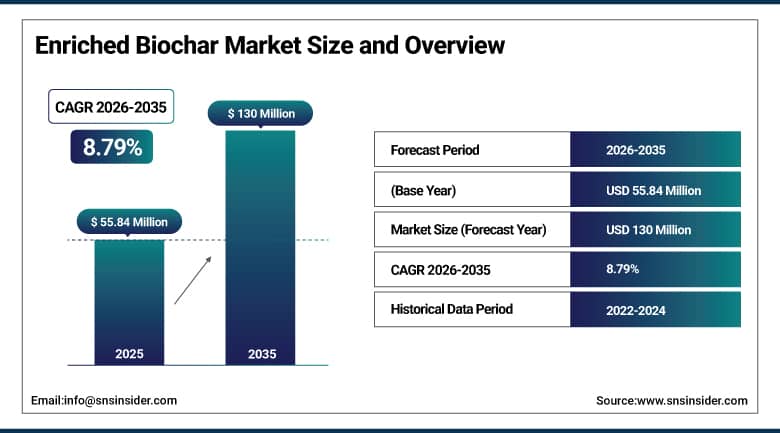
The Enriched Biochar Market was valued at USD 55.84 million in 2025 and is expected to reach USD 130 million by 2035, growing at a CAGR of 8.79% from 2026–2035.
Enriched biochar is a carbonaceous soil amendment produced through the pyrolysis of organic biomass under conditions with limited oxygen availability, followed by enrichment with nutrients and microbial inoculants so as to form a composite multifunctional product designed for increasing soil mineral fertility capacity, nutrient retention and water-holding capacity and carbon sequestration. In addition to the long-term soil conditioning benefits of the biochar matrix and its role as a carbon sink, enriched biochar provides immediate agronomic advantages from the nutrient load it offers (standard biochars are primarily recommend for their functions as a medium to improve soil physical properties and carbon sequestration). Increasing concern regarding soil erosion affecting more than 40% of the total agricultural land base coupled with rising demand for low-emission replacement technologies to conventional fertilizers, and growing carbon credit economy acknowledging biochar as a sequestration solution is further propelling market expansion.
In 2024, the enriched biochar production market was most for the pyrolysis technology with 52.27% share of total. The high carbon stability of biochar is obtained through pyrolysis, which refers to the heating of biomass in oxygen-free atmosphere at a temperature integrated with an absence of moisture and radical thermal degradation at approximately 300-700 °C (Hagemann et al. The U.S. Department of Energy supports this production pathway as pyrolysis with promising carbon sequestration potentials is one of the efficient biomass conversion methods.
The turf and landscaping segment represents the fastest growing enriched biochar application in this end-use sector due to expected substantial demand for sustainable and low water lawn & green space management activities over the forecast period. Fields Professional sports field managers, golf course operations and municipal parks departments have seen opportunities for application of biochar when supplemented with nitrogen or phosphorous that increase turf quality while consuming less water through irrigation allowing for reductions in synthetic fertilizers in high maintenance turfgrass applications.
To Get More Information On Enriched Biochar Market - Request Free Sample Report
Enriched Biochar Market Trends:
-
Carbon credit market growth creating financial incentives for biochar soil application beyond agronomic value, improving project economics.
-
Organic farming expansion driving demand for approved soil amendments that improve fertility without synthetic inputs.
-
Precision agriculture tools enabling site-specific enriched biochar application rates optimized for soil type and crop requirements.
-
Microbially-enriched biochar products inoculated with mycorrhizal fungi and plant-growth-promoting bacteria gaining scientific and commercial traction.
-
Hydrothermal carbonization (HTC) as an alternative production technology enabling use of wet biomass feedstocks not suitable for conventional pyrolysis.
-
Soil remediation applications in contaminated urban and industrial sites using enriched biochar to immobilize heavy metals and restore soil biology.
-
EU Farm to Fork strategy and Carbon Farming Initiative creating regulatory support for biochar adoption in European agricultural markets.
U.S. Enriched Biochar Market Size Outlook:
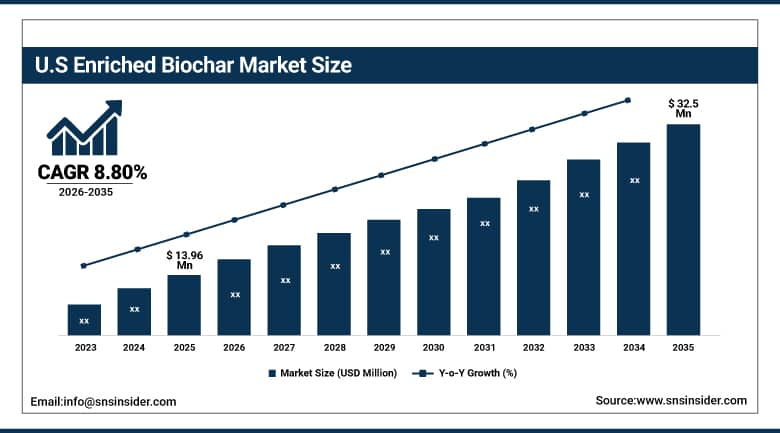
The U.S. Enriched Biochar Market was valued at USD 13.96 million in 2025 and is expected to reach USD 32.5 million by 2035, at a CAGR of 8.80% from 2026 to 2035.
Growth in the U.S. biochar market is driven by increasing organic farming, adoption of precision ag practices, indoor cannabis cultivation and engagement in voluntary carbon markets where farmers are compensated to earn carbon credits based on verified correlative application of biochar to soil. Biochar enrichment (i.e., biochar mixtures with soil) is expected to rise in agricultural use as organic certification standards for soil amendments at the U.S. Department of Agriculture continue to develop supportive policy frameworks, other provisions within the Inflation Reduction Act related to agricultural climate practices could open effective market channels for achieving these outcomes. Two US biochar producers developing enriched biochars for the agricultural marketplace to sea and also in the carbon credit market: Carbon Solutions and Pacific Biochar.
The emerging premium value of biochar carbon credits tied to the permanence of carbon locked in the char matrix is opening a new revenue stream for U.S. biochar producers by increasing the economic attractiveness of selling enriched biochar to farmers who benefit from both agronomic benefits and eventual CDR payment upon soil application.
Enriched Biochar Market Segment Insights
-
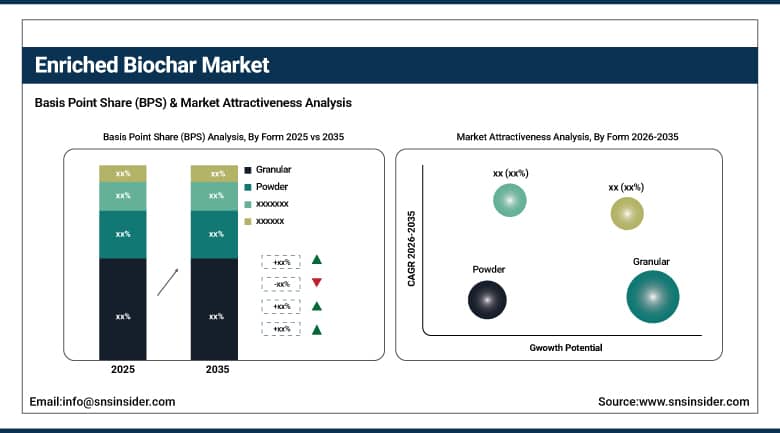
Based on Form, Granular enriched biochar leads for ease of mechanical application; Powder is used for soil incorporation and blending.
-
Based on Application, Agriculture is the largest segment (65%+ of market) for crop yield and soil improvement; Turf is the fastest-growing application.
-
Based on Crop Type, Cereals & Grains dominate as the largest crop sector; Fruits & Vegetables command premium pricing for quality-sensitive growers.
-
Based on Nutrient Enrichment, NPK-enriched biochar serves broad-acre farming; Microbial-enriched is growing fastest for high-value horticultural applications.
By Form: Complete Segment Analysis
Granular (Largest):
The predominant product form is a granular enriched biochar since it can be mechanically applied using conventional agricultural spreading equipment, blended with traditional granular fertilizers and accurately placed via variable-rate application machinery in precision agriculture practices. Granular type products do not generate dust during handling, have lower application losses than powder and are easier to handle for farmers used to handling granular fertilizer products. Granular enriched biochar is most commonly obtained through pelleting pyrolyzed biochar material with nutrient inputs and binders.
Liquid Suspension: (Fastest Growing)
Liquid biochar suspensions facilitate foliar application, fertigation via irrigation systems and seed coating applications that are not possible with solid biochar forms. Liquid coal-based biological products were expanding into garden and agricultural crops that receive precision irrigation programs (phased nutritional regimens). This enables the reliable delivery of biological inoculants and organisms in liquid microbially-enriched biochar suspensions more so than solid products, especially for automated greenhouse irrigation systems.
By Application: Complete Segment Analysis
Agriculture (Largest, 65%+ share):
Enriched biochar is used primarily in agricultural applications, which span nearly all types of crop production systems, from broad-acre commodity grain farming to high value specialty crop production. Biochar that has been enriched thereby further improves soil structure, provides additional cation exchange capacity for retention of essential nutrients, increases water-holding capacity thus minimizing irrigation requirements, and improves the function of soil microbial communities involved in nutrient cycling. Enriched biochar acts as a slow-release nutrient medium reducing the frequency and quantity of fertilizer needed while keeping up with yield. The most potent value proposition of this technology lies in tropical and subtropical soils which have a strong inductive tendency of low nutrient retention, as well as degraded agricultural land, where conventional fertilization is becoming less efficient.
Turf & Landscaping (Fastest Growing):
Eco-friendly lawn and green space management for professional turf managers, golf course operators, sports field managers, and municipal park authorities is driving the highest CAGR segment of turf & landscaping applications. Biochar enhancerd turf improved density, resilience and water use through enhanced soil moisture retention, decreased requirements for synthetic fertilizers and supported soil biology that improves grass health naturally. These enhanced biochar products have premium performance and sustainability credentials that appeal to professional turf management operators in North America and Europe that have high expectations and are environmentally mindful.
By Crop Type: Complete Segment Analysis
Cereals & Grains: (Dominating)
Cereals and grains including wheat, maize, rice, and barley are the largest crop type segment for enriched biochar because these are the dominant global crop categories by planted area and because their large-volume production at commodity price points benefits from the input cost reduction that enriched biochar enables. Research consistently demonstrates 10-20% yield improvements for cereal crops grown in biochar-amended soils compared to conventional fertilization, with particularly pronounced benefits in degraded, sandy, or acidic soils with poor natural nutrient retention.
Fruits & Vegetables: (Fastest Growing)
Fruits and vegetables are a high value crop category where the price premium for enriched biochar products can be properly justified by improvements in quality and increases in yield that produce valuable revenue gains at higher market prices. In other studies, enriched biochar has been shown to improve the colour, sugar content and nutritional profile of fruits. More importantly, enriched biochar is an amendment available that meets organic production standards and growers of organically certified vegetables in particular are enthusiastic adopters.
By Nutrient Enrichment: Complete Segment Analysis
NPK-Enriched: (Largest share)
NPK-enriched biochar products combine nitrogen, phosphorus, and potassium enrichment in a single product, providing a complete fertility program for broad-acre crop production. These all-in-one products are particularly practical for small and medium farmers who benefit from the simplicity of a single soil amendment product that replaces multiple conventional fertilizer applications. NPK enrichment makes biochar directly competitive with conventional multi-nutrient fertilizer blends.
Microbial-Enriched (Fastest Growing):
Microbially-enriched biochar is inoculated with beneficial microorganisms including mycorrhizal fungi, nitrogen-fixing bacteria, phosphate-solubilizing bacteria, and plant-growth-promoting rhizobacteria. Biochar's porous structure provides an ideal habitat for these microorganisms, protecting them from UV radiation, desiccation, and competing soil microbes. Microbial inoculants on biochar carriers survive longer and establish more successfully in soil than liquid or powder inoculant products. This segment is growing fastest because the combination of soil biology stimulation and carbon sequestration creates a uniquely compelling value proposition for organic and regenerative agriculture practitioners.
By Production Technology: Complete Segment Analysis
Pyrolysis: (Largest Share)
The leading production technology for premium biochar, pyrolysis is characterised by commercial maturity, scalability and the ability to produce carbon-rich biochar that is highly stable and suited to agricultural use. It includes a thermal process where biomass is heated at low-oxygen conditions, producing biochar which has large surface area and excellent adsorption power coupled with long-term carbon storage capacity. Many pyrolysis systems are used because they are capable of handling a wide variety of agricultural and forestry residues, as well as producing the useful products bio-oil and syngas. Due to being cost efficient and operationally-proven, this technology is the one most commonly preferred for large-scale agricultural biochar production.
Gasification: (Fastest Growing)
Gasification is the fastest-growing production technology segment as demand increases for integrated waste-to-energy and low-emission biochar production systems. This process partially oxidizes biomass at high temperatures to generate syngas alongside biochar by-products, improving overall energy recovery efficiency. Gasification-based biochar production is gaining popularity among industrial operators and municipalities seeking renewable energy generation combined with sustainable waste management solutions. Advances in modular gasification systems and stricter environmental regulations promoting circular economy practices are further accelerating adoption. The ability to simultaneously produce renewable energy and functional biochar creates a strong economic and environmental value proposition for this technology.
Enriched Biochar Market Regional Analysis:
|
Region |
Major Country |
Share within Region (%) |
|---|---|---|
|
North America |
United States |
71% |
|
Europe |
Germany |
29% |
|
Asia Pacific |
Australia |
31% |
|
Middle East & Africa |
South Africa |
38% |
|
Latin America |
Brazil |
53% |
Europe Enriched Biochar Market Insights:
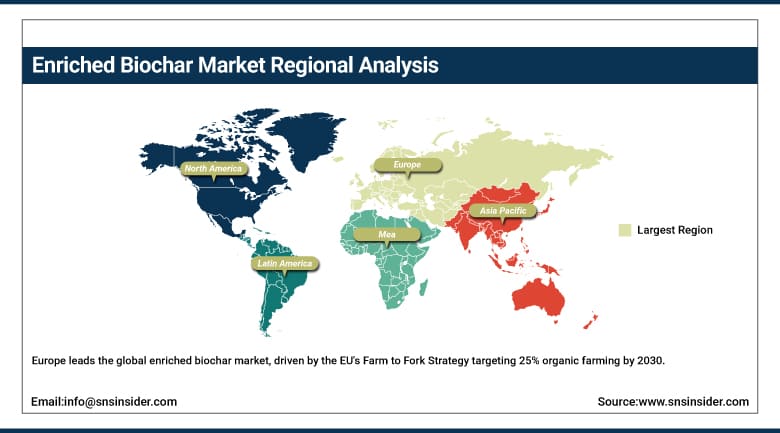
Europe leads the global enriched biochar market, driven by the EU's Farm to Fork Strategy targeting 25% organic farming by 2030, the EU Carbon Farming Initiative creating financial incentives for soil carbon projects, and strong farmer awareness of soil health and sustainability. Germany, the Netherlands, and Scandinavia are the most active markets. European biochar companies including Pyreg, Biocarbon and Novacarbon are leading producers. The EU's recognition of biochar as an approved fertilizer material under EU Fertilising Products Regulation (2019) provides the regulatory framework for market development.
Get Customized Report as Per Your Business Requirement - Enquiry Now
North America Enriched Biochar Market Insights:
North America is a leading and increasing enriched biochar drain. Agricultural demand is fueled by expansion of the U.S. organic farming sector and adoption of precision agriculture. Traded at USD 150-300 per tonne CO2 equivalent in the voluntary carbon market, a financial overlay from biochar carbon removal credits is making the economics of enriching biochar application to farms more positive for participating farmers. The organic farming market is growing in Canada and the increasing efforts of the country to promote agricultural climate programs are creating regional market growth as well.
Asia Pacific Enriched Biochar Market Insights:
Enriched biochar market growth in Asia Pacific is projected to be the strongest, supported by intensity of agricultural operation in China, India and regional clusters across Southeast Asia where soil degradation, nutrient leaching and dependence on synthetic fertilizers are major concerns. This is relevant as Australia is a significant regional market and where research on biochar has already been extensive, both in terms of adoption and local government programs supporting its integration which are discussed below. Government initiatives that encourage soil health and organic farming in India create a favorable condition for biochar-based products being developed in both systems.
Middle East & Africa Enriched Biochar Market Insights:
Middle East & Africa is a small but growing enriched biochar market. Biochar's advantages are well suited to agricultural systems in Sub-Saharan Africa, where the yield response is greatest when biomass feedstock is 'biocharized' and added to tropical soils containing low o rganic matter and poor N retention. Active biochar evaluation is conducted in South Africa's commercial agriculture sector and in its research institutions.
Latin America Enriched Biochar Market Insights:
Latin America has high potential for enriched biochar due to a vast agricultural land base, advanced tropical soils which respond positively to biochar and large organic farming movement especially in Brazil. Brazilian coffee, soybean and sugarcane sectors are also assessing the potential of enriched biochar to provide levers for sustainability program and carbon credit opportunities. Chile and Colombia export more than any other Latin American countries; their burgeoning organic export horticulture sectors are keen candidates for being among the first to adopt premium enriched biochar products for certified organic production.
Enriched Biochar Market Growth Drivers:
-
Sustainable agriculture demand and carbon credit market value are the twin growth drivers
Two structural forces are driving enriched biochar market growth. The first is the global shift toward sustainable agriculture as farmers, retailers, and consumers respond to environmental regulations, supply chain sustainability requirements, and consumer demand for eco-friendly food production. Enriched biochar provides a credible, certified-eligible soil amendment that reduces synthetic fertilizer requirements while improving soil health. The second driver is the carbon credit market, where biochar's exceptional carbon permanence (biochar carbon persists in soil for hundreds to thousands of years) commands premium prices in voluntary carbon markets, providing an additional revenue stream that improves overall project economics.
Soil degradation is one of the most economically important environmental problems that receives relatively little public attention. The UN Food and Agriculture Organization estimates that 40% of global agricultural land is degraded, reducing crop yields, increasing fertilizer requirements, and releasing stored soil carbon to the atmosphere. Enriched biochar is uniquely positioned as a product that simultaneously addresses soil degradation, reduces agricultural input costs, and sequesters carbon a combination that aligns with global policy objectives across agriculture, climate, and food security.
Enriched Biochar Market Restraints:
-
High product cost relative to conventional fertilizers and limited farmer awareness constrain adoption
Enriched biochar currently costs significantly more per unit of nutrient delivered than conventional synthetic fertilizers, making simple agronomic ROI calculations challenging in commodity crop markets where thin margins limit input flexibility. The long-term soil improvement benefits of biochar which accrue over multiple growing seasons are difficult to account for in single-season economic analyses that most farmers use for input purchase decisions. Limited farmer awareness of enriched biochar and the paucity of local demonstration trials with locally relevant soil types and crop varieties also slow adoption in new markets.
Enriched Biochar Market Opportunities:
-
Carbon market premiums and integration with organic certification create value-stacking opportunities
The prospect of combining several ongoing value streams resulting from the use of superior biochar agronomic performance, lower input costs, organic certification premium for organic production as well as carbon credit revenues creates a very attractive economical argument that none by itself will pay for the extra cost. Farmers who enter voluntary carbon markets, and use biochar in their application, can be paid which helps offset the overall agronomic product cost - typically viewed as a long-lasting soil enhancement. With the emergence of standardized biochar certification systems , reliable carbon credits issuance is paving the way for an easier access for farmers to value-stacking propositions.
Recent Developments:
-
2025: Puro.earth expanded its biochar carbon removal credit marketplace to include enriched biochar products from certified producers in Europe and North America, creating new revenue opportunities for enriched biochar manufacturers whose products can now earn premium carbon credits while delivering agronomic benefits to farmers.
-
2024: Carbon Solutions Group launched a large-scale enriched biochar production facility in the U.S. Midwest using agricultural waste feedstocks, with an integrated carbon credit program enabling partner farmers to earn verified carbon removal income alongside agronomic yield benefits from soil application.
-
2023: The European Union's Carbon Farming Initiative published detailed guidance on biochar soil application as an eligible carbon farming practice, providing a regulatory framework for European farmers to earn carbon credits for verified enriched biochar application, significantly boosting market confidence and investment.
Enriched Biochar Key Players
-
Pacific Biochar LLC
-
Carbon Solutions Inc.
-
Biochar Now LLC
-
Pyreg GmbH
-
Novacarbon Ltd.
-
Wakefield BioChar
-
CharGrow
-
Soil Reef Inc.
-
Full Circle Biochar
-
Sonoma BioChar
-
Cool Terra (Pacific Biochar)
-
Australia Biochar (Carbon Cycle)
-
Swiss Biochar GmbH
-
Pyrobiotic GmbH
-
Carbon Gold Ltd.
Enriched Biochar Market Report Scope:
| Report Attributes | Details |
|---|---|
| Market Size in 2025 | USD 55.84 Billion |
| Market Size by 2035 | USD 130 Billion |
| CAGR | CAGR of 8.79% From 2026 to 2035 |
| Base Year | 2025 |
| Forecast Period | 2026-2035 |
| Historical Data | 2022-2024 |
| Report Scope & Coverage | Market Size, Segments Analysis, Competitive Landscape, Regional Analysis, DROC & SWOT Analysis, Forecast Outlook |
| Key Segments | • By Application (Agriculture, Turf & Landscaping, Horticulture, Waste Management & Remediation, Others) • By Crop Type (Cereals & Grains, Fruits & Vegetables, Oilseeds & Pulses, Others) • By Form (Granular, Powder, Liquid Suspension) • By Nutrient Enrichment (Nitrogen-Enriched, Phosphorus-Enriched, NPK-Enriched, Microbial-Enriched, Others) • By Production Technology (Pyrolysis, Hydrothermal Carbonization, Flash Carbonization, Others) |
| Regional Analysis/Coverage | North America (US, Canada), Europe (Germany, UK, France, Italy, Spain, Russia, Poland, Rest of Europe), Asia Pacific (China, India, Japan, South Korea, Australia, ASEAN Countries, Rest of Asia Pacific), Middle East & Africa (UAE, Saudi Arabia, Qatar, South Africa, Rest of Middle East & Africa), Latin America (Brazil, Argentina, Mexico, Colombia, Rest of Latin America). |
| Company Profiles | Pacific Biochar LLC, Carbon Solutions Inc., Biochar Now LLC, Pyreg GmbH, Novacarbon Ltd., Wakefield BioChar, CharGrow, Soil Reef Inc., Full Circle Biochar, Sonoma BioChar, Cool Terra, Australia Biochar, Swiss Biochar GmbH, Pyrobiotic GmbH, Carbon Gold Ltd., Aries Clean Technologies, Airex Energy, Black Owl Biochar, Bioforcetech Corporation, SynCraft Engineering GmbH. |
Frequently Asked Questions
The Enriched Biochar Market is expected to grow at a CAGR of 8.79% from 2026 to 2035.
The Enriched Biochar Market was valued at USD 55.84 million in 2025.
Agriculture dominates with over 65% market share; Turf & Landscaping is growing at the fastest CAGR as eco-friendly green space management gains traction.
Microbially-enriched biochar inoculated with beneficial soil microorganisms is growing fastest, combining biological benefits with biochar's structural advantages.
Europe leads the Enriched Biochar Market, driven by the EU Farm to Fork Strategy, Carbon Farming Initiative, and strong organic farming adoption.
