
Fecal Calprotectin Testing Market Report Scope & Overview:
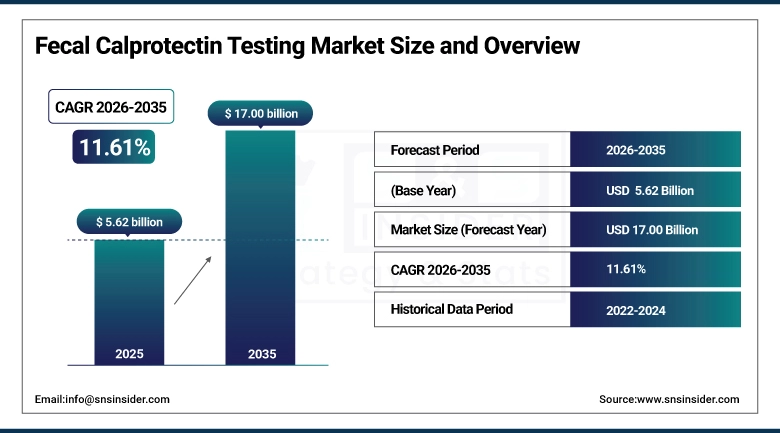
The Fecal Calprotectin Testing Market was valued at USD 5.62 billion in 2025 and is expected to reach USD 17.00 billion by 2035, growing at a CAGR of 11.61% from 2026-2035.
Fecal Calprotectin Testing Market is seeing positive growth due to increasing incidences of inflammatory bowel disorders, growing demand for non-invasive tests, and increased awareness about early detection of GI disease. Growing healthcare infrastructure and advancements in laboratory testing capabilities, along with increased use of biomarker diagnostics, are other factors driving market growth.
Crohn's and Colitis UK estimates that over 500,000 people in the United Kingdom live with IBD each diagnosed patient representing a monitoring test use case that generates multiple fecal calprotectin tests annually throughout their disease lifetime establishing the long-term recurring test volume that sustains market growth independent of new diagnosis rate growth.
Market Size and Forecast
-
Market Size in 2025: USD 5.62 Billion
-
Market Size by 2035: USD 17.00 Billion
-
CAGR: 11.61% from 2026 to 2035
-
Base Year: 2025
-
Forecast Period: 2026-2035
-
Historical Data: 2022-2024
To Get more information on Fecal Calprotectin Testing Market - Request Free Sample Report
Fecal Calprotectin Testing Market Trends
-
Point-of-care fecal calprotectin testing where rapid lateral flow tests providing results within 15 minutes at the patient's primary care visit are enabling same-visit diagnosis and referral decisions that laboratory-based ELISA testing whose multi-day turnaround precludes.
-
Home-based fecal calprotectin testing kits where patients self-collect and self-test with smartphone-connected result reading are expanding testing access for the diagnosed IBD patient population whose disease monitoring frequency creates patient burden when requiring clinic visits.
-
Artificial intelligence result interpretation integration where AI algorithms interpret fecal calprotectin concentration in combination with patient symptom scores, IBD history, and medication status to generate clinical action recommendations is improving the clinical utility of quantitative test results beyond simple threshold comparison.
-
Colorectal cancer screening fecal calprotectin applications where the biomarker's ability to detect mucosal inflammation from colorectal polyps and early cancer enables its potential role in cancer screening programs are sustaining research investment in expanded indication validation beyond the established IBD monitoring application.
U.S. Fecal Calprotectin Testing Market was valued at USD 2.20 billion in 2025 and is expected to reach USD 6.38 billion by 2035, growing at a CAGR of 11.23%.
U.S. Fecal Calprotectin Testing Market is witnessing positive growth due to rising incidences of inflammatory bowel disorders, increasing demand for non-invasive gastrointestinal diagnostics, and growing awareness about early disease monitoring. Advancements in healthcare infrastructure and wider insurance coverage, coupled with increased biomarker testing in hospitals and diagnostic centers, are boosting market growth.
Fecal Calprotectin Testing Market Segment Analysis
-
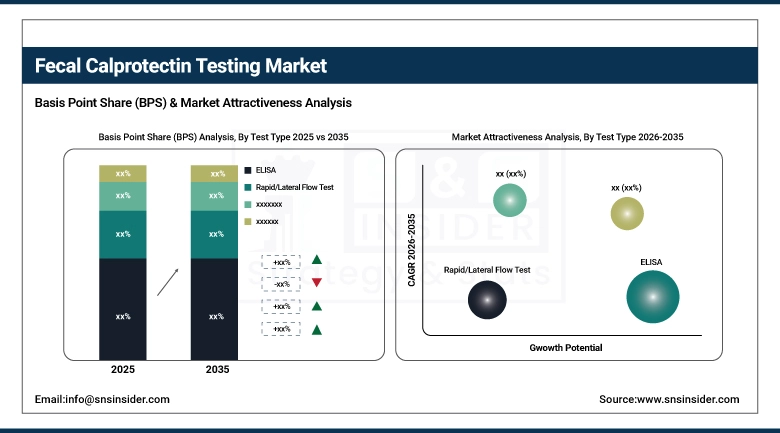
By Test Type, ELISA dominated the market in 2025; EIA (Enzyme Fluoroimmunoassay) growing at fastest CAGR of ~12.43%.
-
By End User, Hospitals & Clinics dominated with 55.25% share in 2025; Diagnostic Laboratories growing fastest.
-
By Application, IBD Diagnosis dominant; Disease Monitoring growing at significant CAGR.
By Test Type: ELISA dominant, EIA fastest CAGR
ELISA (Enzyme-Linked Immunosorbent Assay) held the dominant test type position in the Fecal Calprotectin Testing Market in 2025, reflecting its established position as the reference method for quantitative fecal calprotectin measurement whose analytical performance sensitivity, specificity, and concentration range is validated against clinical outcomes in the majority of published calprotectin research. ELISA's quantitative precision enables the threshold-based clinical decision algorithms that gastroenterology guidelines specify where values below 50 μg/g indicate low inflammation probability, 50-200 μg/g require clinical reassessment, and above 200 μg/g indicate high IBD probability requiring endoscopic evaluation whose clinical utility depends on quantitative accuracy that qualitative or semi-quantitative methods cannot consistently provide. Enzyme Fluoroimmunoassay (EIA) is growing at the fastest test type CAGR of approximately 12.43%, driven by its fluorescence detection sensitivity that exceeds standard ELISA's colorimetric endpoint detection providing superior accuracy at low calprotectin concentrations where the discrimination between IBD remission and early relapse is clinically consequential.
By End User: Hospitals & Clinics dominate, Diagnostic Laboratories growing fastest
Hospitals and Clinics held approximately 55.25% of the Fecal Calprotectin Testing Market in 2025, reflecting the centralized laboratory testing model where hospital clinical chemistry and immunology laboratories provide calprotectin testing services for both inpatient and outpatient gastroenterology clinics within the hospital network. The hospital laboratory setting enables calprotectin testing integration with the broader laboratory test ordering and electronic health record workflow that gastroenterologists and primary care physicians use, sustaining test volume through system-facilitated ordering that standalone community laboratory models require additional marketing investment to sustain. Diagnostic Laboratories are growing at the fastest end-user CAGR, driven by the outsourcing trend where hospitals increasingly refer specialized testing including fecal calprotectin to high-throughput commercial reference laboratories whose automation and testing volume create economies of scale not achievable in hospital laboratories.
By Application: IBD Diagnosis dominate, Disease Monitoring growing fastest
Fecal Calprotectin Testing Market application-wise was led by IBD Diagnosis in 2025 since calprotectin tests have been widely employed in the clinical setting for the diagnosis and differentiation of IBDs and other functional GI disorders like irritable bowel syndrome through its detection of intestinal inflammation with a high level of sensitivity without requiring any endoscopy, which minimizes risks and aids early intervention. Calprotectin testing is increasingly used in Gastroenterology due to the strong link between calprotectin concentrations and the presence of mucosal inflammation of Crohn’s disease and Ulcerative Colitis in patients. Disease Monitoring emerged as an important trend with a substantial CAGR since it is becoming increasingly common for IBD management and recurrence prediction, which requires monitoring through calprotectin testing.
Regional Insights
|
Region |
Major Country |
Share within Region (%) |
|---|---|---|
|
North America |
United States |
88% |
|
Europe |
United Kingdom |
30% |
|
Asia Pacific |
China |
40% |
|
Middle East & Africa |
Israel |
42% |
|
Latin America |
Brazil |
52% |
North America Fecal Calprotectin Testing Market Insights
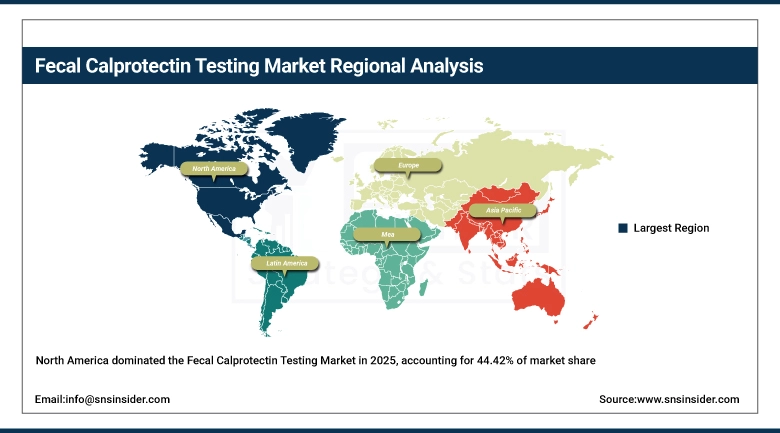
North America dominated the global Fecal Calprotectin Testing Market with approximately 44.42% revenue share in 2025, driven by the United States' high IBD burden, comprehensive laboratory infrastructure, and the progressive expansion of insurance reimbursement for calprotectin testing across commercial and government payer programs. The U.S. market's growth is additionally sustained by the growing direct-to-consumer testing channel where patients with known IBD can order calprotectin monitoring tests through digital health platforms without physician intermediaries increasing testing frequency among the monitoring population.
Get Customized Report as per Your Business Requirement - Enquiry Now
Europe Fecal Calprotectin Testing Market Insights
Europe holds a significant Fecal Calprotectin Testing Market position, driven by the UK's NICE DG11 guideline integration of calprotectin testing into the NHS IBD diagnosis pathway creating systematic primary care test ordering whose protocol-driven demand sustains large test volumes across the NHS network and the established calprotectin testing culture in Germany, Scandinavia, and the Netherlands whose gastroenterology communities adopted the test ahead of other global markets. European manufacturers including BÜHLMANN Laboratories whose fCalExact calprotectin ELISA is the world's most widely used research and clinical calprotectin assay sustain European analytical leadership in fecal calprotectin testing development.
Asia Pacific Fecal Calprotectin Testing Market Insights
Asia Pacific is the fastest-growing regional Fecal Calprotectin Testing Market with approximately 12.88% CAGR during the forecast period, driven by rapidly increasing IBD incidence in China, Japan, South Korea, and India where Westernization of diet and lifestyle in urban populations is associated with the IBD incidence increases documented across the region's medical literature growing healthcare infrastructure investment enabling specialized gastrointestinal diagnostic services, and expanding awareness among gastroenterologists of fecal calprotectin's clinical utility for IBD monitoring in their growing patient populations.
MEA and Latin America Fecal Calprotectin Testing Market Insights
The Middle East's Fecal Calprotectin Testing Market is growing with the Gulf states' sophisticated healthcare systems whose gastroenterology subspecialty care is comparable in quality to Western academic medical centers and the region's IBD prevalence whose documentation is improving as electronic health records capture diagnosis data across the Gulf Cooperation Council health systems. Latin America's market is growing in Brazil, where IBD incidence has increased significantly over the past two decades and where the growing gastroenterology specialist community is adopting calprotectin testing protocols from European guideline frameworks.
Fecal Calprotectin Testing Market Growth Drivers:
-
Rising IBD prevalence and non-invasive diagnostic adoption driving sustained fecal calprotectin testing market growth globally
The increasing incidence of inflammatory bowel diseases (IBD) such as Crohn’s disease and ulcerative colitis is one of the significant factors fueling the demand for fecal calprotectin testing in the Fecal Calprotectin Testing Market worldwide. The rising trend towards the use of non-invasive techniques as compared to invasive endoscopy tests is driving the utilization of fecal calprotectin tests for early diagnosis and monitoring of IBD.
Fecal Calprotectin Testing Market Restraints:
-
Biological variability and insurance coverage gaps creating fecal calprotectin testing market adoption challenges globally
Fecal calprotectin testing's growth is constrained by the biomarker's pre-analytical variability where stool consistency variation, dietary factors, and inter-assay differences between manufacturers create result variability that complicates the threshold-based clinical algorithms that calprotectin use depends on. The within-patient biological variability where calprotectin concentration varies between different parts of the same stool sample requires standardized collection protocols whose implementation inconsistency in primary care settings creates interpretation uncertainty that reduces clinician confidence in individual test results.
Fecal Calprotectin Testing Market Opportunities:
-
Home testing platforms and biologic therapy monitoring creating transformative fecal calprotectin testing market growth opportunities globally
Home-based fecal calprotectin testing where patient-administered lateral flow tests whose smartphone camera-read results integrate directly into the patient's gastroenterology team's monitoring dashboard represents the market's most commercially accessible adoption expansion opportunity. The convenience advantage of home testing for the IBD monitoring patient who currently requires clinic visits or laboratory specimen submission for each calprotectin test is particularly valuable for the growing IBD population on biologic therapy whose monitoring frequency (every 3-6 months) creates significant clinical touchpoint burden. Biologic therapy monitoring represents the fastest-growing calprotectin application segment where the treat-to-target management strategy endorsed by the ECCO and ACG guidelines requires objective mucosal healing assessment between endoscopies, creating systematic calprotectin monitoring demand in the IBD biologic-treated population.
Recent Developments:
-
2026: BÜHLMANN Laboratories launched its fCal Smart calprotectin home monitoring system a smartphone-connected lateral flow test providing quantitative calprotectin measurement within 15 minutes of stool sample application, with automatic result transmission to the gastroenterologist's patient monitoring dashboard — achieving CE marking for IBD disease activity monitoring and receiving NHS England approval as a remote monitoring tool for IBD patients on biologic therapy, with 12 UK IBD centers reporting 40% reduction in unnecessary clinic visits in the first year of patient-initiated monitoring deployment.
-
2025: DiaSorin launched LIAISON Calprotectin 2 automated immunoassay achieving 45-minute turnaround from sample receipt to result on the LIAISON XL automated immunoassay platform, compatible with the installed base of over 5,000 LIAISON instruments globally providing calprotectin testing without dedicated equipment investment for the majority of hospital laboratories already operating LIAISON platforms for other immunoassay applications, and reporting 28% cost reduction versus standalone calprotectin ELISA workflows through platform consolidation.
Fecal Calprotectin Testing Market Key Players
-
BÜHLMANN Laboratories AG
-
Roche Diagnostics AG
-
DiaSorin SpA
-
Thermo Fisher Scientific Inc.
-
Immundiagnostik AG
-
R-Biopharm AG
-
ScheBo Biotech AG
-
Calprotectin Testing Services Ltd.
-
Hycult Biotech BV
-
IBL International (Tecan)
-
Savyon Diagnostics Ltd.
-
Trinity Biotech plc
-
GenWay Biotech Inc.
-
Creative Diagnostics
-
Alpha Laboratories Ltd.
-
Epitope Diagnostics Inc.
-
NovaTec Immundiagnostica GmbH
-
Werfen Group (QUANTA Diagnostics)
-
Medipan GmbH
-
Biotecna Diagnostic SL
Fecal Calprotectin Testing Market Report Scope:
| Report Attributes | Details |
|---|---|
| Market Size in 2025 | USD 5.62 Billion |
| Market Size by 2035 | USD 17.00 Billion |
| CAGR | CAGR of 11.61% From 2026 to 2035 |
| Base Year | 2025 |
| Forecast Period | 2026-2035 |
| Historical Data | 2022-2024 |
| Report Scope & Coverage | Market Size, Segments Analysis, Competitive Landscape, Regional Analysis, DROC & SWOT Analysis, Forecast Outlook |
| Key Segments | • By Test Type (ELISA, Enzyme Fluoroimmunoassay [EIA], Rapid/Lateral Flow Test, Others) • By Application (IBD Diagnosis, Colorectal Cancer Screening, Disease Monitoring, Others) • By End User (Hospitals & Clinics, Diagnostic Laboratories, Others) |
| Regional Analysis/Coverage | North America (US, Canada), Europe (Germany, UK, France, Italy, Spain, Russia, Poland, Rest of Europe), Asia Pacific (China, India, Japan, South Korea, Australia, ASEAN Countries, Rest of Asia Pacific), Middle East & Africa (UAE, Saudi Arabia, Qatar, South Africa, Rest of Middle East & Africa), Latin America (Brazil, Argentina, Mexico, Colombia, Rest of Latin America). |
| Company Profiles | BÜHLMANN Laboratories AG; Roche Diagnostics AG; DiaSorin SpA; Thermo Fisher Scientific Inc.; Immundiagnostik AG; R-Biopharm AG; ScheBo Biotech AG; Calprotectin Testing Services Ltd.; Hycult Biotech BV; IBL International (Tecan); Savyon Diagnostics Ltd.; Trinity Biotech plc; GenWay Biotech Inc.; Creative Diagnostics; Alpha Laboratories Ltd.; Epitope Diagnostics Inc.; NovaTec Immundiagnostica GmbH; Werfen Group (QUANTA Diagnostics); Medipan GmbH; Biotecna Diagnostic SL. |

Frequently Asked Questions
The Fecal Calprotectin Testing Market was valued at USD 5.62 billion in 2025.
North America dominated with approximately 44.42% share; Asia Pacific fastest at ~12.88% CAGR.
Hospitals & Clinics dominated with approximately 55.25% share; Diagnostic Laboratories growing fastest.
ELISA dominated; EIA (Enzyme Fluoroimmunoassay) is growing fastest at approximately 12.43% CAGR.
The Fecal Calprotectin Testing Market is expected to grow at a CAGR of 11.61% from 2026 to 2035.
