Fecal Calprotectin Testing Market is gaining momentum as healthcare organizations are adopting biomarker tests in order to diagnose GI diseases. Increased usage of non-invasive tests, larger IBD patient population, and developments in the area of automation and near-patient testing technologies have created strong demand for fecal calprotectin tests.
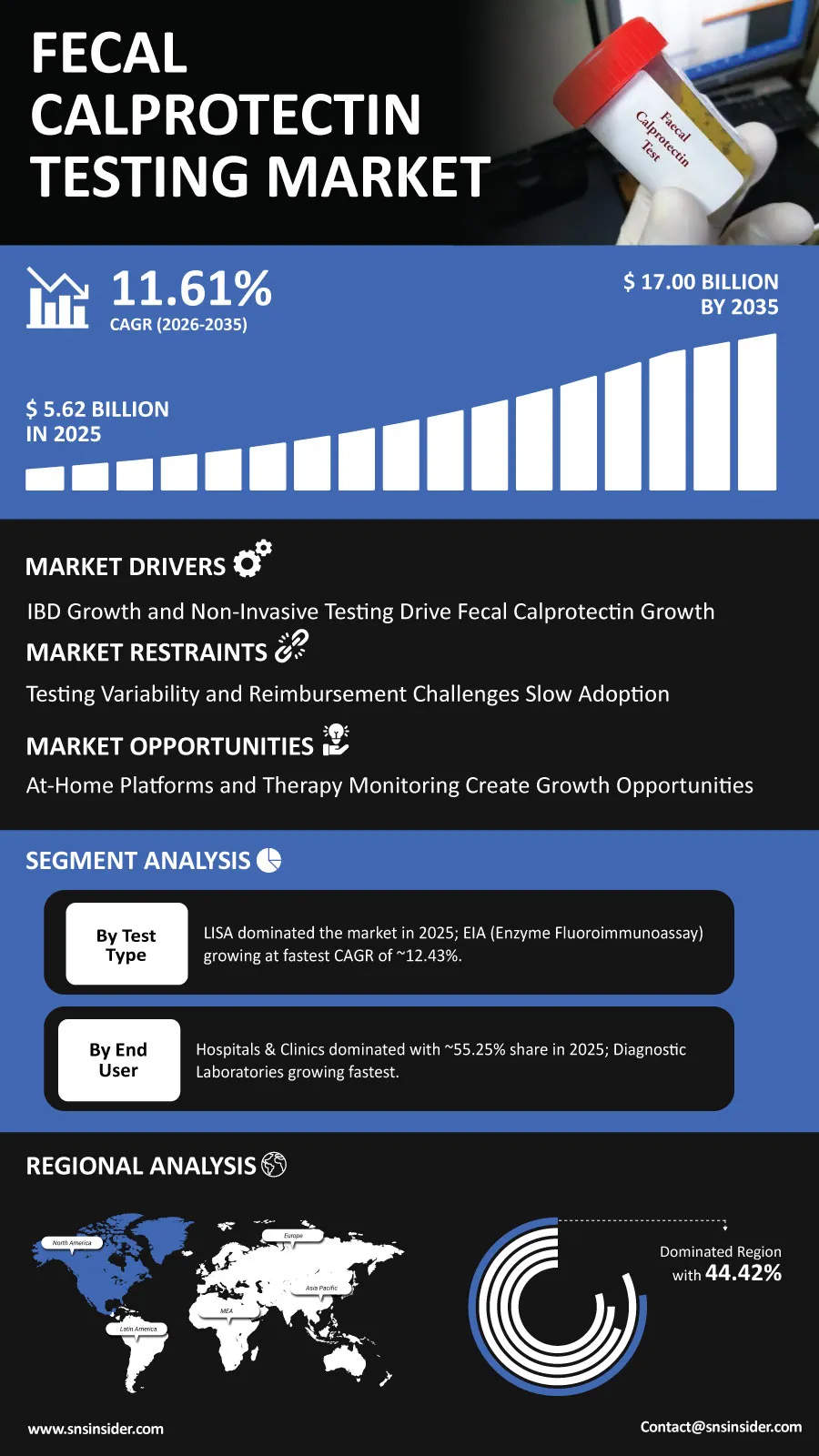
According to a recent study by SNS Insider, the global Fecal Calprotectin Testing Market size valued at USD 5.62 billion in 2025, is anticipated to grow to USD 17.00 billion by 2035, registering a CAGR of 11.61% over the 2026–2035 forecast period. Expansion of the market will be driven by the increasing significance of fecal biomarkers in differentiating between inflammation-associated GI disorders and those that are not associated with inflammation through less invasive procedures.
To Get Detailed Insights on the Fecal Calprotectin Testing Market – Request a Sample Report
Biomarker Testing Gains Ground in Gastrointestinal Care
Fecal calprotectin testing is becoming a valuable tool in clinical settings when seeking objective evidence of inflammatory activity within the intestine. This test helps make the decision about subsequent testing and follow-up in cases of either suspected or diagnosed IBD.
Repetition of the diagnostic process is one of the essential elements as well. Patients suffering from diseases such as Crohn's and ulcerative colitis require repeated tests throughout the duration of their treatment. It should be noted that according to the statistics collected by Crohn's and Colitis UK, there are over 500,000 people suffering from IBD in the United Kingdom.
Testing Technology Moves Toward Faster Results
The laboratories will continue to depend extensively on proven immunoassays, and the companies will innovate rapid and automated options. ELISA was the most dominant type of test in 2025 due to its proven use for quantitation of calprotectin analysis.
The Enzyme Fluoroimmunoassay (EIA) test type is likely to see the highest growth, projected at 12.43% CAGR up to 2035. With enhanced automation and detection options, there will be increased interest in technology that can provide reproducible quantitative analysis as well as work within laboratory practices.
There are also other opportunities for testing arising from the trend towards decentralized healthcare, where point of care tests and home-based tests are becoming common. This includes the potential for using smartphones to analyze and transmit results from tests to healthcare providers.
Hospitals Remain Central to Testing Demand
Hospitals and clinics were responsible for nearly 55.25% of the market revenue in 2025, thus becoming the primary segment of end users. The share can be attributed to the inclusion of fecal calprotectin in the range of services offered by gastroenterologists and laboratories.
The fastest growth can be expected from diagnostic laboratories due to increased outsourcing of specialized tests conducted on automated platforms with high throughput. Such an approach may allow healthcare organizations to gain access to specialized tests without having their own testing equipment.
According to the type of application, IBD diagnostics was the leading market in 2025. Monitoring of the disease becomes increasingly important as doctors look for objective parameters that could complement symptoms and other clinical data when following up patients.
North America Leads While Asia Pacific Accelerates
The region of North America had the biggest share in 2025, contributing about 44.42% to the total revenues of the industry. The contribution of the USA was about 88%. The market value of U.S. Fecal Calprotectin Testing Market is expected to rise from USD 1.63 billion in 2025 to USD 4.97 billion in 2035, recording a 11.7% CAGR.
The U.S. market is driven by availability of laboratories in abundance, rising awareness on the use of biomarker diagnostics and increased use of non-invasive tests for the GI tract.
The Asia Pacific region is expected to witness the highest growth, with a forecasted 12.88% CAGR in the period up till 2035. Contribution of China to the regional revenues is about 40%, with the increased investment in healthcare and rising awareness on IBD diagnostics.
In Europe, the contribution of the United Kingdom to the regional revenues was 30%. Israel is estimated to contribute 42% to the revenues of the Middle East & Africa market.
Home Monitoring Opens New Market Opportunities
Home testing is one of the most attractive avenues available to the industry. Tests that offer quick quantitative results could make routine monitoring easier on patients undergoing IBD therapy on an ongoing basis.
On the other hand, tests related to the identification of biomarkers are becoming increasingly important for treatment approaches that focus on the objective measurement of the disease activity level. These factors combined with the development of the new generation of tests may offer new possibilities for laboratory and diagnostic companies.
Diagnostic Companies Strengthen Competitive Position
This is made up of existing diagnostic companies as well as assay companies who have developed automated systems. The recent innovations discussed within the market research report include the development of the fCal Smart by BÜHLMANN Laboratories in 2026 for home use and LIAISON Calprotectin 2 by DiaSorin in 2025 for automated immunoassay tests.
Key companies operating in the global Fecal Calprotectin Testing Market include BÜHLMANN Laboratories AG, Roche Diagnostics AG, DiaSorin SpA, Thermo Fisher Scientific Inc., Immundiagnostik AG, R-Biopharm AG, ScheBo Biotech AG, Calprotectin Testing Services Ltd., Hycult Biotech BV, IBL International (Tecan), Savyon Diagnostics Ltd., Trinity Biotech plc, GenWay Biotech Inc., Creative Diagnostics, Alpha Laboratories Ltd., Epitope Diagnostics Inc., NovaTec Immundiagnostica GmbH, Werfen Group (QUANTA Diagnostics), Medipan GmbH, and Biotecna Diagnostic SL.
An SNS Insider analyst Parry Kardani commented, "The growing emphasis on objective gastrointestinal disease assessment is creating a strong foundation for fecal calprotectin testing. Faster assays, remote monitoring capabilities, and broader laboratory access could further expand the role of this biomarker across diagnosis and long-term IBD management.
About the Author

Get in touch