
Food Contract Manufacturing Market Report Scope & Overview:
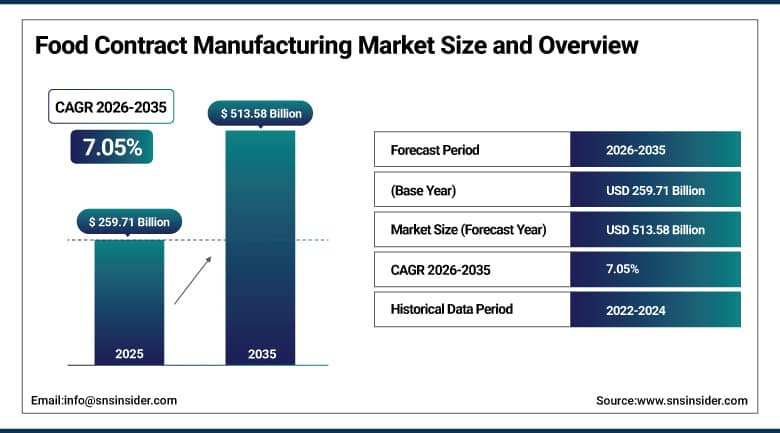
The Food Contract Manufacturing Market was valued at USD 259.71 Billion in 2025 and is expected to reach USD 513.58 Billion by 2035, growing at a CAGR of 7.05% from 2026 to 2035.
Most people who buy a store-brand granola bar or a private-label sparkling water have no idea it likely was not made anywhere near the retailer whose name is on the label, it came off a production line run by a specialist contract manufacturer that may make similar products for a dozen competing brands at once. That arrangement has become close to standard practice across packaged food and beverage categories, since building and running a dedicated manufacturing facility is enormously capital intensive, often USD 50 to 150 million for a modern full-service plant, while contracting out production lets brand owners focus their capital and attention on formulation, marketing, and distribution instead. Private-label growth, which has been steadily climbing as a share of grocery sales, is one of the biggest forces keeping contract manufacturers busy right now.
In November 2025, TreeHouse Foods, Inc. signed a definitive merger agreement with Investindustrial in an all-cash transaction valued at approximately USD 2.9 billion, taking the private-label contract manufacturer private.
To Get More Information On Food Contract Manufacturing Market - Request Free Sample Report
Food Contract Manufacturing Market Trends
-
Private-label unit share continues climbing at retail, keeping contract manufacturers busy with growing store-brand production volumes.
-
Automation and high-efficiency production lines are helping contract manufacturers improve scalability and reduce per-unit costs.
-
Clean-label and functional food demand is pushing manufacturers toward more natural ingredients and greater process transparency.
-
Value chain consolidation is picking up as larger contract manufacturers acquire specialized regional players to expand capabilities.
-
Co-development partnerships between brand owners and manufacturers are becoming more common as companies look to speed product innovation.
U.S. Food Contract Manufacturing Market Outlook
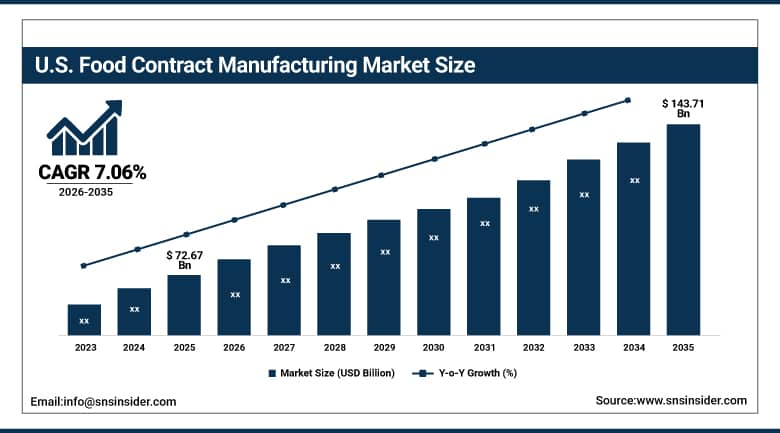
The U.S. Food Contract Manufacturing Market was valued at USD 72.67 Billion in 2025 and is projected to reach USD 143.71 Billion by 2035, growing at a CAGR of 7.06% during 2026-2035.
Food and beverage manufacturing represents a genuinely enormous slice of overall U.S. industrial activity, accounting for roughly 17% of manufacturing sales and 15% of manufacturing employment nationally, and a meaningful share of that activity runs through contract and co-manufacturing arrangements rather than brand owners' own facilities. Large branded food companies increasingly lean on contract manufacturers to cut costs, speed new product launches, and meet growing demand for private-label, clean-label, and functional food products without committing capital to new plants of their own. Strict U.S. regulatory requirements, particularly around food safety documentation under the Food Safety Modernization Act, continue shaping which contract manufacturers can compete for larger branded customers, since compliance infrastructure has become a genuine barrier to entry rather than a formality. Rising adoption of automation and high-efficiency production technology is also helping domestic manufacturers stay cost-competitive against imported private-label alternatives.
In January 2025, TreeHouse Foods, Inc. completed its acquisition of Harris Tea, adding private-label tea blending and sourcing capabilities along with manufacturing facilities in New Jersey and Georgia.
Food Contract Manufacturing Market Segment Analysis
-
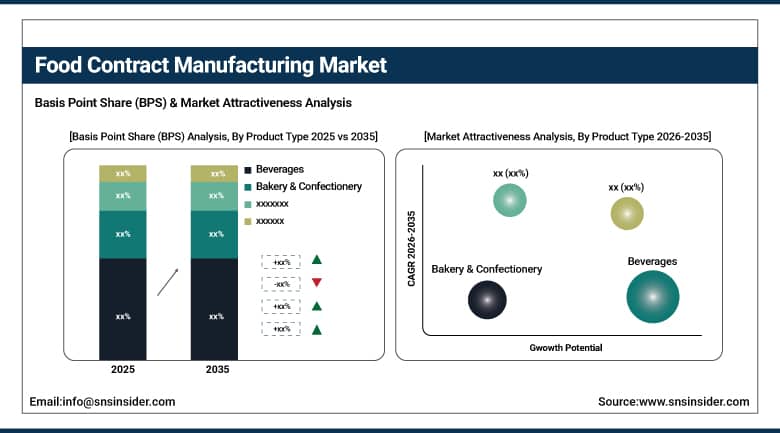
By Product Type, Beverages segment dominated the Food Contract Manufacturing Market in 2025 with 32% share; Bakery & Confectionery segment is the fastest-growing segment, registering a CAGR of 7.60% from 2026 to 2035.
-
By Service Model, Co-Manufacturing segment dominated the market in 2025 with 44% share; Private Label Manufacturing segment is the fastest-growing segment, registering a CAGR of 8.20% from 2026 to 2035.
-
By End-User, Branded Food Companies segment dominated the market in 2025 with 52% share; Private-Label Retailers segment is the fastest-growing segment, registering a CAGR of 8.90% from 2026 to 2035.
-
By Processing Type, Frozen segment dominated the market in 2025 with 31.60% share; Chilled/Refrigerated segment is the fastest-growing segment, registering a CAGR of 8.40% from 2026 to 2035.
By Product Type, Beverages Lead the Food Contract Manufacturing Market While Bakery & Confectionery Gains Ground Fastest
Beverages hold 32% of the Food Contract Manufacturing Market, the largest single product category, and that lead traces directly back to how standardized and high-volume beverage production tends to be relative to more complex food formats. A contract manufacturer running a beverage line can typically serve multiple brand customers with relatively similar formulation and packaging requirements, achieving economies of scale that more customized food categories cannot always match as easily.
Bakery & Confectionery is growing fastest among product types, at a 7.60% CAGR, driven by rising demand for private-label and clean-label baked goods that require specialized equipment and formulation expertise many brand owners do not want to build in-house. Growing consumer interest in premium, artisanal-style baked goods has also pushed more brands toward contract manufacturers with specialized capabilities rather than attempting to replicate that expertise internally.
By Service Model, Co-Manufacturing Dominates While Private Label Manufacturing Emerges as the Fastest-Growing Model
Co-Manufacturing holds 44% of the market by service model, valued because it lets brand owners collaborate directly with manufacturers on formulation, sourcing, and production while retaining meaningful control over quality standards and intellectual property. This collaborative structure appeals particularly to established branded companies that want outsourced production efficiency without fully ceding control over their product's recipe and positioning.
Private Label Manufacturing is growing fastest by service model, at an 8.20% CAGR, tracking directly with private-label retail's continued climb toward record unit share across grocery categories. Retailers investing more heavily in their own store-brand programs are driving manufacturers to expand dedicated private-label production capacity, often at the expense of capacity previously allocated to smaller branded customers.
By End-User, Branded Food Companies Dominates While Private-Label Retailers Registers the Fastest Growth
Branded Food Companies account for 52% of end-user demand, the largest single category, reflecting how widespread outsourcing has become even among the industry's largest, most recognizable names. Branded manufacturers increasingly view contract production as a way to scale new product launches quickly and test market demand without committing capital to dedicated facilities before a product's long-term viability is proven.
Private-Label Retailers is the fastest-growing end-user segment, expanding at an 8.90% CAGR, as grocery chains and mass retailers continue investing aggressively in their own store-brand programs to capture margin that would otherwise go to national brands. Private brand unit share has reached record highs in several major product categories, and that momentum shows few signs of slowing as retailers deepen their private-label investments across tea, snacks, and other categories.
By Processing Type, Frozen Dominates While Chilled/Refrigerated Registers the Fastest Growth
Frozen holds 31.60% of the market by processing type, the largest single category, benefiting from frozen food's practical advantages for contract manufacturing specifically, longer shelf life gives manufacturers more flexibility in production scheduling and inventory management than fresh or chilled alternatives require. Growing frozen food consumption more broadly across both retail and foodservice channels has reinforced this processing type's lead.
Chilled/Refrigerated is growing fastest among processing types, at an 8.40% CAGR, as consumer demand for fresher, less processed food formats pushes brand owners toward contract manufacturers capable of handling shorter shelf-life products with tighter cold-chain requirements. This segment's growth reflects a broader premiumization trend, since chilled products often command higher retail prices than their frozen or ambient equivalents.
Regional Insights
|
Region |
Country |
Share (2025) |
|
North America |
United States |
83.60% |
|
Asia Pacific |
China |
34.20% |
|
Europe |
Germany |
25.60% |
|
Middle East & Africa |
UAE |
16.80% |
|
Latin America |
Brazil |
27.40% |
North America Food Contract Manufacturing Market Insights
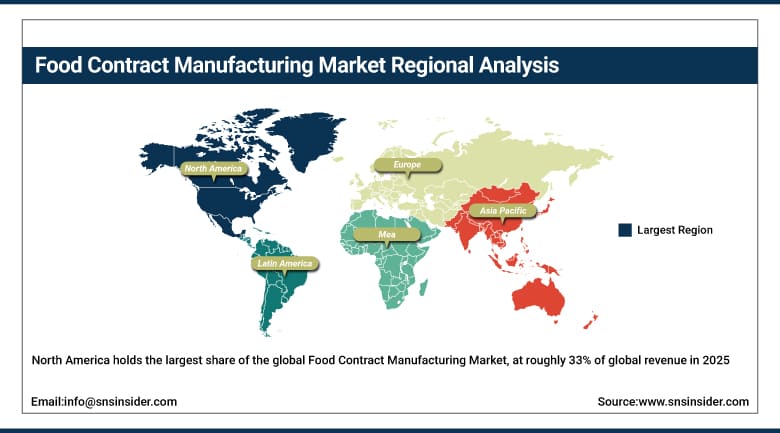
North America holds the largest share of the global Food Contract Manufacturing Market, at roughly 33% of global revenue in 2025, anchored by an enormous domestic food and beverage manufacturing base and branded companies' well-established habit of outsourcing production to cut costs and speed time-to-market. Strict U.S. regulatory requirements around food safety documentation continue to shape competition here, favoring larger, well-capitalized contract manufacturers with robust compliance infrastructure over smaller regional players.
The United States accounts for approximately 83.60% of the North American market, reflecting its massive food and beverage manufacturing base and deep concentration of branded and private-label customers. Canada and Mexico both contribute smaller shares, with Mexico's growing manufacturing base increasingly attracting nearshoring investment from U.S. brand owners.
Get Customized Report as Per Your Business Requirement - Enquiry Now
Asia Pacific Food Contract Manufacturing Market Insights
Asia Pacific is growing faster than any other region in this market, driven by rising demand for packaged foods as urbanization and disposable incomes both climb across the region's large population base. Modern retail expansion, replacing traditional wet markets and informal food distribution in many Asian cities, is creating exactly the kind of packaged food demand that fuels contract manufacturing growth, since organized retail depends on standardized, shelf-stable products at a scale that only industrial production can reliably supply.
China holds roughly 34.20% of the regional market, supported by its massive food processing base and rapidly expanding organized retail sector. India and Southeast Asian markets are growing quickly as packaged food consumption expands beyond major urban centers, while Japan and South Korea contribute through their established food manufacturing and export industries.
Europe Food Contract Manufacturing Market Insights
The food contract manufacturing industry in Europe is well-established and stable due to the high demand for specialized co-packing services in regions such as Germany, and because of the stringent regulations concerning food safety and traceability. The increasing consumption of fresh foods and frozen vegetables in the region has maintained the manufacturing volumes despite low market growth compared to other regions.
Germany is the market leader in Europe with 25.60% market share due to its strong manufacturing base and demand for specialized co-packing services. Other countries that are following include France and the UK, where demand is driven by their developed packaged food retail sectors.
Middle East & Africa and Latin America Food Contract Manufacturing Market Insights
Growth in the Middle East & Africa sector is increasing consistently due to increased consumption of packaged foods in Gulf countries, facilitated by growing efforts to substitute food imports and increased modern retail presence. Growth in the Latin American market is following a similar trajectory due to increased food processing in Brazil and Mexico.
The UAE leads the Middle East & Africa market with a 16.80% share, supported by its role as a regional food manufacturing and distribution hub. Brazil represents 27.40% of the Latin American market, reflecting its large food processing base, with Mexico also contributing through its growing nearshoring-driven manufacturing investment.
Growth Drivers: Private-Label Growth and Cost Optimization Fueling Market Growth
Growth in private label retailing remains the primary reason behind an increasing demand for contract manufacturing because of continuing efforts by grocery stores and other retailers to develop their own private brands and thus secure profits while differentiating themselves among competing products. The desire on the part of brand owners to reduce costs and time needed for launching new products adds another demand driver since contract manufacturing enables testing and scaling of new products without additional investments into new plants.
Finally, growing demand for food products that carry clean labels and are health-oriented also supports this trend because of the requirement to have contract manufacturers who can develop unique formulations of such products.
Restraints: Quality Control Challenges and Supply Chain Volatility Limiting Market Expansion
Consistency of quality from third-party contract manufacturers continues to be an ongoing challenge, especially for companies working with more than one contract manufacturer in various product categories or markets, and the process of outsourcing involves issues relating to intellectual property protection and confidentiality, which many companies find difficult to accommodate. Fluctuations in raw material pricing as well as disruption to supply chains increase the risks involved, in that contract manufacturers are able to bear the brunt of rising costs before passing them along to the brands under existing agreements.
Regulatory compliance, including food safety documentation requirements, can impede the speed at which contract manufacturers enter new markets or new product categories.
Opportunities: Plant-Based Innovation and Automation Investment Creating New Growth Avenues
Emerging plant-based food brands represent a significant growth opportunity for contract manufacturers, since these companies typically need scalable production capacity without the large capital outlays that building dedicated facilities would require. Manufacturers who can offer both formulation expertise and flexible production capacity for plant-based products stand to capture a meaningful share of this fast-growing brand segment.
Investment in automation and high-efficiency production technology offers a second clear opportunity, letting contract manufacturers improve scalability and reduce per-unit costs in ways that strengthen their competitive position against both smaller regional players and brand owners considering insourcing production.
Recent Developments
-
November 2025: TreeHouse Foods, Inc. signed a definitive merger agreement with Investindustrial in an all-cash transaction valued at approximately USD 2.9 billion, taking the private-label contract manufacturer private.
-
January 2025: TreeHouse Foods, Inc. completed its acquisition of Harris Tea, adding private-label tea blending and sourcing capabilities along with manufacturing facilities in New Jersey and Georgia.
-
2025: TreeHouse Foods, Inc. announced the consolidation of its pickle and cookie production into fewer facilities, closing its Chicago, Illinois pickle plant and South Beloit, Illinois cookie plant to optimize its manufacturing footprint.
-
2025: Hearthside Food Solutions continued expanding co-manufacturing capacity across its baking, snacks, and nutrition bar production network to meet rising private-label and better-for-you demand from branded food customers.
Food Contract Manufacturing Companies are:
-
Hearthside Food Solutions LLC
-
TreeHouse Foods, Inc.
-
PacMoore Products, Inc.
-
Cargill, Incorporated
-
Archer Daniels Midland Company
-
Kerry Group plc
-
Symrise AG
-
Glanbia Nutritionals
-
Tate & Lyle plc
-
Ajinomoto Co., Inc.
-
Bunge Global SA
-
Fonterra Co-operative Group Limited
-
Windsor Quality Holdings, LP
-
Custom Culinary, Inc.
-
CJ CheilJedang Corporation
-
McCormick & Company, Incorporated
-
Sensient Technologies Corporation
-
Givaudan SA
Food Contract Manufacturing Market Report Scope:
| Report Attributes | Details |
|---|---|
| Market Size in 2025 | USD 259.71 Billion |
| Market Size by 2035 | USD 513.58 Billion |
| CAGR | CAGR of 7.05% From 2026 to 2035 |
| Base Year | 2025 |
| Forecast Period | 2026-2035 |
| Historical Data | 2022-2024 |
| Report Scope & Coverage | Market Size, Segments Analysis, Competitive Landscape, Regional Analysis, DROC & SWOT Analysis, Forecast Outlook |
| Key Segments | • By Product Type (Beverages, Bakery & Confectionery, Ready-to-Eat Meals, Dairy) • By Service Model (Co-Manufacturing, Private Label Manufacturing, Manufacturing Processing) • By End User (Branded Food Companies, Private-Label Retailers, Foodservice) • By Processing Type (Frozen, Ambient, Chilled/Refrigerated) |
| Regional Analysis/Coverage | North America (US, Canada), Europe (Germany, UK, France, Italy, Spain, Russia, Poland, Rest of Europe), Asia Pacific (China, India, Japan, South Korea, Australia, ASEAN Countries, Rest of Asia Pacific), Middle East & Africa (UAE, Saudi Arabia, Qatar, South Africa, Rest of Middle East & Africa), Latin America (Brazil, Argentina, Mexico, Colombia, Rest of Latin America). |
| Company Profiles | Hearthside Food Solutions LLC, TreeHouse Foods, Inc., PacMoore Products, Inc., Cargill, Incorporated, Archer Daniels Midland Company, Ingredion Incorporated, Kerry Group plc, Symrise AG, Glanbia Nutritionals, Tate & Lyle plc, Ajinomoto Co., Inc., Bunge Global SA, Fonterra Co-operative Group Limited, Windsor Quality Holdings, LP, J&J Snack Foods Corp., Custom Culinary, Inc., CJ CheilJedang Corporation, McCormick & Company, Incorporated, Sensient Technologies Corporation, Givaudan SA |

Frequently Asked Questions
Key players include Hearthside Food Solutions LLC, TreeHouse Foods, Inc., Cargill, Incorporated, Archer Daniels Midland Company, Ingredion Incorporated, Kerry Group plc, Symrise AG, and Glanbia Nutritionals, alongside other established food contract manufacturers.
Key opportunities include scalable production support for emerging plant-based food brands, investment in automation and high-efficiency production technology, and expanding private-label manufacturing capacity for retailers.
The market is driven by continued private-label retail growth, brand owners' push to optimize costs and speed time-to-market, and rising demand for clean-label and functional food products.
The Beverages segment dominated the Food Contract Manufacturing Market in 2025.
The North America region dominated the Food Contract Manufacturing Market in 2025, accounting for approximately 33.49% of global market share.
