
Fox Nuts Market Report Scope & Overview
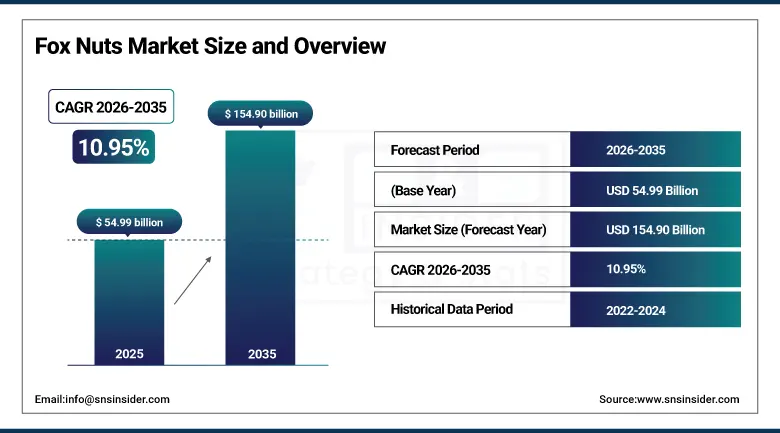
The Fox Nuts Market was valued at USD 54.99 billion in 2025 and is expected to reach USD 154.90 billion by 2035, growing at a CAGR of 10.95% from 2026–2035.
The global fox nuts market is experiencing a dynamic expansion that reflects the broader health and wellness food movement’s progressive mainstreaming of nutritionally superior plant-based snack alternatives that combine genuine functional health benefits with culinary versatility and cultural heritage narratives that resonate across both traditional Asian consumer bases and the growing international health-conscious consumer segments that are actively seeking alternatives to conventional calorie-dense, additive-laden processed snack foods. The Indian state of Bihar, which accounts for approximately 80 to 90% of global fox nut production, has benefited from the Indian government’s Geographical Indication protection for Mithila Makhana and the Pradhan Mantri Formalisation of Micro Food Processing Enterprises programme that is supporting the development of more sophisticated fox nut processing, packaging, and quality assurance infrastructure that enables this traditional agricultural commodity to meet the quality standards and regulatory requirements of international export markets whose premium positioning commands the price points that reward investment in modern food processing technology.
The March 2025 launch by Sattviko of a new line of protein-rich roasted fox nuts fortified with natural herbs targeting health-conscious consumers seeking clean-label, low-calorie snacks exemplifies the product innovation trajectory that is transforming fox nuts from a bulk commodity traded primarily in Asian food markets into a premium branded snack product category with its own dedicated retail positioning, distinct consumer identity, and growing brand equity that commands the premium price points necessary for sustainable commercial expansion into international health food retail channels.
To Get more information on Fox Nuts Market - Request Free Sample Report
Fox Nuts Market Trends
-
Progressive product innovation in premium flavoured and seasoned fox nut formats including masala, cheese, barbecue, mint, turmeric, black pepper, and exotic spice varieties that are expanding the product’s appeal beyond its natural roasted form to attract the broader mainstream health snack consumer whose purchasing decision is influenced as much by taste variety and snacking occasion versatility as by nutritional credentials, enabling brands to compete more effectively with the extensive flavoured nut and seed category that commands substantial supermarket shelf space in developed market health food sections.
-
Growing integration of fox nuts as a functional ingredient within health food formulations including protein bars, granola and trail mix blends, breakfast cereals, energy biscuits, and health-oriented ready-to-eat meal components where their high protein and fibre content, neutral flavour profile, and clean-label positioning make them a nutritionally compelling ingredient that adds functional credibility to premium health food product formulations targeting the nutritionally aware consumer segment.
-
Rising international consumer discovery of fox nuts through Indian diaspora community food culture, social media health content featuring makhana as a superfood recommendation, and the broader interest in traditional Asian health foods that is generating new first-time purchasing among Western health food consumers in the United States, United Kingdom, Canada, Australia, and Germany who are encountering fox nuts through Indian restaurant menus, Indian grocery stores, and health food e-commerce platforms that are progressively expanding their fox nut product range.
-
Growing organic fox nut production and certification in Bihar and West Bengal driven by consumer demand premium for certified organic products across export markets in North America and Europe, government support for organic agriculture transition under Indian agricultural policy frameworks, and the commercial opportunity that organic certification creates for fox nut exporters seeking access to the natural and organic food retail channels whose premium pricing structure makes organic agricultural investment economically viable.
-
Expanding deployment of advanced processing technology including specialised roasting equipment, microwave-based puffing technology, and nitrogen-flushed modified atmosphere packaging systems that are enabling the Indian fox nut processing industry to achieve the consistent product quality, extended shelf life, and food safety compliance standards that international retail chains require before listing imported snack food products, progressively removing the quality and logistics barriers that previously limited fox nut export market penetration to specialty and ethnic food retail channels.
U.S. Fox Nuts Market Outlook
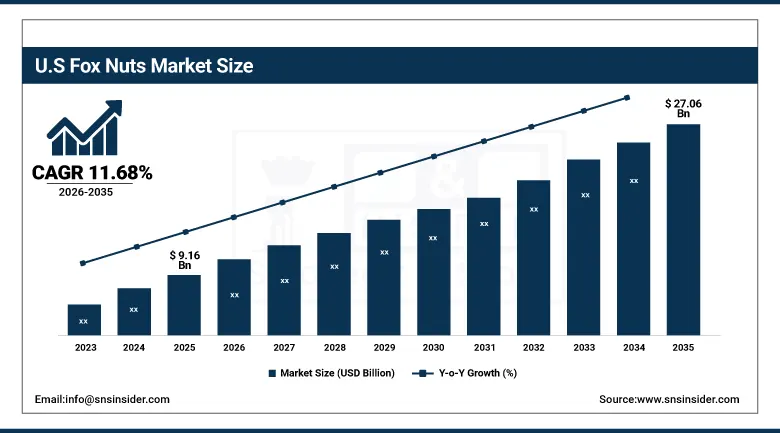
The U.S. fox nuts market was valued at USD 9.16 billion in 2025 and is expected to reach USD 27.06 billion by 2035, growing at a CAGR of 11.68% from 2026–2035, driven by a convergence of demand from the South Asian diaspora community whose familiar cultural engagement with makhana as a Navratri fasting food and everyday healthy snack creates an established and growing domestic consumer base, and the rapidly expanding mainstream American health-conscious consumer segment that is discovering fox nuts through social media wellness content, health food blog recommendations, and the growing availability of premium branded fox nut products through Amazon, Thrive Market, and health-focused grocery channels. The clean eating movement’s emphasis on whole food, minimally processed, plant-based snacking options creates a perfect alignment with fox nuts’ natural agricultural origin, minimal processing requirement, and compelling nutritional profile that positions the product as an authentic clean-label snack alternative to manufactured nutrition bars, processed nut butter products, and synthetic protein snack products whose ingredient lists contrast unfavourably with the simplicity of roasted makhana.
The United States import of fox nuts from India has grown at double-digit annual rates over the past five years as both established Indian food import distributors and new direct-to-consumer makhana brand startups scale their U.S. commercial infrastructure to meet growing retail and e-commerce demand, with the Indian government’s Agricultural and Processed Food Products Export Development Authority’s active promotional support for makhana export market development providing institutional marketing infrastructure that complements individual brand commercial investment in building category awareness among U.S. mainstream health food consumers.
Fox Nuts Market Segment Analysis
-
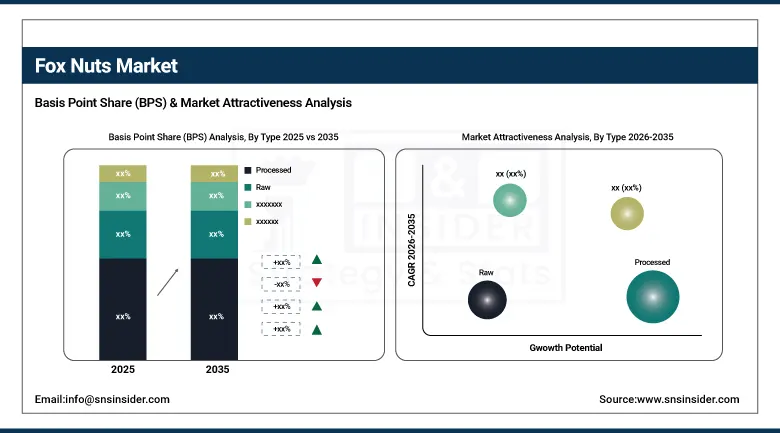
By Type, Processed fox nuts dominated the fox nuts market with the largest revenue share in 2025, reflecting the commercial dominance of roasted, flavoured, and ready-to-eat preparations that deliver the convenience, taste variety, and portion control that contemporary snack consumption occasions demand across both traditional Asian and international health food market contexts; raw fox nuts are the fastest-growing type segment.
-
By Nature, Conventional fox nuts held the dominant market share in 2025, reflecting their volume dominance across the traditional Asian market channels where organic certification premiums are less commercially significant in the mass market segments; organic fox nuts are the fastest-growing nature segment at a CAGR of approximately 12.50% through 2035.
-
By Application, Industrial applications dominated the fox nuts market with the largest share in 2025, reflecting the enormous volume of fox nuts consumed as food processing ingredients across the confectionery, ready-to-eat food; direct human consumption is the fastest-growing application at a CAGR of approximately 12% through 2035 driven by the rapid expansion of the premium branded snack fox nut segment across domestic and export markets.
-
By Distribution Channel, Offline distribution dominated the fox nuts market with approximately 61.3% share in 2025, reflecting the dominance of traditional retail including supermarkets, hypermarkets, specialty health stores, and traditional Asian grocery outlets across the market’s primary consumption geographies; online retail is the fastest-growing distribution channel at a significant CAGR through 2035.
Processed Fox Nuts Lead Type Segment, Raw Grows Fastest
Processed fox nuts retained the dominant type position in the fox nuts market in 2025, anchored by the product format’s commercial superiority in the snacking occasion context that drives the majority of fox nut consumption volume across both Asian and international consumer markets, as the roasted, puffed, seasoned, and flavoured preparations that modern fox nut brands offer deliver the ready-to-eat convenience, texture satisfaction, and taste variety that contemporary snack purchasing decisions require without the preparation effort that raw fox nut cooking demands. The processed segment encompasses everything from the simplest dry-roasted natural makhana sold in basic packaging for traditional Indian consumer markets through the sophisticated flavoured varieties in premium branded resealable packaging targeting the international health food retail premium segment, creating a product range whose commercial breadth serves the full consumer spectrum from traditional purchasers motivated by cultural familiarity and value to mainstream international health food consumers motivated by nutritional positioning and snacking experience quality. Raw fox nuts are the fastest-growing type segment, driven by the artisanal and home cooking community’s interest in working with traditional ingredients whose versatility across savoury curry preparations, sweet traditional recipes, and experimental health food applications creates a distinct consumer engagement pathway that premium food retail’s enthusiasm for heritage and cultural food storytelling supports with growing shelf presence and consumer education investment.
Industrial Application Dominates, Direct Consumption Grows Fastest
Industrial applications retained the dominant position in the fox nuts market in 2025, driven by the enormous volume of makhana consumed as an ingredient across traditional Indian confectionery preparation, temple and religious ceremony offering production, Ayurvedic formulation, and the broad ready-to-eat food processing sector that incorporates fox nuts into namkeen snack mixes, festive gift food packaging, and the commercial food service preparation of traditional Indian cuisine across restaurants, catering operations, and institutional food service across India and its diaspora communities globally. Direct human consumption is the fastest-growing application at approximately 12% CAGR through 2035, propelled by the branded snack segment’s rapid expansion across international health food markets where fox nuts are being positioned as a guilt-free, high-protein, low-calorie snack alternative whose superfood narrative and clean-label credentials differentiate it from the commodity nut and seed snack alternatives competing for health food consumer attention and retail category space.
Offline Distribution Leads, Online Grows Fastest
Offline distribution retained the dominant position with approximately 61.3% of the fox nuts market in 2025, reflecting the traditional dominance of physical retail across the product’s primary Asian market consumer base where supermarkets, hypermarkets, traditional markets, and specialty Indian grocery stores serve as the primary purchasing touchpoints for both conventional bulk makhana and premium branded product formats. Online retail is the fastest-growing distribution channel driven by the transformative role that e-commerce platforms including Amazon, Flipkart in India, and direct-to-consumer brand websites are playing in making premium branded fox nut products accessible to health-conscious consumers across geographies where physical retail fox nut product availability remains limited, enabling brand discovery and trial among the mainstream Western health food consumer demographic whose adoption is essential for the fox nut category’s international commercial mainstream breakthrough.
Regional Analysis
|
Region |
Major Country |
Share Within Region, 2025 (%) |
|---|---|---|
|
North America |
United States |
87.4% |
|
Europe |
Germany |
22.3% |
|
Asia Pacific |
China |
61.7% |
|
Middle East & Africa |
Saudi Arabia |
38.4% |
|
Latin America |
Brazil |
44.2% |
Asia Pacific Fox Nuts Market Insights
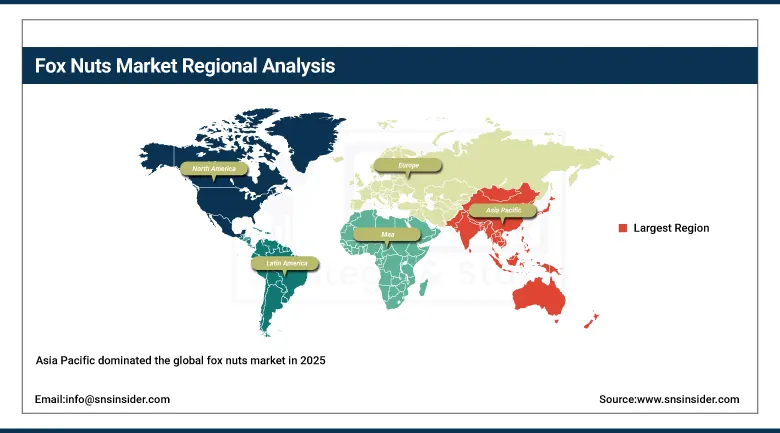
Asia Pacific dominated the global fox nuts market in 2025 as both the world’s dominant production origin region and the largest consumption market, with India accounting for approximately 80 to 90% of global fox nut cultivation in the Bihar, West Bengal, and Madhya Pradesh growing regions that define the Euryale ferox aquatic farming ecosystem whose unique agroclimatic and water resource characteristics make geographic diversification of production into other regions slow and commercially challenging. China accounts for approximately 61.7% of Asia Pacific fox nut consumption revenues through its vast traditional qian shi market across Chinese traditional medicine, festive food, and culinary preparation contexts, and a rapidly growing premium snack segment where lotus seeds in branded packaging are finding placement in the health food sections of major Chinese retail chains and e-commerce platforms. Japan, South Korea, and Southeast Asian markets including Thailand, Singapore, and Vietnam represent growing secondary Asia Pacific consumption markets where cultural familiarity with lotus seed ingredients in traditional desserts, soups, and health foods creates a receptive consumer base for the modern premium fox nut snack products that brands are progressively introducing across these markets.
Get Customized Report as per Your Business Requirement - Enquiry Now
North America Fox Nuts Market Insights
North America is the fastest-growing regional fox nuts market, driven primarily by the United States where the extraordinary expansion of the premium health snack category, the rapid growth of the South Asian diaspora community providing a culturally familiar consumer foundation, and the progressive mainstream adoption by the broader health-conscious American consumer whose discovery of fox nuts is being accelerated by social media, health food influencer content, and the growing retail availability of premium branded makhana products across natural food retail and e-commerce channels. The United States accounts for approximately 87.4% of North American fox nut revenues and represents the single most commercially important international expansion opportunity for Indian makhana producers and brands, as the combination of market scale, purchasing power, health food cultural receptivity, and e-commerce infrastructure creates the ideal commercial environment for building the category awareness and brand loyalty that sustains long-term market development. Canada contributes approximately 12.6% of North American revenues through its large South Asian diaspora population providing an established cultural consumption foundation and a growing mainstream health food market whose natural and organic grocery sector is progressively incorporating premium fox nut products into its functional snack range.
Europe Fox Nuts Market Insights
Europe is a growing fox nuts market where the health food retail sector’s progressive embrace of Asian superfoods, the large South Asian diaspora communities in the United Kingdom, Germany, and the Netherlands providing established cultural consumption foundations, and the organic food market’s receptivity to certified organic Indian agricultural products are creating the conditions for sustainable fox nut category development across European retail channels. Germany accounts for approximately 22.3% of European fox nut revenues as the region’s largest national market, with a health-conscious consumer culture that prioritises nutritional density and natural food origins, a well-developed organic food retail sector, and growing curiosity about Asian culinary and health food traditions that is driving trial among the mainstream German consumer beyond the South Asian diaspora community that has historically constituted the primary domestic fox nut consumer base. The United Kingdom represents the second-most-important European market through its large British-Indian community creating a substantial cultural consumer foundation and a mainstream health food retail culture that has rapidly embraced fox nuts through placement in major supermarket health food sections including Sainsbury’s, Tesco, and Waitrose whose shelf listings provide the visibility and consumer validation that accelerate mainstream adoption.
Latin America and MEA Fox Nuts Market Insights
Latin America and the Middle East and Africa are emerging fox nut markets where growing health food awareness, expanding South Asian diaspora communities, and the progressive introduction of premium plant-based snack products through modern retail and e-commerce channels are creating the early commercial conditions for sustained fox nut market development across regions that are earlier in their product awareness and adoption journey than the more established North American and European international markets. Saudi Arabia leads Middle East and Africa fox nut revenues at approximately 38.4% of the regional total, driven by a large South Asian expatriate community that maintains cultural consumption of makhana in traditional contexts, the growing premium health food retail sector in Riyadh and Jeddah serving the Kingdom’s health-conscious affluent consumer base, and Vision 2030’s wellness economy development creating expanding distribution infrastructure for premium natural food products. Brazil accounts for approximately 44.2% of Latin American revenues through a health-conscious urban consumer culture, growing Asian food retail infrastructure in São Paulo and Rio de Janeiro serving both diaspora and mainstream consumers, and a premium natural snack market whose openness to exotic plant-based foods creates a receptive environment for fox nut brand introduction.
Market Dynamics
Growth Drivers: Rising global health consciousness driving demand for nutritionally superior natural snack alternatives, expanding South Asian diaspora creating cultural consumer foundations in international markets, and product innovation in flavoured and functional formats broadening mainstream appeal
The primary structural growth drivers for the fox nuts market are the extraordinary alignment between fox nuts’ nutritional profile and the specific health attributes that contemporary health food consumers most actively seek in their snack purchasing decisions, combining high protein content, dietary fibre, low caloric density, low glycaemic index, antioxidant richness, and gluten-free composition in a naturally derived, minimally processed whole food format whose clean-label simplicity satisfies the ingredient transparency demands of the most nutritionally demanding consumer segment that is simultaneously the most willing to pay premium prices for demonstrably superior snack alternatives. The global expansion of the South Asian diaspora community, estimated at over 35 million individuals across North America, Europe, the Middle East, and Australia, is creating pre-existing cultural consumer bases for makhana in international markets that dramatically reduce the awareness building investment required for initial market penetration by providing an established purchasing community from which the mainstream health food consumer discovery and adoption cycle can propagate through peer recommendation, culinary curiosity, and social media cultural food content exposure.
Restraints: Geographic production concentration creating supply chain vulnerability, limited mainstream consumer awareness in developed markets outside diaspora communities, and premium price barrier limiting mass market penetration across price-sensitive consumer segments
A significant restraint on the fox nuts market is the extreme geographic concentration of global fox nut cultivation in Bihar’s aquatic farming regions, where approximately 80 to 90% of the world’s Euryale ferox seed production originates from a relatively limited agricultural ecosystem whose output is vulnerable to monsoon rainfall variability, flooding events, drought conditions affecting the water table levels that aquatic plant cultivation requires, and the labour market conditions of a rural agricultural workforce whose alternative employment opportunities influence seasonal agricultural labour availability and cost for the harvesting and post-harvest processing operations that determine raw material supply volume and quality.
Opportunities: E-commerce channel development enabling global brand building without retail physical distribution, organic certification premium creating agricultural investment return for Bihar makhana farmers, and functional ingredient application in protein bars and health foods creating new demand channels
The e-commerce channel development opportunity represents the most commercially accessible pathway for Indian fox nut brands and exporters seeking to build international market presence without the substantial minimum volume commitments, promotional investment requirements, and distribution margin structures that physical retail channel access in premium supermarkets demands, enabling direct-to-consumer brand building through Amazon Prime listings, Thrive Market membership placement, and subscription snack box inclusion that collectively provide fox nut products with consumer reach and trial generation at commercially viable unit economics that would be impossible to achieve through physical retail investment alone at early market development stages.
Recent Developments
-
2025: Sattviko introduced a new line of protein-rich roasted fox nuts fortified with natural herbs in March 2025, targeting health-conscious consumers seeking clean-label, low-calorie snacks with enhanced nutritional functional benefits, and expanding its premium makhana product portfolio with value-added formulations that command premium price positioning relative to standard roasted makhana alternatives.
-
2025: The Indian government expanded its GI-protected Mithila Makhana export promotion programme through APEDA’s international trade fair participation and buyer-seller meeting organisation, facilitating introductions between Bihar makhana producers and international health food retail buyers across North American, European, and Middle Eastern markets seeking certified quality makhana supply for premium product development.
-
2025: Conscious Foods expanded its premium organic makhana product range with new flavour variants and expanded distribution through Amazon India, Flipkart, and international e-commerce channels, building brand equity across the premium branded segment of the Indian and international fox nuts market through digital-first marketing that targets the health-conscious urban consumer demographic whose purchasing decisions are heavily influenced by social media wellness content.
-
2025: Farmley strengthened its fox nuts portfolio with introduction of keto-friendly and high-protein positioned makhana snack variants targeting the fitness and diet-conscious consumer segment, and expanded its retail distribution presence across major Indian supermarket chains and online grocery platforms with premium packaged makhana products in resealable convenience formats.
-
2025: Multiple Bihar-based makhana processing cooperatives received quality certification upgrades and export registration enabling access to European Union and U.S. organic food market import channels, reflecting the progressive improvement of post-harvest processing and food safety infrastructure across the makhana supply chain supported by state government and central government food processing scheme investment.
Fox Nuts Market Key Players
-
Swami Makhana Products Pvt. Ltd.
-
SHS Foods
-
National Farms & Foods
-
K.K. Products
-
Sattviko
-
Farmley
-
Conscious Foods
-
Maruti Makhana
-
Shakti Shudha
-
Manju Makhana
-
Vedaka (Amazon)
-
Janta Makhana Bhandar
-
Priya Foods
-
Navgiri Foods
-
GAIA Health Foods
-
Sresta Natural Bioproducts
-
24 Mantra Organic
-
Snackible
-
WOW! Momo Foods Pvt. Ltd.
-
Bihar State Food and Civil Supplies Corporation
Fox Nuts Market Report Scope:
| Report Attributes | Details |
|---|---|
| Market Size in 2025 | USD 54.99 Billion |
| Market Size by 2035 | USD 154.90 Billion |
| CAGR | CAGR of 10.95% From 2026 to 2035 |
| Base Year | 2025 |
| Forecast Period | 2026-2035 |
| Historical Data | 2022-2024 |
| Report Scope & Coverage | Market Size, Segments Analysis, Competitive Landscape, Regional Analysis, DROC & SWOT Analysis, Forecast Outlook |
| Key Segments | • By Type (Processed, Raw) • By Nature (Organic, Conventional) • By Application (Direct Human Consumption, Industrial) • By Distribution Channel (Offline, Online) |
| Regional Analysis/Coverage | North America (US, Canada, Mexico), Europe (Eastern Europe [Poland, Romania, Hungary, Turkey, Rest of Eastern Europe] Western Europe] Germany, France, UK, Italy, Spain, Netherlands, Switzerland, Austria, Rest of Western Europe]), Asia Pacific (China, India, Japan, South Korea, Vietnam, Singapore, Australia, Rest of Asia Pacific), Middle East & Africa (Middle East [UAE, Egypt, Saudi Arabia, Qatar, Rest of Middle East], Africa [Nigeria, South Africa, Rest of Africa], Latin America (Brazil, Argentina, Colombia, Rest of Latin America) |
| Company Profiles | Swami Makhana Products Pvt. Ltd., SHS Foods, National Farms & Foods, K.K. Products, Sattviko, Farmley, Conscious Foods, Maruti Makhana, Shakti Shudha, Manju Makhana, Vedaka (Amazon), Janta Makhana Bhandar, Priya Foods, Navgiri Foods, GAIA Health Foods, Sresta Natural Bioproducts, 24 Mantra Organic, Snackible, WOW! Momo Foods Pvt. Ltd., Bihar State Food and Civil Supplies Corporation |
Frequently Asked Questions
The fox nuts market is expected to grow at a CAGR of 10.95% from 2026 to 2035.
The fox nuts market was valued at USD 54.99 billion in 2025.
Rising global health consciousness driving demand for nutritionally superior natural plant-based snack alternatives whose clean-label composition and superfood nutritional profile align with contemporary health food consumer preferences.
Processed fox nuts dominated with the largest revenue share in 2025.
Asia Pacific dominated the fox nuts market in 2025, with China as the leading national market within the region.
