
Fresh Vegetables Market Report Scope & Overview:
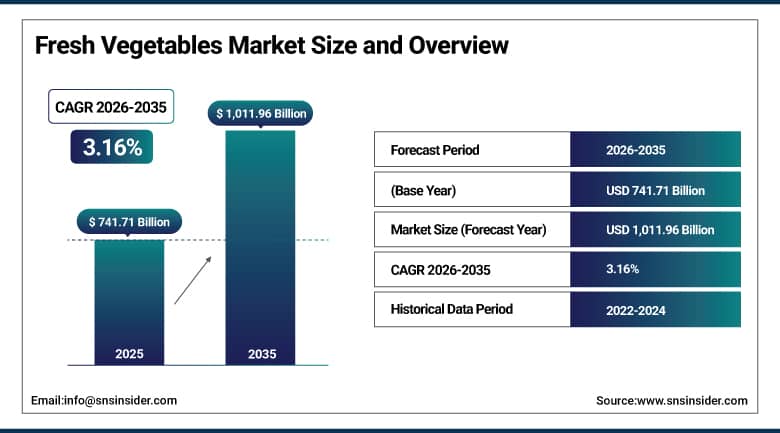
The Fresh Vegetables Market was valued at USD 741.71 Billion in 2025 and is expected to reach USD 1,011.96 Billion by 2035, growing at a CAGR of 3.16% from 2026 to 2035.
The Fresh Vegetables Market is growing due to increasing awareness about the health benefits of vegetable consumption that includes vitamins, minerals, fiber, and antioxidants. Health awareness and preference for fresh and nutritious food products are driving the demand for fresh vegetables around the world. Urbanization and changes in lifestyle are other factors leading to growing demand for fresh vegetables through retail stores, online grocery shopping, and foodservice providers. Higher disposable income in developing economies is also leading to the growth in spending on quality vegetables. Furthermore, the growth in food service industry, increase in demand for vegetarianism, and rise in organic agriculture practices are also contributing toward market growth. Cold chain management, better storage and packaging techniques, and improved logistics and distribution network are decreasing losses after harvest of vegetables.
Fresh Del Monte Produce completed a USD 285 million acquisition of select Del Monte Foods assets on March 19, 2026, including canned vegetable, tomato, and refrigerated fruit units, in a "brand reunification" strategy allowing seamless transition from the fresh produce aisle to the pantry with unprecedented leverage during annual retail contract negotiations, reflecting the scale of structural consolidation reshaping how leading vertically integrated producers position themselves across fresh and shelf-stable vegetable categories.
To Get More Information On Fresh Vegetables Market - Request Free Sample Report
Fresh Vegetables Market Trends
-
Growing food processing industry demand continues to use fresh vegetables to produce convenience foods, frozen products, and packaged items at an accelerating pace.
-
Rising demand for leafy greens, including lettuce, spinach, kale, and Swiss chard, continues as consumers regard these vegetables as healthy options for salads and smoothies.
-
Expanding automated plant factory and sensor-equipped greenhouse operations continue optimizing farm-fresh produce supply chains across leading Asian markets.
-
Increasing organic and sustainable produce demand continues to reshape farming method preferences among health-conscious, environmentally aware consumers.
-
Growing snackification of fresh vegetables through protein-forward salad kits continues to reposition traditional produce companies as health-and-wellness lifestyle brands.
U.S. Fresh Vegetables Market Outlook
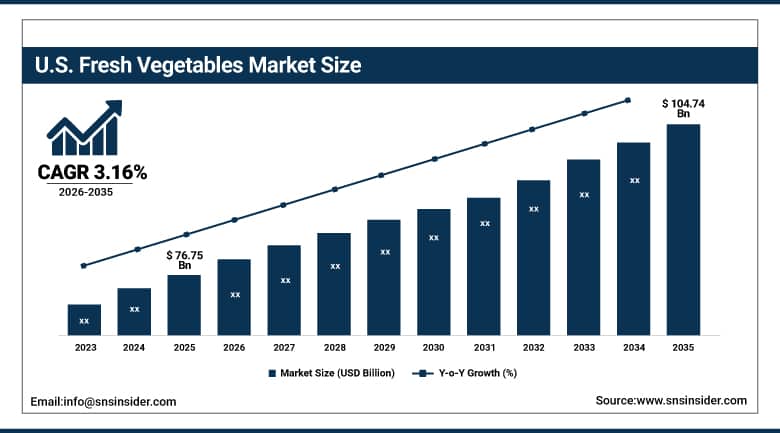
The U.S. Fresh Vegetables Market was valued at USD 76.75 Billion in 2025 and is projected to reach USD 104.74 Billion by 2035, growing at a CAGR of 3.16% during 2026–2035.
The U.S. Fresh Vegetables Market is witnessing growth because of the rise in consumer awareness about the nutritional value of fresh vegetables, along with increasing preference for healthy food. The growing awareness among consumers regarding health, combined with the popularity of vegetarian and organic diet plans, is contributing to the increased consumption of fresh vegetables. Moreover, the demand for fresh and processed vegetables is expected to drive growth in the market. The presence of well-established distribution channels in the form of supermarket chains, hypermarkets, convenience stores, and online food retailers is adding to the ease of availability of fresh vegetables across the country. An increasing demand for food service from restaurants and kitchens is leading to the increased consumption of fresh vegetables.
Taylor Farms launched 11 new protein-forward products in March 2026, successfully "snackifying" the vegetable category as its salad kits carry a higher price floor that consumers are willing to pay for convenience, positioning the company as a health-and-wellness lifestyle brand rather than a traditional produce supplier and demonstrating how leading fresh vegetable companies continue evolving beyond commodity-based business models.
Fresh Vegetables Market Segment Analysis
-
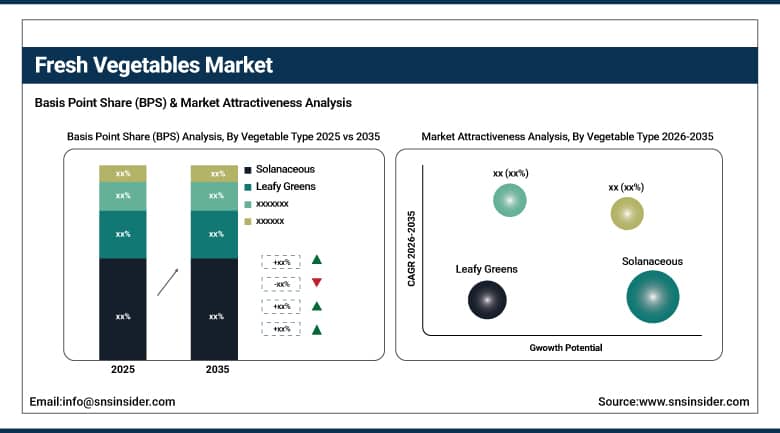
By Vegetable Type, Solanaceous segment dominated the Fresh Vegetables Market in 2025 with 27% share; Leafy Greens segment is the fastest-growing segment.
-
By Distribution Channel, Retail Stores/Supermarkets segment dominated the Fresh Vegetables Market in 2025 with 42% share; Online Retailing segment is the fastest-growing segment.
-
By Farming Method, Conventional segment dominated the Fresh Vegetables Market in 2025 with 84% share; Organic segment is the fastest-growing segment.
By Vegetable Type, Solanaceous Vegetables Dominate the Fresh Vegetables Market While Leafy Greens Register the Fastest Growth
Solanaceous vegetables dominated the Fresh Vegetables Market in 2025 with a 27% share, due to high consumption levels from common vegetables consumed such as tomatoes, potatoes, peppers, and eggplants. The vegetables' diverse use in the kitchen, versatile use in the culinary field and all-year round demand have a great contribution to the volume of consumption. Cultivation methods, production and availability in the retail stores are contributing factors. Higher urban populations and the rising demand for convenient vegetables are enhancing the wide consumption of solanaceous vegetables.
Leafy Greens are the fastest-growing vegetable segment, as a result of increased knowledge about healthy diets among consumers and preventive wellness. The consumption of vegetables that include spinach, lettuce, kale, and others with high vitamins, minerals, fiber and antioxidant content is growing. Consumption growth is being supported by adoption of salad eating, plant-based dieting, smoothies, and healthy meals. Urban farming, hydroponics and controlled environment agriculture are increasing year-round availability. Demand for fresh and nutrient-rich vegetables is driving the growth of the segment.
By Distribution Channel, Retail Stores/Supermarkets Dominate the Fresh Vegetables Market While Online Retailing Experiences the Fastest Growth
Retail Stores/Supermarkets dominated the Fresh Vegetables Market in 2025 with a 42% share, due to their extensive geographical coverage, variety of vegetable types available, and fresh produce supply chains already in place. Consumers buy vegetables regularly when shopping at the grocery store, and the supermarkets offer consumers an easy way to shop a wide range of different types, sizes, and price levels. Promotional activities, produce sections, proper display, and increasing capabilities of temperature management help make the sale.
Online Retailing is the fastest-growing distribution channel, due to increasing use of smartphones and Internet access, shopping preferences that are oriented towards convenience, and delivery services for groceries. People can order their fresh vegetables from home and compare different types and prices and have access to a wider assortment without going to the physical stores. Investments in logistics systems and packaging have been made to keep the product fresh during transport. Quick commerce channels, digital payment options, subscriptions, and delivery services in the cities are growing rapidly.
By Farming Method, Conventional Farming Dominates the Fresh Vegetables Market While Organic Farming Witnesses the Fastest Growth
Conventional farming dominated the Fresh Vegetables Market in 2025 with an 84% share, due to its high production capacities, strong agricultural infrastructure and competitive pricing. Traditional cultivation is still popular because of its well-established farming techniques, abundant availability of inputs and effective logistics. High volume production capacity will help it to keep up with the demand on the part of consumers, retailers, and food service providers. The abundance of familiar methods, supply chain development and reduced cost of production become additional advantages of this type of farming.
Organic farming is the fastest-growing farming method, supported by increasing consumer awareness about the quality of the products, environment issues and the problems related to inputs used in the agricultural sector. More and more consumers are demanding products that do not contain pesticides and fertilizers and can be used for the premium segment and health-oriented food products. Growing income levels, growth in organic produce certification and availability contribute to the popularity of the practice.
Regional Insights
|
Region |
Country |
Regional Share (2025) |
|---|---|---|
|
Asia Pacific |
China |
34.60% |
|
North America |
United States |
84.60% |
|
Europe |
Germany |
22.80% |
|
Middle East & Africa |
UAE |
20.60% |
|
Latin America |
Brazil |
34.60% |
Asia Pacific Fresh Vegetables Market Insights
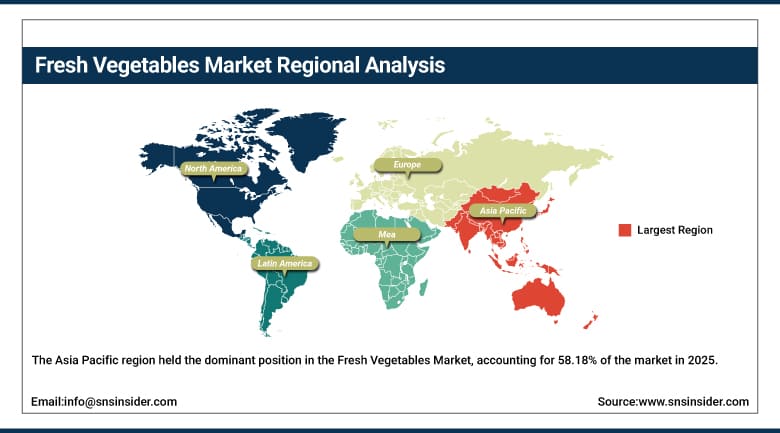
The Asia Pacific region held the dominant position in the Fresh Vegetables Market, accounting for 58.18% of the market in 2025 due to the presence of a huge population consuming vegetables, urbanization, and increasing use of automated agriculture in the region. Adoption of controlled environment agriculture is resulting in increased production of vegetables round the year. The plant factory sub-segment in Japan, which focuses mainly on leafy greens and root crops, achieved 18% revenue growth in 2025. This shows the growing investment in advanced agriculture techniques in the region.
China held an estimated share of 34.60% of the Asia Pacific fresh vegetables market in 2025 owing to the vast number of vegetables produced and consumed in the region. Other regions making significant contributions to the growth of the region are Japan, India, and South Korea. South Korea has introduced the Smart Farm Korea 2025 initiative which invests KRW 1.2 trillion into sensor-based greenhouses.
Get Customized Report as Per Your Business Requirement - Enquiry Now
North America Fresh Vegetables Market Insights
North America is expected to exhibit significant growth during 2026-2035, owing to high disposable incomes that facilitate consumption of quality fresh produce. The investments being made by industries in the latest technology for preservation, transportation in refrigerated vehicles, and cold chain logistics have led to improved shelf-life of products. Moreover, rising preference of consumers for convenience snacks has been driving the intake of vegetables. In addition, developments in packaging and value added vegetable products of major producers are facilitating regional growth of the market.
United States constituted around 84.60% share of the North American market in 2025, owing to presence of many health conscious consumers and leading producers such as Dole, Taylor Farms, and Fresh Del Monte in the country. Growth in the region is being contributed by Canada through increased usage of fresh produce and consumer preference for ready-to-eat vegetable products.
Europe Fresh Vegetables Market Insights
In 2025, Europe contributed to the overall global Fresh Vegetables Market owing to its advanced retailing distribution network and the growing trend of consumers opting for organic, fresh, and sustainable vegetables. Health awareness in major European countries is boosting the consumption of vegetables. Innovations in the area of packaging and preservation along with effective cold chain operations are contributing towards improving the quality of vegetables while reducing food wastage. All these factors are fueling the demand for fresh vegetables in the region.
Germany was the leading country within the region in 2025 with a 22.80% regional share. The country's advanced retailing network and demand for fresh and healthy food products contributed to its leading position in the regional market. Other significant contributors to the regional market include the United Kingdom, France, and the Netherlands.
Middle East & Africa and Latin America Fresh Vegetables Market Insights
Middle East & Africa shows constant growth owing to investments in advanced retail infrastructure and increasing health-consciousness among consumers in Gulf nations. Increased demand for healthy produce increases the market prospects. Latin America too is growing thanks to increased fresh vegetable intake, which comes from urbanization, rising incomes, and better retail networks. Brazil still retains its place as the dominant player in South America owing to its vast agriculture base and rising domestic consumption of fresh vegetables.
The UAE had a leading share of 20.60% in the Middle East & Africa market in 2025 due to its growing retail modernization and health-conscious consumer demand. The share of Brazil in the Latin American market stood at 34.60% in 2025, owing to the high annual consumption of fresh produce in the São Paulo state amounting to over 3.5 million metric tons per year.
Growth Drivers: Health Consciousness and Retail Distribution Expansion Driving Market Growth
The growth of the Fresh Vegetables Market will be mainly supported by health awareness, urbanization and lifestyle changes, growth in retail/e-commerce sales channels, and innovations in packaging and preservation technologies. Modern knowledge of nutrition makes people demand fresh vegetables, making them increasingly important when it comes to making purchases, while food processors use them to manufacture ready-to-eat foods and packaged products.
Increasing demands of the food processing industry will continue using fresh vegetables to manufacture convenience foods, frozen products, and packaged products. Demand for leafy vegetables will grow, as these vegetables are seen as a healthy choice for salads and smoothies. Automating plant factory and sensor-based greenhouses will optimize the supply chain of farm-fresh produce.
Restraints: Perishability Challenges and Seasonal Supply Fluctuations Limiting Market Expansion
While having positive underlying demand trends, the industry is exposed to considerable constraints associated with perishability and limited shelf-life, which demands a well-managed cold chain logistics infrastructure. Seasonality remains a key driver of volatility in price and availability, especially for vegetable types that require certain environmental conditions for cultivation and harvesting.
Increased competition within the expanding pool of vertically integrated suppliers, especially in light of structural consolidation trends influencing category positioning, is likely to keep margins under pressure in mainstream vegetable categories. Additionally, increasing input costs, such as labor, freight, and packaging costs, remain earnings pressures.
Opportunities: Automated Farming Technology and Protein-Forward Product Innovation Creating New Growth Avenues
Substantial opportunity exists in continued development of automated plant factory and sensor-equipped greenhouse technology capable of optimizing year-round production while reducing environmental footprint and seasonal supply dependency. Companies that successfully commercialize controlled-environment agriculture stand to capture significant share of category growth as leading Asian markets demonstrate strong revenue growth from fully automated operations.
Growing snackification and protein-forward product innovation presents a further significant growth avenue, as leading producers increasingly position themselves as health-and-wellness lifestyle brands rather than traditional commodity suppliers. Expanding organic and sustainable produce demand across emerging markets in Asia Pacific and Latin America also represents meaningful untapped opportunity for fresh vegetable manufacturers.
Recent Developments
-
2025: Fresh Del Monte announced a joint venture with Managro, including expansion of an avocado and lime packing house in Colombia.
-
2025: Fresh Del Monte sold its Mann Packing business to Church Brothers Farms, enabling sharper focus on core fresh fruit and specialty products.
-
2024-2025: Fresh Del Monte expanded regenerative agriculture practices across its farms by 11%, with 74% of its pineapples now grown on carbon-neutral farms.
-
2026: Village Farms International's sales grew 27% to USD 64 million in the second quarter of 2026, driven by record cannabis revenues alongside continued fresh produce growth.
Fresh Vegetables Companies are:
-
Dole plc
-
Fresh Del Monte Produce Inc.
-
Taylor Farms
-
Bonduelle Group
-
Greenyard NV
-
Mastronardi Produce Ltd.
-
Tanimura & Antle Fresh Foods, Inc.
-
Ocean Mist Farms
-
Church Brothers Farms
-
Lipman Family Farms
-
Dandy® / Duda Farm Fresh Foods
-
Vegpro International Inc.
-
Keelings
-
Village Farms International, Inc.
-
Gotham Greens
-
BrightFarms
-
Mazzoni S.p.A.
-
AMFresh Group
Fresh Vegetables Market Report Scope:
| Report Attributes | Details |
|---|---|
| Market Size in 2025 | USD 741.71 Billion |
| Market Size by 2035 | USD 1,011.96 Billion |
| CAGR | CAGR of 3.16% From 2026 to 2035 |
| Base Year | 2025 |
| Forecast Period | 2026-2035 |
| Historical Data | 2022-2024 |
| Report Scope & Coverage | Market Size, Segments Analysis, Competitive Landscape, Regional Analysis, DROC & SWOT Analysis, Forecast Outlook |
| Key Segments | • By Vegetable Type (Solanaceous, Leafy Greens, Cruciferous, Root Vegetables, Allium, Legumes, Cucurbitaceous) • By Distribution Channel (Retail Stores/Supermarkets, Online Retailing, Farmers' Markets, Specialty Stores, Foodservice, Wholesale) • By Farming Method (Conventional, Organic) |
| Regional Analysis/Coverage | North America (US, Canada), Europe (Germany, UK, France, Italy, Spain, Russia, Poland, Rest of Europe), Asia Pacific (China, India, Japan, South Korea, Australia, ASEAN Countries, Rest of Asia Pacific), Middle East & Africa (UAE, Saudi Arabia, Qatar, South Africa, Rest of Middle East & Africa), Latin America (Brazil, Argentina, Mexico, Colombia, Rest of Latin America). |
| Company Profiles | Dole plc, Fresh Del Monte Produce Inc., Taylor Farms, Bonduelle Group, Grimmway Farms, Greenyard NV, Mastronardi Produce Ltd., Tanimura & Antle Fresh Foods, Inc., Ocean Mist Farms, Church Brothers Farms, Lipman Family Farms, Dandy / Duda Farm Fresh Foods, Vegpro International Inc., Keelings, Nature’s Pride B.V., Village Farms International, Inc., Gotham Greens, BrightFarms, Mazzoni S.p.A., AMFresh Group. |
Frequently Asked Questions
The Fresh Vegetables Market is expected to grow at a CAGR of 3.16% from 2026 to 2035.
The Fresh Vegetables Market was valued at USD 741.71 Billion in 2025.
The market is driven by rising health consciousness, urbanization and changing lifestyles, and expansion of retail and e-commerce channels.
The Solanaceous Vegetables segment dominated the Fresh Vegetables Market in 2025.
The Asia Pacific region dominated the Fresh Vegetables Market in 2025, accounting for approximately 64.18% market share.
