
Fuselage Market Report Scope & Overview:
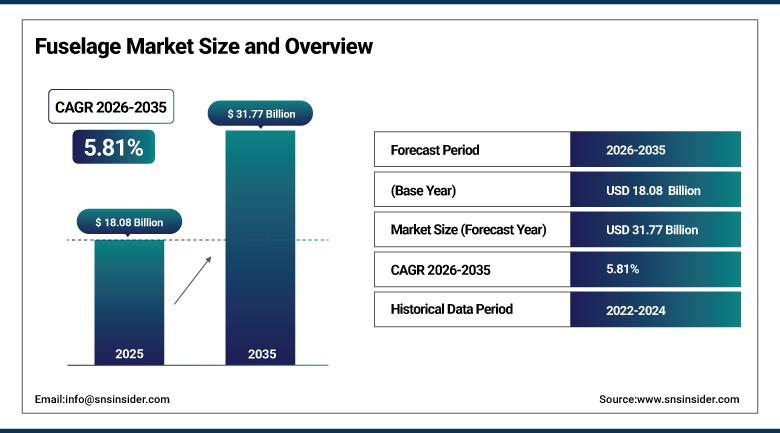
The Fuselage Market was valued at USD 18.08 billion in 2025 and is expected to reach USD 31.77 billion by 2035, growing at a CAGR of 5.81% from 2026-2035.
The Fuselage Market will be influenced by the increasing demand for commercial aircraft, driven by rising air passenger traffic and the expansion of global air transportation. Aircraft makers are working on new fuselage designs that are stronger, lighter, more fuel-efficient and safer for passengers. Increasing production of narrow-body and wide-body aircraft and modernization of military aircraft fleets are driving demand for fuselage components. Lightweight and durable aircraft structures are evolving because of developments in aluminum alloys, titanium alloys and carbon fiber reinforced polymer composites. The market is also likely to grow with the increasing orders for aircraft and adoption of advanced manufacturing technologies.
⮞In July 2025, Airbus confirmed that its A320 Family aircraft production program was progressing toward a target of 75 aircraft per month in 2027, supporting increased manufacturing activity across the commercial aerospace supply chain, including fuselage and other airframe structures.
To Get more information Fuselage Market - Request Free Sample Report
Fuselage Market Trends
-
Growing adoption of lightweight materials, including aluminum alloys and carbon fiber-reinforced polymer composites, in aircraft fuselage manufacturing.
-
Rising demand for advanced fuselage structures to improve fuel efficiency, aircraft performance, and passenger comfort.
-
Continued advancements in automated manufacturing, additive manufacturing, and precision assembly technologies for fuselage production.
-
Increasing investment in next-generation commercial and military aircraft, driving demand for advanced fuselage components.
-
Expanding use of digital design, simulation, and structural health monitoring technologies to enhance fuselage durability, safety, and maintenance efficiency.
Fuselage Market Outlook
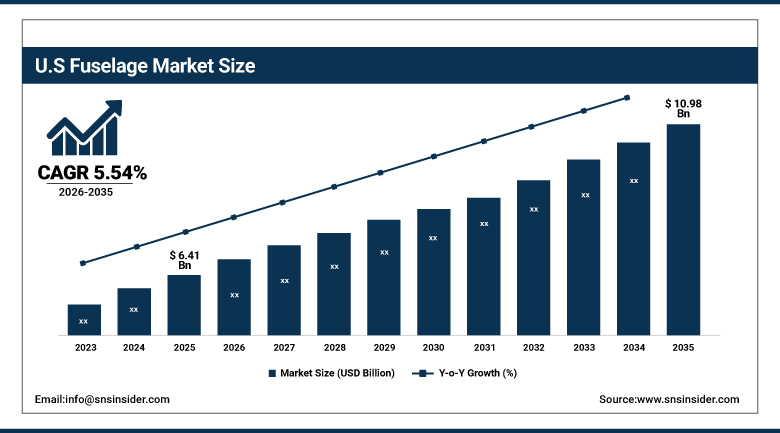
The U.S. Fuselage Market was valued at USD 6.41 Billion in 2025 and is expected to reach USD 10.98 Billion by 2035, growing at a CAGR of 5.54% from 2026-2035.
U.S. growth of the Fuselage Market will remain supported by increasing aircraft production, rising air passenger traffic, fleet modernization programs, and growing demand for lightweight and fuel-efficient aircraft structures. Also, demand will be driven by advances in composite materials, improvements in fuselage manufacturing technologies and increasing investments in commercial and military aviation. Going forward, aircraft manufacturers will continue to focus on lightweight fuselage design, structural durability and fuel efficiency to respond to changing performance and sustainability needs. Increasing focus on aircraft efficiency, safety and advanced structural materials will help support continued development of the U.S. fuselage industry.
⮞In October 2024, Boeing announced its third-quarter aircraft delivery results, reporting 116 commercial aircraft deliveries during the quarter, reflecting activity across its commercial aircraft manufacturing and delivery operations.
Fuselage Market Segment Analysis
-
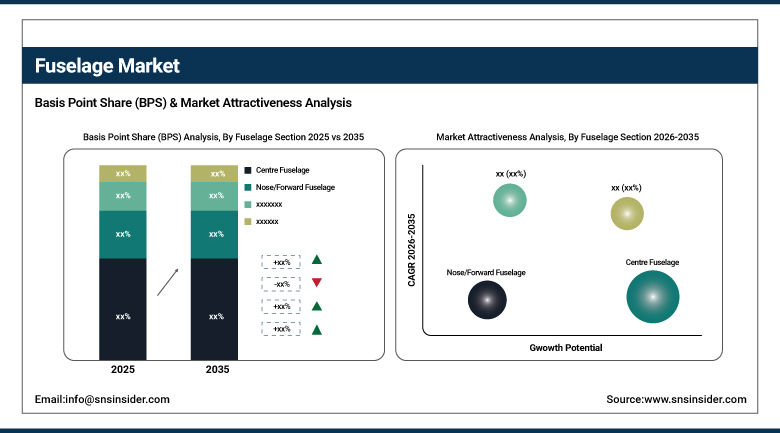
By Fuselage Section, the Centre Fuselage segment dominated the Fuselage Market with approximately 32.68% share in 2025, while the Centre Fuselage segment is the fastest growing with a CAGR of approximately 5.94%.
-
By Aircraft Type, the Narrow-Body Aircraft segment dominated the Fuselage Market with approximately 54.80% share in 2025, while the Military Aircraft segment is the fastest growing with a CAGR of approximately 6.89%.
-
By Material Type, the Aluminum Alloys segment dominated the Fuselage Market with approximately 57.31% share in 2025, while the Thermoplastic Composites segment is the fastest growing with a CAGR of approximately 10.17%.
-
By Structure Type, the Semi-Monocoque Fuselage segment dominated the Fuselage Market with approximately 63.47% share in 2025, while the Composite Barrel Fuselage segment is the fastest growing with a CAGR of approximately 11.97%.
By Fuselage Section, Centre Fuselage dominates and Centre Fuselage grows fastest
Centre Fuselage segment holds the dominating share of the Fuselage Market, supported by its critical role in connecting major aircraft structures, including the forward and aft fuselage sections, and accommodating essential systems and structural components. The demand for center fuselage structures is being fueled by increased aircraft production, increased demand for commercial air travel and ongoing fleet modernisation. In addition, the prominence of the segment is also being driven by the increasing focus on aircraft structural integrity, lightweight materials, and manufacturing efficiency.
Centre Fuselage segment is also expected to experience the fastest growth in the Fuselage Market, driven by increasing investments in next-generation aircraft programs, advancements in advanced composite materials, and rising demand for fuel-efficient aircraft. The adoption of automated manufacturing processes and new structural assembly techniques is improving production efficiencies leading to lighter aircraft and improved structural performance that will help support continued growth in this segment.
⮞In May 2025, India’s Ministry of Defence announced the handover of the first centre fuselage assembly for the LCA Tejas Mk1A to Hindustan Aeronautics Limited (HAL) by VEM Technologies, marking a milestone in private-sector manufacturing of major aircraft structural assemblies.
By Aircraft Type, Narrow-Body Aircraft dominates and Military Aircraft grows fastest
Narrow-Body Aircraft constitutes the leading segment in the Fuselage Market, supported by the high production volumes of single-aisle commercial aircraft used for short- and medium-haul routes. The major factors driving the demand for narrow-body aircraft fuselages are increasing demand for air travel, fleet expansion of airlines and replacement of ageing aircraft. They are also the most efficient of the segment with lower operating costs and are suitable for high frequency domestic and regional flights.
Military Aircraft represents a rapidly growing segment of the Fuselage Market, driven by rising defense expenditures, military fleet modernization programs, and increasing procurement of advanced fighter jets, transport aircraft, and surveillance aircraft. Developments in the next generation of military aircraft, and the increasing focus on national security and defense readiness, are driving advanced fuselage structures.
⮞In February 2025, Tata Boeing Aerospace announced the delivery of its 300th AH-64 Apache helicopter fuselage, highlighting continued manufacturing activity in military aircraft structures.
By Material Type, Aluminum Alloys dominates and Thermoplastic Composites grows fastest
Aluminum Alloys constitute the leading segment in the Fuselage Market due to their extensive use in aircraft structures, supported by their favorable strength-to-weight ratio, durability, corrosion resistance, and cost-effectiveness. The application and demand of this material continue to be driven by ongoing manufacturing processes and proven performance in commercial and military aircraft. The segment is getting more and more important with the current commercial aircraft production and the need for light-weight and sound fuselage components.
Thermoplastic Composites represent the fastest-growing segment in the Fuselage Market, driven by increasing demand for lightweight aircraft structures, improved fuel efficiency, and advanced materials that support lower manufacturing and maintenance costs. Their high strength-to-weight ratio, impact resistance, recyclability and potential for faster manufacturing cycles are encouraging their use in aerospace applications. The segment is likely to grow owing to ongoing developments in composite processing technologies and increasing focus on sustainable aircraft manufacturing.
⮞In July 2025, Airbus highlighted the extensive use of aluminum in aircraft fuselages and its ongoing efforts to improve material circularity and recycling in aerospace manufacturing.
By Structure Type, Semi-Monocoque Fuselage dominates and Composite Barrel Fuselage grows fastest
The Semi-Monocoque Fuselage segment dominates the Fuselage Market due to its widespread use in commercial and military aircraft, supported by its favorable balance of structural strength, durability, weight efficiency, and manufacturing flexibility. Internal supports and stressed skin combine to give the aircraft a framework that can carry the loads of flight, yet remain within reasonable weight limits. The commercial aircraft production and the increasing demand of aircraft modernization are expected to lead this segment to dominate the forecast period.
The Composite Barrel Fuselage segment is the fastest-growing segment in the Fuselage Market, driven by increasing demand for lightweight aircraft structures, improved fuel efficiency, and reduced maintenance requirements. Composite barrel designs enable the integration of large fuselage sections with fewer joints, which may result in lower structural weight and better manufacturing efficiency. The segment is anticipated to be driven by the rising acceptance of advanced composite materials and the rising investment in the development of next-generation aircraft.
Regional Analysis
|
Region |
Major Country |
Share within Region, 2025 (%) |
|---|---|---|
|
North America |
United States |
87.46% |
|
Asia Pacific |
China |
48.72% |
|
Europe |
United Kingdom |
15.74% |
|
Latin America |
Brazil |
32.68% |
|
Middle East & Africa |
Israel |
12.45% |
North America Fuselage Market Insights
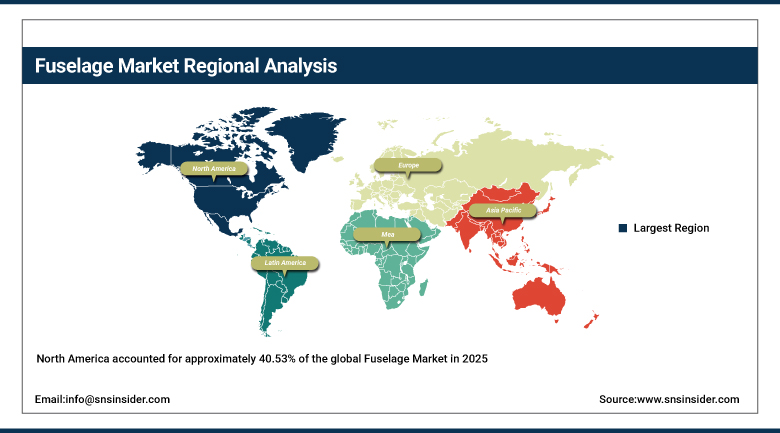
North America accounted for approximately 40.53% of the global Fuselage Market in 2025, driven by strong aircraft manufacturing capabilities, substantial defense spending, and increasing demand for commercial and military aircraft. The vast majority of regional demand comes from the US, driven by the presence of major aerospace manufacturers, defense contractors and aircraft component suppliers.
Canada contributes to regional market growth through its established aerospace manufacturing industry and participation in commercial and military aviation programs. Technological advancements in the design of aircraft, the use of lightweight materials and sophisticated manufacturing technologies, particularly the increased use of composite materials and high-performance aluminum alloys, further consolidate North America’s position in the global fuselage market.
Get Customized Report as per Your Business Requirement - Enquiry Now
Asia Pacific Fuselage Market Insights
Asia Pacific is anticipated to witness a CAGR of approximately 6.69% in the Fuselage Market throughout the forecast period from 2026 to 2035, driven by increasing aircraft production, rising air passenger traffic, and growing investments in commercial and military aviation across the region. China is expected to play a major role in the growth of the regional market on the back of its growing aerospace manufacturing capabilities and rising investments in domestic aircraft development.
Japan will contribute through its established aerospace manufacturing industry and technological advancements in aircraft structures and materials, while India is expected to experience growing demand for fuselages supported by the expansion of its aviation sector, increasing aircraft orders, and government initiatives to strengthen domestic aerospace manufacturing.
Europe Fuselage Market Insights
Europe is a major regional market for fuselage manufacturing, due to the region’s well-established aerospace industry and the presence of major aircraft manufacturers and component suppliers. The UK has a long-standing aerospace manufacturing capability, and expertise in advanced aircraft structures, which supports regional demand.
Germany and France dominate the European fuselage market, as they have built up aircraft manufacturing industries, strong engineering bases, and regular investments in lightweight materials and innovative fuselage designs. Demand for the region’s fuselage structures is expected to continue with aircraft production, fleet upgrades and increased use of composite materials.
MEA & Latin America Fuselage Market Insights
The Middle East & Africa represents an emerging market for aircraft fuselages, supported by investments in military aviation, fleet modernization, and the expansion of commercial aviation infrastructure. Israel, Saudi Arabia and the United Arab Emirates all add to regional demand through defense procurement programs, aerospace manufacturing initiatives and efforts to increase domestic aviation capabilities. Higher spending on military aircraft, and on maintenance, repair and overhaul (MRO) work, is also driving demand for advanced fuselage structures and light-weight materials.
In Latin America, the Fuselage Market is led by Brazil, which plays a significant role in the regional aerospace industry through its established aircraft manufacturing capabilities and the presence of major aerospace companies. Demand is supported by the manufacture of commercial aircraft, fleet renewal and the requirement for structural components for regional and military aircraft. The regional fuselage market is expected to grow gradually due to growing investments in aerospace manufacturing, aircraft maintenance and aviation infrastructure.
Market Dynamics
Growth Drivers: Rising Aircraft Production and Demand for Lightweight, Fuel-Efficient Structures
Major factors driving the growth of the Fuselage Market include the increasing demand for commercial and military aircraft and increasing global aircraft production. Aircraft manufacturers are continuously increasing their production capacities to cater to the increasing air passenger traffic, fleet modernization requirements, and defense aviation needs. Advances in aerospace materials and manufacturing technologies enhance fuselage strength, structural durability and overall aircraft performance and reduce weight.
A further major driver of market growth is the increasing use of lightweight materials such as advanced aluminum alloys and carbon fiber composites which reduce aircraft weight, improve fuel efficiency and lower operating costs. Furthermore, growing investments in the development of next-generation aircraft, coupled with the need for fuel-efficient aircraft structures and sustainable aviation solutions, are also driving the market growth. Manufacturers are concentrating on improving the aerodynamic performance, reducing emissions and increasing the operational efficiency
⮞In March 2025, Airbus outlined technologies for next-generation single-aisle aircraft targeting a 20–30% improvement in fuel efficiency, highlighting continued industry investment in advanced aircraft design and more efficient aviation technologies.
Restraints: High Development Costs and Technical Reliability Challenges
High development and testing costs associated with fuselage design, manufacturing, and certification represent a significant restraint on the Fuselage Market, as manufacturers must meet stringent structural integrity, weight, durability, and safety requirements. The use of advanced composite materials, precision manufacturing processes and specialised production technologies increases investment requirements especially for next generation aircraft fuselage structures. And that’s in addition to the difficulties of guaranteeing the resistance to fatigue, corrosion, changes of pressure and repeated operational stress in the lifetime of an aircraft.
Technical reliability and manufacturing complexity further constrain market growth, as fuselage components must undergo rigorous inspection, testing, and certification to comply with aviation safety standards. Defects, material inconsistencies or production delays can increase costs of maintenance and lengthen aircraft delivery schedules. Additional challenges include supply chain disruptions, shortages in skilled labor and the challenge of incorporating lightweight materials into current aircraft manufacturing processes that could compromise fuselage manufacturers’ ability to produce efficiently and raise total development costs.
⮞In February 2024, Boeing reported manufacturing nonconformities involving 737 fuselages supplied by Spirit AeroSystems, prompting additional inspections and quality-control measures that illustrated the technical and production challenges associated with fuselage manufacturing.
Opportunities: Commercial Aircraft Production Expansion and Advanced Lightweight Materials Integration
The Fuselage Market is expected to see significant growth opportunities with the continued expansion of commercial aircraft production. Aircraft manufacturers are ramping up production capacity to meet the growing demand for air travel and fleet modernization. The trend providing opportunities for fuselage manufacturers to supply components that meet demanding requirements for structural performance, safety and durability continues to be strengthened by the increasing backlog of aircraft orders and the need for fuel-efficient aircraft.
Over the longer term, the opportunity for fuselage manufacturers is greater integration of advanced lightweight materials, such as carbon fiber composites and advanced aluminum alloys, to further enhance aircraft performance and operational efficiency. These materials are lighter in weight thus increasing fuel economy and reducing emissions, but without sacrificing strength and durability. Aircraft manufacturers are looking at next generation designs and sustainability. The growing market demand will benefit suppliers with advanced material processing, innovative fuselage designs and proven aerospace expertise.
⮞In June 2025, Airbus projected demand for approximately 43,400 new passenger and freighter aircraft over 2025–2044, driven by rising air traffic and fleet replacement needs, creating opportunities for fuselage manufacturers to support increased aircraft production.
Recent Developments:
-
2025: Airbus completed its acquisition of selected Spirit AeroSystems assets, including A350 fuselage facilities in North Carolina and France, strengthening production control and supply-chain stability.
-
2025: Airbus commenced operations at its Kinston, North Carolina, facility, specializing in advanced composite manufacturing for A350 fuselage structures and wing spars supporting commercial aviation.
-
2026: Spirit AeroSystems’ welded thermoplastic composite fuselage technology became a finalist for the JEC Composites Innovation Awards, highlighting fast, lightweight assembly without conventional mechanical fasteners.
Fuselage Market Key Players
-
The Boeing Company
-
Airbus SE
-
Leonardo S.p.A.
-
GKN Aerospace
-
Kawasaki Heavy Industries, Ltd.
-
Mitsubishi Heavy Industries, Ltd.
-
Aernnova Aerospace
-
Latécoère
-
Daher
-
Korea Aerospace Industries, Ltd. (KAI)
-
Aciturri Aerostructures
-
FACC AG
-
Triumph Group
-
Saab AB
-
Subaru Corporation
-
Sonaca Group
-
Embraer S.A.
-
Lockheed Martin Corporation
-
Northrop Grumman Corporation
-
Turkish Aerospace Industries
Fuselage Market Report Scope:
| Report Attributes | Details |
|---|---|
| Market Size in 2025 | USD 18.08 Billion |
| Market Size by 2035 | USD 31.77 Billion |
| CAGR | CAGR of 5.81% From 2026 to 2035 |
| Base Year | 2025 |
| Forecast Period | 2026-2035 |
| Historical Data | 2022-2024 |
| Report Scope & Coverage | Market Size, Segments Analysis, Competitive Landscape, Regional Analysis, DROC & SWOT Analysis, Forecast Outlook |
| Key Segments | • By Fuselage Section (Nose/Forward Fuselage, Centre Fuselage, Aft/Rear Fuselage, Tail Cone, Cockpit/Flight Deck Module) • By Aircraft Type (Narrow-Body Aircraft, Wide-Body Aircraft, Regional Aircraft, Business Jets, Military Aircraft) • By Material Type (Aluminum Alloys, Titanium Alloys, Steel Alloys, Carbon Fiber Reinforced Polymer Composites, Thermoplastic Composites) • By Structure Type (Semi-Monocoque Fuselage, Monocoque Fuselage, Truss/Frame-Based Fuselage, Composite Barrel Fuselage) |
| Regional Analysis/Coverage | North America (US, Canada), Europe (Germany, UK, France, Italy, Spain, Russia, Poland, Rest of Europe), Asia Pacific (China, India, Japan, South Korea, Australia, ASEAN Countries, Rest of Asia Pacific), Middle East & Africa (UAE, Saudi Arabia, Qatar, South Africa, Rest of Middle East & Africa), Latin America (Brazil, Argentina, Mexico, Colombia, Rest of Latin America). |
| Company Profiles | The Boeing Company, Airbus SE, Leonardo S.p.A., GKN Aerospace, Kawasaki Heavy Industries, Ltd., Mitsubishi Heavy Industries, Ltd., Aernnova Aerospace, Latécoère, Daher, Korea Aerospace Industries, Ltd. (KAI), Aciturri Aerostructures, FACC AG, Triumph Group, Saab AB, Subaru Corporation, Sonaca Group, Embraer S.A., Lockheed Martin Corporation, Northrop Grumman Corporation, Turkish Aerospace Industries |

Frequently Asked Questions
Leading players include The Boeing Company, Airbus SE, Leonardo S.p.A., GKN Aerospace, Kawasaki Heavy Industries, among others.
Key opportunities include expanding commercial aircraft production and adopting lightweight composite materials to improve fuel efficiency, structural performance, and manufacturing efficiency.
Rising air passenger traffic, increasing aircraft production, military fleet modernization, and advancements in lightweight materials are driving fuselage market growth.
The Narrow-Body Aircraft segment dominated the Fuselage Market in 2025, accounting for approximately 54.80% of the global market share.
North America dominated the Fuselage Market in 2025, accounting for approximately 40.53% share, supported by strong aerospace manufacturing capabilities and defense spending.
