
Generative AI in Animation Market Report Scope & Overview:
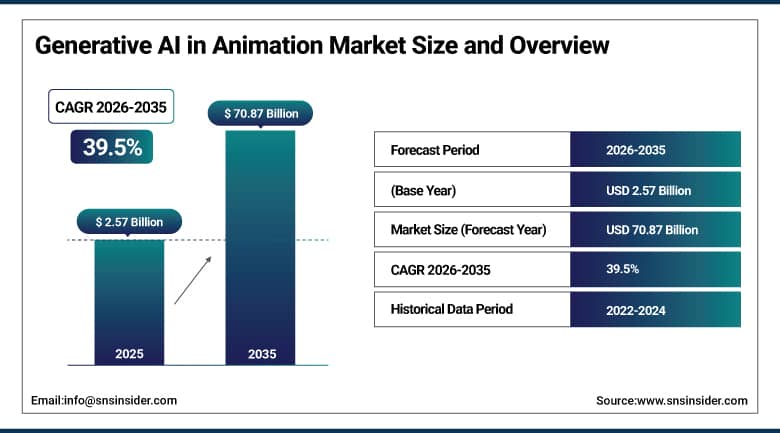
The Generative AI in Animation Market was valued at USD 2.57 Billion in 2025 and is expected to reach USD 70.87 Billion by 2035, growing at a CAGR of 39.5% from 2026–2035.
The global generative AI in animation market is rapidly transforming traditional animation workflows by enabling faster, cost-effective, and high-quality content creation. AI-driven tools including GANs, Transformers, and VAEs are revolutionizing character design, scene generation, and motion capture, while cloud-based platforms are improving accessibility and enabling distributed production team collaboration. The market is growing due to increasing demand in film, television, gaming, and advertising whose content production volume and speed-to-market requirements exceed what conventional manual animation workflows can efficiently deliver. Key players including Adobe, Autodesk, NVIDIA, and Pixar are driving innovation through generative AI integration into professional animation production pipelines that automate repetitive tasks, enhance visual realism, and accelerate rendering efficiency.
In 2024, Adobe launched Firefly Video in Adobe Premiere Pro, enabling generative AI-powered video frame extension, object removal, and scene generation directly within professional video editing and animation workflows. The launch represents the most commercially significant generative AI animation capability integration into a professional creative production platform, enabling motion designers and animators to generate and extend animated content without leaving the Adobe Creative Suite environment whose installed base of millions of professional creative users creates immediate commercial deployment at extraordinary scale.
To Get More Information On Generative AI in Animation Market - Request Free Sample Report
Generative AI in Animation Market Trends:
-
Text-to-animation platforms are expanding content creation accessibility by enabling users to generate animated videos through simple natural language prompts without advanced animation expertise
-
Real-time AI animation rendering is supporting interactive applications such as virtual influencers, digital avatars, gaming environments, live streaming, and virtual events
-
AI-powered motion capture retargeting is streamlining animation production workflows by automatically adapting human motion data to diverse digital characters
-
Personalized animated content generation is creating new opportunities in advertising, e-commerce, and marketing through customized visual experiences tailored to individual users
-
Multimodal generative AI models capable of processing text, images, audio, and video inputs are enhancing animation quality, creative control, and commercial deployment across multiple industries
U.S. Generative AI in Animation Market Outlook:
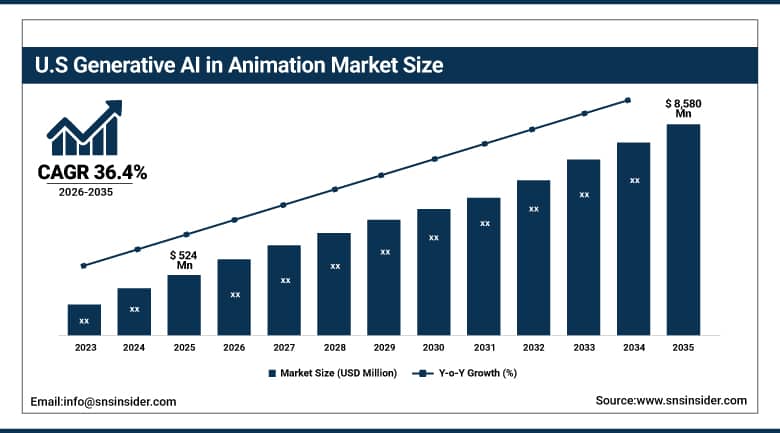
The U.S. Generative AI in Animation Market was valued at approximately USD 524 Million in 2025 and is expected to reach approximately USD 8,580 Million by 2035, growing at a CAGR of approximately 36.4%.
The U.S. is the world's most commercially advanced generative AI in animation market within North America's dominant revenue position. Adobe, Autodesk, NVIDIA, Runway ML, Stability AI, and Pixar (Disney)’s commercial operations collectively define the domestic generative AI animation technology frontier. Hollywood's content production scale whose streaming platform demand creates continuous animated content production investment, the gaming industry’s extraordinary asset creation volume, and the advertising sector's demand for high-quality animated creative at reduced production cost collectively create the most commercially concentrated generative AI animation demand environment.
In March 2025, Runway announced the launch of Act One, a video-to-video character animation model that transfers facial expressions and body movements from reference video footage to animated characters, enabling animators to use simple performance capture without specialist equipment to drive character animation at high fidelity. The technology creates a commercial pathway for independent and mid-budget production teams to access performance-driven character animation capability previously requiring dedicated motion capture infrastructure investment exceeding USD 500,000 per production.
Generative AI in Animation Market Segment Analysis:
-
By Type, the Transformers segment dominated the Generative AI in Animation Market with approximately 45% share in 2025, while the GANs segment is the fastest growing.
-
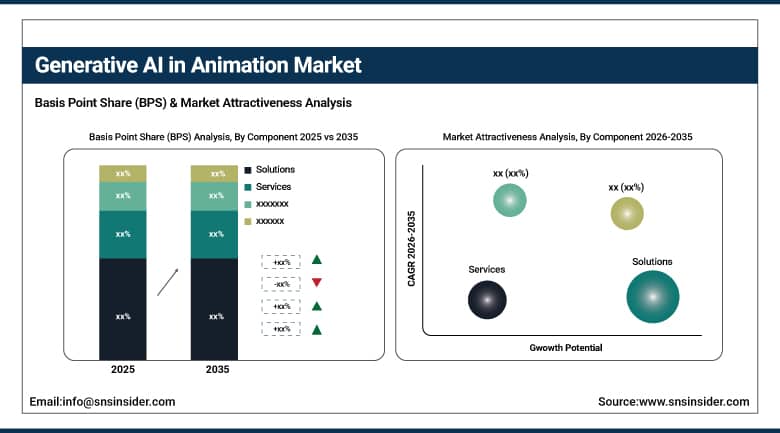
By Component, the Solutions segment dominated the Generative AI in Animation Market with approximately 72% share in 2025, while the Services segment is the fastest growing.
-
By End Use, the Gaming segment dominated the Generative AI in Animation Market with approximately 32% share in 2025, while the Television/OTT Streaming segment is the fastest growing.
By Component, solutions dominate, services grow fastest
Solutions retained the dominant component position with approximately 72% of the generative AI in animation market in 2025. Software platforms that integrate generative AI animation capability into professional production workflows including Adobe Firefly’s Creative Cloud integration, Autodesk’s AI-enhanced Maya and 3ds Max, NVIDIA’s Omniverse platform, and standalone generative animation platforms like Runway and Pika create the primary commercial purchase whose subscription or license model sustains long-duration revenue relationships with animation studios, advertising agencies, and gaming companies. The solution segment’s dominance reflects both the market’s software-native commercial structure and the enterprise’s preference for platform investments that encompass multiple generative AI animation capabilities in a single commercial relationship.
Services are the fastest-growing component because the complexity of integrating enterprise-scale generative AI animation workflows into existing production pipeline infrastructure, training custom generative models on proprietary style and character assets, and deploying validated AI animation tools that comply with studio quality and brand consistency standards creates professional services demand. Each major animation studio or advertising agency that adopts generative AI animation creates implementation service engagement whose workflow redesign, artist retraining, and quality validation programme sustains multi-month service relationships whose value compounds with ongoing managed service support.
By Type, transformers dominate, GANs grow fastest
Transformers retained the dominant type position with approximately 45% of the generative AI in animation market in 2025. Transformer architecture’s commercial dominance reflects its position as the foundational model architecture whose attention mechanism and self-supervised pre-training create the text understanding, image generation, and video synthesis capability that the most commercially deployed generative AI animation tools are built upon. Stable Diffusion’s text-to-image transformers whose animation frame generation creates the basis for AI animation workflows, OpenAI Sora’s video generation transformers whose physics-accurate scene animation demonstrates transformer architecture’s commercial ceiling, and Adobe Firefly’s Creative Suite-integrated transformer models collectively sustain transformer’s dominant type position. The transformer’s scaling law whose larger model creates qualitatively better output sustains investment in increasingly powerful transformer animation models.
GANs are the fastest-growing type because their high-fidelity output quality for specific animation tasks including character texture synthesis, face reenactment for performance transfer, and style-consistent image sequence generation creates commercial premium in applications where output realism directly determines commercial value. Professional feature film applications whose output quality standard requires photorealistic character rendering create GAN procurement whose per-project commercial value substantially exceeds text-to-animation alternatives. Each visual effects studio that deploys GAN-based face replacement, de-aging, or digital double creation creates commercial procurement whose production value justification sustains premium GAN tool specification.
By End Use, gaming dominates, TV/OTT grows fastest
Gaming retained the dominant end-use position with approximately 32% of the generative AI in animation market in 2025. The game industry’s extraordinary asset creation volume, whose AAA game title may require tens of thousands of unique animated character, environment, and object assets, creates the most commercially intensive generative AI animation tool procurement of any content sector. Each game production team that deploys generative AI for environment texture generation, NPC behavior animation, and cutscene production creates tools procurement whose commercial scale reflects the game’s asset count multiplied by production efficiency improvement value. Procedural world generation’s dependence on AI-generated landscape, architecture, and vegetation animation creates further gaming sector procurement that sustains the segment’s dominant commercial position.
Television and OTT streaming is the fastest-growing end use because Netflix, Disney+, Amazon Prime Video, and regional streaming platform’s extraordinary animated content commissioning volume creates structured demand for AI-accelerated animation production capability. Each streaming service that commissions a new animated series requires episode delivery timelines and content volume that traditional manual animation workflows cannot sustain at economically viable production cost without AI assistance. The streaming platform’s global localization requirement whose content adaptation across dozens of languages and cultural contexts creates additional AI animation demand for automated lip-sync adaptation and character expression localization.
Regional Analysis:
|
Region |
Major Country |
Share within Region, 2025 (%) |
|---|---|---|
|
North America |
United States |
87.4% |
|
Europe |
United Kingdom |
28.4% |
|
Asia Pacific |
China |
44.8% |
|
Middle East & Africa |
UAE |
38.4% |
|
Latin America |
Brazil |
44.2% |
North America Generative AI in Animation Market Insights
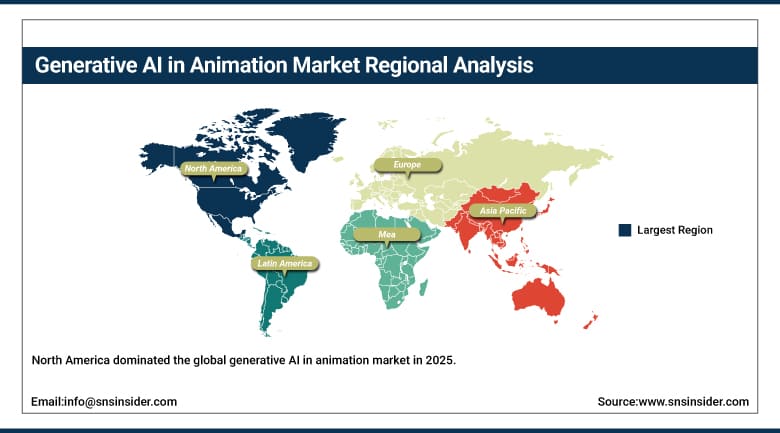
North America dominated the global generative AI in animation market in 2025 through its concentration of the world's largest animation studios, gaming companies, and advertising agencies, combined with the most commercially advanced generative AI technology development ecosystem encompassing Adobe, NVIDIA, Runway ML, OpenAI, and Stability AI. The United States accounts for approximately 87.4% of North American revenues through Hollywood’s content production scale, the gaming industry’s extraordinary asset creation demand, and the advertising market’s animated content production investment.
Canada contributes approximately 12.6% of North American revenues through its major animation production hub in Vancouver, the visual effects industry’s generative AI adoption, and the gaming development community’s tool procurement.
Get Customized Report as Per Your Business Requirement - Enquiry Now
Europe Generative AI in Animation Market Insights
Europe is a technically sophisticated generative AI in animation market where the United Kingdom’s advertising and visual effects industry, France’s animation production heritage including Ubisoft and renowned animation studios, and Germany’s media and gaming sector create structured institutional demand. The United Kingdom accounts for approximately 28.4% of European revenues through its BAFTA-calibre visual effects production sector, the advertising industry’s animated creative investment, and the BBC and Channel 4’s animated content commissioning.
France and Germany are significant secondary markets where the animated film production community, gaming companies including Ubisoft and Crytek, and the advertising agency sector create consistent generative AI animation tool procurement. The EU’s AI Act’s transparency requirements for AI-generated content create compliance-oriented service demand from European animation studios.
Asia Pacific Generative AI in Animation Market Insights
Asia Pacific is the fastest-growing regional generative AI in animation market, driven by China’s extraordinary animation and gaming industry scale, Japan’s globally influential anime production sector, South Korea’s gaming and webtoon content creation, and India’s rapidly growing animation outsourcing and OTT content production. China accounts for approximately 44.8% of Asia Pacific revenues through its domestic animation market’s scale, the gaming industry’s AI tool adoption, and technology companies’ generative AI animation platform development.
Japan’s anime industry’s progressive adoption of AI-assisted frame generation for production efficiency, South Korea’s webtoon-to-animation conversion workflow, and India’s outsourced animation studio sector’s AI tool adoption collectively create above-average market development that compounds with Asia Pacific’s growing digital content consumption.
MEA & Latin America Generative AI in Animation Market Insights
UAE leads MEA revenues at approximately 38.4% through its growing digital media sector, the advertising industry’s animated content investment, and the government’s digital economy initiative creating creative technology procurement. Brazil leads Latin American revenues at approximately 44.2% through its vibrant advertising industry’s animated creative demand, the growing OTT content production sector, and the gaming development community’s generative AI tool adoption. Saudi Arabia’s media and entertainment investment and South Africa’s animation production sector collectively sustain growing regional generative AI animation market development through 2035.
Market Dynamics:
Growth Drivers: Streaming platform content demand and gaming asset creation creating structured AI animation procurement
Streaming platform content demand is the generative AI in animation market’s most commercially certain structural growth driver. Netflix’s, Disney+’s, and Amazon Prime Video’s combined animated content commissioning at above-traditional-broadcast frequency creates production volume requirements that traditional manual animation workflows cannot satisfy at economically viable cost without AI productivity enhancement. Each streaming series whose episode delivery schedule requires animated content production faster than conventional pipelines enable creates structured generative AI tool procurement whose ROI is measured in production timeline compression and per-episode cost reduction.
The gaming industry’s extraordinary asset creation volume is simultaneously creating above-market-average generative AI animation tool adoption. Each AAA game title’s requirement for tens of thousands of unique animated assets creates AI tool procurement whose production efficiency improvement value sustains premium platform investment. The shift toward procedurally generated open-world environments whose landscape, architecture, and vegetation variety requires generative AI animation creates structural gaming sector demand that compounds with gaming industry investment growth.
Restraints: Copyright and ethical concerns and artist workforce impact creating regulatory and reputational risk
Copyright and ethical concerns represent the most commercially consequential restraint in the generative AI in animation market. Training data copyright disputes, whose legal outcome could impose licensing costs or training data restrictions that increase generative AI model development expense, create commercial uncertainty for platform developers whose training investment could be subject to retroactive liability. Each court case that rules against generative AI training data use without compensation creates regulatory precedent whose commercial impact on generative AI animation platform economics moderates’ investment pace.
Artist workforce impact concerns create reputational and labor relations risk for animation studios and advertising agencies whose generative AI adoption creates communication challenges with animation guild organizations and creative professional communities. Each high-profile studio announcement of AI-assisted production creates public relations management investment whose cost moderates the pace of transparent AI animation adoption communication.
Opportunities: Personalized animated content and interactive AI animation for gaming and metaverse
Personalized animated content generation represents the most commercially accessible near-term market expansion opportunity whose targeted advertising, personalized video marketing, and individualized educational content creation create new animation demand categories that conventional non-personalized content cannot address. Each advertising platform that deploys AI-generated personalized animated creative whose conversion rate improvement versus static alternatives demonstrates commercial ROI creates structured procurement that sustains the personalized animation service market’s commercial momentum.
Interactive AI animation for gaming and metaverse applications represents the most commercially transformative long-term opportunity whose real-time AI-animated character response to player behavior, procedurally generated animated world evolution, and AI-powered avatar personalization create gaming experience differentiation whose commercial value justifies premium AI animation engine specification in next-generation game development.
Recent Developments:
-
2025: Runway announced the launch of Act One video-to-video character animation model in March 2025 that transfers facial expressions and body movements from reference video to animated characters, enabling performance-driven character animation without specialist motion capture equipment.
-
2024: Adobe launched Firefly Video in Adobe Premiere Pro in 2024 enabling generative AI-powered video frame extension, object removal, and scene generation directly within professional video editing and animation workflows accessible to millions of Creative Suite users.
-
2024: NVIDIA launched its Video4 foundation model framework in 2024 for high-quality video and animation generation, providing animation studios and game developers with enterprise-grade AI video synthesis capability integrated with NVIDIA Omniverse production pipeline infrastructure.
-
2024: Pika Labs released Pika 1.5 in 2024 with enhanced video-to-video transformation, motion brush controls, and extended clip duration capabilities targeting independent animators and marketing teams seeking accessible AI animation generation for social media and advertising content.
-
2023: Stability AI released Stable Video Diffusion in November 2023, an open-source video generation model enabling AI animation frame synthesis from single images whose open licensing created commercial deployment across hundreds of animation workflow tool builders and creative platforms.
Generative AI in Animation Market Key Players:
-
Adobe Inc.
-
Autodesk Inc.
-
NVIDIA Corporation
-
Runway ML Inc.
-
Pika Labs Inc.
-
Stability AI Ltd.
-
OpenAI
-
Google LLC
-
Meta Platforms Inc.
-
Pixar Animation Studios
-
SideFX
-
Kling AI
-
Dream Machine
-
HeyGen Inc.
-
Synthesia Ltd.
-
Reallusion Inc.
-
Wonder Dynamics
-
Cascadeur
-
Viggle AI
-
Artlist Ltd.
Generative AI in Animation Market Report Scope:
| Report Attributes | Details |
|---|---|
| Market Size in 2025 | USD 2.57 Billion |
| Market Size by 2035 | USD 70.87 Billion |
| CAGR | CAGR of 39.5% From 2026 to 2035 |
| Base Year | 2025 |
| Forecast Period | 2026-2035 |
| Historical Data | 2022-2024 |
| Report Scope & Coverage | Market Size, Segments Analysis, Competitive Landscape, Regional Analysis, DROC & SWOT Analysis, Forecast Outlook |
| Key Segments | • by Type (Transformers, GANs/Generative Adversarial Networks, VAEs/Variational Autoencoders, Others) • by Component (Solutions, Services) • by End Use (Gaming, Television/OTT Streaming, Advertising, E-Commerce & Retail, Film & Entertainment, Others) |
| Regional Analysis/Coverage | North America (US, Canada, Mexico), Europe (Eastern Europe [Poland, Romania, Hungary, Turkey, Rest of Eastern Europe] Western Europe] Germany, France, UK, Italy, Spain, Netherlands, Switzerland, Austria, Rest of Western Europe]), Asia Pacific (China, India, Japan, South Korea, Vietnam, Singapore, Australia, Rest of Asia Pacific), Middle East & Africa (Middle East [UAE, Egypt, Saudi Arabia, Qatar, Rest of Middle East], Africa [Nigeria, South Africa, Rest of Africa], Latin America (Brazil, Argentina, Colombia, Rest of Latin America) |
| Company Profiles | Adobe Inc., Autodesk Inc., NVIDIA Corporation, Runway ML Inc., Pika Labs Inc., Stability AI Ltd., OpenAI, Google LLC, Meta Platforms Inc., Pixar Animation Studios, SideFX, Kling AI, Dream Machine, HeyGen Inc., Synthesia Ltd., Reallusion Inc., Wonder Dynamics, Cascadeur, Viggle AI, Artlist Ltd. |

Frequently Asked Questions
The Generative AI in Animation Market is expected to grow at a CAGR of 39.5% from 2026 to 2035.
The Generative AI in Animation Market was valued at USD 2.57 Billion in 2025.
Rising adoption of AI-powered animation tools enhancing creativity and production efficiency, with streaming platform content demand creating volume production requirements that traditional manual animation cannot satisfy economically, and gaming industry asset creation scale creating structured generative AI tool procurement.
Transformers dominated the Generative AI in Animation Market with approximately 45% share in 2025, while GANs is the fastest growing segment.
North America dominated the Generative AI in Animation Market in 2025, with the United States accounting for approximately 87.4% of North American revenues. Asia Pacific is the fastest-growing region.
