
GNSS Chip Market Report Scope & Overview:
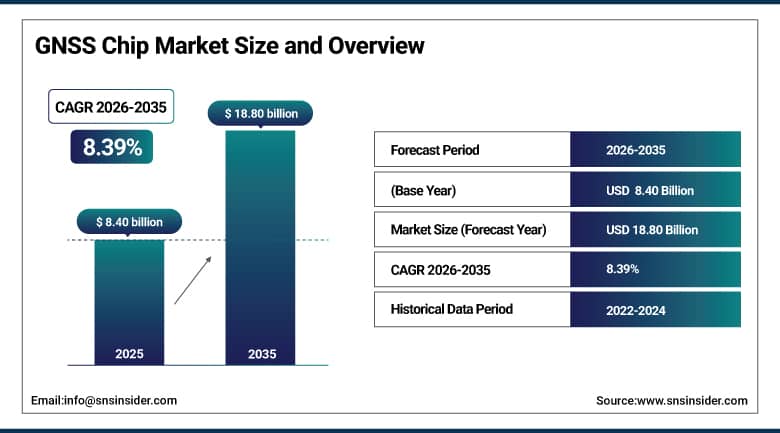
The GNSS Chip Market size was valued at USD 8.40 Billion in 2025 and is projected to reach USD 18.80 Billion by 2035, growing at a CAGR of 8.39% during 2026–2035.
The GNSS chip market is offering good opportunities due to the increasing demand for resilient and secure positioning, navigation and timing (PNT) solutions. Growing apprehensions regarding GNSS signal susceptibilities to jamming and spoofing are spurring the need for alternative and hybrid positioning technologies. Integration of satellite-based backup systems, alongside authenticated timing solutions, allows for reliable performance across critical infrastructure, telecommunications, and defense applications. Furthermore, innovations in small, low-power chip design along with high adoption rates in various connected devices are creating additional market opportunity and fuelling longer-term growth of GNSS chip technologies.
In October 2025, Iridium released their new PNT ASIC chip, built to improve GNSS resilience with a secure, satellite-based option for positioning and timing data. Commercial availability is expected by mid-2026, and the chip supports indoor operation and works with GNSS systems.
To Get More Information On GNSS Chip Market - Request Free Sample Report
GNSS Chip Market Trends Highlights:
-
Increasing demand for high-precision positioning across automotive, smartphones, and IoT devices is driving market growth
-
Rising adoption of multi-frequency and dual-band GNSS chips is improving accuracy and reliability in complex environments
-
Strong growth in autonomous vehicles, drones, and smart mobility solutions is accelerating GNSS chip integration
-
Expansion of 5G networks and connected infrastructure is enhancing real-time tracking and navigation capabilities
-
Growing concerns over GNSS signal security are boosting demand for anti-jamming and resilient positioning technologies
-
Asia-Pacific dominates the market, while North America is emerging as a key innovation and high-growth region
U.S. GNSS Chip Market Size Outlook:
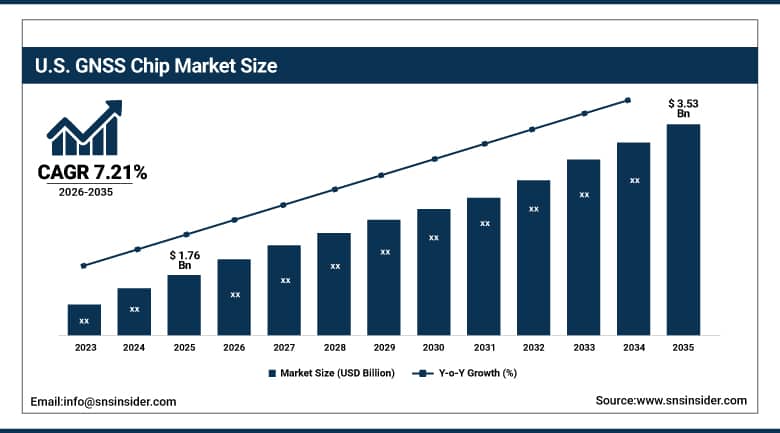
The U.S. GNSS Chip Market was valued at USD 1.76 Billion in 2025 and is projected to reach USD 3.53 Billion by 2035, growing at a CAGR of 7.21% during 2026–2035. The growth is fueled by increase in the adoption of the modern navigational technologies in automotive, defense & aerospace applications. Fueling the market growth further is the increasing need for high-precision positioning in unmanned vehicles, drones, and logistics tracking too. Furthermore, robust technological advancement, growing IoT ecosystem, and integration of GNSS in smart consumer devices and infrastructure are driving long-term growth of the market.
Market Drivers: Rising Investment in Ultra-Low Power GNSS Chips Driving Next-Generation Applications
The GNSS chip market is growing rapidly encouraged by the investments poured into ultra low power chip technologies which result in efficient positioning solutions for IoT, wearables, and therefore battery-sensitive devices. Innovations on cutting the power demand of GNSS with same time high accuracy are furthering the versatility of GNSS applications in consumer electronics and smart devices. Moreover, the increasing demand for always-on connectivity, real-time tracking, and compact form factors, accelerates the adoption. Innovation is further driven through funding support for start-up semiconductor enterprises, enabling product development and strengthening the overall GNSS ecosystem internationally.
In 2024, Qualinx, a Netherlands-based developer of an ultra-low-power GNSS chip to enable ultra-low-power, energy-efficient positioning for IoT and wearables applications, raised €20 million . The funding will help scale production and bring nextclass low-Power GNSS technologies and sustain innovation.
Market Restraints: Critical Challenges Impacting Accuracy, Security, and Adoption of GNSS Chip Technologies
The primary GNSS chip industry restraints remain the signal interference, spoofing, and jamming issues; the reliability and accuracy of GNSS positioning have serious implications in urban, or sensitive environments. It is still a high dependency on satellite infrastructure but performances in obstructed areas such as tunnels or dense cities are limited too and will serve to restrict adoption. The design of a multi-frequency GNSS chip is more complex, which increases the cost of the chip and takes further research on power consumption. Regulatory constraints; security concern in critical applications, and competition with alternative positioning technologies such as Wi-Fi and sensor-based navigation, further slow the adoption and growth of the market.
Market Opportunities: Growing Demand for High-Precision GNSS Chips in Advanced Surveying and Remote Applications
The GNSS chip industry presents a strong growth opportunity due to the growing demand for high accuracy positioning across surveying, construction, and geospatial applications. The latest technology enables multi-frequency GNSS chip performance, RTK accuracy and improved anti-interference capabilities, all allowing reliable performance, even in the most complex and distant settings. By reducing the reliance on traditional communication networks, satellite-based correction services increase the applicability of GNSS and facilitate infrastructure development and remote operations. Growing adoption of GNSS-enabled solutions in smart infrastructure, autonomous systems, and precision mapping is also anticipated to drive the demand for next-generation, high-performance GNSS chip technologies worldwide.
GNSS Chip Market Segment Highlights:
-
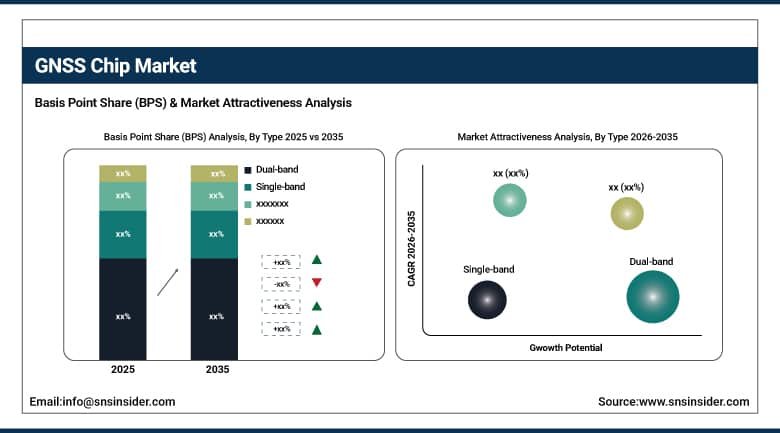
By Type: Dual-band (Dominant & Fastest Growing – 33.70% in 2025 → 43.80% in 2035)
-
By End-user: Personal Navigation (Dominant – 31.60% in 2025 → 27.40% in 2035); Fleet Management (Fastest Growing – 18.90% in 2025 → 24.80% in 2035)
-
By Technology: Global Navigation Satellite System (Dominant – 42.80% in 2025 → 31.50% in 2035); Global Positioning System (Fastest Growing – 26.40% in 2025 → 34.90% in 2035)
-
By Application: Automotive (Dominant & Fastest Growing – 29.40% in 2025 → 34.70% in 2035)
Dual-band (Dominant & Fastest-Growing) – By Type
The dual-band segment is expected to maintain its dominance in the GNSS chip market throughout the forecast period, driven by its superior positioning accuracy, enhanced signal reliability, and ability to mitigate interference in complex environments. Increasing adoption across smartphones, automotive navigation systems, and IoT devices is further strengthening its market position. Additionally, dual-band technology is projected to be the fastest-growing segment due to rising demand for high-precision location services, expansion of autonomous and connected applications, and continuous advancements in multi-constellation GNSS capabilities, which are enhancing performance across diverse end-use scenarios.
Personal Navigation (Dominant) and Fleet Management (Fastest-Growing) – By End-User
The personal navigation segment is expected to dominate the GNSS chip industry driven by the usage of a personal navigation in smartphones, wearables and consumer devices which are also based on everyday navigation and location services. This sectors range is maintained by -consistent demand for real time directions, mapping and mobility applications. Nevertheless, the fleet management segment is predicted to grow at a faster pace, primarily due to increasing demand for vehicle tracking, route optimization, and logistics efficiency solutions, along with a growing requirement for real-time monitoring and cost optimization throughout transportation and supply chain operations.
Global Navigation Satellite System (Dominant) and Global Positioning System (Fastest-Growing) – By Technology
The global navigation satellite system segment dominates the GNSS chip market due to its multi-constellation capability, offering enhanced accuracy, reliability, and global coverage across various applications. Its integration across consumer electronics, automotive, and industrial sectors ensures sustained demand. Meanwhile, the global positioning system segment is projected to witness the fastest growth, driven by continuous technological upgrades, improved signal performance, and increasing integration in commercial and high-precision applications, supporting advanced navigation and timing requirements.
Automotive (Dominant & Fastest-Growing) – By Application
The GNSS chip industry by automotive segment is anticipated to remain the largest market, growing at the fastest CAGR during the forecast period. This is mainly fuelled by mounting integration of GNSS chips in connected automobiles, as well as advanced driver-assistance system (ADAS) and autonomous driving (AD) technologies. Moreover, the increase in demand for real-time navigation, vehicle safety features, and intelligent transportation systems is continues to further augment adoption. In addition, the transition to electric and smart mobility solutions continues to bolster GNSS technology position in the automotive ecosystem of future.
GNSS Chip Market Regional Highights:
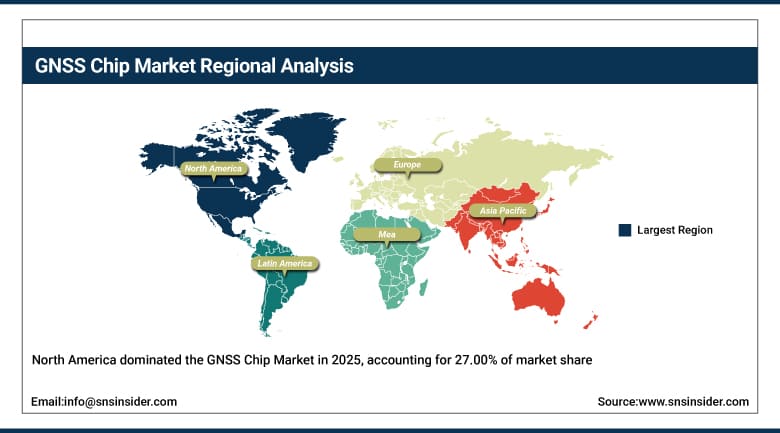
|
Region |
Major Country |
Share (%) |
Market Size (USD Bn) |
|---|---|---|---|
|
North America |
United States |
27.00% |
2.27 |
|
Europe |
Germany |
5.50% |
0.46 |
|
Asia Pacific |
China |
14.00% |
1.18 |
|
Middle East & Africa |
Saudi Arabia |
1.50% |
0.13 |
|
Latin America |
Brazil |
1.80% |
0.15 |
North America GNSS Chip Market Insights:
North America is emerging as one of the fastest-growing regions in the GNSS chip market, due to growing adoption of advanced navigation technologies across various industries, such as automotive, defense and aerospace, etc. The growth of high-precision positioning, mainly due to increasing demand in autonomous driving, drone applications, and SIP for logistics tracking, is driving this market. Even the large investment in 5G infrastructure coupled with smart mobility solutions adds to the power of GNSS. The presence of technology giants, continual advancement in location-based services will contribute towards regional market growth.
Get Customized Report as Per Your Business Requirement - Enquiry Now
U.S. GNSS Chip Market Insights:
The U.S. GNSS chip market dominates owing to their multiple end-use applications across defense, aerospace and modernized automotive sectors. Continuous technological advancement, high focus on precision navigation, and autonomous systems will further extend the market leadership and long-term revenue growth.
Asia-Pacific GNSS Chip Market Insights:
The Asia Pacific GNSS chip industry is driven by two factors, which are rapidly increasing consumer electronics manufacturing in the region resulting in high smartphone penetration along with robust demand for connected devices. GNSS integration is also gaining from increasing adoption of advanced driver-assistance systems (ADAS) and fleet tracking and logistics optimization. Smart infrastructure and 5G-enabled applications boost the real-time positioning accuracy. In addition, growing usage of GNSS in industrial automation, agriculture and wearable technologies keeps fueling high regional market demand for high-performance, energy-efficient GNSS chip solutions.
China GNSS Chip Market Insights:
China dominates the GNSS chip industry where the local electronics manufacturing ecosystem is robust and produces significant quantities of smartphones along with rapidly growing adoption of connected technologies. Growing automotive electronics, IoT deployment, and demand for accurate navigation solutions accelerate GNSS chip integration across multiple fast-growing applications.
Europe GNSS Chip Market Insights:
The Europe GNSS chip market is steadily expanding, driven by the rising adoption of advanced navigation technologies for automotive, aviation, and industrial applications. The increasing need for precision positioning in autonomous driving, smart transportation, and logistics optimization is driving the market growth. GNSS integration in connected vehicles is getting accelerated due to strong regulatory support for vehicle safety and emission reduction. Moreover, increased investments in smart infrastructure and digitalization and improvements in satellite navigation systems is predicting sustained demand for high-performance GNSS chip solutions through the region.
Germany GNSS Chip Market Insights:
Germany’s GNSS chip industry is dominating owing to the extensive automotive manufacturing, growing adoption of ADAS and autonomous driving technologies, and demand for precise navigation solution, along with ongoing innovation in industrial and mobility application.
Latin America GNSS Chip Market Insights:
The Latin America GNSS chip industry is witnessing gradual growth, growing with the increasing adoption of location-based services in the transportation, agriculture, and logistics sector. Growth in the demand for integrated GNSS-enabled fleet management and asset tracking solutions Real-time positioning capabilities are boosted with the expansion of digital and mobile connection. For instance, deployment of GNSS in precision agriculture, mining operations, and urban mobility solutions is likely to drive steady market evolution across the region.
Brazil GNSS Chip Market Insights:
Brazil is the largest market in Latin America’s GNSS chip industry, driven by strong demand for navigation in agriculture, logistics, and fleet management. Increasing adoption of precision farming and connected mobility solutions continues to support market growth.
Middle East & Africa GNSS Chip Market Insights:
The Middle East & Africa GNSS chip industry is steadily growing, stimulated by the proliferation of location-based services in transportation, logistics and construction. The rising investments in smart city projects and growth of infrastructure development are driving the demand for precise positioning technologies. The growth will be supported further by increasing usage of GNSS, particularly in oil & gas operations, mining, and fleet tracking. In addition, advanced telecommunications networks and the increasing penetration of connected devices are facilitating real-time navigation, propelling the market growth in the subsequent years..
Saudi Arabia GNSS Chip Market Insights:
Saudi Arabia will be the predominant country, fuelled by investments in smart cities, infrastructure, and transport, as well as the rising use of location-based solutions in logistics, oil & gas, and mobility.
GNSS Chip Market Recent Developments:
u-blox is a Switzerland-based semiconductor company established in 1997, specializing in GNSS positioning chips, wireless communication modules and Internet of Things (IoT) solutions. Based in Thalwil, the company provides leading semiconductor technologies for precise positioning and connectivity applications for the automotive, industrial, and consumer markets worldwide.
-
In November 2024, u-blox launched the UBX-M10150-CC GNSS chip, designed for wearable applications such as smartwatches and fitness devices. The chip features ultra-low power consumption (~10 mW), high positioning accuracy, and an ultra-compact form factor, enabling longer battery life and sleeker device designs.
Qualcomm is a U.S.-based semiconductor company established in 1985, headquartered in San Diego, California. The firm focuses on wireless technologies, mobile chipsets, and GNSS-enabled processors. Qualcomm is a leader in 5G, IoT and automotive solutions, with location and connectivity technology that enables a wide variety of global markets to serve consumers around the world.
-
In August 2025, Qualcomm launched the Snapdragon W5+ Gen 2 and W5 Gen 2 wearable platforms featuring enhanced GNSS accuracy with AI-based positioning and satellite (NB-NTN) support. The platform improves location tracking by up to 50% while enabling low-power, high-precision navigation in compact wearable devices.
GNSS Chip Companies are:
-
Broadcom Inc
-
MediaTek Inc.
-
STMicroelectronics
-
u-blox
-
Sony Group Corporation
-
Samsung Electronics
-
Intel Corporation
-
NXP Semiconductors
-
Infineon Technologies
-
Quectel Wireless Solutions
-
Telit Cinterion
-
Unicore Communications
-
Navika Electronics
-
Furuno Electric Co., Ltd.
-
Hemisphere GNSS
-
Septentrio
-
Topcon Corporation
-
Trimble Inc.
| Report Attributes | Details |
|---|---|
| Market Size in 2025 | USD 8.40 Billion |
| Market Size by 2035 | USD 18.80 Billion |
| CAGR | CAGR of 8.39% From 2026 to 2035 |
| Base Year | 2025 |
| Forecast Period | 2026-2035 |
| Historical Data | 2022-2024 |
| Report Scope & Coverage | Market Size, Segments Analysis, Competitive Landscape, Regional Analysis, DROC & SWOT Analysis, Forecast Outlook |
| Key Segments | • By Type (Dual-band, Single-band, Multi-frequency, Integrated and Standalone) • By End Use (Personal Navigation, Fleet Management, Location-Based Services, Military and Surveying) • By Technology (Global Navigation Satellite System, Global Positioning System, Galileo, Compass and QZSS) • By Application (Automotive, Aerospace, Consumer Electronics, Telecommunications and Agriculture) |
| Regional Analysis/Coverage | North America (US, Canada), Europe (Germany, UK, France, Italy, Spain, Russia, Poland, Rest of Europe), Asia Pacific (China, India, Japan, South Korea, Australia, ASEAN Countries, Rest of Asia Pacific), Middle East & Africa (UAE, Saudi Arabia, Qatar, South Africa, Rest of Middle East & Africa), Latin America (Brazil, Argentina, Mexico, Colombia, Rest of Latin America). |
| Company Profiles | Qualcomm, Broadcom Inc., MediaTek Inc., STMicroelectronics, u-blox, Skyworks Solutions, Sony Group Corporation, Samsung Electronics, Intel Corporation, NXP Semiconductors, Infineon Technologies, Quectel Wireless Solutions, Telit Cinterion, Unicore Communications, Navika Electronics, Furuno Electric Co., Ltd., Hemisphere GNSS, Septentrio, Topcon Corporation, Trimble Inc. |

Frequently Asked Questions
Asia-Pacific dominated the GNSS Chip Market in 2025.
The “Dual-band” segment dominated during the projected period.
The GNSS chip market is driven by rising demand for precise location-based services in smartphones, automotive navigation, IoT devices, and autonomous systems, supported by advancements in satellite infrastructure and increasing adoption of connected technologies.
The Market was valued at USD 8.40 Billion in 2025 and is projected to reach USD 18.80 Billion by 2035.
The Market is expected to grow at a CAGR of 8.39% during 2026–2035.
